How these picks were made: this is a specifications comparison, not a test. NextCarReview did not install, use or measure any of these chargers. The picks reflect published amperage, plug options, safety listings, warranty terms and manufacturer list prices as of October 2026.
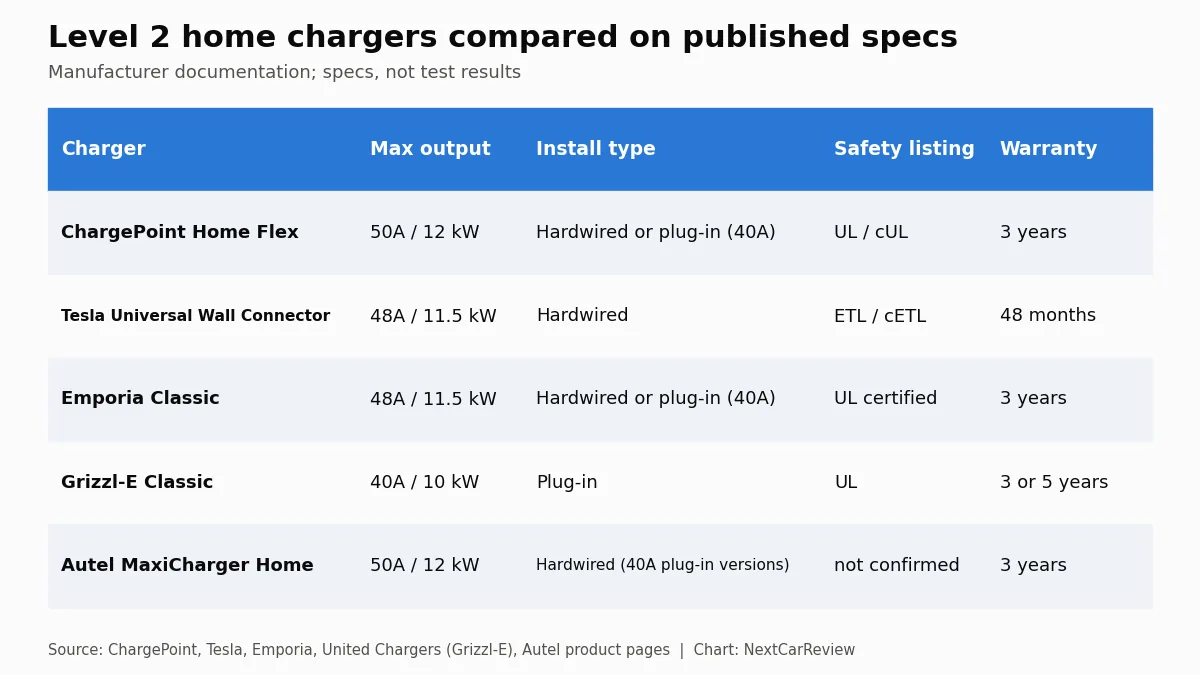
On paper, the ChargePoint Home Flex offers the widest amperage range, the Tesla Universal Wall Connector suits mixed NACS and J1772 households, the Emporia Classic pairs 48 amps with a UL listing at a mid-range price, the Grizzl-E Classic is the lowest-priced option here, and the Autel MaxiCharger Home has the most connectivity options. Match the charger to your car’s onboard charger and your panel before anything else.
Every spec, price and warranty term in this comparison comes from the manufacturer’s own product pages, datasheets or manuals, plus the ENERGY STAR certified EVSE list. These picks are based on published specifications, not product testing. NextCarReview does not test chargers or vehicles for this guide; see our sourcing policy.
Most “best home EV charger” lists read like someone lived with each unit for months. This one does not pretend to. It compares five popular Level 2 chargers on the things a manufacturer has to publish and stand behind: output, plug options, connector, safety listing, warranty and price. That makes it a useful shortlist, and it tells you exactly what each pick is based on.
Before choosing hardware, it helps to know your circuit options and costs. Our guide to installation cost and permits covers that, and the main guide to electric vehicle charging stations covers the bigger picture.
How These Chargers Were Compared
Methodology disclosure: this comparison is built from manufacturer product pages, datasheets, installation manuals and warranty documents, plus the federal ENERGY STAR certified-charger dataset. NextCarReview did not test these chargers in a lab or a home. No claims are made about durability, app reliability or build quality beyond what the manufacturer publishes.
What was compared: maximum output (amps and kW), hardwired vs. plug-in options, connector type, Wi-Fi and app features, safety listing, ENERGY STAR status where it could be matched to the model, warranty length, and manufacturer list price in early October 2026.
Comparison Table
| Charger | Max output | Install type | Connector | Smart features | Safety listing | Warranty | List price |
|---|---|---|---|---|---|---|---|
| ChargePoint Home Flex | 50A / 12 kW | Hardwired, or NEMA 14-50 / 6-50 plug (40A) | J1772 or NACS | Wi-Fi app | UL / cUL | 3 years | See ChargePoint store |
| Tesla Universal Wall Connector | 48A | Hardwired | NACS plus docked J1772 adapter | Wi-Fi, power management | ETL / cETL | 48 months (residential) | See Tesla shop |
| Emporia Classic | 48A / 11.5 kW hardwired; 40A / 9.6 kW plug-in | Hardwired or NEMA 14-50 | J1772 or NACS | Wi-Fi app | UL certified | 3 years | $449 (J1772); $479 (NACS) |
| Grizzl-E Classic | 40A / 10 kW | NEMA 14-50 or 6-50 plug | J1772 | None (no internet connection) | UL (E510712) | 3 or 5 years | $299.99 |
| Autel MaxiCharger Home | 50A / 12 kW | Hardwired (40A plug-in versions sold) | J1772 | Wi-Fi, Bluetooth, Ethernet | Not confirmed on product page | 3 years (limited) | $599 |
ChargePoint Home Flex: Most Flexible Amperage
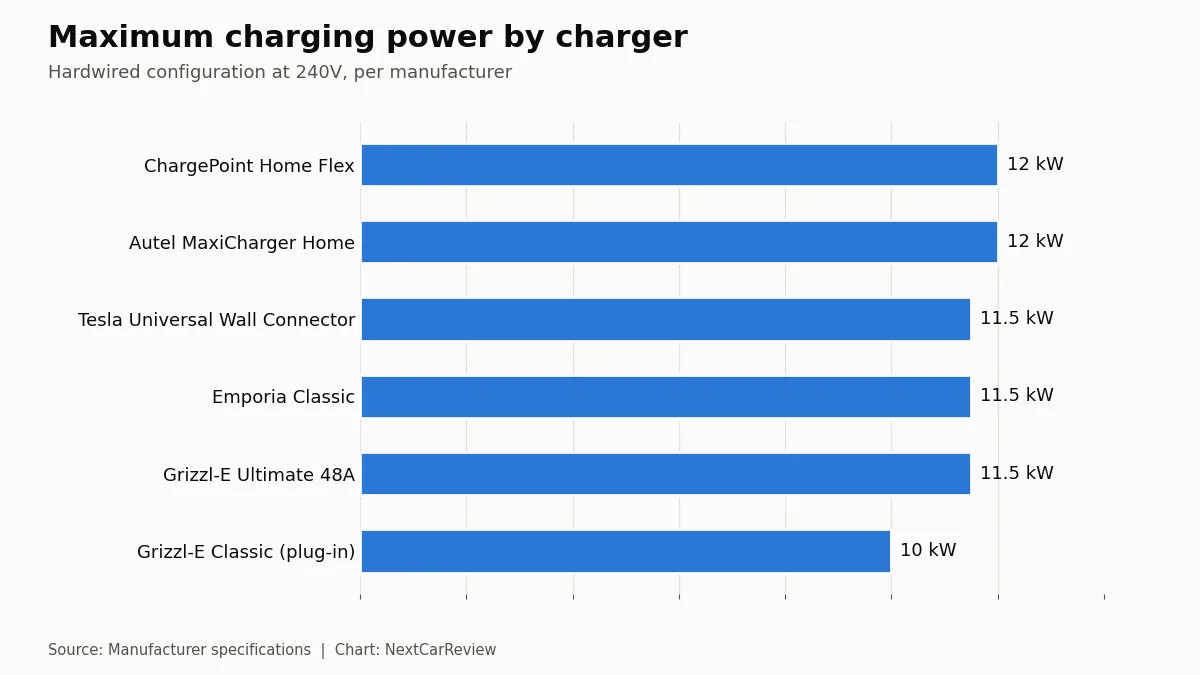
ChargePoint’s datasheet lists a maximum of 12 kW (240V at 50 amps), with output adjustable in the app to 16, 24, 32, 40, 48 or 50 amps. That range is the Home Flex’s main selling point: you can match it to almost any circuit and turn it up later if you upgrade your panel. ChargePoint’s product page says it is available with J1772 or NACS connectors, rates it at up to 50 amps hardwired and up to 40 amps on a NEMA 6-50 or 14-50 plug, and lists a 3-year warranty. The datasheet lists a 23-foot cable, dual-band Wi-Fi, UL and cUL listing, and ENERGY STAR certification.
Best fit: owners who want app scheduling and the freedom to change amperage as their car or panel changes.
Tesla Universal Wall Connector: For NACS and J1772 Households
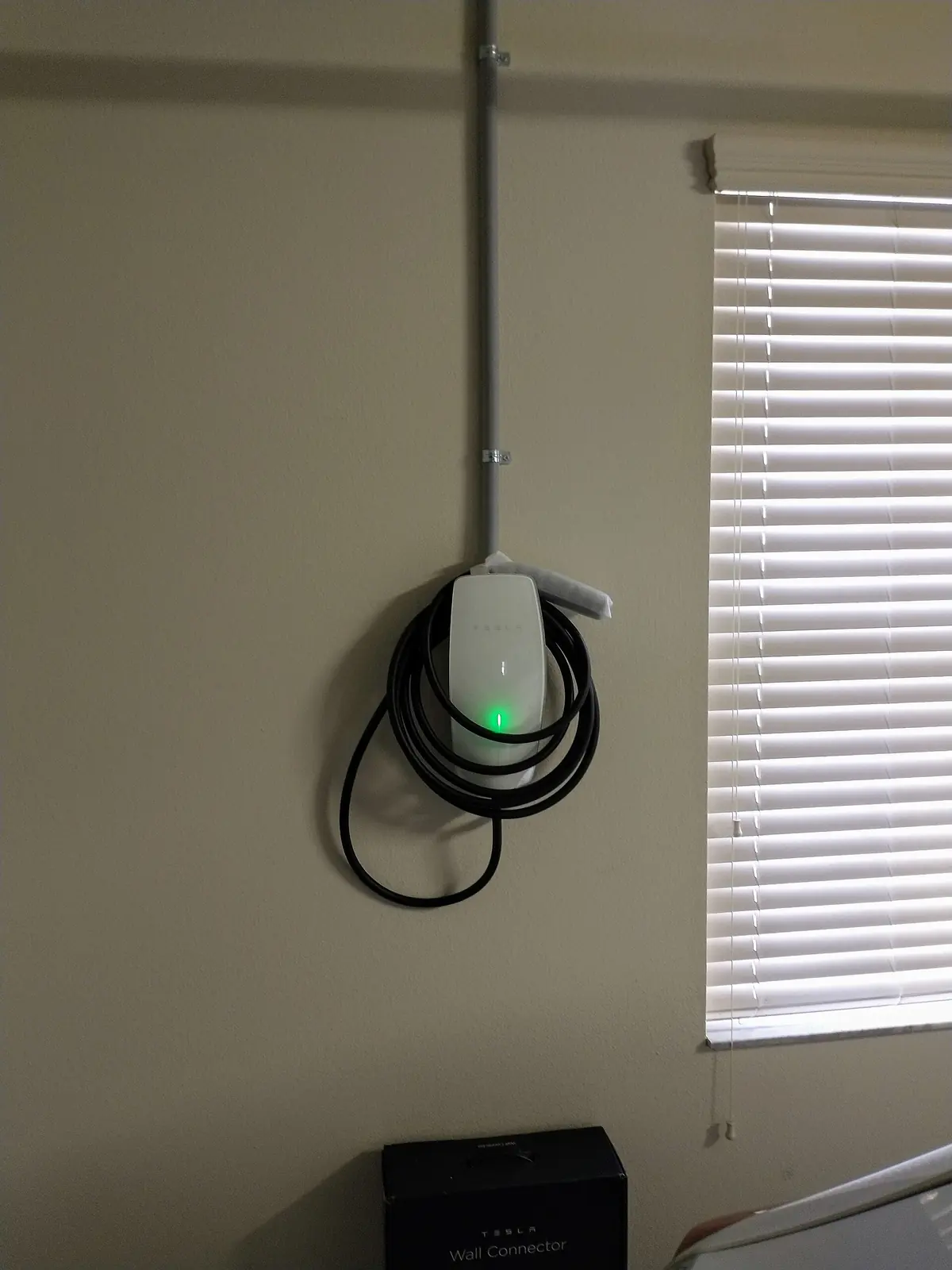
Tesla’s specifications list an output range of 12 to 48 amps, a 24-foot cable, 2.4 GHz Wi-Fi, a Type 3R enclosure and ETL/cETL approval. Tesla’s instructions describe two handles: a NACS connector in the holster and a J1772 adapter that docks on the unit, so one charger can serve a Tesla and a J1772 car. Tesla’s charging equipment warranty covers manufacturing defects for 48 months of normal residential use (12 months for commercial use).
It is hardwired only. Tesla’s Gen 3 manual also notes built-in load management, which lets the maximum output be set to fit an existing electrical supply.
Best fit: two-EV households with mixed connectors, or anyone buying a NACS-port EV who wants a J1772 option on the wall.
Emporia Classic: 48 Amps and a UL Listing at a Mid-Range Price
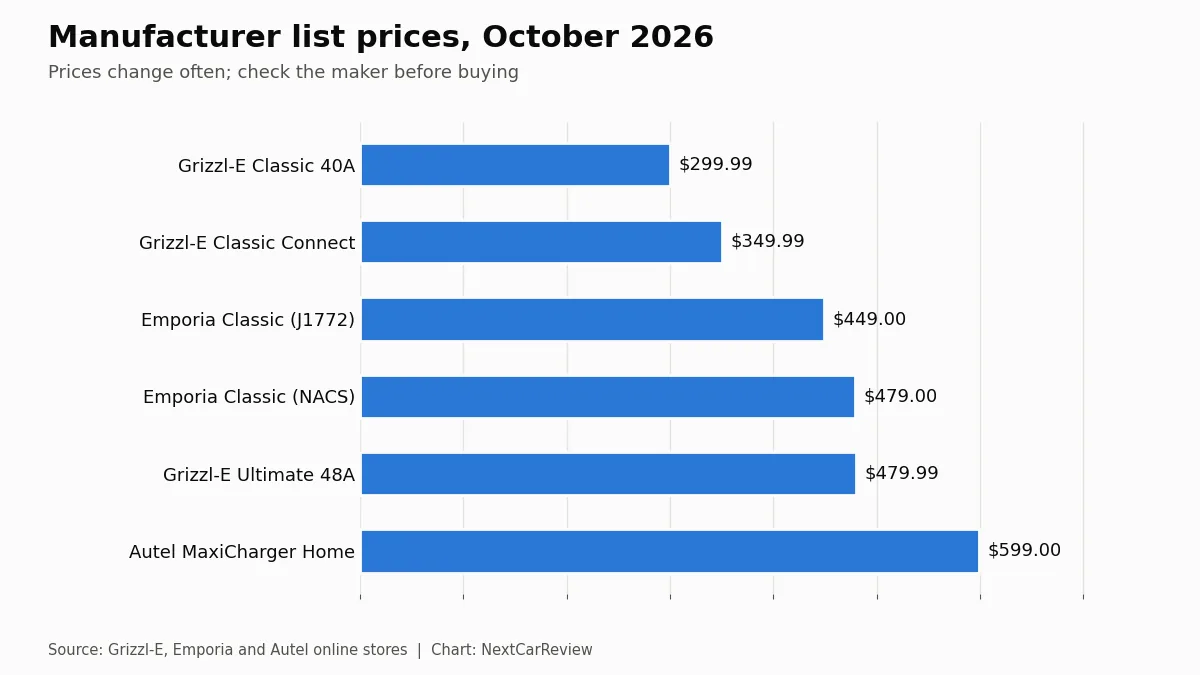
Emporia lists the Classic at $449 with a J1772 connector and $479 with NACS. It is rated 11.5 kW (240V at 48 amps) hardwired and 9.6 kW (40 amps) on a NEMA 14-50 plug, with a 25-foot cable. Emporia describes it as UL certified and GFCI-protected, ENERGY STAR rated, and backed by a 3-year warranty.
Best fit: owners of 11 kW-capable cars who want full 48-amp output without paying top dollar.
Grizzl-E Classic: Simplest and Lowest Priced
The Grizzl-E Classic from United Chargers lists at $299.99, the lowest price in this group. It delivers 40 amps (10 kW), adjustable down to 32, 24 or 16 amps, on a NEMA 14-50 or 6-50 plug with a 25-foot J1772 cable. It has no internet connection at all, which some owners will see as a plus. Grizzl-E lists UL file E510712 and ENERGY STAR certification, with a 3- or 5-year warranty.
If you want an app, the Classic Connect adds 2.4 GHz Wi-Fi for $349.99 with J1772 or NACS, and the hardwired Ultimate 48A lists at $479.99 for 11.5 kW.
Best fit: budget buyers whose car’s onboard charger is 7.2 to 9.6 kW, and anyone who just wants a plug that works.
Autel MaxiCharger Home: Most Connectivity Options
Autel lists the MaxiCharger AC Elite Home hardwired unit at $599, with adjustable charging up to 50 amps (12 kW), a 25-foot J1772 cable, and Wi-Fi, Bluetooth, Ethernet, CAN and RS485 connectivity. It carries a 3-year limited warranty. Autel also sells 40-amp plug-in versions with NEMA 6-50 and 14-50 plugs.
One caution: the product page still shows a “Certification Pending” note dated May 2022. Several Autel MaxiCharger models appear on the ENERGY STAR list, but the specific retail model could not be matched. Confirm the safety listing on the unit’s label or with Autel before you buy.
Best fit: buyers who want wired Ethernet or a 50-amp hardwired install and will verify the listing first.
What sets the field apart, on paper
- Highest published output: ChargePoint Home Flex and Autel at 50A (12 kW).
- Longest warranty term published: Grizzl-E at up to 5 years (with its 5-year option); Tesla lists 48 months for residential use.
- Lowest list price: Grizzl-E Classic at $299.99.
Watch-outs
- Plug-in versions top out at 40A on the units that offer both.
- Tesla’s Universal Wall Connector is hardwired only.
- Autel’s safety listing was not confirmed on its product page.
Hardwired vs. Plug-In: Which Should You Choose?
A hardwired charger connects directly to the circuit. It is the only way to get 48 or 50 amps from the chargers here, and it suits outdoor installs. A plug-in charger uses a NEMA 14-50 or 6-50 outlet. ChargePoint and Emporia both cap their plug-in versions at 40 amps. A plug-in unit is easier to take with you when you move or to swap later. Note that the National Electrical Code requires ground-fault protection for receptacles installed for EV charging, so a new outlet still needs a proper install by an electrician.
What to Check Before You Buy
- Your car’s onboard charger. A 7.2 kW car gains nothing from a 48-amp unit. An 11 kW car, such as the 2026 Toyota C-HR or Ford Mustang Mach-E, can use about 48 amps.
- Your panel capacity. A 48-amp charger needs a 60-amp circuit, per Tesla’s manual. Get a load calculation first.
- A safety listing. Look for UL, ETL or another nationally recognized lab on the label.
- Connector. If your next car will have a NACS port, buying a NACS or dual-connector charger now avoids an adapter later. See our guide to NACS vs. CCS.
- App lock-in. Smart chargers tie scheduling and energy data to the maker’s app. If you would rather not depend on a cloud service, a non-connected unit works fine with a car that schedules its own charging.
For how home charging habits relate to battery health, see Level 2 charging and battery longevity. Still shopping for the car? Our list of the best electric cars under $40,000 pairs well with a budget charger. Renting? Read our guide to apartment and renter charging options. And note that the federal charger tax credit ended for installs after June 30, 2026, as explained in our Section 30C guide.
EV Charging Guide Series
Start with the main guide: choosing and using EV charging stations. More in this series:
Frequently Asked Questions
What is the best Level 2 home EV charger?
There is no single best unit for everyone. On published specs, the ChargePoint Home Flex has the most adjustable amperage settings, the Tesla Universal Wall Connector fits homes with both NACS and J1772 cars, and the Grizzl-E Classic has the lowest list price of the chargers compared here. The right pick depends on your car’s onboard charger, your panel capacity and whether you want app features.
How many amps should a home EV charger be?
Enough to match your car’s onboard charger, within what your panel can supply. A car with a 7.2 kW onboard charger, such as the 2026 Nissan Leaf, does not benefit from more than about 32 amps. Cars that accept 11 kW need about 48 amps, which per Tesla’s manual calls for a 60-amp circuit.
Is a hardwired or plug-in EV charger better?
Hardwired chargers can run at higher power: ChargePoint and Emporia both rate their plug-in versions at 40 amps versus 48 to 50 amps hardwired. Plug-in chargers using a NEMA 14-50 or 6-50 outlet are easier to move or replace. Both need a properly installed 240V circuit.
Does a Level 2 charger need to be UL listed?
You should buy one that carries a safety listing from a nationally recognized testing laboratory, such as UL or ETL. ChargePoint lists UL and cUL, Grizzl-E lists UL file E510712, Emporia says its charger is UL certified, and Tesla lists ETL/cETL for the Universal Wall Connector.
Do Level 2 chargers hurt battery life?
Level 2 runs at far lower power than DC fast charging, and DOE says most EV owners do the majority of their charging at home. For what affects long-term battery health, see our guide on how long EV batteries last.
Can I still get a tax credit for a home EV charger?
Not federally for new installs. The Section 30C credit is not allowed for property placed in service after June 30, 2026. Check state and utility programs instead.
⚠️ Professional Notice:
This is a specifications-based comparison compiled from manufacturer documentation, not independent product testing. NextCarReview did not test durability, reliability, app performance or real-world charging speed for any product listed. Rankings reflect published specs, safety listings, warranty terms and list prices only.
Prices and specifications change often; confirm them with the manufacturer before buying. Installation of any hardwired charger or 240V outlet should be done by a licensed electrician. NextCarReview does not receive compensation from any manufacturer named here.
Data Sources and Verification
- ChargePoint Home Flex product page (amperage, connectors, warranty)
- ChargePoint Home Flex datasheet (PDF)
- Tesla Universal Wall Connector technical specifications
- Tesla Universal Wall Connector warranty information
- Tesla Universal Wall Connector handle instructions (NACS and J1772)
- Emporia Level 2 EV Charger store page
- Emporia EV chargers overview
- Grizzl-E Classic product page
- Grizzl-E Classic Connect product page
- Grizzl-E Ultimate 48A product page
- Autel MaxiCharger AC Elite Home hardwired product page
- ENERGY STAR certified EV chargers dataset
- DOE AFDC: Charging Electric Vehicles at Home
Figures were checked against the sources above in late September and early October 2026. Prices, laws and network data change; verify before you rely on them.

Morgan Reyes is the founder and editor-in-chief of NextCarReview, which Morgan launched in August 2024. A 2022 graduate of Columbia University, Morgan is based in New York and writes and edits the site’s reviews, comparisons and buying guides. Morgan does not road-test vehicles. Every article is built from published primary data: EPA FuelEconomy.gov ratings, NHTSA crash ratings, recalls and owner complaints, IIHS results, and manufacturer specifications and pricing, with each figure cited and checked before publication. Contact: admin@nextcarreview.com