In this article 9 sections
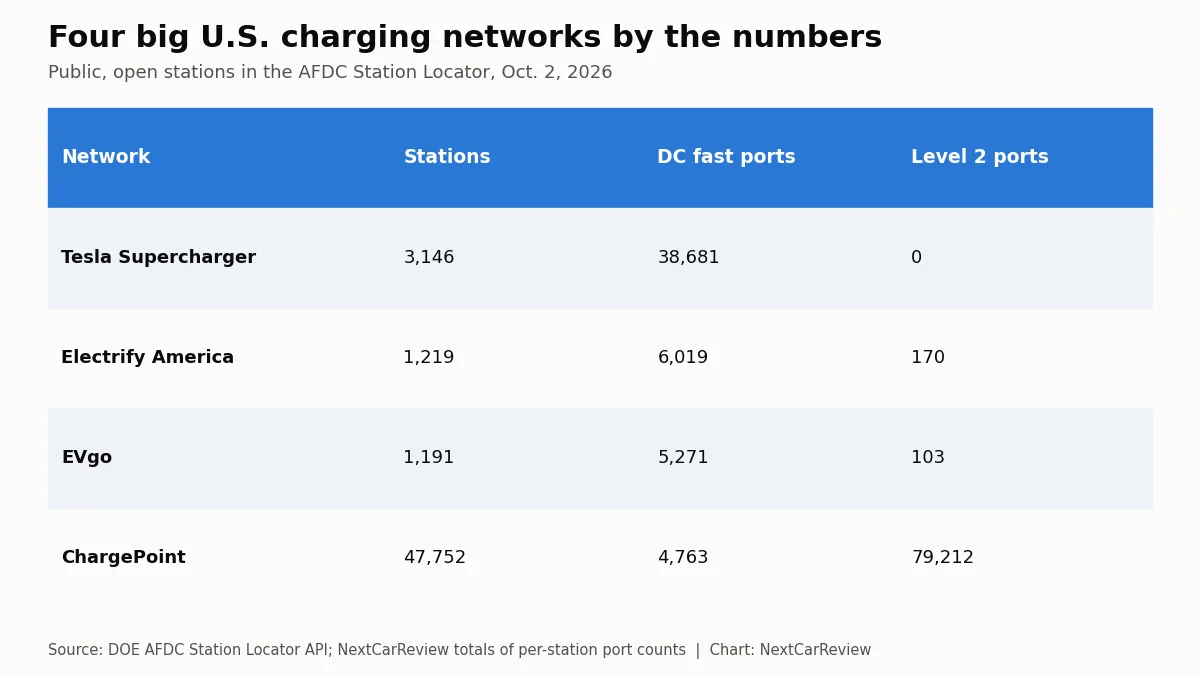
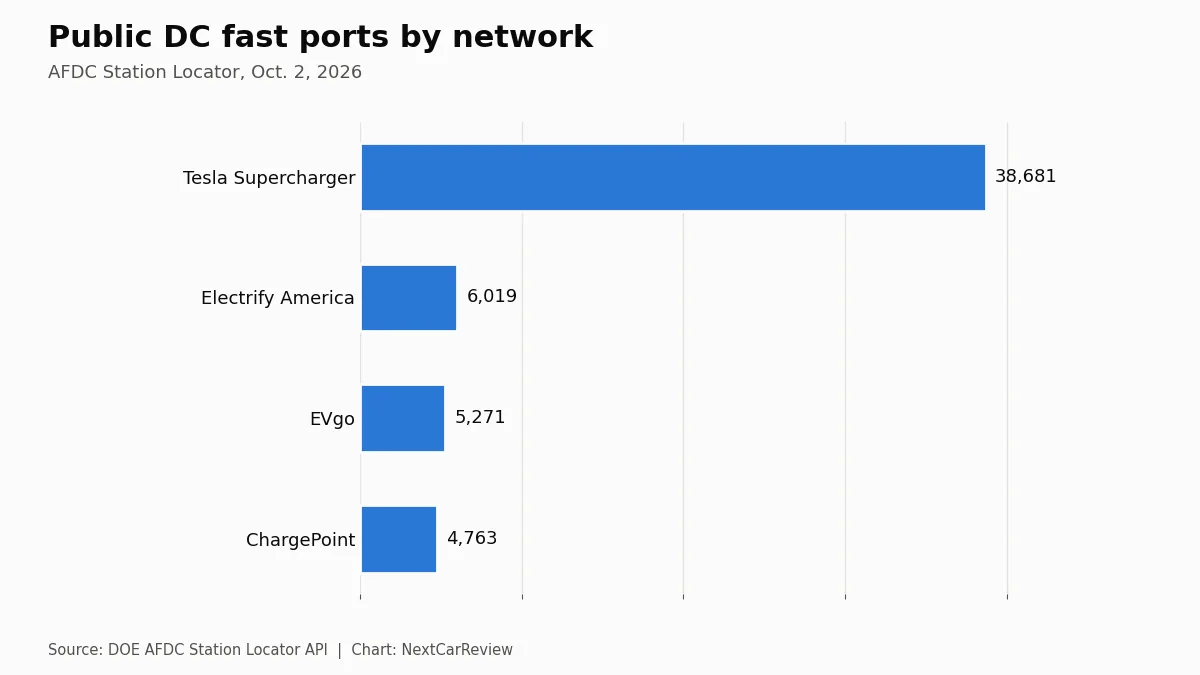
Tesla’s Supercharger network is the biggest DC fast network by a wide margin, with 38,681 public DC fast ports in DOE data, more than Electrify America, EVgo and ChargePoint combined. Many 2026 non-Tesla EVs now ship with NACS ports or offer approved adapters, which makes it relevant to far more drivers than before.
Electrify America and EVgo are the main CCS fast-charging alternatives, each with about 5,000 to 6,000 DC fast ports. ChargePoint is mostly a Level 2 network, with 79,212 public Level 2 ports. Plan on using at least two networks: one for road trips and one near home.
Station and port counts come from the DOE AFDC Station Locator (public, open U.S. stations, October 2, 2026). Pricing comes from each network’s published pricing pages; uptime figures are attributed to the organization that published them. NextCarReview does not test chargers or vehicles for this guide; see our sourcing policy.
Picking an EV now means picking, at least loosely, the charging networks you will use on the road. The four names most U.S. drivers run into are Tesla Supercharger, Electrify America, EVgo and ChargePoint. They differ in size, in the kind of charging they offer and in how they price it.
This comparison uses federal station data and each network’s own published pricing, so you can see the differences without marketing spin. For a broader primer, see our guide to electric vehicle charging stations.
Comparison Table
| Network | Public stations | DC fast ports | Level 2 ports | Published pricing | Membership | Reported reliability |
|---|---|---|---|---|---|---|
| Tesla Supercharger | 3,146 | 38,681 | 0 | Varies by site; AFDC-listed median $0.60/kWh (range $0.37 to $0.98) | Optional for non-Tesla drivers | No network-wide figure published that could be verified |
| Electrify America | 1,219 | 6,019 | 170 | Varies by location and plan; shown in app | Pass+ $7/mo, about 25% off | Self-reported 2025 uptime: 92.89% to 96.64% by equipment generation |
| EVgo | 1,191 | 5,271 | 103 | Varies by region; some time-of-use pricing | Plus $6.99/mo; PlusMax $12.99/mo | No current figure verified |
| ChargePoint | 47,752 | 4,763 | 79,212 | Set by each station owner | None required | No network-wide figure verified |
Counts are public, open U.S. stations in the DOE AFDC Station Locator on October 2, 2026. Tesla’s Level 2 “Destination” chargers are listed separately in AFDC and are not included in the Supercharger row.
Tesla Supercharger
Tesla’s fast-charging network dwarfs the others in DOE data: 38,681 public DC fast ports at 3,146 locations, more than Electrify America, EVgo and ChargePoint’s DC fast ports combined. Prices are set per site. Among the 161 Supercharger locations that list a per-kWh price in AFDC, prices ranged from $0.37 to $0.98, with a median of $0.60.
Reliability track record and why it matters
Tesla’s density is its built-in backup: with nearly 39,000 DC fast ports, there is often another stall or another site nearby if one is down. Tesla does not publish a network-wide uptime figure that NextCarReview could verify, so this comparison does not assign it a number. Driver check-ins in apps such as PlugShare are the best real-time signal for any specific site.
Non-Tesla access via NACS
This is the big change of the past two years. Many 2026 non-Tesla EVs ship with the NACS (SAE J3400) port: Hyundai’s Ioniq 9 and Toyota’s C-HR have NACS ports, and the 2026 Nissan Leaf uses NACS for DC fast charging. Hyundai even publishes a 41-minute 10% to 80% time for the Ioniq 9 on a V3 Supercharger. CCS-port models such as the Chevrolet Equinox EV and Ford Mustang Mach-E rely on an automaker-approved NACS adapter. Read our NACS vs CCS connector access guide for the details, and see our review of the Ioniq 9’s NACS port and Supercharger access for a real-world example.
Pros: by far the most DC fast ports; wide highway coverage; growing native NACS compatibility.
Cons: site-by-site pricing that can run high; non-Tesla access depends on your car and adapter; no verified public uptime figure.
Electrify America
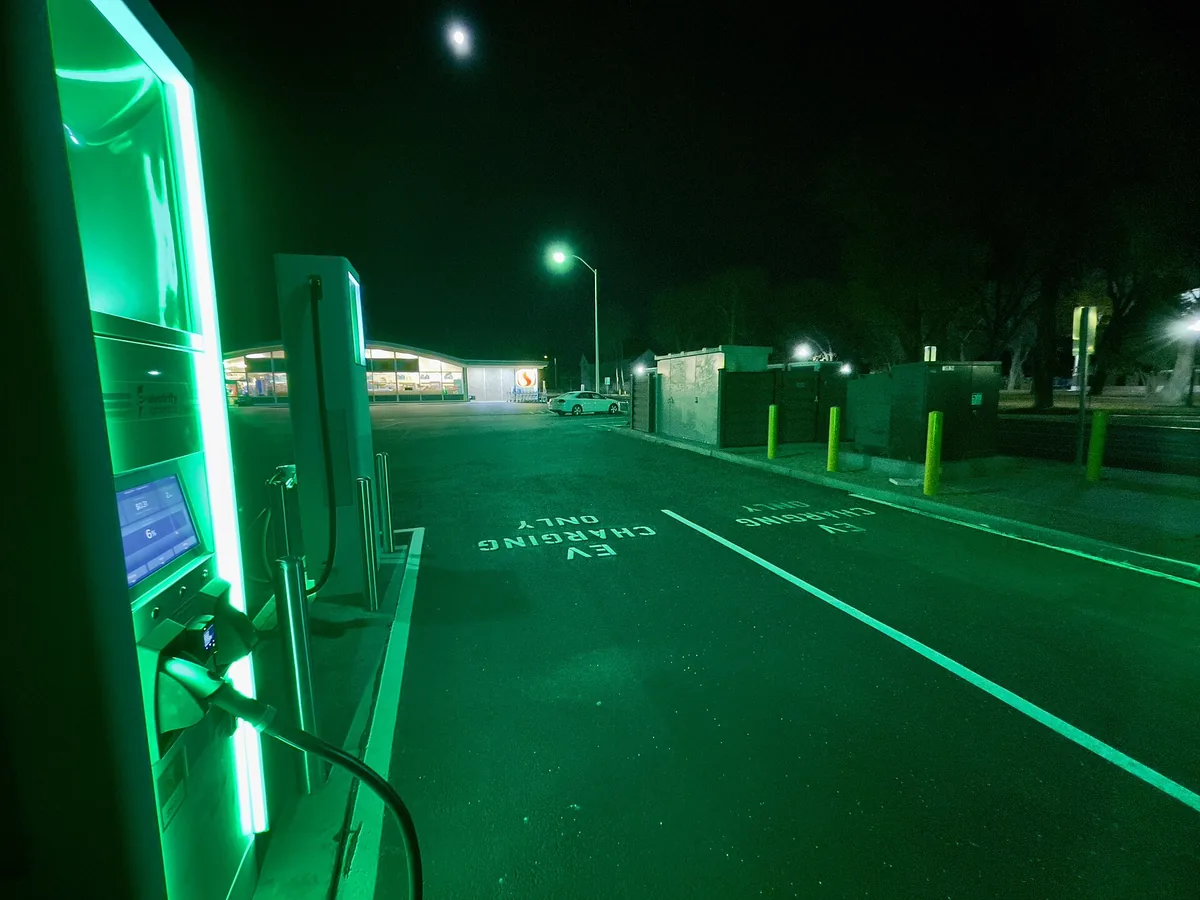
Electrify America lists 1,219 public stations and 6,019 DC fast ports in AFDC data. It is almost entirely a fast-charging network, with only 170 Level 2 ports.
Speed advantage (up to 350 kW)
In its 2025 annual report to EPA, Electrify America says it was the first to deploy 350 kW chargers with UL-certified liquid-cooled cables in the United States and the first to deploy Plug&Charge networkwide, and that every fast charger has a credit and debit card chip reader. Cars that can accept very high power benefit most: Hyundai lists the Ioniq 9 at 24 minutes from 10% to 80% on a 350 kW charger with a CCS adapter.
Reported reliability issues
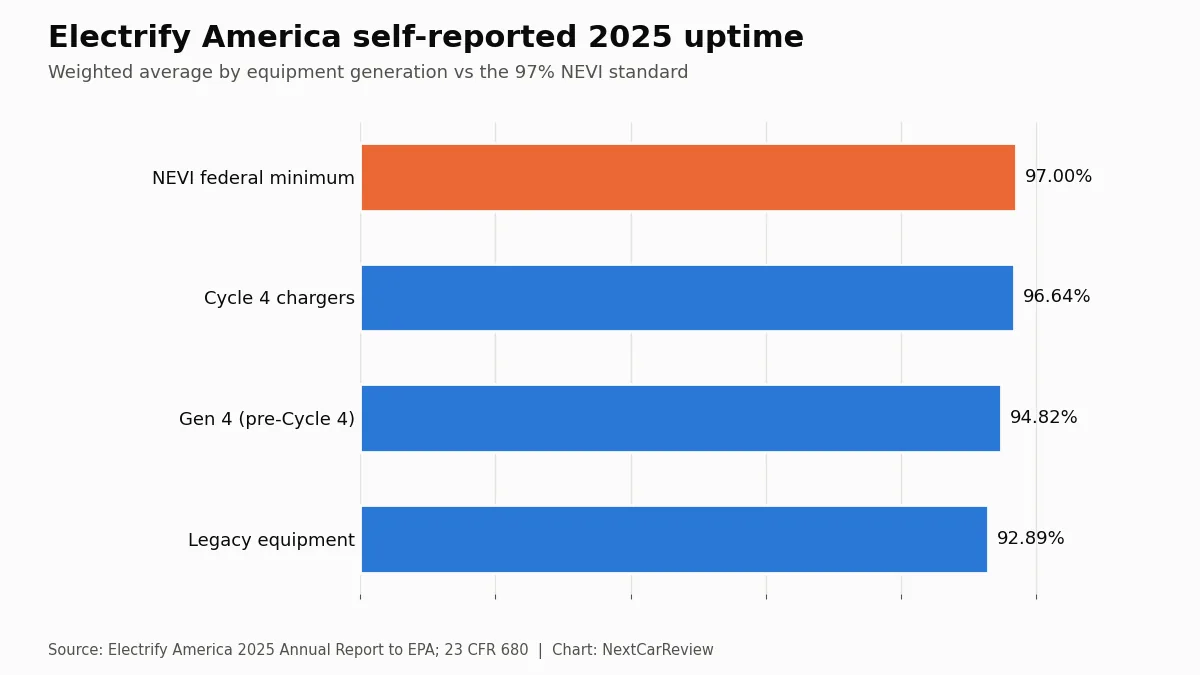
Reliability is the question drivers ask most about any CCS network. Electrify America’s own report gives a measurable picture: 2025 weighted average uptime of 96.64% for its newest Cycle 4 chargers, 94.82% for Gen 4 chargers commissioned before Cycle 4, and 92.89% for legacy equipment. For comparison, federal NEVI standards require funded stations to average more than 97% uptime per port. These are Electrify America’s figures, not independent measurements.
Pricing depends on location, plan and energy delivered, and shows in the app or at the charger. Pass+ costs $7 a month and saves about 25%. A $0.40 per-minute idle fee starts ten minutes after a session ends.
EVgo
EVgo lists 1,191 public stations and 5,271 DC fast ports in AFDC data. Its app says it supports CHAdeMO, CCS and NACS connectors, and its Autocharge+ feature starts a session as soon as you plug in once your car is enrolled.
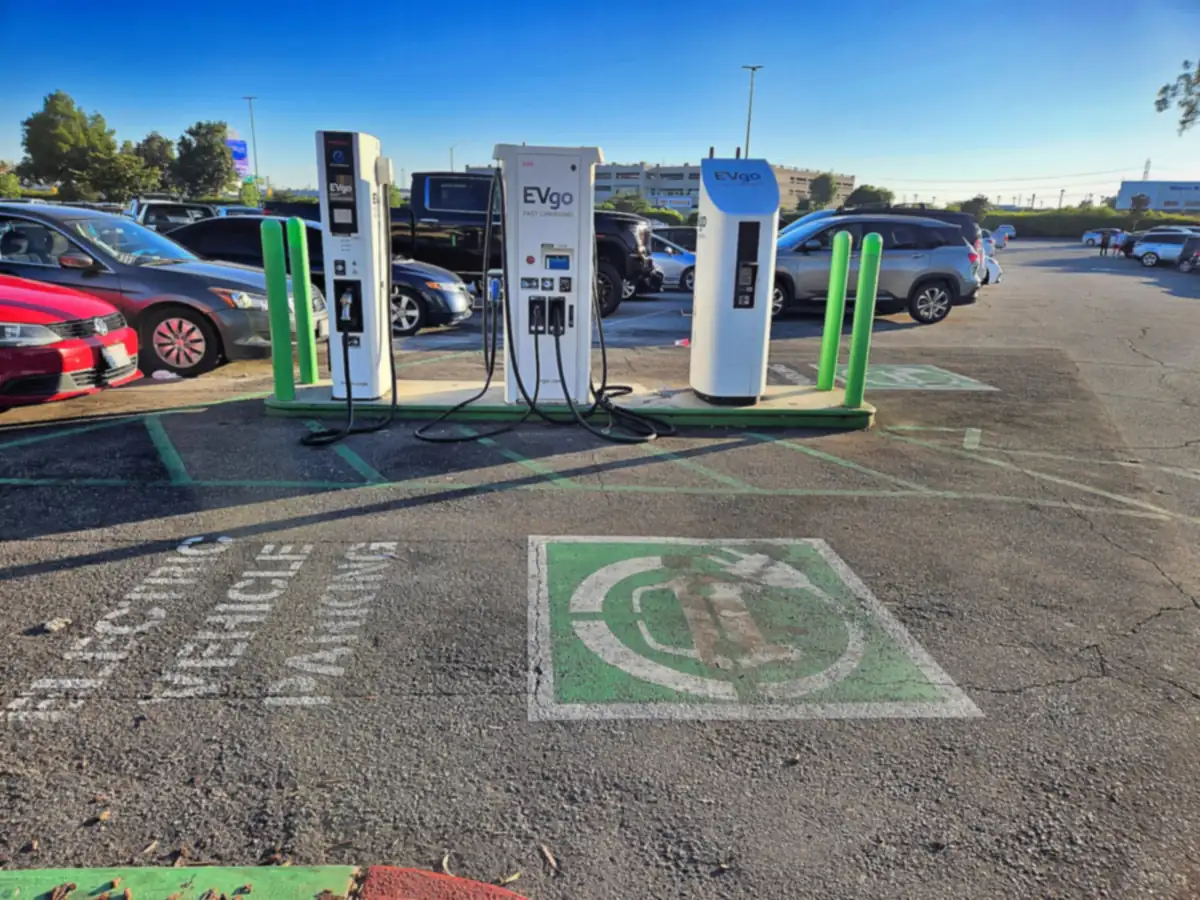
EVgo’s pricing is the most clearly tiered of the four. Pay As You Go has no monthly fee but a $0.99 session fee; EVgo Plus costs $6.99 a month and saves up to 15%; EVgo PlusMax costs $12.99 a month and saves up to 30%, both with no session fees. Rates vary by region, some markets use time-of-use pricing, and a $2.99 transaction fee applies to sessions started by credit card.
ChargePoint
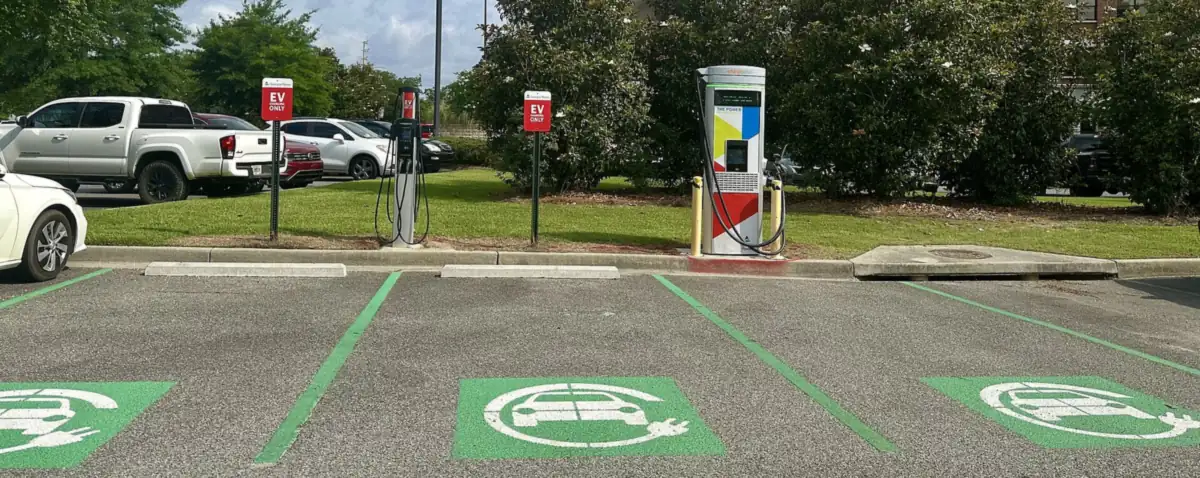
ChargePoint is the largest network on this list by station count, with 47,752 public stations in AFDC data. It also says it connects drivers to more than 1.4 million public and private charging ports worldwide, a global total that includes private ports.
Why it’s mostly a Level 2 and workplace network, not a DC fast leader
A common misconception is that ChargePoint competes head to head with Tesla and Electrify America on the highway. In DOE data it has 79,212 public Level 2 ports but 4,763 DC fast ports. That makes it primarily a Level 2 network, the kind of charging found at offices, shopping centers and apartment complexes. ChargePoint explains that each station owner sets the price, which can be per kWh, per hour, a flat fee, or include idle fees. Some sites are free; others are pricey.
Speed vs. Reliability: Why They’re Different Questions
A 350 kW charger only helps if it is working and your car can accept that much power. A slower charger that works on the first try often gets you back on the road sooner. When comparing networks, look at three things separately: peak power your car can actually use, how many stalls a site has (more stalls means more backups), and recent driver reports for that site.
Which Network Should You Actually Plan Around?
- Tesla owners and NACS-port EVs: plan around Superchargers, and keep one CCS network app as a backup if your car can use it.
- CCS-port EVs without an adapter: plan road trips around Electrify America and EVgo, and check whether your automaker offers an approved NACS adapter.
- Apartment dwellers and commuters: ChargePoint’s Level 2 sites may be your everyday charger; use a DC network for top-ups.
- Frequent public chargers: do the membership math for the network you use most.
To set up the right apps for these networks, see our guide to the best EV charging apps. For a dollar-by-dollar look at what these networks actually cost against home charging, see our cost comparison. And if you are shopping for a large luxury EV, our Escalade IQ review covers how its charging setup fits into this picture.
EV Charging Guide Series
Start with the main guide: choosing and using EV charging stations. More in this series:
- EV charging levels explained: Level 1 vs Level 2 vs DC fast
- How long it takes to charge an electric car
- The Section 30C EV charger tax credit in 2026
- Home vs public EV charging cost per mile
- How to install a Level 2 charger at home
- Best Level 2 home EV chargers compared
- EV charging for renters and apartment dwellers
- Best EV charging apps and cards
Frequently Asked Questions
Which EV charging network is the largest in the U.S.?
It depends on what you count. In DOE AFDC data from October 2, 2026, ChargePoint has the most public stations (47,752) and Level 2 ports (79,212), while Tesla’s Supercharger network has the most DC fast ports (38,681). Electrify America lists 6,019 DC fast ports and EVgo 5,271.
Is Tesla Supercharger better than Electrify America?
For coverage, Tesla has far more DC fast ports in DOE data. For non-Tesla drivers, access depends on your car’s port and approved adapters, and pricing varies by site. Electrify America says its fast chargers support Plug&Charge and have credit and debit card readers, and that memberships are never required.
Can non-Tesla EVs use Tesla Superchargers?
Many can. Several 2026 models, such as the Hyundai Ioniq 9 and Toyota C-HR, have NACS ports, and Hyundai publishes Supercharger charging times for the Ioniq 9. Other models use an automaker-approved adapter; Chevrolet and Ford both list NACS adapters for their CCS models. Check Tesla’s support pages and your automaker’s guidance before relying on a specific site.
Which EV charging network is the most reliable?
No independent, network-wide uptime figure covers all four networks in the same way. Electrify America self-reported 2025 weighted average uptime of 96.64% for its newest Cycle 4 chargers, 94.82% for earlier Gen 4 units and 92.89% for legacy equipment. Federally funded NEVI stations must average more than 97% uptime per port. Check recent driver reports in apps like PlugShare before a trip.
Is ChargePoint a fast-charging network?
Mostly not. ChargePoint has 4,763 public DC fast ports in DOE data compared with 79,212 Level 2 ports. It is best known for workplace, retail and destination Level 2 charging, and prices are set by each station owner.
Do I need a membership to use these networks?
No. Electrify America, EVgo and Tesla all allow pay-as-you-go charging. Memberships lower the rate: Electrify America Pass+ is $7 a month for about 25% savings, and EVgo Plus is $6.99 a month for up to 15% savings.
⚠️ Professional Notice:
Station and port counts are NextCarReview totals of per-station data from the DOE AFDC Station Locator API for public, open U.S. stations on October 2, 2026; they change daily. Pricing comes from network pricing pages and AFDC-listed station prices, which vary by site and change frequently. Uptime figures are the publishing organization’s own data, not NextCarReview measurements. NextCarReview did not test any charging network.
NextCarReview does not receive compensation from any charging network for this comparison.
Data Sources and Verification
- DOE AFDC Station Locator (network station and port data, Oct. 2, 2026)
- DOE AFDC: Alternative Fueling Station Counts by State
- Electrify America 2025 National Annual Report to EPA (uptime, Plug&Charge) (PDF)
- Electrify America pricing
- Electrify America FAQ (idle fees)
- EVgo pricing plans
- ChargePoint: who sets charging prices
- ChargePoint news release, July 7, 2026 (network size)
- Tesla: Non-Tesla Supercharging support page
- Hyundai: 2026 Ioniq 9 specifications (NACS port, Supercharger times) (PDF)
- Chevrolet Equinox EV (NACS adapter)
- eCFR: 23 CFR Part 680, National EV Infrastructure standards
- EVgo app listing (Autocharge+, connectors)
Figures were checked against the sources above in late September and early October 2026. Prices, laws and network data change; verify before you rely on them.

Morgan Reyes is the founder and editor-in-chief of NextCarReview, which Morgan launched in August 2024. A 2022 graduate of Columbia University, Morgan is based in New York and writes and edits the site’s reviews, comparisons and buying guides. Morgan does not road-test vehicles. Every article is built from published primary data: EPA FuelEconomy.gov ratings, NHTSA crash ratings, recalls and owner complaints, IIHS results, and manufacturer specifications and pricing, with each figure cited and checked before publication. Contact: admin@nextcarreview.com