
In this article 8 sections
No, not for new installations. The federal EV charger tax credit, Section 30C, is not allowed for any property placed in service after June 30, 2026. The One Big Beautiful Bill Act (Public Law 119-21) moved its end date up from December 31, 2032.
If your home charger was installed and working between January 1 and June 30, 2026, at your main home, in an eligible census tract, you may still claim up to 30% of the cost (maximum $1,000 per item) on your 2026 tax return using Form 8911. For anything installed after June 30, 2026, look to state and utility programs instead.
Credit rules and dates in this guide are taken from IRS.gov, the Form 8911 instructions and the DOE Alternative Fuels Data Center. NextCarReview does not test chargers or vehicles for this guide; see our sourcing policy.
If you are shopping for a home charger this fall, you may still see articles promising a federal tax credit of up to $1,000. For a charger you install now, that credit is gone. Below is what Section 30C covered, exactly when it ended, who can still claim it, and where to look for help paying for a charger in late 2026.
For the bigger picture on charger types and where to charge, see our guide to electric vehicle charging stations.
What the Section 30C EV Charger Tax Credit Covered
Section 30C is the Alternative Fuel Vehicle Refueling Property Credit. In plain terms, it paid back part of the cost of buying and installing equipment that fuels or charges a vehicle, including home Level 2 chargers. The IRS also lists bidirectional charging equipment and chargers for 2- and 3-wheeled electric vehicles as qualifying property.
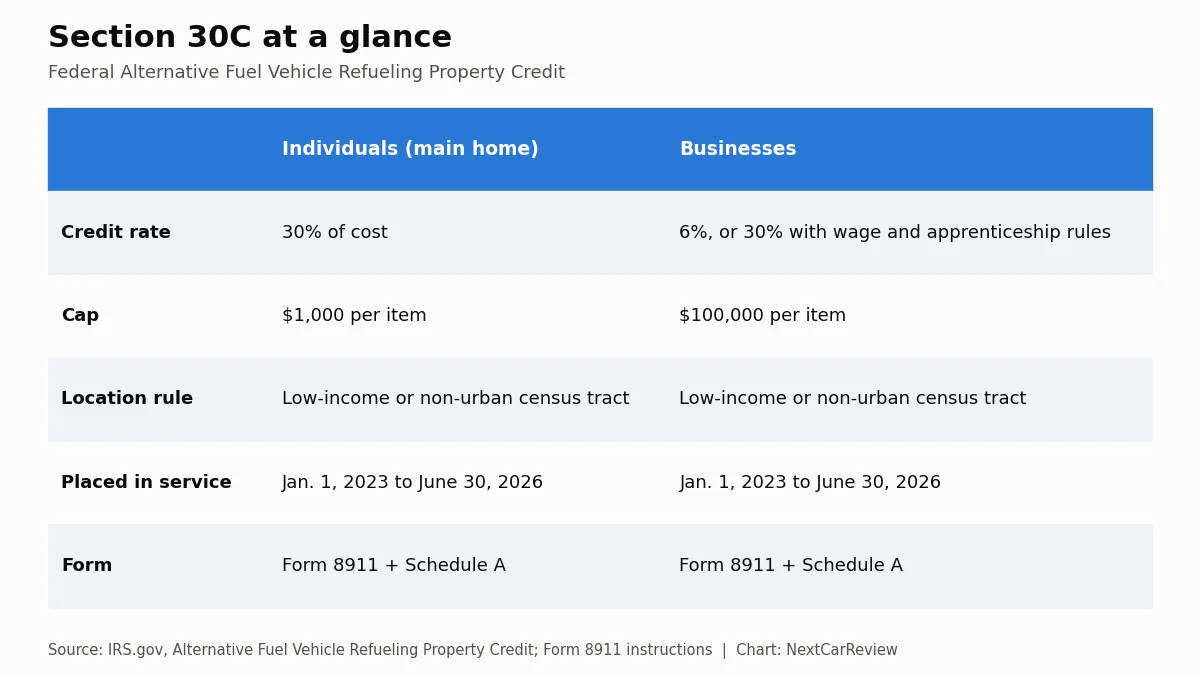
The residential version (30% up to $1,000)
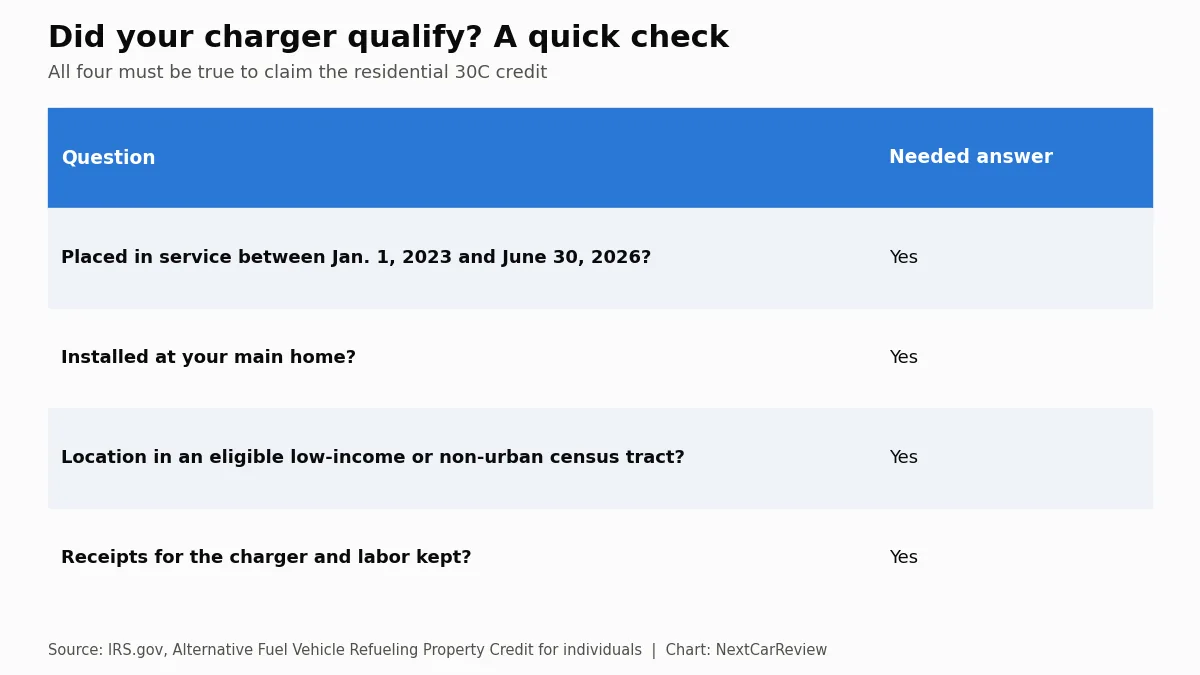
For individuals, the IRS describes the credit as 30% of the cost of the property, up to a maximum credit of $1,000 per item. The IRS page for individuals frames that limit as per charging port. To qualify, the equipment had to be:
- Installed at your main home (primary residence)
- Located in an eligible low-income community or non-urban census tract
- Placed in service, meaning installed and ready to use, within the credit window
Costs included the charger and the associated labor, so a $1,200 hardware-plus-installation job could have returned $360, while a $4,000 job hit the $1,000 cap.
The commercial/business version (up to $100,000 per item)
Businesses could claim 6% of the cost, up to $100,000 per item. Projects meeting the prevailing wage and apprenticeship requirements qualified for 30%, with the same $100,000 per-item limit. The same census-tract and placed-in-service rules applied.
Why the Credit Ended in 2026
The One Big Beautiful Bill Act and the June 30, 2026 cutoff
Until 2025, 30C was scheduled to run through December 31, 2032. Public Law 119-21, signed July 4, 2025 and commonly known as the One Big Beautiful Bill Act, changed that. In the IRS’s words from the Form 8911 instructions, the law “changed the termination date for the section 30C alternative fuel vehicle refueling property credit from December 31, 2032, to June 30, 2026.”
The IRS FAQ on the law puts it even more simply: the credit will not be allowed for any property placed in service after June 30, 2026. The DOE Alternative Fuels Data Center lists the same 06/30/2026 expiration.
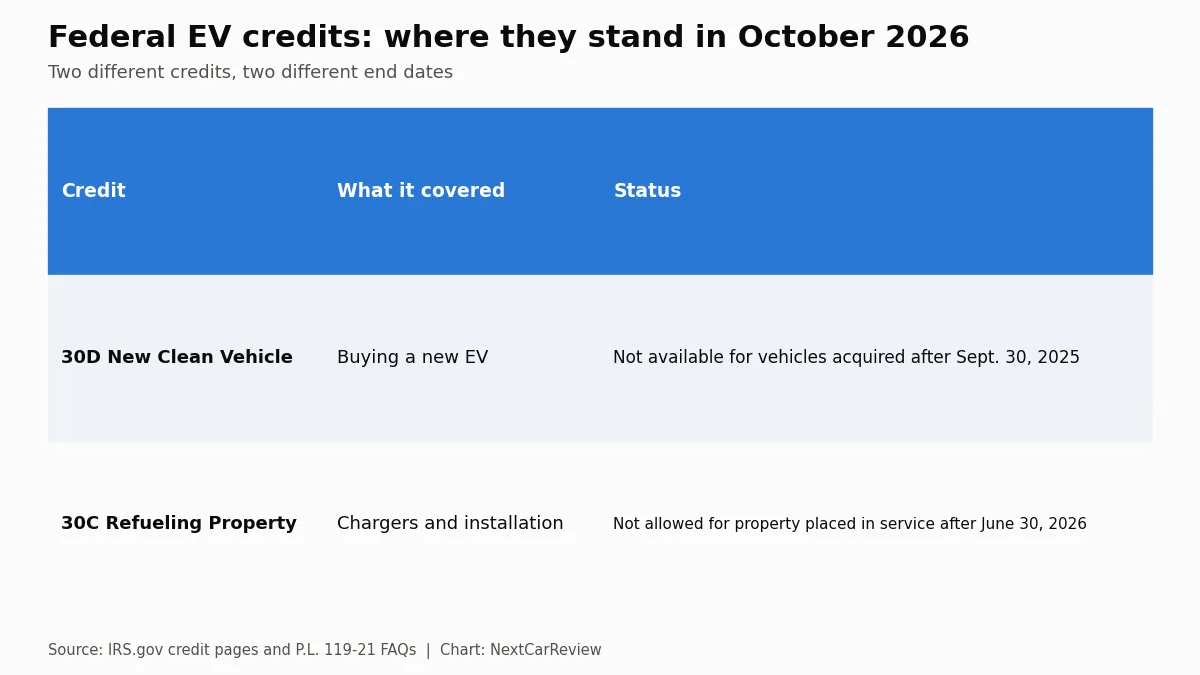
Do not confuse 30C with the federal EV purchase credit. The $7,500 New Clean Vehicle Credit (Section 30D) ended earlier: the IRS says it is not available for vehicles acquired after September 30, 2025. Our explainer on the federal EV purchase tax credit’s status covers that change, including the binding-contract rule.
Who Could Still Qualify
The deciding date is when the charger was placed in service, not when you bought it or when you file. The IRS individuals page says the credit applies to eligible property placed in service from January 1, 2023 through June 30, 2026.
- Installed January 1 to June 30, 2026: claim it on your 2026 federal return, which you file in 2027, if the other rules are met.
- Installed in 2023, 2024 or 2025: the credit belonged on that year’s return. If you missed it, ask a tax professional about your options.
- Installed July 1, 2026 or later: not eligible, even if you paid a deposit earlier.
Census Tract Eligibility Rules (While the Credit Was Active)
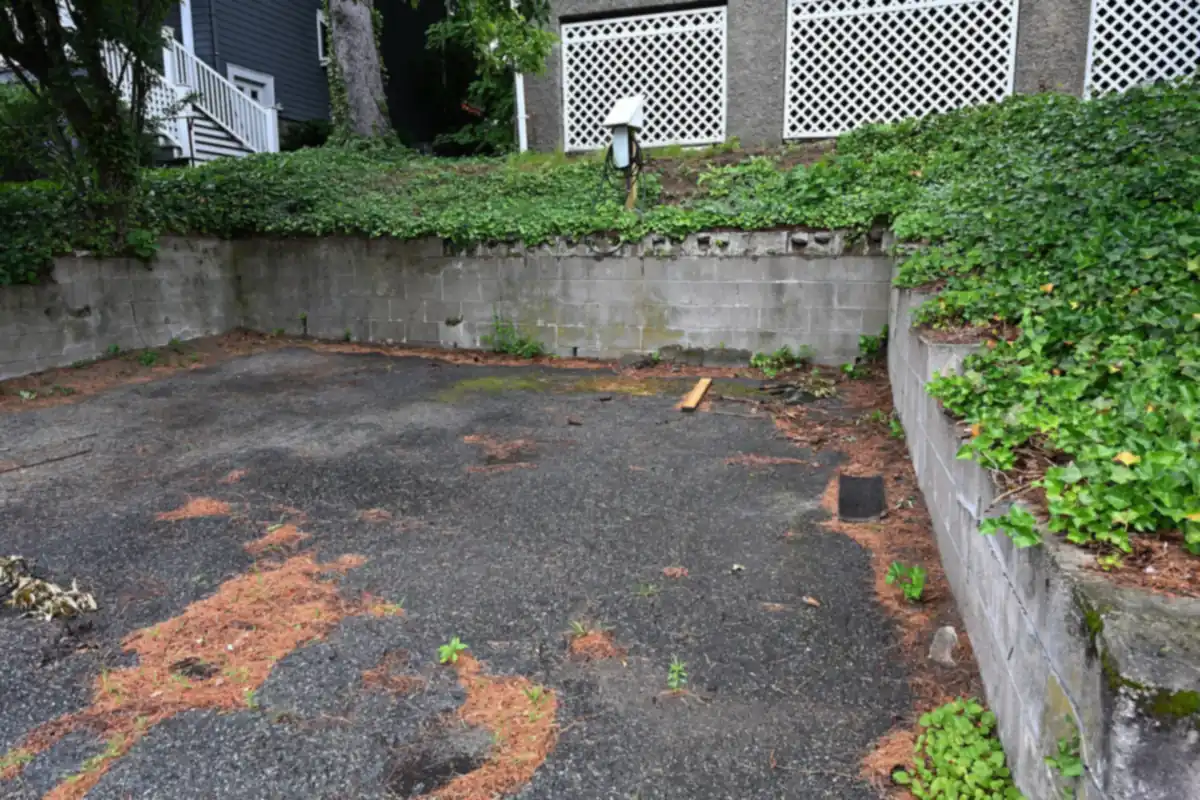
The location test tripped up many homeowners. The property had to sit in either a low-income community census tract, as defined under the New Markets Tax Credit rules, or a non-urban census tract under Treasury and IRS guidance. Meeting either one was enough.
Which tract list applies depends on the in-service date. For property placed in service after January 1, 2025, the IRS points filers to the Census Bureau’s 2020 census tract tools and the matching appendix of eligible tracts; earlier installs use the 2015 tract data. If your tract’s GEOID is not on the list, the IRS states plainly that the property is not eligible. Argonne National Laboratory’s Geospatial Energy Mapper also maps eligible areas.
What’s Left: State and Utility Incentives That Still Exist
With the federal credit closed to new installs, the help that remains is local. It falls into three buckets:
- State rebates and tax credits. Some states run their own charger or EV programs. Start with our roundup of state EV incentives that are still active.
- Utility programs. Many electric utilities offer charger rebates, EV time-of-use rates or managed-charging programs. Program funding runs out; PG&E, for example, lists its multifamily and small business charger program as fully subscribed.
- Lower running costs. The biggest long-term saving is still charging at home on residential rates. See our comparison of home vs public charging costs.
The DOE Alternative Fuels Data Center keeps a searchable laws and incentives database by state, which is a good cross-check before you buy.
How to Claim the Credit for Chargers Installed Before the Deadline (Form 8911)
- Confirm the dates. The charger must have been placed in service between January 1 and June 30, 2026 for a 2026 claim.
- Confirm the census tract. Look up your address’s 2020 census tract GEOID and check it against the IRS eligible-tract list.
- Gather receipts. The IRS tells filers to keep receipts verifying the purchase and associated labor costs.
- Complete Schedule A (Form 8911) for each item of qualified property, then Form 8911.
- File with your 2026 return. The credit carries to Schedule 3 of Form 1040, per the Form 8911 instructions.
If you are still choosing hardware for a charger you have not installed yet, the credit will not apply, but the specs still matter. Our guide to chargers that qualified for the credit compares popular Level 2 units by amperage, safety listing and warranty.
Who this matters for now: homeowners who installed a charger in the first half of 2026 and are preparing their 2026 return, and anyone reading older articles that still describe 30C as available through 2032.
EV Charging Guide Series
Start with the main guide: choosing and using EV charging stations. More in this series:
- EV charging levels explained: Level 1 vs Level 2 vs DC fast
- How long it takes to charge an electric car
- Home vs public EV charging cost per mile
- How to install a Level 2 charger at home
- Best Level 2 home EV chargers compared
- EV charging for renters and apartment dwellers
- Tesla Supercharger vs Electrify America vs EVgo vs ChargePoint
- Best EV charging apps and cards
Frequently Asked Questions
Is the federal EV charger tax credit still available in 2026?
Only for chargers placed in service on or before June 30, 2026. The IRS says the Section 30C credit will not be allowed for any property placed in service after that date, under Public Law 119-21, commonly called the One Big Beautiful Bill Act.
How much was the residential EV charger tax credit worth?
For individuals, 30% of the cost of the charging equipment and installation, up to $1,000 per item. The IRS individuals page describes the limit as per charging port. The charger had to be installed at your main home in an eligible census tract.
What form do I use to claim the EV charger credit?
IRS Form 8911, Alternative Fuel Vehicle Refueling Property Credit, filed with your income tax return for the year the property was placed in service. You complete a separate Schedule A (Form 8911) for each item of qualified property.
I installed my charger in March 2026. Can I still claim the credit?
Possibly. Property placed in service between January 1 and June 30, 2026 falls inside the credit window, so it would go on your 2026 return, assuming your home is in an eligible low-income or non-urban census tract and it is your main home. Keep receipts for the equipment and labor.
Is the EV charger credit the same as the federal EV tax credit?
No. The $7,500 New Clean Vehicle Credit (Section 30D) covered buying an EV and is not available for vehicles acquired after September 30, 2025. Section 30C covered charging equipment and ended for property placed in service after June 30, 2026.
What incentives are left for home EV chargers?
State programs and utility rebates or EV rate plans are the main options now. Availability varies widely by state and utility, so check your state energy office, your electric utility and the DOE Alternative Fuels Data Center laws and incentives database.
⚠️ Professional Notice:
This article explains federal tax rules as published by the IRS as of October 2026. It is general information, not tax advice. Eligibility depends on your facts, including when the property was placed in service and its census tract. Consult a qualified tax professional or the IRS before claiming any credit.
Tax law can change. NextCarReview will review this page against IRS.gov at least quarterly.
Data Sources and Verification
- IRS: Alternative Fuel Vehicle Refueling Property Credit
- IRS: Alternative Fuel Vehicle Refueling Property Credit for individuals
- IRS: Instructions for Form 8911 (Rev. December 2025)
- IRS: About Form 8911 and Schedule A
- IRS: FAQs on modifications under Public Law 119-21 (One Big Beautiful Bill)
- IRS: FAQs on eligible census tracts for the Section 30C credit
- IRS: Credits for new clean vehicles purchased in 2023 or after (30D status)
- DOE Alternative Fuels Data Center: Alternative Fuel Infrastructure Tax Credit
- U.S. Census Bureau: 2020 Census Tract tools
- Argonne National Laboratory: Geospatial Energy Mapper
Figures were checked against the sources above in late September and early October 2026. Prices, laws and network data change; verify before you rely on them.

Morgan Reyes is the founder and editor-in-chief of NextCarReview, which Morgan launched in August 2024. A 2022 graduate of Columbia University, Morgan is based in New York and writes and edits the site’s reviews, comparisons and buying guides. Morgan does not road-test vehicles. Every article is built from published primary data: EPA FuelEconomy.gov ratings, NHTSA crash ratings, recalls and owner complaints, IIHS results, and manufacturer specifications and pricing, with each figure cited and checked before publication. Contact: admin@nextcarreview.com