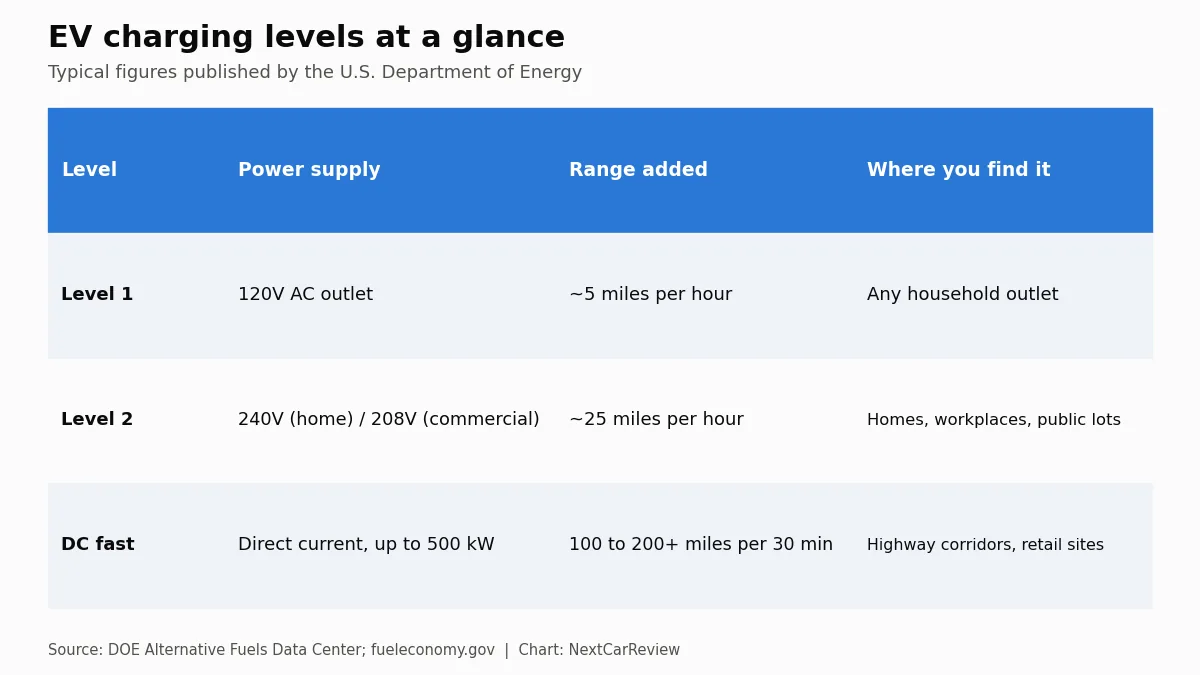
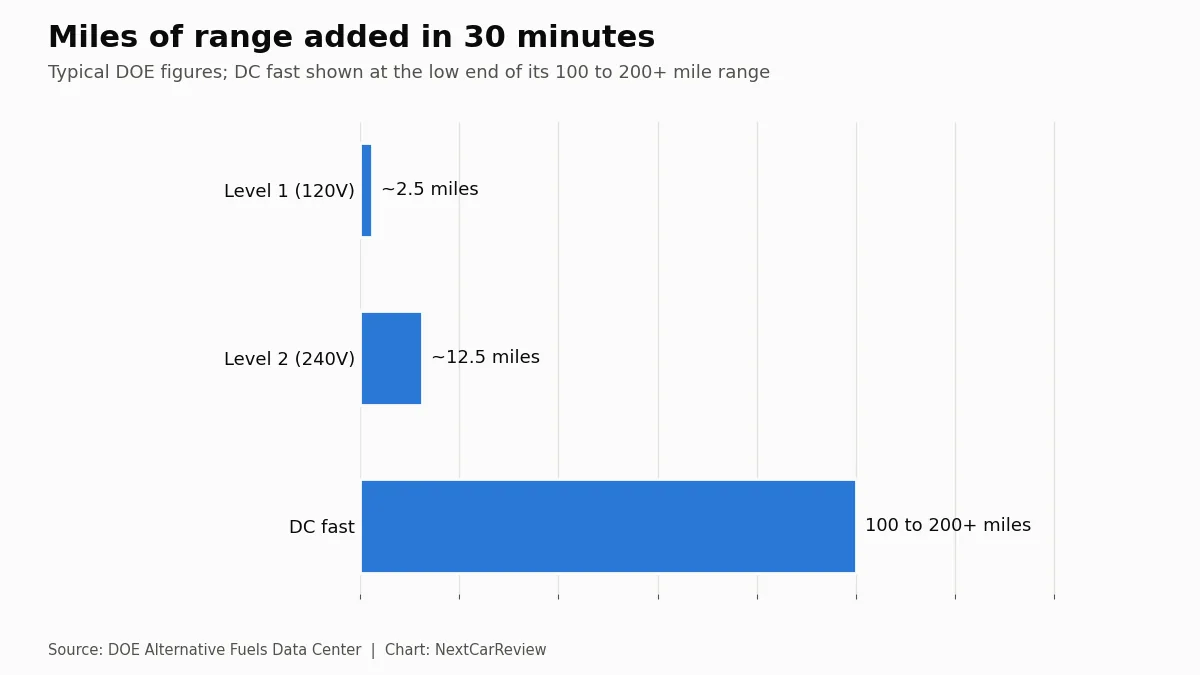
Level 1 plugs into a regular 120V outlet and adds roughly 5 miles of range per hour. Level 2 runs on 240V and adds roughly 25 miles per hour, enough to refill most EVs overnight. DC fast charging (often called Level 3) adds 100 to 200+ miles in about 30 minutes and is built for road trips.
For most owners, the right answer is Level 2 at home or work for daily driving and DC fast charging only when you are traveling. Level 1 is a workable fallback if you drive short distances and park at home every night.
Charging-speed and station figures in this guide come from the DOE Alternative Fuels Data Center, fueleconomy.gov and manufacturer specification sheets. NextCarReview does not test chargers or vehicles for this guide; see our sourcing policy.
Every EV owner runs into the same three terms in the first week: Level 1, Level 2 and DC fast charging. The labels sound technical, but the idea is simple. The level tells you how much power reaches the car, and power decides how many miles you get back for every hour plugged in.
This guide breaks down each level using U.S. Department of Energy (DOE) figures, explains why DC fast charging works differently, and helps you pick the setup that fits how you drive. For the bigger picture on home, work and road-trip charging, see our guide to choosing the right EV charging station.
The Three EV Charging Levels at a Glance
The table below uses the DOE’s typical figures. Your own numbers will vary with the car and the charger, but these are a reliable starting point.
| Level | Voltage / power | Range added (typical) | Typical location | Typical energy cost |
|---|---|---|---|---|
| Level 1 | 120V AC household outlet | About 5 miles per hour | Garage or driveway outlet | Your home rate (U.S. average 18.31¢/kWh in July 2026) |
| Level 2 | 240V AC at home, 208V at commercial sites | About 25 miles per hour | Homes, workplaces, parking lots | Home rate at home; public prices vary (EVgo lists $0.28/kWh in select locations) |
| DC fast (“Level 3”) | Direct current, power outputs up to 500 kW | About 100 to 200+ miles per 30 minutes | Highway corridors, retail centers | Highest; Tesla Supercharger sites listing a price in AFDC show a $0.60/kWh median |
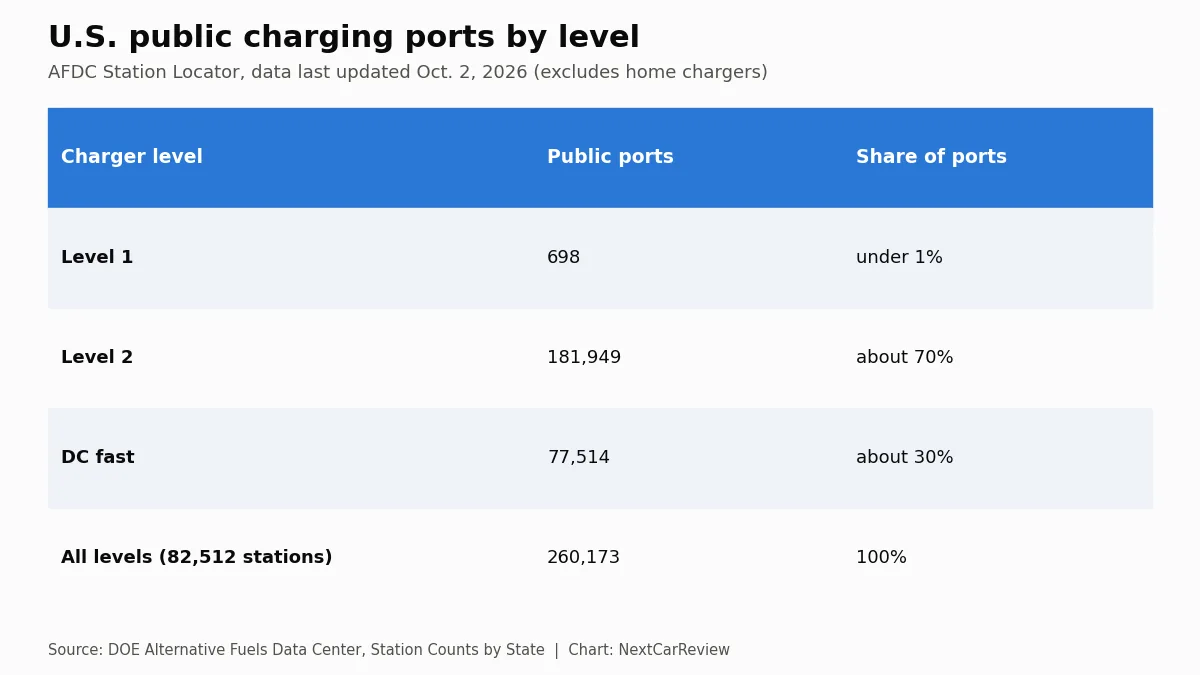
Public infrastructure is mostly Level 2. As of October 2, 2026, the DOE’s Alternative Fuels Data Center (AFDC) counted 260,173 public charging ports at 82,512 locations: 181,949 Level 2 ports, 77,514 DC fast ports and only 698 Level 1 ports. Those totals do not include chargers in private homes.
Level 1 Charging: What Comes With Most EVs
Level 1 means plugging the car into a standard 120V outlet with a portable charging cord. Check whether a cord came with your car or is sold as an accessory. There is nothing to install if you already have an outlet near your parking spot.
How much range Level 1 actually adds per hour
The DOE puts Level 1 at approximately 5 miles of range per hour of charging. Its own example: 8 hours of charging at 120V can replenish about 40 miles of electric range for a mid-size EV. Leave the car plugged in for 12 hours and you are in the 60-mile neighborhood.
That is slow, but the AFDC notes that many EV owners meet their daily driving needs by charging overnight on Level 1.
Who Level 1 works for (and who it doesn’t)
Level 1 is a good fit if you: drive about 30 to 40 miles a day or less, park at home every night, drive a plug-in hybrid with a small battery, or need a backup at a relative’s house.
Level 1 is a poor fit if you: commute long distances, share one EV between two drivers, or regularly come home with a nearly empty battery. A full recharge of a large battery can take days on 120V.
Level 2 Charging: The Home and Workplace Standard
Level 2 is where most EV charging happens. The DOE says Level 2 equipment can charge a typical EV battery overnight, at roughly 25 miles of range per hour. fueleconomy.gov adds that real-world Level 2 speed ranges from just a few miles per hour to around 40, depending on the equipment and the vehicle.
240V explained in plain terms
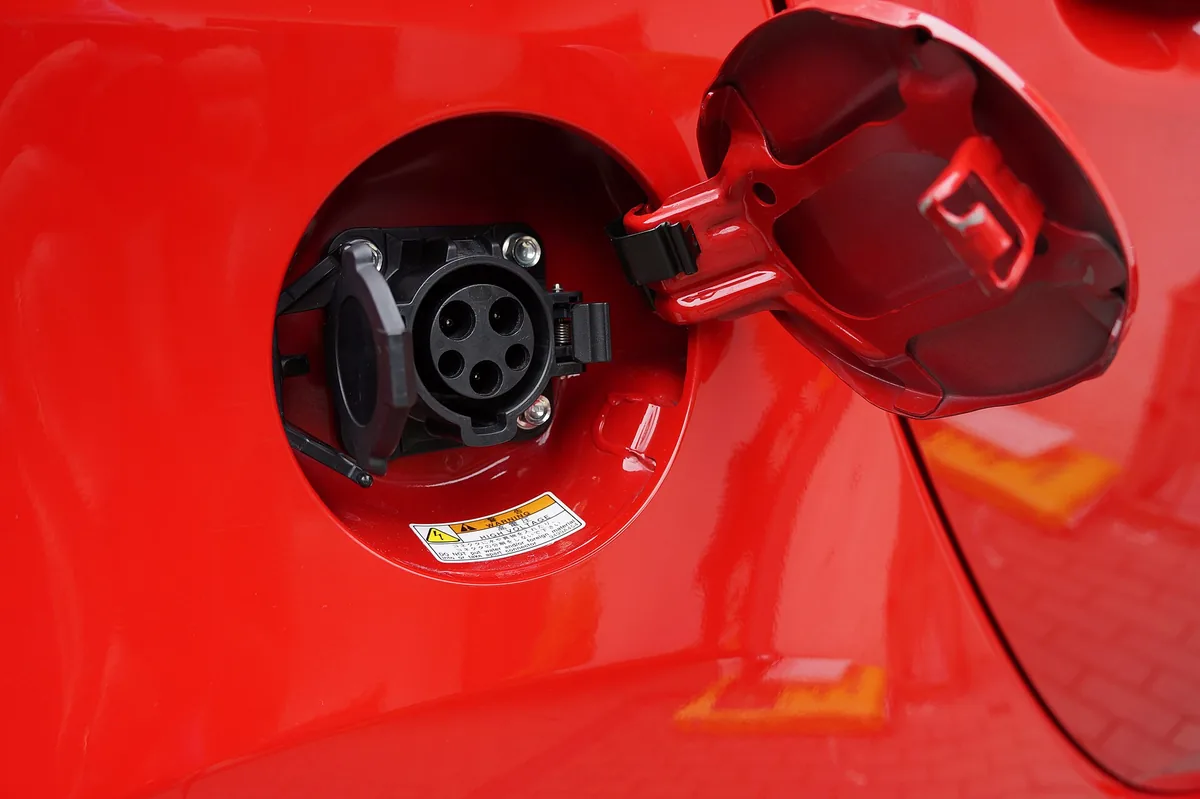
A household outlet supplies 120 volts. A Level 2 circuit supplies 240 volts, the same type of circuit that runs an electric clothes dryer or range. Commercial Level 2 stations often run on 208V, which is slightly slower than 240V at the same amperage.
The AFDC describes the SAE J1772 connector as the standard plug for Level 1 and Level 2, and most non-Tesla EVs sold in North America have used it. Newer models are moving to the SAE J3400 (NACS) port. The 2026 Nissan Leaf, for example, keeps a J1772 port for AC charging and adds a NACS port for DC fast charging. You can read more about the Nissan Leaf Crossover’s NACS charging port in our review, and about which connector your EV uses in our NACS vs. CCS guide.
Amperage and why it changes charging speed
Power is volts times amps. At 240V, every extra amp adds 240 watts. The AFDC says most residential Level 2 chargers operate at up to 30 amps, delivering 7.2 kW. Higher-output wall units go further: Tesla’s Gen 3 Wall Connector manual lists 48 amps (11.5 kW) on a 60-amp breaker, 40 amps (9.6 kW) on a 50-amp breaker and 32 amps (7.6 kW) on a 40-amp breaker.
There is a catch. Your car’s onboard charger sets a ceiling. The 2026 Nissan Leaf has a 7.2 kW onboard charger, so a 48-amp wall unit will not make it charge faster than a 30- to 32-amp unit would. Check your car’s onboard charger rating before paying for a bigger circuit. Our guide to how long each charging level takes runs the numbers by battery size.
DC Fast Charging (Level 3): Built for the Road
DC fast chargers are the large dispensers you see at highway stops and shopping centers: Tesla Superchargers, Electrify America, EVgo and others. The DOE lists DC fast charging at approximately 100 to 200+ miles of range per 30 minutes, with equipment power outputs up to 500 kW.
Why DC fast charging skips the onboard charger
Batteries store direct current (DC). The grid delivers alternating current (AC). With Level 1 and Level 2, the conversion from AC to DC happens inside the car, in the onboard charger, which is small and limited to roughly 7 to 11 kW in many current EVs.
A DC fast charger does the conversion inside the station, using much larger hardware, and feeds DC straight to the battery. That is how it can deliver many times more power than any home setup. The car’s battery management system still decides how much power it will accept.
Charging curve: why the last 20% is slower
DC fast charging is not a steady rate. fueleconomy.gov notes that charge rate depends on the battery’s state of charge and temperature. As the pack fills, the car reduces power to protect the cells, so the stretch from 80% to 100% takes far longer per mile than the stretch from 10% to 80%.
That is why automakers quote DC times as 10% to 80%. Nissan lists 35 minutes for the 2026 Leaf on DC fast charging over that window. On a road trip, charging to about 80% and moving on is usually quicker overall than waiting for a full battery.
Temperature matters too. Idaho National Laboratory research found DC fast charging rates can deteriorate considerably in cold weather, and range drops as well. See how charging speed slows in cold weather and what preconditioning does about it.
AC vs DC Charging: The Technical Difference That Actually Matters
The practical takeaway fits in two lines. With AC charging (Level 1 and Level 2), your car’s onboard charger is the bottleneck. With DC charging, the station and your battery’s charging curve are the bottleneck.
| AC charging (Level 1 and 2) | DC fast charging | |
|---|---|---|
| Where AC becomes DC | Inside the car (onboard charger) | Inside the charging station |
| What limits speed | Lower of charger output or onboard charger rating | Station output, battery state of charge and temperature |
| Common connectors | J1772 or J3400 (NACS) | CCS, J3400 (NACS), legacy CHAdeMO |
| Best use | Daily charging while parked for hours | Road trips and quick top-ups |
Strengths of each level
- Level 1: no installation cost, works almost anywhere with an outlet.
- Level 2: refills most EVs overnight at home electricity rates.
- DC fast: adds 100+ miles in a coffee-stop window.
Trade-offs to know
- Level 1: too slow for long commutes or large batteries.
- Level 2: needs a 240V circuit, which can mean an electrician and a permit.
- DC fast: the most expensive per kWh, and speed falls off above roughly 80%.
Which Charging Level Is Right for Your Situation?
Start with where your car sleeps. With a driveway or garage and more than about 40 miles a day of driving, a Level 2 home charger makes the biggest difference. Drive less than that with an outlet nearby, and Level 1 may be enough to start.
If you rent or park on the street, workplace Level 2 and public Level 2 near home do the job that a garage charger would. DC fast charging fills gaps and handles road trips. For the cost side of these choices, our pillar guide on electric vehicle charging stations compares home, work and public options in one place.
EV Charging Guide Series
Start with the main guide: choosing and using EV charging stations. More in this series:
Frequently Asked Questions
What is the difference between Level 1, Level 2 and Level 3 EV charging?
Level 1 uses a 120V household outlet and adds about 5 miles of range per hour, according to the U.S. Department of Energy. Level 2 uses 240V (or 208V at commercial sites) and adds about 25 miles per hour. DC fast charging, often called Level 3, delivers direct current at high power and adds roughly 100 to 200+ miles in 30 minutes.
Is Level 3 the same as DC fast charging?
Yes, in everyday use. Level 3 is the informal name most drivers use for DC fast charging. Official DOE materials call it DC fast charging, and it includes Tesla Superchargers and CCS fast chargers from networks such as Electrify America and EVgo.
How many miles per hour does a Level 2 charger add?
DOE uses about 25 miles of range per hour as a typical figure. fueleconomy.gov notes the real number can range from a few miles per hour to around 40, depending on the charger’s amperage, your car’s onboard charger and the vehicle’s efficiency.
Can I install a DC fast charger at home?
Not practically. fueleconomy.gov lists DC fast charging at 480 volts or more, which is commercial-grade electrical service, and the equipment runs at very high power. Home charging is done with Level 1 or Level 2 equipment, which DOE says is how most EV owners do the majority of their charging.
Why does DC fast charging slow down near 80%?
Charging power depends on the battery’s state of charge and temperature. As the battery fills, the car reduces power to protect it, which is why automakers quote DC fast times as 10% to 80% rather than 0% to 100%.
Does cold weather affect charging speed?
Yes. Research from Idaho National Laboratory found DC fast charging rates can drop considerably in cold temperatures. A cold battery accepts power more slowly until it warms up, which is why many newer EVs offer battery preconditioning before a fast-charging stop.
⚠️ Professional Notice:
Charging speeds in this article are typical figures published by the U.S. Department of Energy and vehicle manufacturers. Actual speed depends on your vehicle’s onboard charger, battery size, state of charge, battery temperature, and the charger’s output. NextCarReview did not measure these figures.
Electrical work for a Level 2 circuit should be done by a licensed electrician in line with local code. Nothing here is electrical, legal or financial advice.
Data Sources and Verification
- DOE Alternative Fuels Data Center: Developing Infrastructure to Charge Electric Vehicles (charging levels, connectors)
- DOE AFDC: Charging Electric Vehicles at Home
- DOE AFDC: Alternative Fueling Station Counts by State (data last updated Oct. 2, 2026)
- fueleconomy.gov: Charging Your Plug-in Electric Vehicle
- Idaho National Laboratory via OSTI: Empirical analysis of EV fast charging under cold temperatures (Energy Policy, 2018)
- Tesla Gen 3 Wall Connector installation manual (amperage and power table)
- Nissan USA: 2026 Nissan Leaf press kit (charging ports and specs)
- U.S. EIA Electric Power Monthly, Table 5.6.A (residential electricity prices)
- EVgo pricing page (Level 2 pricing in select locations)
Figures were checked against the sources above in late September and early October 2026. Prices, laws and network data change; verify before you rely on them.

Morgan Reyes is the founder and editor-in-chief of NextCarReview, which Morgan launched in August 2024. A 2022 graduate of Columbia University, Morgan is based in New York and writes and edits the site’s reviews, comparisons and buying guides. Morgan does not road-test vehicles. Every article is built from published primary data: EPA FuelEconomy.gov ratings, NHTSA crash ratings, recalls and owner complaints, IIHS results, and manufacturer specifications and pricing, with each figure cited and checked before publication. Contact: admin@nextcarreview.com