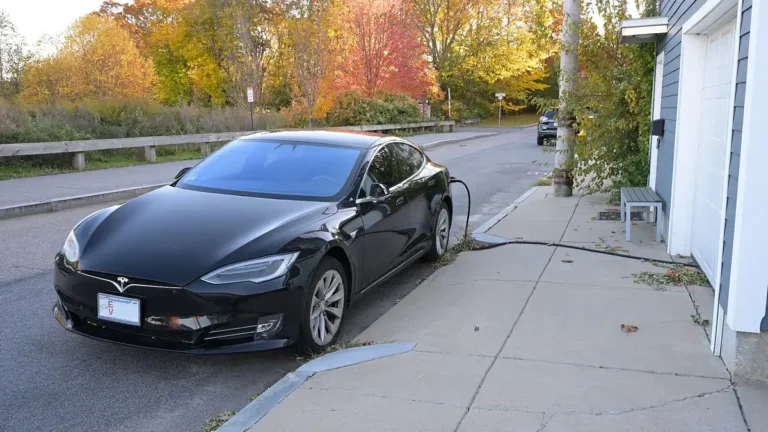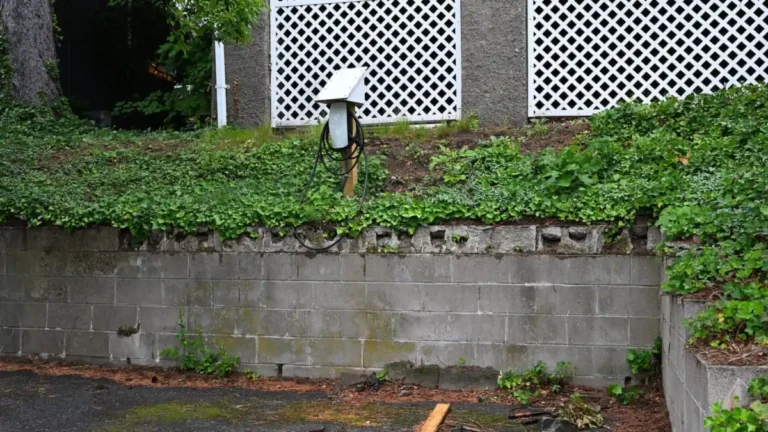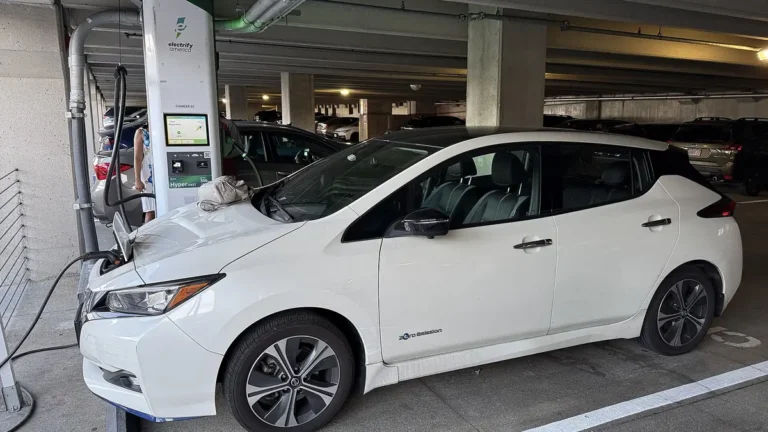
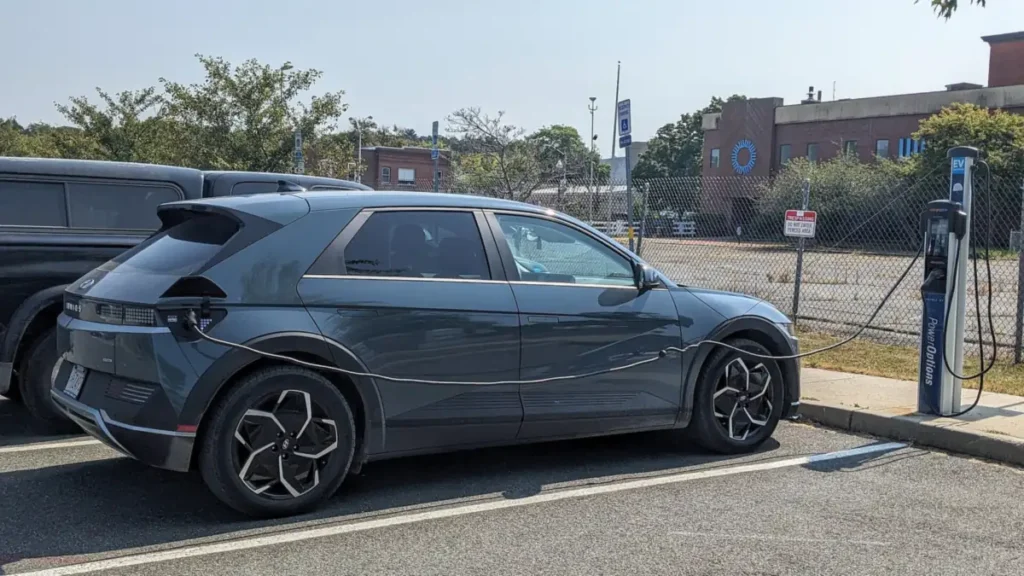
Yes, but it takes more planning. Renting without a dedicated parking spot is the hardest EV ownership situation, and it is worth being honest about that before you buy. The renters who make it work usually have one reliable anchor: workplace charging, a public Level 2 station near home, or a landlord-approved charger.
Several states, including California, Colorado, Illinois and Oregon, have right-to-charge laws that let tenants request permission to install a charger, typically at their own cost. Those laws do not require a landlord to provide one for free.
Legal summaries come from official state statute text (California) and the DOE AFDC Laws and Incentives database; charging guidance comes from DOE’s multifamily, workplace and home charging pages. NextCarReview does not test chargers or vehicles for this guide; see our sourcing policy.
Most EV advice assumes a garage, a driveway and a homeowner who can call an electrician. Plenty of drivers have none of those. If you rent, live in a condo with shared parking, or park on the street, the question is not which wall charger to buy. It is where your car will reliably get its energy every week.
This guide lays out the realistic options, what right-to-charge laws actually do, and what to ask your landlord. For general charging basics, see our guide to electric vehicle charging stations.
Your Realistic Charging Options as a Renter
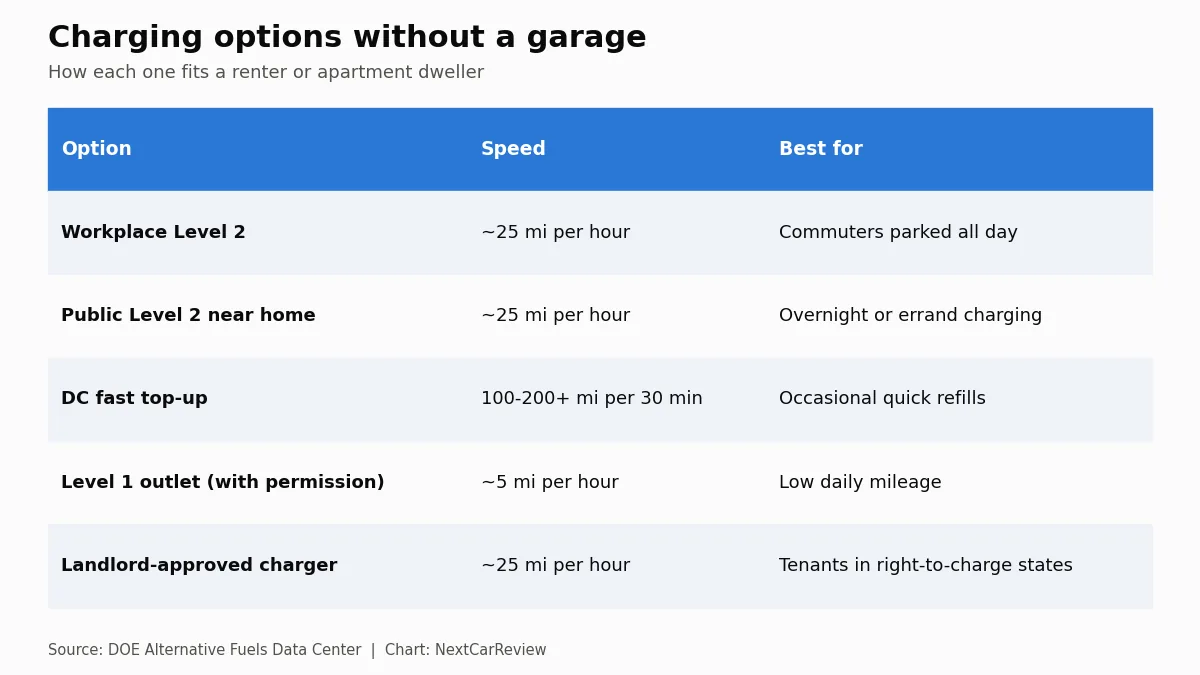
DOE puts it plainly: charging at multifamily housing requires additional considerations and may be more like public charging than charging at a single-family home. In practice, that means building a routine around one or two dependable sources.
Workplace charging
Workplace charging is the most underrated option for renters. If your car sits in an employer’s lot for eight or nine hours, a Level 2 station there can cover most of a week’s driving. At DOE’s typical rate of about 25 miles of range per hour, a full workday adds far more than most commutes use. DOE’s workplace charging guidance notes it can make driving electric more convenient and affordable for employees. Ask your HR or facilities team whether stations exist, whether they cost anything, and whether there is a sharing policy.
Public Level 2 charging near home
A public Level 2 station at a grocery store, library, municipal lot or gym near home can serve as your “home” charger. Look for one you can reach routinely and where you can park for a few hours. Pricing varies by site owner and can include per-hour fees, so check before you settle into a routine. Our comparison of public charging costs explains what to expect.
Public DC fast charging as an occasional top-up
DC fast charging can add 100 to 200+ miles in about 30 minutes, per DOE. It works well as a weekly top-up, but it is the most expensive way to charge. Relying on it alone can bring your energy cost per mile close to a gas car’s.
Asking your landlord or HOA for a dedicated charger
If you have an assigned spot, a charger there is the gold standard. Depending on your state, you may have a legal right to request one, as covered below. Even without a law, it costs nothing to ask, especially if you offer to cover installation and electricity.
“Right to Charge” Laws: What They Actually Cover
Right-to-charge laws limit a landlord’s or association’s ability to block a charger. They do not require anyone to build one for you. The common pattern: the tenant or owner submits a written request, pays for installation and electricity, uses a licensed contractor, and carries insurance.
California is the most detailed example. Civil Code 1947.6 says that for any lease executed, extended or renewed on or after July 1, 2015, a landlord “shall approve a written request of a lessee to install an electric vehicle charging station at a parking space allotted for the lessee,” as long as the request meets the statute’s requirements. The tenant pays the costs and may be required to carry personal liability coverage of up to 10 times the annual rent. Exemptions include leases that do not provide parking and properties with fewer than five parking spaces.
For condos and HOAs, California Civil Code 4745 voids rules that effectively prohibit or unreasonably restrict an owner’s charger, and an application not denied in writing within 60 days is deemed approved.
Which states have them (as of October 2026)
| State | Tenant provision | Condo / HOA provision | Notes |
|---|---|---|---|
| California | Yes, Civ. Code 1947.6 | Yes, Civ. Code 4745 | Tenant pays costs; 60-day deemed approval for associations |
| Colorado | Yes, C.R.S. 38-12-601 | Yes | Tenant installs at own expense; landlord may charge reasonable fees |
| Illinois | Yes, Electric Vehicle Charging Act (765 ILCS 1085) | Yes | Tenant may install Level 1 or Level 2 at an allotted space |
| Oregon | Yes, ORS 90.462 | Yes | Landlord to approve a complete application within 60 days, with exceptions |
| Florida | None listed | Yes, condominiums | Owner pays; licensed contractors required |
| New Jersey, New York, Maryland, Virginia, Washington, Hawaii | None listed | Yes | Owner generally bears costs; details vary |
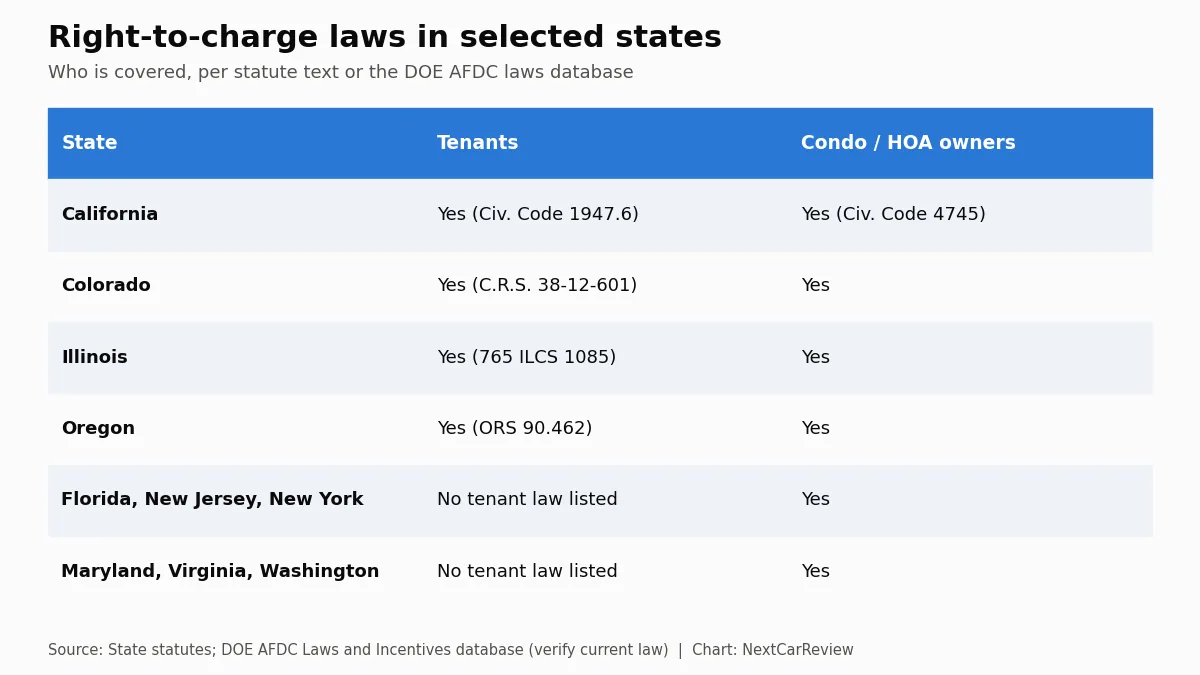
Treat this table as a starting point. Laws are amended, conditions apply, and the DOE database summarizes rather than quotes most statutes. Read the current text for your state and check your lease before you send a request.
What to Ask Your Landlord or Property Manager
- Are there existing chargers or 240V outlets in the garage or lot, and can tenants use them?
- Would you approve a charger at my assigned space if I pay for installation and electricity?
- How would electricity be billed: a separate meter, a smart charger with usage tracking, or a flat fee?
- What insurance and contractor requirements apply?
- Who owns the charger when I move out, and does it stay or go?
- Is the property eligible for a utility multifamily charging program?
Put the request in writing. California’s law is built around a written request, and Oregon’s around a complete application with a 60-day response window. If you get a yes, our guides on home charger installation cost and process and the best Level 2 home chargers cover the next steps. A plug-in charger can move with you when your lease ends.
Portable and Trickle Charging From a Standard Outlet
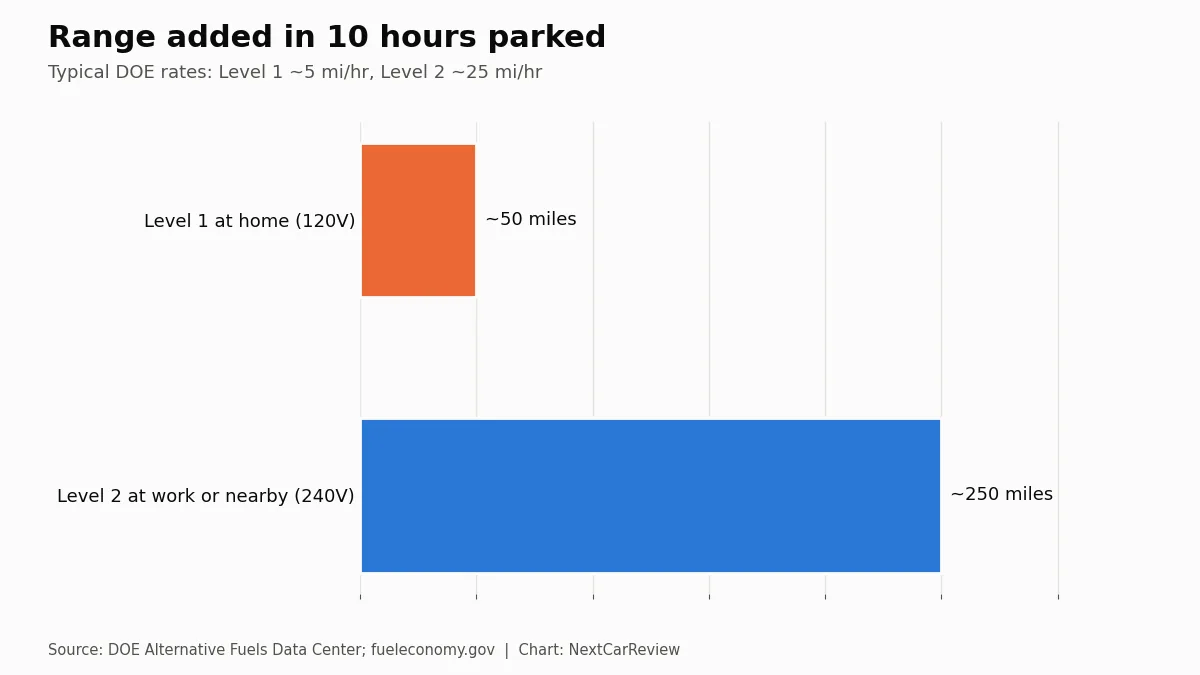
Level 1 charging is not just “not enough.” DOE notes that many EV owners meet their daily driving needs by charging overnight with Level 1 equipment, at roughly 5 miles of range per hour. Ten hours plugged in adds around 50 miles. If you drive 30 miles a day and have permission to use an outlet near your spot, that may be all you need.
Ask before you plug in. Running a cord across a sidewalk or using a shared outlet without permission may violate your lease or local rules. Use only the charging cord made for your vehicle, plugged directly into a properly grounded outlet.
Multifamily Charging Programs and Utility Incentives
Property owners, not just tenants, have incentives to add charging. DOE’s multifamily guidance notes building owners may be able to use state or utility incentives, and AFDC links to a multi-unit dwelling charging toolkit and a guide called “EV Charging Access for Renters.”
Utility programs vary. Xcel Energy’s Minnesota multifamily program offers selected participants utility-owned EV supply infrastructure (the wiring that serves the chargers), installed and maintained at no cost, plus lower-cost chargers. PG&E’s multifamily and small business program installed chargers at no cost to property owners in priority communities, but it now lists itself as fully subscribed. Point your landlord to your utility’s EV page and to our roundup of state EV incentive programs.
EV Charging Guide Series
Start with the main guide: choosing and using EV charging stations. More in this series:
- EV charging levels explained: Level 1 vs Level 2 vs DC fast
- How long it takes to charge an electric car
- The Section 30C EV charger tax credit in 2026
- Home vs public EV charging cost per mile
- How to install a Level 2 charger at home
- Best Level 2 home EV chargers compared
- Tesla Supercharger vs Electrify America vs EVgo vs ChargePoint
Frequently Asked Questions
Can renters install an EV charger?
In some states, tenants have a legal right to request one. California’s Civil Code 1947.6, for example, requires a landlord to approve a tenant’s written request to install a charger at the tenant’s assigned parking space, for leases executed, extended or renewed on or after July 1, 2015, with the tenant paying the costs. Colorado, Illinois and Oregon have tenant provisions too. Elsewhere, you need your landlord’s permission.
What is a right-to-charge law?
A state law that limits a landlord’s or homeowners association’s ability to block an EV charger installation. Most require the tenant or owner to pay for installation, maintenance and electricity and to carry insurance. They protect the right to install a charger; they do not require the property owner to provide one.
How do apartment dwellers charge their EVs?
Most rely on a mix of workplace Level 2 charging, public Level 2 stations near home, occasional DC fast charging, and, where allowed, a standard outlet for Level 1 charging. DOE notes multifamily charging can be more like public charging than charging at a single-family home.
Is Level 1 charging enough for a renter?
It can be for low-mileage drivers. DOE estimates Level 1 adds about 5 miles of range per hour, and notes that many EV owners meet their daily needs charging overnight on Level 1. Ten hours plugged in adds roughly 50 miles.
Does my HOA have to let me install a charger?
In many states, an association cannot prohibit or unreasonably restrict a charger in an owner’s designated parking space. California, Colorado, Florida (condominiums), New Jersey, New York, Maryland, Virginia, Washington, Oregon, Illinois and Hawaii all have association-related provisions in the DOE laws database. Rules on costs, insurance and approval timelines differ by state.
Are there programs that pay for apartment charging?
Some utilities run multifamily programs. Xcel Energy’s Minnesota multifamily program, for example, offers selected participants utility-owned EV supply infrastructure (the wiring that serves the chargers) installed and maintained at no cost, plus lower-cost chargers. Programs fill up; PG&E lists its multifamily and small business charger program as fully subscribed.
⚠️ Professional Notice:
This article summarizes state laws as published in official statute text or the DOE Alternative Fuels Data Center laws database as of October 2026. It is general information, not legal advice. Right-to-charge laws change and contain conditions and exemptions not covered here. Read the current statute for your state and your lease, and consult a tenant-rights organization or attorney before relying on any law.
Any charger or new outlet must be installed by a licensed electrician with the property owner’s written approval and required permits.
Data Sources and Verification
- California Civil Code 1947.6 (tenant charging stations)
- California Civil Code 4745 (common interest developments)
- DOE AFDC laws database: Colorado
- DOE AFDC laws database: Illinois
- DOE AFDC laws database: Oregon
- Oregon Revised Statutes 90.462 (text via oregon.public.law)
- DOE AFDC laws database: Florida
- DOE AFDC laws database: New York
- DOE AFDC: Charging at multifamily housing
- DOE AFDC: Workplace charging
- DOE AFDC: Charging Electric Vehicles at Home
- Xcel Energy Minnesota Multifamily EV Solutions program summary (PDF)
- PG&E Multifamily Housing and Small Business EV Charger Program
Figures were checked against the sources above in late September and early October 2026. Prices, laws and network data change; verify before you rely on them.

Morgan Reyes is the founder and editor-in-chief of NextCarReview, which Morgan launched in August 2024. A 2022 graduate of Columbia University, Morgan is based in New York and writes and edits the site’s reviews, comparisons and buying guides. Morgan does not road-test vehicles. Every article is built from published primary data: EPA FuelEconomy.gov ratings, NHTSA crash ratings, recalls and owner complaints, IIHS results, and manufacturer specifications and pricing, with each figure cited and checked before publication. Contact: admin@nextcarreview.com