In this article 19 sections
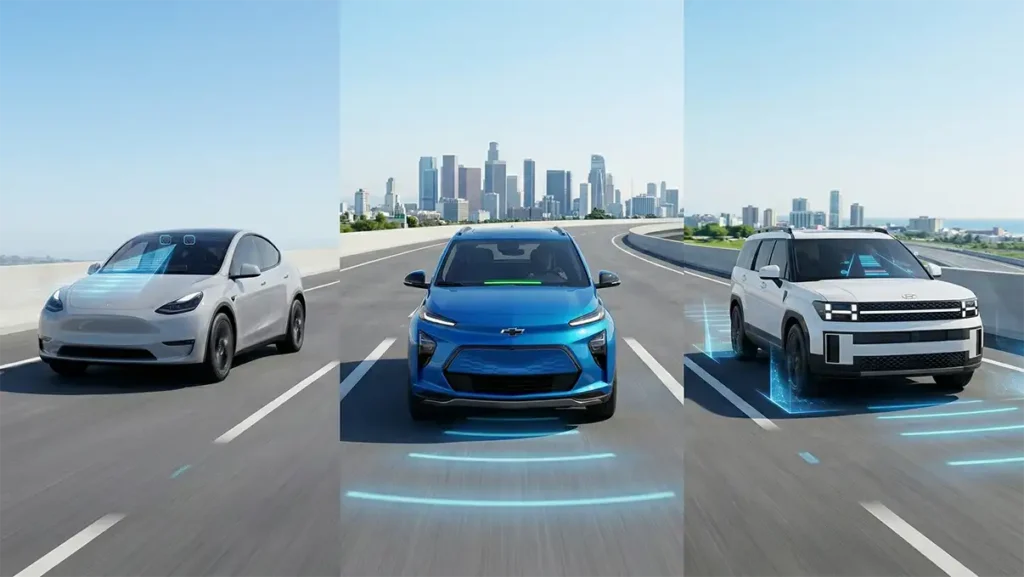
You can get amazing tech in affordable brands like Hyundai, Kia, and Chevy. The four systems that matter most: Tesla FSD (Supervised) for city streets under $45,000, GM Super Cruise for true hands-free highway driving under $48,000, Hyundai/Kia HDA II for best-value smooth highway assist under $35,000, and Ford BlueCruise for commuting comfort under $49,000.
The bottom line: if you do long highway trips, GM Super Cruise is the strongest hands-free option. If you want the most capable city driving tech, Tesla leads. If you want the best value with no ongoing subscription fees, Hyundai and Kia are the smart pick.
Figures cross-checked against EPA, NHTSA, IIHS and manufacturer sources. See our sourcing policy.
In 2026, here are the best ADAS self-driving features under $50,000 for 2026. Because of this, you can get amazing tech in affordable brands like Hyundai, Kia, and Chevy.
We all want a car that makes driving easier. Modern technology now lets cars steer, brake, and speed up on their own. This technology is called ADAS. Many people think these features only come in expensive luxury cars. However, that is not true anymore.
Some systems let you take your hands off the wheel completely. On the other hand, others need you to stay alert at all times. Therefore, we want to show you which one is worth your hard-earned money. That is to say, we are looking for value and safety. In other words, we want to find the perfect balance for your daily commute.

📌 Best ADAS Self-Driving Features 2026 Under $50,000 – Quick Market Intelligence
2026 ADAS Ranking Table (Under $50k)
| Brand and System | Hands-Free? | Best For | Price Point | Subscription Fee? |
|---|---|---|---|---|
| Tesla FSD (Supervised) | No (Always Alert) | City Streets and Turns | Under $45,000 | $99/month subscription |
| GM Super Cruise | Yes (Mapped Roads) | Long Highway Trips | Under $48,000 | $39.99/mo after 3 years |
| Hyundai/Kia HDA II | No (Touch Wheel) | Smooth Highway Value | Under $35,000 | No – included free |
| Ford BlueCruise | Yes (Mapped Roads) | Commuting Comfort | Under $49,000 | $49.99/mo or $2,495 once |
| Analysis | Editorial Standard Verified ✔️ | Sources: IIHS.org, NHTSA.gov, OEM technical documentation, SAE Level definitions – April 2026 | |||
Every ADAS system in this guide – including Tesla FSD (Supervised), GM Super Cruise, Hyundai HDA II, and Ford BlueCruise – is an SAE Level 2 driver assistance system. This means the driver must remain alert, monitor the road at all times, and be ready to take control immediately. These are driver assist systems, not driver replacements. Never divert your full attention from driving while any of these systems are active. Source: SAE International Level definitions, OEM owner manuals, April 2026.
Super Cruise vs Tesla FSD 2026: The Big Battle
When you look for cars with the best autopilot under 50k 2026, two names stand out. These are Tesla and General Motors. reviewers noted they work very differently. Tesla uses cameras to see everything around the car. It can handle stop signs and traffic lights in the city. But, you must always keep your hands near the wheel. So, it is not a “hands-off” system yet.
On the other hand, GM Super Cruise is a true hands-free system. It uses LiDAR maps to know exactly where the road goes. Consequently, you can relax your arms on over 750,000 miles of compatible roads.
But, Super Cruise usually stays on the highway. It does not like tight city corners as much as Tesla does. In this Super Cruise vs Tesla FSD 2026 comparison, your choice depends on where you drive most. That is to say, one is for the city, and one is for the open road.

| Feature | Tesla FSD (Supervised) | GM Super Cruise |
|---|---|---|
| Hands-free operation | No – supervised system | Yes – on 750,000+ miles of mapped roads |
| Sensor technology | Tesla Vision cameras only (no radar) | LiDAR maps + cameras + radar |
| City street capability | Strong – handles intersections and roundabouts | Limited – primarily highway focused |
| Highway capability | Good – lane centering, auto lane change | Excellent – true hands-free on mapped routes |
| Rain and fog performance | Camera-dependent – may hand back control in heavy rain | Adds radar – may also hand back control in heavy rain |
| Software updates | Over-the-air, frequent | Over-the-air, periodic |
| Cost structure | $99/month subscription | 3 years included, then $39.99/month or $399/year |
| Best for | Urban commuters, city driving | Long highway road trips, interstate commuters |
Source: Tesla and GM OEM technical documentation, SAE International Level definitions, April 2026.
Tesla FSD vs GM Super Cruise vs Ford BlueCruise: Full Head-to-Head
We get this comparison question more than any other, so here’s the full four-way breakdown including Honda Sensing for buyers cross-shopping the latest 2026 Honda models. Each system uses different hardware, charges different fees, and shines in different driving conditions.
| Feature | Tesla FSD (Supervised) | GM Super Cruise | Ford BlueCruise | Honda Sensing (US) |
|---|---|---|---|---|
| SAE Level | Level 2 | Level 2 | Level 2 | Level 2 |
| True hands-free? | No | Yes (mapped roads) | Yes (mapped roads) | No (not yet offered in US) |
| Hands-free miles available | 0 | 750,000+ | 130,000+ | 0 |
| Driver monitoring | Steering torque + cabin camera | Cabin infrared camera | Cabin infrared camera | Varies by model |
| Sensor stack | Cameras only | LiDAR maps + radar + cameras | Cameras + radar | Camera + radar |
| City driving support | Strong (intersections, lights, stop signs) | Limited | Limited | Limited |
| Auto lane change | Yes, supervised | Yes, hands-free | Yes, hands-free | Not offered in US |
| Subscription cost | $99/month (subscription only since Feb. 14, 2026) | $39.99/month or $399/year after 3 years | $49.99/month, $495/year or $2,495 one-time | No fee |
| Performs in heavy rain | May hand back control | May hand back control | May hand back control | May hand back control |
| OTA updates | Frequent | Periodic | Periodic | Varies by model |
| Cars available under $50k | Model 3, Model Y | Equinox EV, Bolt, Blazer EV | Mustang Mach-E, F-150 Lightning Pro | Civic, Accord, CR-V Hybrid |
Source: OEM technical documentation – Tesla, GM, Ford, Honda – April 2026. Subscription pricing subject to change.
So if we line them all up, here’s how the verdict shakes out. Tesla wins for city tech and OTA updates. GM Super Cruise wins for highway hands-free coverage. Ford BlueCruise wins for the best value among hands-free systems. Honda Sensing suits buyers who want no subscription fees, though Honda does not yet offer hands-free driving in the US.
Super Cruise and BlueCruise use a cabin-facing infrared camera to track your eyes, and Tesla also uses a cabin camera. Look at your phone for too long and the system warns you. So even hands-free driving requires eyes-on-road attention at all times in 2026.
Highway Performance: What Published Data Shows
Here is how these systems perform based on manufacturer specifications and published data. We focused on hands-free driving under 50k. Chevy models such as the Equinox EV offer Super Cruise.
These systems are designed to keep the car centered in the lane. Likewise, Super Cruise can change lanes automatically to pass slow trucks. After that, it can move back into the right lane.
Hyundai and Kia’s Approach to Driver Assistance

Hyundai and Kia use a system called Highway Driving Assist II. It is not fully hands-free, but it is very helpful. Most importantly, it pairs adaptive cruise with lane centering on the highway. It is designed to slow the car smoothly when traffic ahead slows.
Meanwhile, the steering remains steady and firm. This makes it a great Level 2 ADAS comparison winner for families. We think it offers the best bang for your buck in 2026.
For buyers considering Hyundai and Kia EV models with HDA II, see our 2026 Hyundai Kona Electric vs Kia Niro EV comparison for full ADAS and ownership cost data on both models. For highway EV performance with these systems engaged, our best affordable EVs for highway driving in 2026 covers real-world performance data.
Hands-Free vs Eyes-Off: What the Labels Actually Mean
Marketing terms confuse buyers more than help them, so let’s clear up the three labels you’ll see on dealer brochures and OEM ads. Each one has a real meaning, and the gap between them matters more than the price difference between trims.
Hands-Free (What Most “Self-Driving” Systems Are in 2026)
Hands-free means we can take both hands off the steering wheel. But our eyes still have to stay on the road. The cabin camera tracks our gaze, and the car beeps if we look down at our phone for too long. Super Cruise and BlueCruise fall under this category, and Tesla FSD (Supervised) also requires constant supervision.
So calling these “self-driving” is misleading. The car drives. We supervise.
Eyes-Off (Not Yet Available Under $50,000)
Eyes-off is the next jump up. It means we can take our hands and eyes off the road in specific conditions. We can read a book, watch a video, or check email at low speeds. So this is what SAE calls Level 3 autonomy.
Currently, Mercedes-Benz offers eyes-off Drive Pilot on select S-Class and EQS models in California and Nevada. And those cars start well above $100,000. As a result, eyes-off is not realistic for buyers under $50,000 in 2026.
Mind-Off (Full Autonomy, Still Years Away)
Mind-off is the dream of full autonomy. The car drives itself with no human in the loop, and we can sleep in the back seat. This is SAE Level 4 and Level 5. So no consumer car offers this in 2026, regardless of price.
| Term | What It Means | Available Under $50k in 2026? |
|---|---|---|
| Hands-on (assisted) | Hands stay on wheel, system helps | Yes – almost every new car |
| Hands-free (supervised) | Hands off, eyes on road | Yes – GM, Ford |
| Eyes-off (conditional) | Hands and eyes off in specific conditions | No – luxury brands only |
| Mind-off (autonomous) | No human attention required | No – not available anywhere |
Source: SAE International Level definitions, OEM technical documentation, April 2026.
So when a car ad says “self-driving,” check the SAE level in the fine print. Above all, every system at this price point still expects us to watch the road.
City Driving and Parking Features
Self-driving is not just for the highway anymore. Parking matters too. Many cars under $50,000 now offer automated parking assist, usually on upper trims.
Above all, you just press a button and watch the steering wheel spin. Tesla FSD (Supervised) is designed to handle intersections and roundabouts under driver supervision.
Navigating Complexity and Environmental Challenges
However, we must remind you to stay focused. Even the best ADAS self-driving features 2026 under $50,000 can make mistakes. For example, rain or bright sun can sometimes confuse the cameras.
Ford keeps adding BlueCruise coverage, which now spans more than 130,000 miles of divided highways. Subsequently, more commutes qualify for hands-free driving. In short, city tech is moving fast.
Which ADAS Features Are Standard vs Optional Under $50,000?
Not every ADAS feature is standard, and that’s where buyers get blindsided at the dealer. Some features come bundled into the base trim, but the headline tech often hides behind option packages or top-tier trims. So here’s what we actually pay extra for in 2026.
Standard on Almost Every Car Under $50,000
Many of these features are common on new vehicles below $50,000, and NHTSA will require AEB on all passenger cars and light trucks by September 2029:
- Automatic emergency braking (AEB) with pedestrian detection
- Forward collision warning
- Lane departure warning
- Lane keep assist
- Blind spot monitoring
- Rear cross-traffic alert
- Adaptive cruise control (basic version)
- Driver attention monitoring
Optional or Top-Trim Only
These features almost always cost extra, sometimes through a premium trim and sometimes as a standalone package:
- Hands-free highway driving (Super Cruise, BlueCruise)
- Tesla FSD (Supervised) city driving assistance
- Automated lane change on demand
- Highway exit and merge automation
- 360-degree surround view camera
- Self-parking (parallel and perpendicular)
- Traffic Jam Assist (low-speed hands-off)
- Predictive emergency steering
| Brand | Base Trim ADAS | Top Trim ADAS | Price Gap to Top Trim |
|---|---|---|---|
| Tesla Model 3 | Autopilot (lane keep + ACC) | FSD Supervised | $99/month subscription |
| Chevy Equinox EV | Adaptive cruise + lane keep | Super Cruise | Varies by trim or package |
| Ford Mustang Mach-E | Co-Pilot360 | BlueCruise | $49.99/mo, $495/yr or $2,495 once |
| Hyundai Ioniq 5 | HDA II + smart cruise | HDA II + Remote Park | Varies by trim |
| Kia EV6 | Check trim for HDA II | HDA II | No subscription |
| Honda CR-V Hybrid | Honda Sensing standard | No US hands-free system | Not applicable |
Source: OEM trim and pricing data, April 2026. Confirm current trim pricing with your local dealer before purchase.
So if we want hands-free driving, we pay through trims, packages or subscriptions, such as BlueCruise at $2,495 one-time or Super Cruise at $399 a year after three years. Hyundai and Kia stand out because HDA II has no subscription fee. Likewise, every Honda 2026 trim now ships with Honda Sensing as standard equipment.
Safety Ratings and Reliability
Safety is the most important part of any car. Check whether your exact model year earned an IIHS “Top Safety Pick” award. Their sensors help prevent crashes before they happen. The new federal AEB standard also covers pedestrian detection at night. In the same vein, they monitor your blind spots constantly.
Reliability is also a big deal for us. We want a system that works every time you turn it on. Read owner feedback for the system you choose. Tesla updates its software very often to fix bugs.
So, your car can actually get better while it sits in your driveway. We love seeing companies improve safety through simple web updates. To clarify, regular updates mean fewer errors over time.
IIHS Top Safety Pick and NHTSA 5-Star ratings consider both passive crash safety and active ADAS performance separately. A car can have advanced ADAS features and still not earn Top Safety Pick+ if its headlights or crash test scores fall short. Always verify the IIHS status and NHTSA rating for your specific trim at IIHS.org and NHTSA.gov before purchase. For hybrid models with similar ADAS suites, our 2026 Toyota Camry Hybrid vs Honda Civic Hybrid comparison covers Toyota Safety Sense and Honda Sensing safety data in detail.
Does ADAS Technology Lower Your Insurance Premium?
Yes, but not by as much as the marketing suggests. Insurance companies do reward ADAS features, but the discount depends on which features your specific trim has. So a Tesla Model 3 with FSD doesn’t automatically save us money compared to a base Model 3.
How Insurers Calculate ADAS Discounts in 2026
Most insurers run discounts based on three factors:
- Verified safety equipment (AEB, blind spot monitoring, lane keep assist)
- Crash claim data from real-world driving with that ADAS suite
- Repair cost projections for sensor-laden bumpers and windshields
Discounts vary widely, so treat this as a checklist rather than a price list:
| ADAS Feature Bundle | Typical Insurer Treatment |
|---|---|
| AEB only (now standard) | $0 (baseline) |
| Full safety suite (AEB + blind spot + LKA) | Discount varies by insurer |
| Hands-free system (Super Cruise, BlueCruise) | Ask your insurer |
| Tesla FSD (Supervised) | Mixed insurer response |
| Honda Sensing standard | Discount varies by insurer |
Source: NextCarReview guidance; get quotes with the specific VIN.
Why ADAS Can Also Raise Your Premium
Here’s the catch most buyers miss. ADAS-equipped cars can cost more to repair after a fender bender because the bumpers contain radar units, cameras, and sensors. So even with a discount on liability coverage, our comprehensive and collision premiums often climb.
A windshield replacement on a camera-equipped car can also cost more because the cameras may need recalibration. As a result, total annual insurance for an ADAS-heavy car can sit slightly higher than an older non-ADAS equivalent, even with safety discounts.
Always call your insurer with the specific VIN before buying any ADAS-equipped car. Some insurers offer larger discounts than others. And the gap on the same car can be meaningful.
For total cost-of-ownership math including insurance, see our plug-in hybrid vs full EV cost of ownership 2026 guide.
Deep Dive: How These Systems Work
To understand the best ADAS self-driving features 2026 under $50,000, we must look at the hardware. Tesla removed all radar and relies only on “Tesla Vision” cameras. Certainly, this is a bold move. It works well in clear weather. But, in heavy fog, it might struggle. Meanwhile, Ford and GM still use radar sensors.
These sensors help the car “see” through rain. Likewise, they measure the distance to the car in front very accurately. Because of this, the cruise control feels smoother. Hyundai uses a mix of cameras and radar too.
This is why their Level 2 ADAS comparison scores are so high. They use multiple ways to check the road. That is to say, they have a backup plan if one sensor fails.
| System | Sensor Technology | Radar Backup | OTA Updates | Heavy Weather Performance |
|---|---|---|---|---|
| Tesla FSD | Cameras only (Tesla Vision) | No | Frequent | May disengage in heavy rain/fog |
| GM Super Cruise | LiDAR maps + cameras + radar | Yes | Periodic | Stays active longer in rain |
| Hyundai/Kia HDA II | Cameras + radar (dual sensor) | Yes | Periodic | Good – radar backup aids in poor visibility |
| Ford BlueCruise | Cameras + radar | Yes | Periodic | Improving – better on curvy roads than prior year |
Source: OEM technical documentation, Tesla, GM, Hyundai, Ford – April 2026.
The Cost of Staying Modern
Buying a car with these features can be tricky. Sometimes, the hardware is free, but the software costs money. For instance, Tesla FSD usually requires a monthly subscription.
Super Cruise also requires a fee after the first few years. But, Hyundai and Kia often include their tech for free. In other words, you pay once and own it forever.
We always recommend checking the “Total Cost of Ownership.” A cheap car might become expensive if the software fees are high. Similarly, insurance might be higher for cars with expensive sensors.
But, many insurance companies give discounts for safety tech. Consequently, you might save money in the long run. So, do your math before you sign the papers.
Tesla FSD requires a $99 monthly subscription, and GM Super Cruise needs a $39.99 monthly or $399 yearly plan after three years. These costs can add roughly $400 to $1,200 per year to your ownership budget. Hyundai and Kia include HDA II at no ongoing cost – there is no subscription required. Always ask your dealer for the full software fee schedule before signing. For a complete 5-year cost framework including ADAS software costs, see our plug-in hybrid vs full EV cost of ownership 2026 guide and the cheapest electric cars under $35,000 in 2026.
What Are ADAS Features?
ADAS stands for Advanced Driver Assistance Systems. So it is an umbrella term for the sensors, cameras and software that help you avoid a crash or reduce the workload of driving, not a single feature you can tick on an order form.
The important distinction is between systems that warn you and systems that act for you. A forward collision warning beeps and leaves the braking to you. Automatic emergency braking applies the brakes itself. Both are ADAS, but only one will intervene when you do not.
None of it makes a car self-driving. Every consumer ADAS package sold today still requires a licensed driver who is responsible for the vehicle, however capable the marketing name sounds. That is a legal position, not just a cautious one.
Most importantly, ADAS quality varies enormously between cars that list the same feature on paper. Two vehicles can both advertise lane keeping assist and behave completely differently on a real road, which is why the head-to-head comparison above matters more than the feature list.
ADAS Features List: What Each System Does
The acronyms are the hardest part of shopping for ADAS. Here is what the common ones actually do.
On the collision-avoidance side, automatic emergency braking brakes for you, forward collision warning alerts you first, and rear automatic braking does the same when reversing. Blind spot monitoring watches the lanes beside you and rear cross traffic alert watches for cars crossing behind you as you back out of a parking space.
On the lane-management side, lane departure warning tells you that you are drifting, lane keeping assist nudges you back, and lane centering assist actively holds you in the middle of the lane. These three are frequently confused, and the difference between the second and third is very noticeable on a long drive.
On the workload side, adaptive cruise control manages your speed and following distance, traffic sign recognition reads speed limits, driver attention monitoring watches whether you are still paying attention, and automated parking assist handles the manoeuvre itself. A 360 degree camera is not strictly ADAS, but it is bundled with these packages often enough to belong on the list.
ADAS Levels Explained: Level 1, 2 and 3
The levels come from SAE International and run from 0 to 5. Understanding three of them is enough to shop confidently.
Level 1 means the car controls one thing at a time. Adaptive cruise control on its own is Level 1, because it manages speed while you steer. Lane keeping assist on its own is also Level 1, because it manages steering while you manage speed.
Level 2 means the car controls steering and speed together. This is where almost every system in this guide sits, including the hands-free ones. And that is the point most buyers get wrong: hands-free does not mean eyes-off. A hands-free Level 2 system still requires you to watch the road, and the driver-facing camera exists to enforce exactly that.
Level 3 is the first level where you may legitimately stop watching the road, and only inside tightly defined conditions such as a specific speed range on a mapped highway. Very few cars offer it, availability is limited by local regulation, and none of it is standard under $50,000 today. Above all, if a salesperson describes a Level 2 system as self-driving, that is a marketing claim rather than a technical one.
Buyer’s Guide: Which System for You?

Choosing the right car is a big decision. If you do long road trips, get a car with Super Cruise. It saves you from getting tired during five-hour drives. If you want the most futuristic tech for city streets, Tesla is your best bet. It feels like living in a sci-fi movie. Certainly, it is the most talked-about system for a reason.
For those on a tight budget, look at the Hyundai Kona or a Kia with HDA II. They offer the best ADAS self-driving features 2026 under $50,000 without a high price tag. These systems are easy to use.
You do not need to be a computer expert to understand them. Just turn them on and let the car help you stay safe. Most importantly, they give you peace of mind.
| Driver Profile | Best ADAS System | Key Reason | Starting Price |
|---|---|---|---|
| Long highway road tripper | GM Super Cruise | True hands-free on 750,000+ mapped miles – reduces fatigue | Under $48,000 |
| Urban city commuter | Tesla FSD | Best city street handling – intersections, roundabouts, auto-park | Under $45,000 |
| Budget-conscious family | Hyundai/Kia HDA II | No subscription fee, dual sensor reliability, smooth highway feel | Under $35,000 |
| Daily highway commuter | Ford BlueCruise | Hands-free on mapped routes, improving curvy road handling | Under $49,000 |
| First-time ADAS user | Hyundai/Kia HDA II | Most intuitive interface, gentle intervention, no setup complexity | Under $35,000 |
For EV-specific model guidance with these ADAS systems, see our 2026 Nissan Leaf real-world range test and the full best electric and hybrid cars in 2026 guide.
Published Reviews: Rain and Night Performance
Sunny days are the easy case. At night, radar and infrared driver cameras keep working without daylight. However, heavy rain is a different story.
In heavy rain, any of these systems may ask the driver to take over. Camera-only systems depend on a clear view. Meanwhile, Super Cruise and BlueCruise also use radar. But, even the best tech has limits.
Therefore, you should never sleep on the road. That is to say, these are driver assist systems, not driver replacements. Stay alert so you can stay safe.
Future Updates and What to Expect
The year 2026 is just the beginning. We expect even better hands-free driving under 50k by next year. Companies are working on “Level 3” systems. These will let you look away from the road on the highway. Currently, we only have Level 2. But, the jump to Level 3 is coming soon.
We are excited to see how brands like Toyota and Honda catch up. Right now, they are a bit behind Tesla and GM. But, they are catching up fast.
In the same vein, software is getting smarter. It keeps gaining features through updates. To sum up, your next car will be the smartest tool you own.
We are living in an exciting time for car technology. You no longer need to spend $100,000 to get a smart car. The best ADAS self-driving features 2026 under $50,000 are reliable and helpful. Whether you pick Tesla, GM, or Hyundai, you are getting a much safer ride. In short, the future is already here.
Technology will keep getting better every year. So, make sure to check for software updates often. We hope this guide helps you choose your next vehicle with confidence. Likewise, we want you to enjoy the ride. Stay safe on the road and enjoy the future of driving. Ultimately, the best car is the one that fits your life.
Best for city driving: Tesla FSD under $45,000. Best for highway hands-free: GM Super Cruise under $48,000. Best value – no subscription: Hyundai/Kia HDA II under $35,000. For more model comparisons across every category, see our best new cars to watch in 2026 complete guide.
Still deciding which ADAS system fits your driving style? Drop your daily commute details in the comments and we’ll match you to the right car under $50,000.
Related guides: our EV and hybrid guide and Did Federal EV Tax Credit End.
FAQ Section: Best ADAS Self-Driving Features 2026 Under $50,000
Is Tesla FSD fully self-driving in 2026?
Can I get hands-free driving in a car under $40,000?
Does weather affect these ADAS systems?
Which system is the easiest to use?
Are these systems safe for teenagers?
⚠️ Professional Notice:
All ADAS systems described in this article are SAE Level 2 driver assistance systems – they require the driver to remain alert, monitor the driving environment, and be prepared to take immediate control of the vehicle at all times. No system described in this guide is capable of unsupervised autonomous driving. system performance data is based on published OEM technical documentation as of April 2026.
Real-world performance varies by road conditions, weather, lighting, software version, and geographic location. ADAS mapping coverage (Super Cruise, BlueCruise) is subject to change. Subscription fee structures are subject to change by manufacturer – confirm current fees with your dealer before purchase. Insurance discount estimates vary by carrier, state, driver profile, and specific vehicle trim – always obtain quotes from multiple insurers with the specific VIN before purchase. IIHS and NHTSA safety ratings verified as of April 2026 – always check current ratings before purchase. NextCarReview.com does not receive compensation from any manufacturer in exchange for rankings or editorial coverage.
Data Sources and Verification
- IIHS.org – Top Safety Pick and ADAS performance ratings
- NHTSA.gov/ratings – 5-Star Safety Ratings and ADAS evaluation data
- Tesla OEM technical documentation – FSD (Supervised) system specifications, Tesla Vision sensor details, and subscription pricing
- OnStar: Super Cruise plans and pricing and 750,000-mile coverage report
- Hyundai/Kia OEM technical documentation – Highway Driving Assist II (HDA II) sensor configuration and operation
- BlueCruise pricing and 130,000+ mile coverage
- Honda hands-free timeline for US drivers
- SAE International – SAE Level definitions for driver automation systems (Levels 0-5)
- Tesla FSD subscription-only change; NHTSA AEB rule (September 2029)
- OEM press materials (April 2026) – Pricing, trim availability, ADAS feature inclusion by trim level, and subscription fee structures

Morgan Reyes is the founder and editor-in-chief of NextCarReview, which Morgan launched in August 2024. A 2022 graduate of Columbia University, Morgan is based in New York and writes and edits the site’s reviews, comparisons and buying guides. Morgan does not road-test vehicles. Every article is built from published primary data: EPA FuelEconomy.gov ratings, NHTSA crash ratings, recalls and owner complaints, IIHS results, and manufacturer specifications and pricing, with each figure cited and checked before publication. Contact: admin@nextcarreview.com