In this article 9 sections
A VIN has 17 characters in four sections set by federal regulation (49 CFR Part 565): 1-3 manufacturer identifier, 4-8 vehicle attributes, 9 check digit, 10-17 model year (10), plant (11) and serial number (12-17).
The quickest wins: position 10 gives the model year (T = 2026, V = 2027), position 11 the assembly plant, and the check digit catches typos. The letters I, O and Q are never used.
Paste any 17-character VIN into the NextCarReview VIN decoder to see the year, make, model, engine and plant data that NHTSA’s vPIC database holds for it.
Rules come from 49 CFR Part 565 (Vehicle Identification Number Requirements) and NHTSA’s vPIC API. Manufacturer-specific examples are from VIN decoding documents filed with NHTSA. NextCarReview does not sell vehicle history reports and does not rank paid report services; see our sourcing policy.
This is general information. Decoded details come from manufacturer submissions to NHTSA; always confirm a specific vehicle with its title, the manufacturer or a dealer.
Every modern car, SUV and truck sold in the US carries a 17-character vehicle identification number, and the format is not up to each automaker. NHTSA’s regulation, 49 CFR Part 565, fixes what each position must represent, which characters are allowed and how the check digit is calculated. Once you know the structure, you can read a surprising amount from a VIN on your own, and confirm the rest with our free VIN decoder.
What Does Each Position in a VIN Mean?
| Position | Section (Part 565) | What it represents |
|---|---|---|
| 1-3 | First section: manufacturer identifier | World Manufacturer Identifier (WMI): the maker and vehicle type |
| 4-8 | Second section: vehicle attributes | For cars: make, line, series, body type, engine type and restraints; trucks and MPVs add GVWR and brake details |
| 9 | Third section | Check digit (0-9 or X) |
| 10 | Fourth section, 1st character | Model year |
| 11 | Fourth section, 2nd character | Plant of manufacture (where the VIN is affixed) |
| 12-17 | Fourth section, rest | Production sequence number |
Part 565 also sets basic rules: every VIN has exactly 17 characters, no two vehicles made within a 60-year period from the 1980 model year may share a VIN, and every character must be a capital, sans-serif letter from A-H, J-N, P and R-Z or a numeral 0-9. The letters I, O and Q are not allowed (49 CFR 565.13).
Positions 1-3: Who Built the Vehicle?
The first three characters, the World Manufacturer Identifier (WMI), identify the manufacturer and the type of vehicle. Under Part 565, WMIs are assigned through SAE International on NHTSA’s behalf, and a 9 in the third position means the maker is a low-volume manufacturer that uses positions 12-14 as part of its identifier (49 CFR 565.15-565.16).
NHTSA publishes WMI assignments through its vPIC API. For example, the vPIC DecodeWMI endpoint returns CHEVROLET, General Motors LLC, passenger car for the WMI 1G1 (vPIC DecodeWMI/1G1). The first character often hints at where the vehicle was built. vPIC’s DecodeWMI results show this: 4T1 is Toyota Motor Manufacturing, Kentucky; 2T1 is Toyota Motor Manufacturing Canada; 3FA is Ford Motor Company, Mexico; and JTD is Toyota Motor Corporation in Japan. vPIC’s country field records the manufacturer of record, not always the plant, so use position 11 or a decoder to confirm where a specific vehicle was assembled. Our brand guides in the series box list the WMIs vPIC returns for Toyota, Ford, Chevrolet and Honda.
Positions 4-8: What Is the Vehicle?
The vehicle descriptor section is where manufacturers encode the vehicle’s attributes. Part 565 requires specific information to be decipherable from these five characters, depending on vehicle type:
| Vehicle type | Information positions 4-8 must make decipherable |
|---|---|
| Passenger car | Make, line, series, body type, engine type, and all restraint devices and their location |
| Multipurpose passenger vehicle (SUV) | Make, line, series, body type, engine type, GVWR, and restraints (10,000 lb GVWR or less) |
| Truck | Make, model or line, series, chassis, cab type, engine type, brake system, GVWR, and restraints (10,000 lb or less) |
| Incomplete vehicle | Make, model or line, series, cab type, engine type and brake system |
How the characters are arranged is up to each manufacturer, which is why a Ford’s position 4 means something different from a Honda’s. Manufacturers must file the key with NHTSA, and those filings are what VIN decoders use. For passenger cars and light trucks, position 7 must be a letter, a detail that matters for reading the model year.
Position 9: How Does the Check Digit Work?
Position 9 is a check digit, defined in Part 565 as a single number or the letter X used to verify the accuracy of the VIN’s transcription. The calculation (49 CFR 565.15(c)):
- Convert each character to a number. Digits keep their value; letters use Part 565’s table (A=1, B=2, C=3, D=4, E=5, F=6, G=7, H=8, J=1, K=2, L=3, M=4, N=5, P=7, R=9, S=2, T=3, U=4, V=5, W=6, X=7, Y=8, Z=9).
- Multiply each value by its position weight: 8, 7, 6, 5, 4, 3, 2, 10 for positions 1-8; 0 for position 9; then 9, 8, 7, 6, 5, 4, 3, 2 for positions 10-17.
- Add the products and divide by 11.
- The remainder is the check digit; a remainder of 10 is written as X.
Part 565’s own worked example uses the VIN 1G4AH59H45G118341: the weighted products add up to 411, and 411 divided by 11 leaves a remainder of 4, so the check digit is 4. If you mistype one character, the check digit will usually no longer match, which is why decoders flag such VINs as invalid.
Position 10: How Do You Read the Model Year?
Part 565 assigns one character per model year in a 30-year cycle. Recent and upcoming codes:
| Position 10 code | Model year |
|---|---|
| F | 2015 |
| G | 2016 |
| H | 2017 |
| J | 2018 |
| K | 2019 |
| L | 2020 |
| M | 2021 |
| N | 2022 |
| P | 2023 |
| R | 2024 |
| S | 2025 |
| T | 2026 |
| V | 2027 |
| W | 2028 |
| X | 2029 |
| Y | 2030 |
The same letters were used for 1980-2009, so Part 565 adds a rule for cars, SUVs and light trucks: if position 7 is a letter, position 10 refers to 2010-2039; if position 7 is a number, it refers to 1980-2009 (49 CFR 565.15(d)). Numbers 1-9 in position 10 stand for 2031-2039. Remember that model year and calendar year differ: Part 565 allows a model year’s production period to run up to 24 months.
Positions 11-17: Where and When Was It Built?
Position 11 identifies the plant of manufacture, which Part 565 defines as the plant where the manufacturer affixes the VIN. The codes are assigned by each manufacturer, so the same letter means different plants at different companies, and sometimes for different model lines at the same company. Positions 12-17 are the sequence number assigned in production; for passenger cars and light trucks, the last five characters must be numeric.
Because plant codes are manufacturer-specific, the reliable way to read position 11 is a decoder that uses the manufacturer’s filings. Our VIN decoder returns the plant city and country that NHTSA’s database holds for a VIN, and our brand guides list the plant codes manufacturers have filed with NHTSA.
Where Can You Find a Car’s VIN?
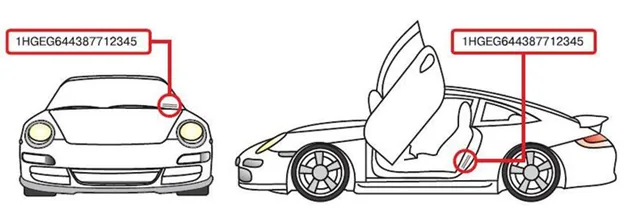
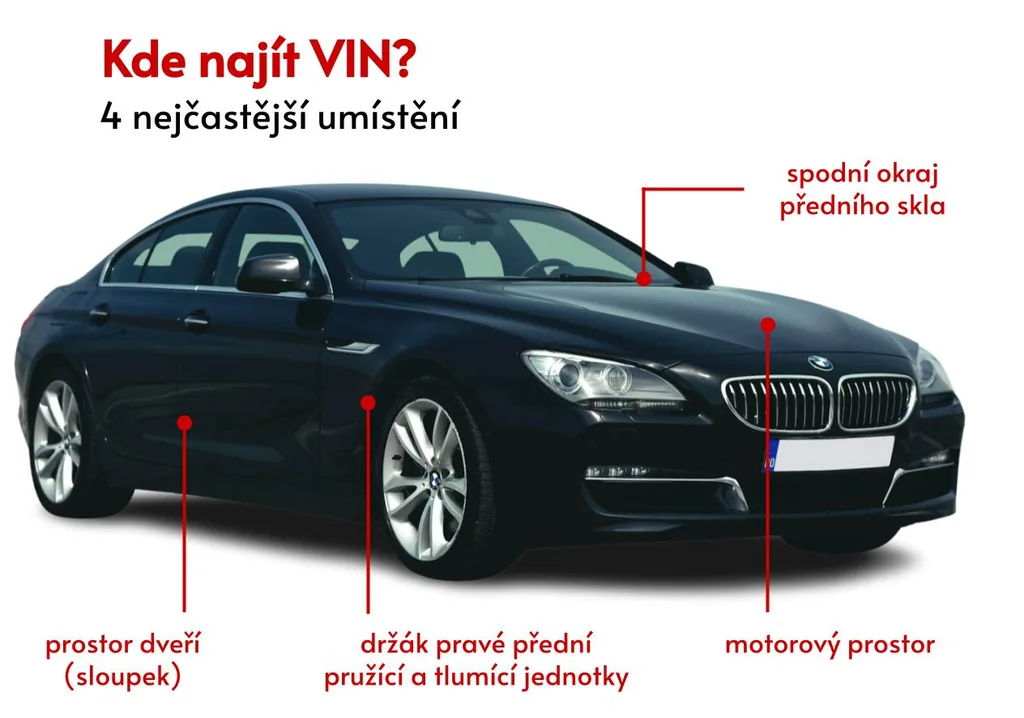
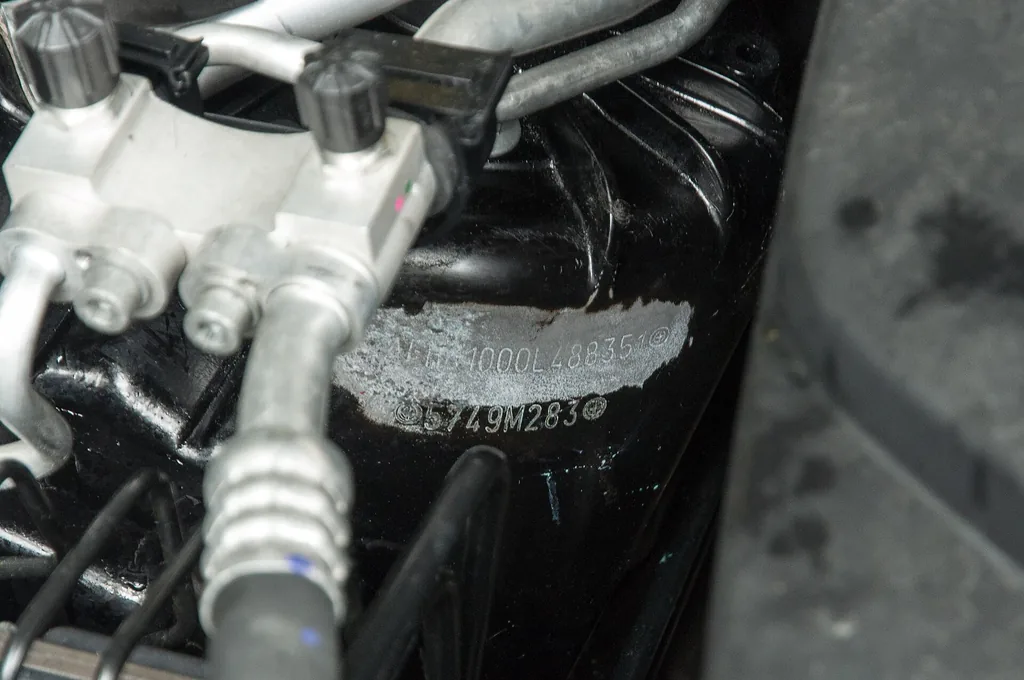
- Dashboard: Part 565 requires the VIN for cars, SUVs, light trucks and low-speed vehicles to be inside the passenger compartment and readable through the windshield from outside, near the driver’s-side windshield pillar, in characters at least 4 mm tall.
- Paperwork: the title, registration card and insurance documents.
- Door jamb label: the certification label on the driver’s door frame on most vehicles.
Before buying a used car, check that the VIN on the dashboard matches the door label and the title. A mismatch, or a VIN plate that looks tampered with, is a reason to walk away and is something our accident history check guide covers in more detail.
Frequently Asked Questions
What do the 17 characters of a VIN mean?
Under 49 CFR Part 565, positions 1-3 identify the manufacturer and vehicle type (the World Manufacturer Identifier), positions 4-8 describe the vehicle’s attributes, position 9 is a check digit, position 10 is the model year, position 11 is the plant of manufacture, and positions 12-17 are the production sequence number.
Which letters are never used in a VIN?
Part 565 allows only the letters A-H, J-N, P, R-Z and the numerals 0-9, so the letters I, O and Q never appear. That avoids confusion with the numbers 1 and 0.
How do I find the model year from a VIN?
Look at position 10. Part 565 assigns a code to each year; for example S = 2025, T = 2026 and V = 2027. For cars and light trucks, a letter in position 7 tells you the code refers to 2010-2039 rather than 1980-2009.
What is the VIN check digit?
Position 9 is a check digit calculated from the other 16 characters: each character gets a value, each position a weight, the products are added, and the total is divided by 11. The remainder (0-9, or X for 10) is the check digit. A VIN whose check digit doesn’t match likely has a typo.
Where is the VIN on a car?
For passenger cars, SUVs and light trucks, Part 565 requires the VIN inside the passenger compartment, readable through the windshield from outside near the driver’s-side windshield pillar. It also appears on the title, registration and usually the driver’s door jamb label and insurance card.
⚠️ Professional Notice:
VIN rules summarized from 49 CFR Part 565 as published in the eCFR (October 2026). Manufacturer encoding of positions 4-8 and 11 varies; use the manufacturer’s filing or a decoder for a specific vehicle.
NextCarReview.com is not affiliated with NHTSA, NMVTIS, NICB or any vehicle history company and receives no compensation from them.
VIN & Vehicle History Guides
Decode any VIN free: NextCarReview VIN decoder. More in this series:
Data Sources and Verification

Morgan Reyes is the founder and editor-in-chief of NextCarReview, which Morgan launched in August 2024. A 2022 graduate of Columbia University, Morgan is based in New York and writes and edits the site’s reviews, comparisons and buying guides. Morgan does not road-test vehicles. Every article is built from published primary data: EPA FuelEconomy.gov ratings, NHTSA crash ratings, recalls and owner complaints, IIHS results, and manufacturer specifications and pricing, with each figure cited and checked before publication. Contact: admin@nextcarreview.com