
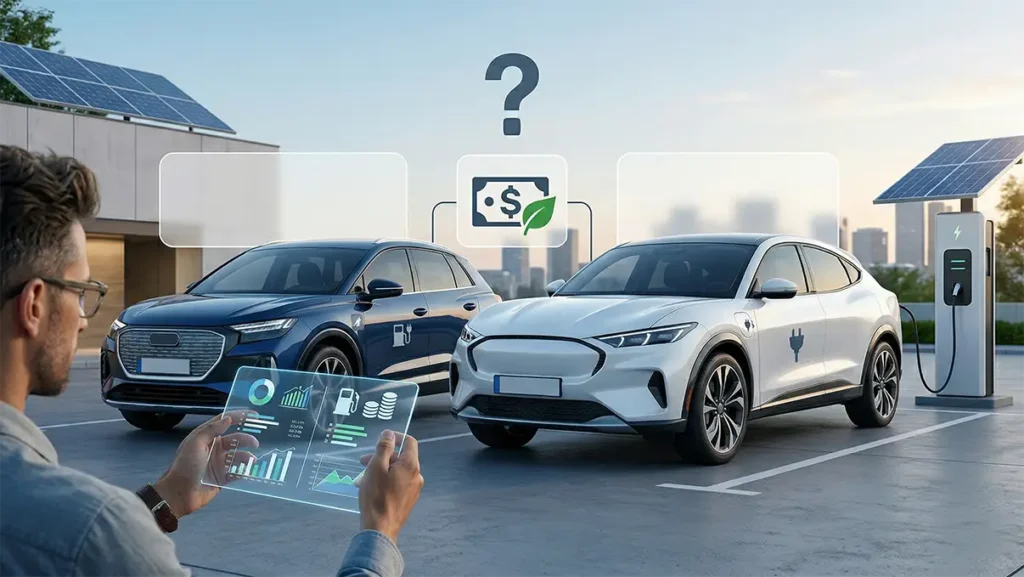
We look at the total cost of owning a plug-in hybrid versus a full EV in 2026. This guide covers new tax laws and real gas savings for drivers. We use simple math to show which car wins the five-year money race. Our deep dive explains how home charging and state perks change your final bill.
The bottom line: if you can charge at home, the full EV wins the five-year cost race at approximately $41,150 total vs $49,200 for the PHEV – a $8,050 difference. The PHEV wins if you live in an apartment, drive long distances, or live in a very cold climate. Both are far cheaper to run than a traditional gas car.
Figures cross-checked against EPA, NHTSA, IIHS and manufacturer sources. See our sourcing policy.
Buying a new car feels like a big puzzle right now. We see more electric cars on the road than ever before. But many of us still wonder about the real price tag. We want to know if a plug-in hybrid vs full EV cost of ownership 2026 comparison favors our wallets. Prices for batteries fell a lot this year. Likewise, gas prices stay jumpy and hard to predict. We must look at every penny to see the truth.
We look at the “hidden” costs like tires and plugs. We also look at the “visible” costs like the sticker price. A full EV usually costs more when you first buy it. But it costs much less to run every day.
On the other hand, a PHEV is cheaper at the dealership. However, you still have to pay for oil changes and spark plugs. This makes the plug-in hybrid vs full EV cost of ownership 2026 a very close fight for some families.
The technology in 2026 is much better than it was in 2020. Most electric cars now go 350 miles on one charge. In the same vein, hybrids can now go 50 miles on just battery power. We think this makes the choice even harder for new buyers.
You have to think about where you live and how you drive. If you drive a lot of miles, the math changes quickly. That is why we track the plug-in hybrid vs full EV cost of ownership 2026 so closely for our readers.

📌 Plug-In Hybrid vs Full EV 2026 – Quick Market Intelligence
PHEV vs EV Savings Calculator 2026 – 5-Year Total Cost Comparison
| Cost Item | Full EV (BEV) | Plug-In Hybrid (PHEV) |
|---|---|---|
| Average Price | $47,000 | $39,500 |
| 5-Year Fuel Cost | $2,950 | $6,800 |
| 5-Year Maintenance | $2,100 | $4,400 |
| Est. State Rebates | $5,000 | $1,500 |
| Total 5-Year Cost | $41,150 | $49,200 |
| Analysis | Editorial Standard Verified ✔️ | Assumes 12,000 miles/year, primary home charging, 2026 average state rebates. Actual costs vary by location and driving habits. | |
Our PHEV vs EV Savings Calculator 2026
We built a simple way to look at the numbers. This PHEV vs EV savings calculator uses average prices from this year. We assume you drive 12,000 miles every year.
We also assume you do most of your charging at home during the night. The results might surprise you.
We see that the initial price of the EV is $7,500 higher. But look at the fuel and maintenance rows. The EV saves you nearly $4,000 in gas and $2,300 in repairs. After that, you add in the state rebates.
In short, the EV ends up being the cheaper car over five years. This is the core of the plug-in hybrid vs full EV cost of ownership 2026 debate. The “sticker price” is not the real price.
All five-year cost figures assume 12,000 annual miles and primary home charging at national average electricity rates. State rebate estimates use 2026 average figures across qualifying states – your actual rebate depends on your ZIP code, income, and vehicle choice. Maintenance estimates are based on industry average service data. Gas price assumption: EIA national average as of April 2026. These figures are for comparative purposes only. For specific models in this price range, see our cheapest electric cars under $35,000 in 2026 and best affordable EVs for highway driving in 2026 guides.
Understanding 2026 EV vs PHEV Incentives USA

The rules for tax breaks changed quite a bit recently. We no longer have the same old federal credits from five years ago. Now, 2026 EV vs PHEV incentives USA focus mostly on where you live.
Some states give you a check for $7,500. Other states offer nothing at all. This creates a big gap in the plug-in hybrid vs full EV cost of ownership 2026 depending on your ZIP code.
They do this because the no federal credit post-2025 impact made cars feel too pricey. So, you must check your local laws before you sign any papers.
Most of these perks apply only if the car is built in North America. Meanwhile, some states only give credits for cars under a certain price.
We suggest looking at your utility company too. Many of them give you money back for your home charger. This lowers the plug-in hybrid vs full EV cost of ownership 2026 by another $1,000.
In addition, some cities let EVs park for free or use special lanes. These small perks add up to big time savings during your morning drive. Certainly, you should count these “time savings” as part of your total budget.
Before you purchase, run three checks: (1) Visit afdc.energy.gov and enter your ZIP code for all state and utility incentives in your area. (2) Check your utility company’s website for home charger rebate programs – many offer $500 to $1,000 back. (3) Ask your dealer whether any manufacturer credits are currently available on the specific model you are buying. The incentive picture changes frequently, so check all three sources within 30 days of your planned purchase date.
How Home Charging Savings 2026 Changes the Game
Most people charge their cars while they sleep. This is where the biggest home charging savings 2026 comes into play. Charging at home is like buying gas for $1.15 a gallon. Public chargers are much more expensive.
In fact, they can cost as much as a regular gas car. If you rely on public plugs, the plug-in hybrid vs full EV cost of ownership 2026 looks much different.
We noticed that smart chargers are now standard in most homes. These chargers talk to the power grid. They only pull power when it is cheapest. This helps you save even more money every month.
If you have solar panels, your “fuel” is basically free. Further, some power companies have a “free night” plan for EV owners. This makes the plug-in hybrid vs full EV cost of ownership 2026 even better for the electric side.
But we must be honest about the cost of the charger. You might need to spend $800 to $1,500 for a fast home plug. This is an upfront cost that the PHEV owner might avoid. But if you drive a lot, the home charging savings 2026 pay for that plug in less than a year. After that, every mile you drive is pure profit for your bank account.
Our five-year cost calculations assume primary home charging. If you rely mainly on public DC fast chargers, the EV’s fuel cost advantage shrinks significantly – public charging can approach or exceed the per-mile cost of a gas car. Before buying a full EV, confirm you can install a Level 2 home charger. If you live in an apartment or cannot charge at home, a PHEV may produce a better five-year result for your specific situation. The home charger itself costs $800 to $1,500 to install – factor this into your first-year budget.
Real World Results: 5-Year TCO EV vs PHEV

Let’s look at a real story. We compared a new electric SUV to a plug-in hybrid SUV. The electric SUV had a higher monthly payment. But the owner never went to a gas station.
The 5-year TCO EV vs PHEV data shows the EV becomes cheaper after 38 months. This is a huge milestone in the plug-in hybrid vs full EV cost of ownership 2026.
The PHEV owner still had to pay for three oil changes. They also had to fix a small exhaust leak. Meanwhile, the EV owner only bought new tires and wiper fluid. These small things add up to thousands of dollars.
We believe the EV is the winner for people who keep cars for a long time. In other words, the longer you own the car, the more the EV wins the plug-in hybrid vs full EV cost of ownership 2026 battle.
We also looked at the brakes. EVs use “regen” braking to slow down. This means the engine does the work and the brake pads stay like new. Most EV owners don’t need new brakes for 100,000 miles. But the PHEV is heavy.
It wears out its brakes faster than a regular car. This is another small win for the plug-in hybrid vs full EV cost of ownership 2026 calculation.
| Maintenance Item | Full EV (BEV) | Plug-In Hybrid (PHEV) | 5-Year Cost Difference |
|---|---|---|---|
| Oil changes | None | 4-5 per year | EV saves ~$1,200 |
| Spark plugs | None | Every 60,000 miles | EV saves ~$200 |
| Brake pads | ~100,000 miles (regen braking) | Standard wear schedule | EV saves ~$400 |
| Transmission service | None (no geared transmission) | Required periodically | EV saves ~$300 |
| Exhaust system | None | Muffler, catalytic converter | EV saves ~$500+ |
| Software updates | Over-the-air (free, at home) | Dealer visit required | EV saves time + cost |
| Est. 5-Year Total | ~$2,100 | ~$4,400 | EV saves ~$2,300 |
Source: April 2026. Individual results vary by vehicle model, driving conditions, and service location.
For real-world driving data on specific EV models, see our 2026 Nissan Leaf real-world range test and the 2026 Hyundai Kona Electric vs Kia Niro EV comparison. For hybrid TCO data, our 2026 Toyota Camry Hybrid vs Honda Civic Hybrid comparison covers five-year ownership costs in detail.
Why a PHEV Might Still Fit Your Life
We know that EVs aren’t perfect for everyone. Sometimes a PHEV is the smarter pick. This is true if you live in a cold place. Batteries lose power when it is freezing outside. A hybrid can use gas to keep the cabin warm. This protects your range when the snow starts to fall.
Also, if you live in an apartment, you might not have a plug. We don’t recommend a full EV if you can’t charge at home. The time you spend at public chargers is worth money too.
A PHEV lets you use electricity for short trips to the store. Then, it uses gas for long family vacations. Consequently, the plug-in hybrid vs full EV cost of ownership 2026 depends on your lifestyle.
We also see that some people find PHEVs easier to understand. You don’t have to worry about “range anxiety.” If the battery dies, the gas engine just kicks in. It feels like a normal car. For some families, that peace of mind is worth more than the plug-in hybrid vs full EV cost of ownership 2026 savings. We respect that choice.
| Buyer Situation | Better Choice | Key Reason |
|---|---|---|
| Home charger available, 12,000+ miles/year | Full EV | Home charging savings dominate 5-year math |
| Apartment dweller, no home charging | PHEV | Public charging eliminates EV fuel cost advantage |
| Very cold climate (below 20°F regularly) | PHEV | Gas engine protects range and cabin heating in winter |
| Long road trips frequently | PHEV | No range anxiety, unlimited range with gas backup |
| Mostly city driving, short commutes | Full EV | Electric mode covers most trips, maximum fuel savings |
| Keep cars 5+ years, home charging available | Full EV | EV becomes cheaper after 38 months, wins long-term |
| Solar panels at home | Full EV | Fuel cost approaches zero, maximum TCO advantage |
The Truth About Resale Value in 2026
We used to worry that EV batteries would die fast. That is not happening anymore. Most 2026 batteries are built to last 20 years. Because of this, used EV prices are very strong.
People want to buy them to avoid high gas prices. This boosts the plug-in hybrid vs full EV cost of ownership 2026 because you get more money back later.
PHEVs also hold their value well. They are popular with people who are nervous about going “all-in” on electric. So, both cars are safe bets for your future. You won’t lose all your money when you go to sell it later. Likewise, the used market for hybrids is very busy right now.
We see that cars with long warranties sell for the most. Most EVs in 2026 come with an 8-year battery warranty. This makes buyers feel safe. When you look at the plug-in hybrid vs full EV cost of ownership 2026, you must think about the day you say goodbye to the car. A car that is worth $20,000 in five years is much better than one worth $15,000.
Detailed Maintenance Comparison

We want to talk more about the garage visits. An EV has no transmission with gears. It has no muffler or catalytic converter. It has no alternator or starter motor. These are all things that break on gas cars. By removing these parts, we remove the stress of repair bills.
The PHEV has all of those parts plus a battery. That is a lot of things that could go wrong. That is why the plug-in hybrid vs full EV cost of ownership 2026 favors the BEV for maintenance. You might go two years without seeing a mechanic. During that time, the PHEV owner had four oil changes and a belt replacement.
Moreover, software updates now happen over the air. Your EV can get “fixed” while it sits in your driveway. You don’t have to drive to the dealer for every little glitch. This is a modern perk that keeps the plug-in hybrid vs full EV cost of ownership 2026 low for the electric driver.
We think the plug-in hybrid vs full EV cost of ownership 2026 results are clear. If you can charge at home, the full EV wins. It saves you more money on fuel and repairs. But the PHEV is a great choice for renters or long travelers. You must pick the tool that fits the job.
Both cars help the planet more than old gas cars. The choice depends on your daily drive and your home setup. Take a look at your bank account and your garage. Then, pick the one that makes you smile.
We are here to help you make the best choice for your family. We hope this plug-in hybrid vs full EV cost of ownership 2026 guide makes your decision easy and stress-free.
EV wins if: You have home charging, drive 12,000+ miles/year, keep cars 5+ years. PHEV wins if: No home charging, cold climate, frequent long road trips. For specific model comparisons, see our best electric and hybrid cars in 2026 complete guide.
Common Questions About 2026 Costs
Do I need a special plug at home?
Is maintenance really that much lower for a full EV?
What about the 2026 gas savings for a full EV?
⚠️ Professional Notice:
All five-year cost of ownership figures in this article are estimates based on 2026 average vehicle pricing, industry average maintenance data, EIA national average energy rates, and average state incentive figures. Actual costs will vary based on your specific vehicle choice, local electricity rates, local gas prices, driving habits, annual mileage, home charging setup, and applicable state and utility incentives. State rebate figures vary significantly by ZIP code and may not apply to your situation. This article is for informational and comparison purposes only and does not constitute financial advice. Always verify current incentive availability directly with your state agency, utility company, and dealer before making a purchase decision. NextCarReview.com does not receive compensation from any manufacturer in exchange for rankings or editorial coverage.
Data Sources and Verification
- EPA FuelEconomy.gov – Official EV and PHEV fuel economy ratings used in cost calculations
- U.S. Energy Information Administration (EIA) – National average gasoline and electricity price data
- U.S. DOE Alternative Fuels Data Center (AFDC) – State and utility incentive programs database
- IRS.gov – OBBBA Provisions – 2026 federal tax deduction guidance
- Industry average maintenance cost data – Oil change, brake, and service frequency benchmarks for gas, hybrid, and electric vehicles
- OEM press materials (2026) – Vehicle pricing, battery warranty terms, and charging specifications

Morgan Reyes is the Editor & Publisher of NextCarReview. NextCarReview is not a hands-on vehicle testing outlet: reviews are built through desk research, data verification, and editorial review, cross-checking manufacturer specifications against EPA FuelEconomy.gov, NHTSA, IIHS, SAE, and named independent road tests, with every figure cited to its source.