In this article 8 sections
Yes, the federal EV tax credit changed dramatically. The $7,500 new-vehicle credit ended for most buyers on September 30, 2025. The $4,000 used-EV credit and the commercial credit behind lease deals ended on the same date. State incentives still vary widely. So before you walk into a dealership and assume you are getting a government discount, read this first.
Figures cross-checked against EPA, NHTSA, IIHS and manufacturer sources. See our sourcing policy.
If you have been putting off an electric vehicle purchase while waiting to hear what happened to the federal tax credit, the answer is now clear. The landscape shifted sharply in late 2025, and many buyers are walking into dealerships with outdated information about what they can and cannot claim.
This guide cuts through the confusion. We explain what the federal credit was, what changed and when, what still exists for certain buyers, and how the repeal reshapes the math on every EV purchase in 2026. So whether you are buying new, used, or leasing, this is the page to read before you sign anything.
The short version is this. The generous $7,500 new-EV credit that helped millions of buyers offset sticker prices is largely gone for 2026 purchases. That does not mean incentives disappeared completely. But it does mean the calculation has changed, and some EVs that looked affordable under the old rules now require a harder look at actual cost.

What Was the Federal EV Tax Credit?
Federal EV Tax Credit – Quick Policy Intelligence
The federal EV tax credit under the Inflation Reduction Act allowed qualifying buyers to subtract up to $7,500 directly from their federal tax bill when purchasing a new eligible electric vehicle. A separate $4,000 credit applied to qualifying used EVs. These were nonrefundable credits, meaning they reduced your tax liability but did not generate a refund if the credit exceeded what you owed.
How the Old Credit Worked
Under the previous rules, a buyer who qualified could reduce their federal income tax bill by up to $7,500 on a new EV purchase. The vehicle had to meet assembly location requirements, battery sourcing standards, and price caps. The buyer also had to fall below income thresholds. So not every buyer or every vehicle qualified, but millions did benefit from the credit between 2023 and 2025.
Starting in January 2024, the IRS also allowed buyers to transfer the credit to the dealer at point of sale, effectively reducing the purchase price immediately rather than waiting until tax filing. That change made the credit significantly more useful for buyers who did not want to front the full sticker price.
Income and Vehicle Price Limits
Under the original framework, income caps applied. Single filers above $150,000 adjusted gross income, head-of-household filers above $225,000, and joint filers above $300,000 could not claim the credit. Vehicle price caps also applied: $80,000 for SUVs, pickups, and vans, and $55,000 for sedans and hatchbacks. So luxury EVs at high prices were already excluded before the credit ended entirely.
Did the Federal EV Tax Credit End?
Yes, for most new-vehicle purchases, it did. The credit was ended by Public Law 119-21, enacted July 4, 2025, for vehicles acquired after September 30, 2025. A vehicle counts as acquired when a binding written contract is signed and a payment is made, so a buyer who did both by that date can still claim the credit even if delivery came later.
When It Ended and What Changed
The repeal removed the $7,500 new-EV credit from the federal tax code for vehicles purchased after September 30, 2025. The $4,000 used-EV credit ended on the same date, for vehicles acquired after September 30, 2025. The point-of-sale transfer mechanism that allowed dealers to apply the credit at purchase also ended with the new-vehicle credit.
So the acquisition date matters enormously. A buyer who signed a binding contract and made a payment by September 30, 2025 could still qualify for up to $7,500. A buyer who first contracted on October 1, 2025 received nothing from the federal government. This created a surge in late-September 2025 deliveries as buyers and dealers rushed to beat the deadline.
Why It Was Repealed
The repeal came from a broader political shift on EV policy. Critics of the credit argued it disproportionately benefited higher-income buyers, subsidized foreign battery manufacturers, and distorted the market unnecessarily as EV adoption grew. Supporters argued the credits were still necessary to close the price gap between EVs and comparable gas vehicles. The repeal passed as part of a larger budget reconciliation package and took effect on the date specified in the legislation.
What Still Exists in 2026
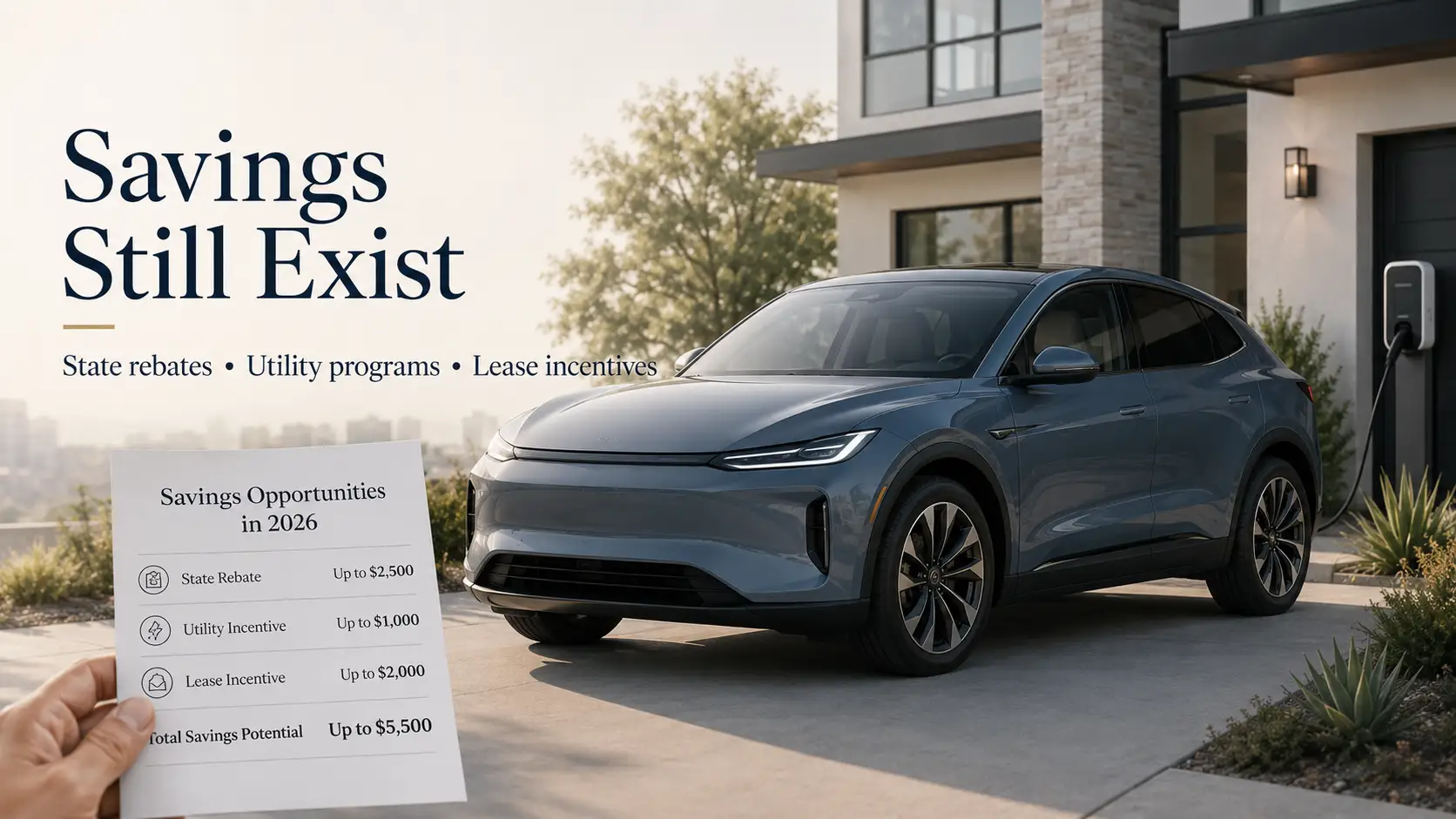
The repeal of the new-vehicle federal credit did not eliminate every EV incentive available to buyers. So before you conclude that going electric is now financially painful, review what actually remains.
The Used EV Credit (Section 25E)
The $4,000 used EV credit under Section 25E did not survive: it is not available for vehicles acquired after September 30, 2025. For earlier purchases, the vehicle had to be at least two model years old, sold by a licensed dealer, priced at or below $25,000, and the buyer had to meet income requirements. Single filers must be below $75,000, head-of-household below $112,500, and joint filers below $150,000.
So the used credit targets a very different buyer profile than the new-vehicle credit did. It benefits buyers shopping the affordable used EV market and excludes higher earners entirely. Confirm the vehicle and transaction qualify before counting on this credit.
State and Local Incentives
State and local EV incentives vary enormously and did not disappear with the federal repeal. Some states offer rebates, tax credits, reduced registration fees, HOV lane access, and free public charging that together can amount to thousands of dollars in savings. California, Colorado, New York, and several other states maintain active programs. Other states offer nothing or have sunset their programs.
So your geography matters more than ever in 2026. A buyer in California purchasing an eligible EV may still access several thousand dollars in state incentives. A buyer in Texas faces no comparable state program. Research your specific state program before you shop, because what applies to your neighbor may not apply to you.
The Leasing Workaround
This is the detail most buyers miss. When a consumer leases an EV, the vehicle is technically owned by the leasing company, which is often a manufacturer’s financing arm or a bank. Through September 2025, leasing companies could claim the Section 45W commercial clean vehicle credit and pass some of it to consumers as lower lease payments. However, the IRS says 45W is not allowed for vehicles acquired after September 30, 2025, so that path has also closed.
So a buyer who leases in 2026 should not expect a federal credit discount. Some manufacturers still offer their own lease cash, which varies by brand and region. So ask specifically what incentive is applied when you negotiate a lease. Do not assume it happens automatically.
Manufacturer Incentives and Cash Back
Some manufacturers responded to the credit repeal by introducing their own cash incentives to keep effective transaction prices from rising sharply. These vary widely by brand, model, and region. They are not guaranteed and can change monthly. So treat any manufacturer incentive as a negotiating point rather than a reliable permanent feature of the purchase.
How This Changes EV Buying Math

The repeal of the new-vehicle credit changes the purchase calculation in several concrete ways. So let us work through what it means at different price points and buyer situations.
Effective Sticker Price Increases
The most straightforward impact is that new EV sticker prices are now what buyers actually pay before any remaining state incentives. A $45,000 EV that effectively cost $37,500 after the federal credit under the old rules now costs $45,000 minus any applicable state incentives. In states with no program, the full $45,000 is the starting point. So the gap between an EV and a comparable gas vehicle has widened in markets where state programs do not compensate for the lost federal credit.
The Lease Calculation
For buyers who planned to purchase, leasing deserves a serious look. If the manufacturer offers strong lease cash, a lease could deliver better effective economics than a purchase in 2026. Run the numbers on both scenarios with your specific vehicle and lease terms before deciding. And confirm in writing what credit, if any, is being applied to the lease.
Used EV vs New EV Math
The used-vehicle market for EVs no longer comes with a federal credit, since Section 25E ended for vehicles acquired after September 30, 2025. A used EV priced at $24,000 now simply costs $24,000. Even so, used EV prices can be a meaningful entry point into electric ownership. So buyers who are flexible on model year should evaluate the used market carefully before committing to new.
Total Cost of Ownership Still Favors EVs in Most Cases
Despite the credit loss, electric vehicles still carry meaningful advantages in operating cost. Electricity costs less than gasoline in most US markets. EVs require fewer scheduled maintenance visits, no oil changes, and have fewer brake replacements due to regenerative braking. So over a five-year ownership period, the total cost of ownership for an EV often remains competitive with a comparable gas vehicle even without the federal credit, particularly for high-mileage drivers.
What You Should Do Before You Buy in 2026
So how should you approach an EV purchase now that the landscape has shifted? We suggest four concrete steps before you sign anything.
First, confirm your state incentive situation. Go to your state’s official energy or DMV website and verify what programs are currently active. Do not rely on dealer information alone, because dealers sometimes misrepresent or misunderstand state programs.
Second, get a quote for leasing alongside any purchase quote. Ask the dealer explicitly which manufacturer incentives are applied to the lease and by how much. Compare the effective monthly and total cost of leasing versus purchasing with current incentives applied to each.
Third, evaluate the used EV market if your budget is flexible. Without the Section 25E credit, judge a used EV on its price, battery health and remaining warranty.
Fourth, compare the total five-year cost of ownership for your shortlisted EV against a comparable gas vehicle without assuming any credit. If the EV still wins on total cost, the credit repeal changes the upfront math but not the long-term conclusion. If the credit loss makes the EV more expensive on a total-cost basis, the case for buying it weakens and deserves more scrutiny.
For the best current picks across the EV and hybrid market, our best electric and hybrid cars 2026 guide covers every strong option at every price point. For buyers focused on staying under a specific budget, our best electric cars under $40,000 in 2026 guide narrows the field to the strongest affordable picks. And to understand how real-world range compares to EPA ratings on today’s top EVs, our electric cars worse real world range guide is essential reading before you finalize your choice.
The Bottom Line
The federal new-vehicle EV tax credit ended on September 30, 2025. That is a real change with real financial consequences for buyers who planned their budgets around it. But the story does not end there. The used-vehicle and commercial credits ended on the same date. State incentives vary widely and remain meaningful in many markets. Manufacturer lease cash can still help in some cases. And total cost of ownership still favors EVs in most ownership scenarios despite the higher upfront cost.
So the right response to the credit repeal is not to abandon your EV consideration. It is to do the homework more carefully than you might have under the old rules. Verify state programs, compare lease and purchase math, evaluate the used market, and look honestly at five-year total cost before you decide. The numbers still often favor electric. They just require more work to confirm now.
Related guides: our EV and hybrid guide and 2005 Toyota Hybrid Battery.
Frequently Asked Questions About the Federal EV Tax Credit
Did the federal EV tax credit end?
Can I still get any federal credit on a new EV in 2026?
What is the used EV credit and who qualifies?
Do state EV incentives still exist?
Is leasing an EV better than buying in 2026?
Does the credit repeal make EVs too expensive to buy?
⚠️ Professional Notice:
This article reflects federal EV tax credit rules as understood as of August 2026. Tax law is complex and subject to change. The information in this article is general in nature and does not constitute tax advice. Readers should consult a qualified tax professional to determine how current rules apply to their specific income, vehicle, and purchase situation before making any financial decision. State and local incentive programs also change frequently. Verify current program availability and terms directly with your state’s official energy or revenue department. NextCarReview.com does not receive compensation from any government program, manufacturer, or financial institution in exchange for rankings or editorial coverage.
Data Sources and Verification
- Internal Revenue Service (IRS) – Section 30D new clean vehicle credit, Section 25E used clean vehicle credit, and Section 45W commercial clean vehicle credit official guidance
- US Department of Energy – Alternative Fuels Data Center EV incentive database, 2026
- Federal budget reconciliation legislation – official text and effective dates for EV credit repeal, 2025
- IRS: FAQs on credit changes under Public Law 119-21
- IRS: Used clean vehicle credit
- IRS: New clean vehicle credit
- State energy agency databases – California CVRP, Colorado CDOT, New York NYSERDA, and comparable state program documentation, August 2026
- Total cost of ownership modeling, lease vs purchase math comparison, and market impact assessment, August 2026
- Automotive industry reporting – dealer survey data on manufacturer incentive programs following credit repeal, August 2026
Related EV charging guides

Morgan Reyes is the founder and editor-in-chief of NextCarReview, which Morgan launched in August 2024. A 2022 graduate of Columbia University, Morgan is based in New York and writes and edits the site’s reviews, comparisons and buying guides. Morgan does not road-test vehicles. Every article is built from published primary data: EPA FuelEconomy.gov ratings, NHTSA crash ratings, recalls and owner complaints, IIHS results, and manufacturer specifications and pricing, with each figure cited and checked before publication. Contact: admin@nextcarreview.com