
In this article 9 sections
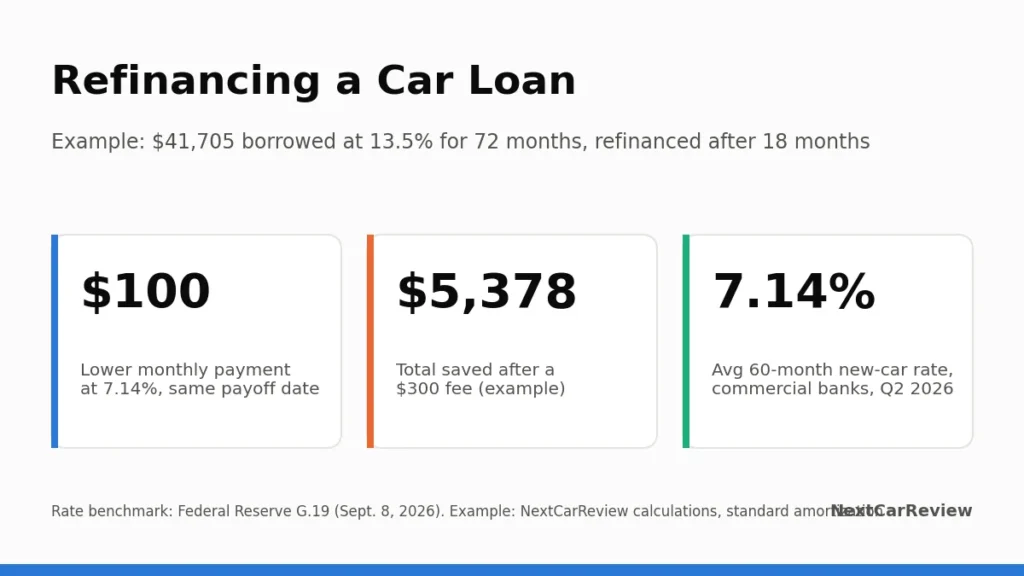
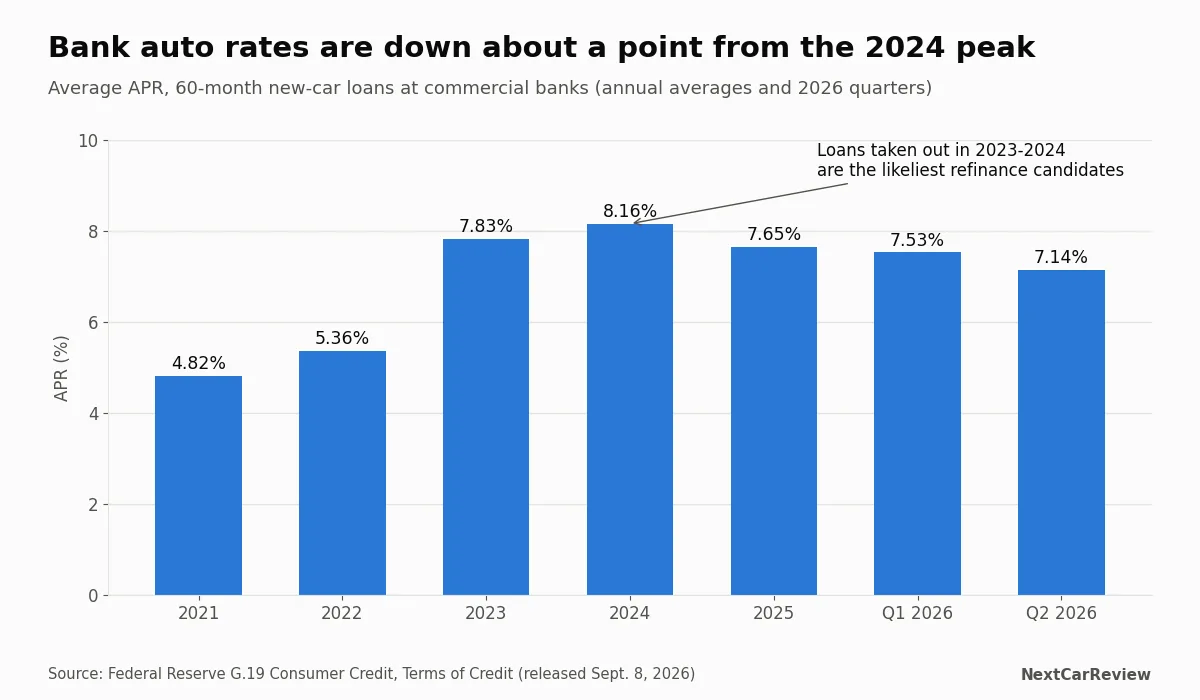
Refinancing replaces your current auto loan with a new one, ideally at a lower APR. It saves money when the rate drop is meaningful, you refinance early (interest is front-loaded) and you keep the payoff date the same or sooner. Federal Reserve data put the average 60-month new-car loan at commercial banks at 7.14% in Q2 2026, down from 8.16% in 2024, a useful benchmark for your quote.
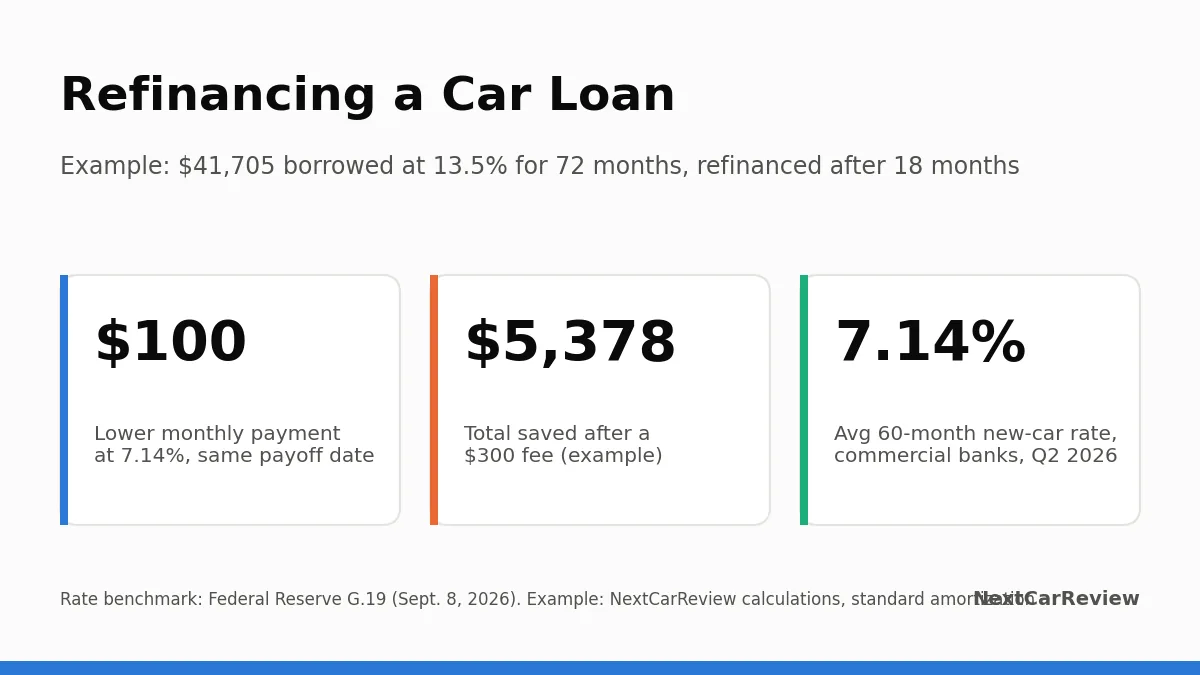
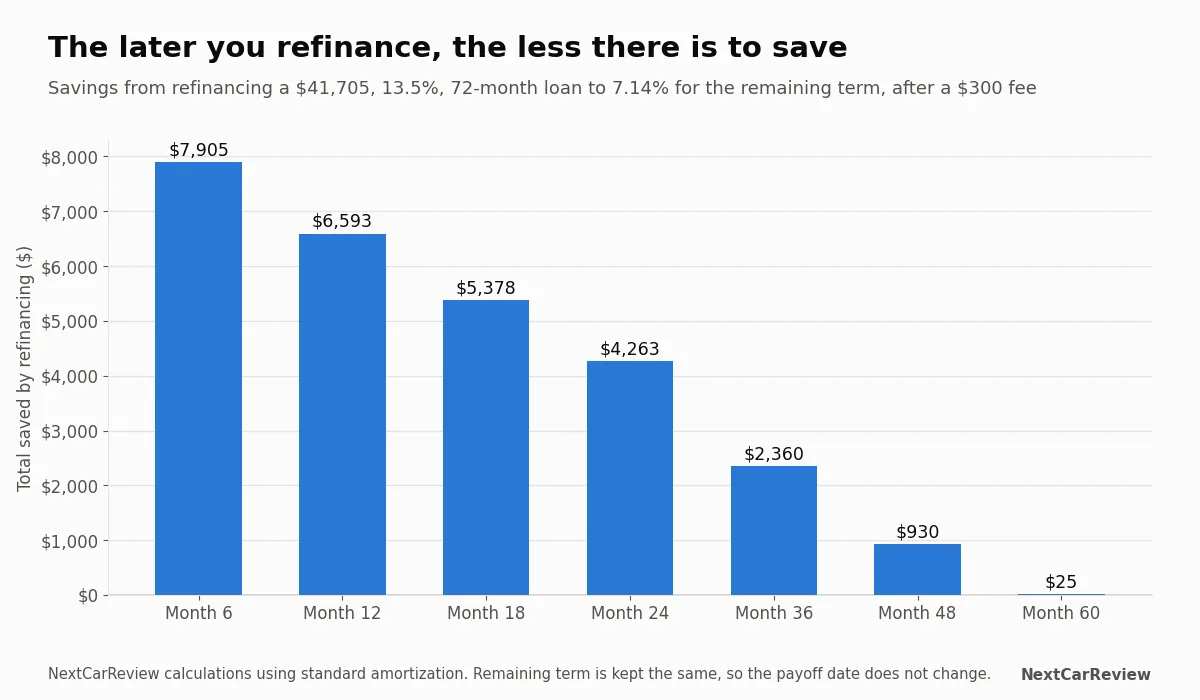
Example: a $41,705 loan at 13.5% for 72 months, refinanced to 7.14% after 18 months with a $300 fee, cuts the payment from $848 to $749 and saves about $5,378. Stretching back to a fresh 72-month term lowers the payment further but gives back much of the saving.
Rate benchmarks come from the Federal Reserve G.19 release; borrower guidance from the CFPB; all examples use standard amortization math. NextCarReview does not lend money, sell insurance or test financial products for this guide; see our sourcing policy.
Many buyers sign whatever financing is offered at the dealership to get the car home, then wonder months later whether they are overpaying. Refinancing is how you fix that. The new lender pays off your old loan and you repay the new one, so the only things that change are the rate, the term, the payment and any fees. The math is simple enough to check yourself, and the NextCarReview auto loan calculator handles it directly: its FAQ explains entering your payoff balance as the price, leaving trade-in at zero, and comparing the new payment and interest with what remains on your current loan.
Step 1: Know Where Your Loan Stands
Get three numbers from your current lender or statement: the payoff amount (which can differ slightly from the principal balance), the APR and the number of payments left. Then check the contract for a prepayment penalty. The CFPB notes that refinancing means prepaying the original loan in full, which can trigger a fee if your contract has a prepayment penalty clause; some states prohibit them.
Remaining balance after k payments = P(1 + r)k − payment × ((1 + r)k − 1) / r. For the example loan ($41,705 at 13.5%, 72 months, payment $848.24), r = 0.01125 and after 18 payments the balance is about $34,189.
Step 2: Benchmark the Rate You Can Get
Average rates give you a reality check. The Federal Reserve’s G.19 data show commercial banks averaged 7.14% on 60-month new-car loans and 6.97% on 72-month loans in Q2 2026, with finance companies at 6.3% in June 2026. Refinance loans are effectively used-car loans, which typically carry higher rates than new-car loans, and your score drives the offer. If you financed in 2023 or 2024, when bank averages were 7.83% and 8.16%, or your credit has improved since you bought the car, you are a likely candidate.
Shop several lenders, including banks, credit unions and online lenders, within a short window. The CFPB says auto loan inquiries made within 14 to 45 days are generally counted as a single inquiry by common scoring models.
Step 3: Compare the Total Cost, Not Just the Payment
Add any fees to the new principal (the example assumes $300 for lender and state retitling charges), compute the new payment with P × r(1 + r)n / ((1 + r)n − 1), and multiply by the number of payments. Compare that with the total you would pay by keeping the current loan: $848.24 × 54 = $45,805.
| Option | New payment | Payments | Total remaining cost | vs. keeping loan |
|---|---|---|---|---|
| Keep current loan (13.5%) | $848.24 | 54 | $45,805 | — |
| Refinance at 7.14%, same payoff date | $748.65 | 54 | $40,427 | saves $5,378 |
| Refinance at 7.14%, reset to 72 months | $590.32 | 72 | $42,503 | saves $3,302, but 18 more payments |
| Refinance at 11.5%, reset to 72 months | $665.33 | 72 | $47,904 | costs $2,099 more |
Balance $34,189 after 18 of 72 payments; $300 fee added to each refinance. NextCarReview calculations.
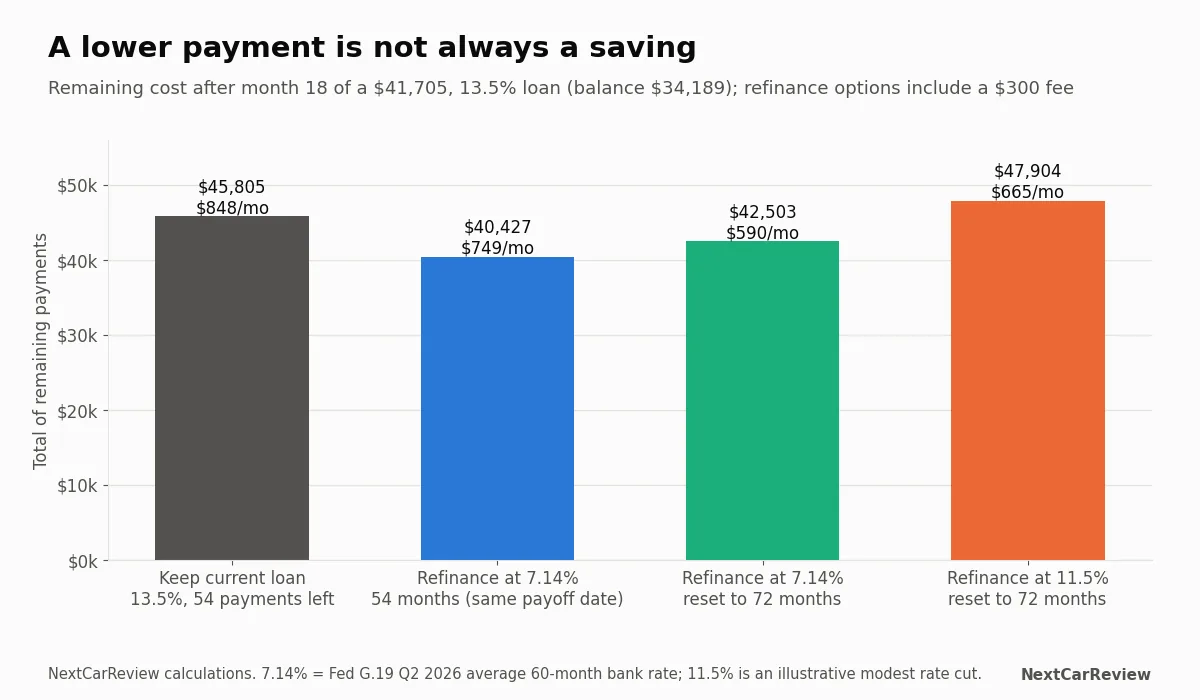
The last row is the trap. A modest rate cut combined with a fresh long term produces a lower payment and a higher total cost. It also keeps you owing more than the car is worth for longer, which matters if it is totaled or you need to sell.
Enter your payoff balance as the vehicle price, set trade-in and tax to zero, add any lender fee, and enter the new APR and term to compare against your current loan. Open the calculator →
Step 4: Check the Timing
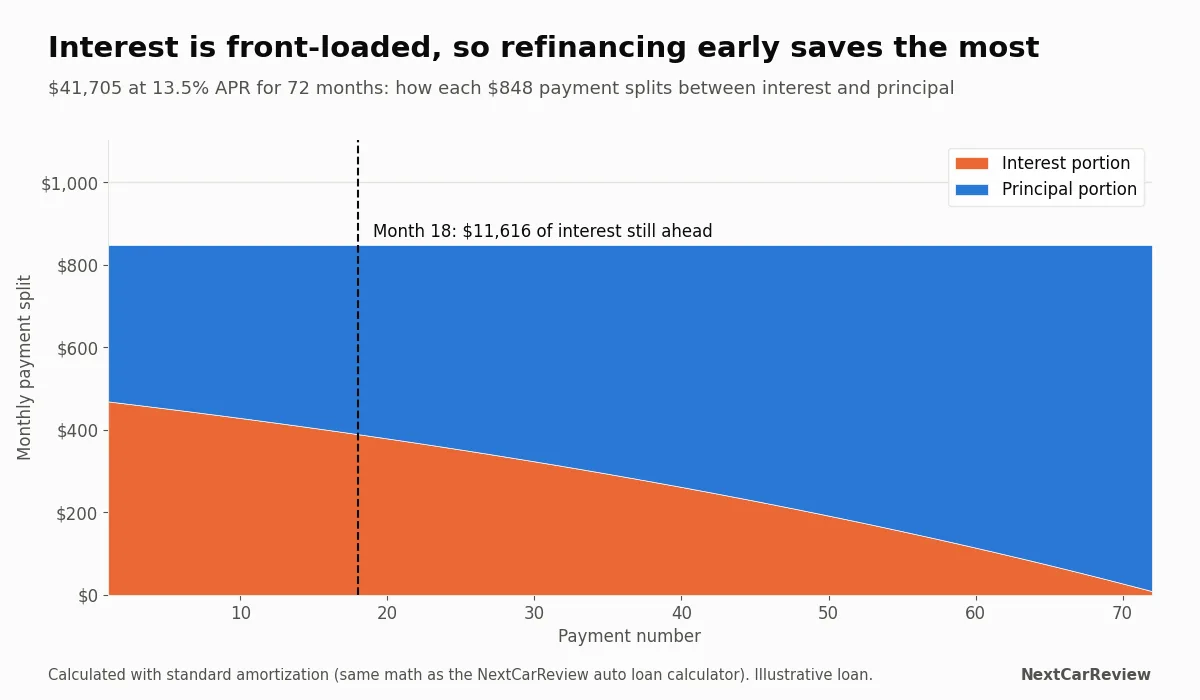
Because each payment covers that month’s interest first, the early payments on a high-rate loan are mostly interest. Refinancing early captures the most savings; refinancing in the final year or two often saves too little to justify the effort and fees.
Pros and Cons of Refinancing
| Pros | Cons |
|---|---|
| Lower APR reduces total interest | Fees, retitling costs or prepayment penalties eat into savings |
| Lower payment frees monthly cash flow | Extending the term can raise total cost |
| Can remove a co-borrower or change lenders | Hard inquiry and new account can briefly dip your score |
| Rate-shopping window limits the credit impact | Underwater loans may not qualify without a paydown |
Who Should Consider Refinancing
- Borrowers whose credit score has risen since they bought the car.
- Anyone who accepted dealer-arranged financing without comparing offers; the CFPB lists the APR as negotiable at purchase, and refinancing is the after-the-fact fix.
- Borrowers who financed in 2023-2024, when average rates peaked.
- Owners struggling with payments, who should also ask their current lender about options; the CFPB has guidance for borrowers who cannot make car payments.
If you financed under a promotional offer such as 0% financing for 72 months, refinancing will not help. For a walkthrough of every calculator input, see our car loan calculator guide and the payment calculator explainer.
Before You Sign the New Loan
- Confirm the payoff amount and that the new lender will pay the old one directly.
- Keep making payments on the old loan until it shows as paid.
- Ask for refunds of the unused portion of GAP or service contracts tied to the old loan, which the CFPB says may be available when a loan is paid off or refinanced.
- Do not add new add-on products to the refinance unless you have priced them separately.
Car Finance Guides
Run your own numbers: auto loan calculator, car payment calculator and auto insurance calculator. More in this series:
Frequently Asked Questions
When does it make sense to refinance a car loan?
When you can get a meaningfully lower APR, you are early enough in the loan that most of the interest is still ahead, the fees and any prepayment penalty are small, and you keep the term the same or shorter. Your credit improving since you bought the car, or having accepted a high dealer-arranged rate, are the most common reasons.
How much can I save by refinancing?
In this article’s example, a $41,705 loan at 13.5% for 72 months refinanced to 7.14% after 18 months, with the same payoff date and a $300 fee, lowers the payment from about $848 to $749 and saves about $5,378 in total. Savings shrink the later you refinance.
Does refinancing a car loan hurt your credit?
Applying creates a credit inquiry and opening a new loan changes your accounts, which can cause a small, usually temporary dip. The CFPB says auto loan inquiries within a 14- to 45-day window are generally treated as one, so compare several lenders in a short period.
Are there fees to refinance an auto loan?
Possibly. Some lenders charge an origination or processing fee, states charge to retitle the vehicle or record the new lien, and your current contract may have a prepayment penalty. The CFPB recommends checking your contract and state law for prepayment penalties before you refinance.
Can I refinance if I owe more than the car is worth?
It is harder. Many lenders limit the loan-to-value ratio, so an underwater loan may need a cash paydown or may not qualify. If you bought GAP coverage on the original loan, ask about a prorated refund when it is paid off.
Should I extend my term when I refinance?
Only if you need the lower payment and accept the cost. Resetting the example loan to a new 72-month term at 7.14% drops the payment to about $590 but adds 18 months of payments; at a smaller rate cut to 11.5%, resetting to 72 months would cost about $2,099 more than keeping the original loan.
⚠️ Professional Notice:
This article is general educational information, not financial or credit advice. The worked example uses an illustrative loan ($41,705, 13.5%, 72 months) and an assumed $300 in fees; benchmark rates are Federal Reserve G.19 averages for Q2 2026, and offers you receive depend on your credit, the vehicle’s age and value, and the lender. Check your contract for prepayment penalties and consult a qualified financial professional for advice on your situation.
NextCarReview does not receive compensation from any lender, dealer or insurer for this coverage.
Data Sources and Verification
- CFPB: Can I prepay my loan at any time without penalty?
- CFPB: How will shopping for an auto loan affect my credit?
- CFPB: What things can I negotiate when shopping for a car or auto loan?
- CFPB: What should I do if I can’t make my car payments?
- CFPB: What is Guaranteed Asset Protection (GAP) insurance? (refunds on payoff or refinance)
- Federal Reserve G.19 Consumer Credit, Terms of Credit (Sept. 8, 2026)
- New York Fed Household Debt and Credit Report, Q2 2026
- NextCarReview auto loan calculator (refinance method in its FAQ)
Figures were checked against the sources above between September 15 and October 3, 2026. Rates, prices and laws change; verify before you rely on them.

Morgan Reyes is the founder and editor-in-chief of NextCarReview, which Morgan launched in August 2024. A 2022 graduate of Columbia University, Morgan is based in New York and writes and edits the site’s reviews, comparisons and buying guides. Morgan does not road-test vehicles. Every article is built from published primary data: EPA FuelEconomy.gov ratings, NHTSA crash ratings, recalls and owner complaints, IIHS results, and manufacturer specifications and pricing, with each figure cited and checked before publication. Contact: admin@nextcarreview.com