In this article 13 sections
The best 3-row SUV under $45,000 is the redesigned Kia Telluride (sold as a 2027 model) from $39,190, backed by a 10-year/100,000-mile powertrain warranty and an IIHS 2026 Top Safety Pick+ award for vehicles built after June 2026. The Toyota Grand Highlander Hybrid leads the 3-row hybrid class at up to 36 mpg combined (EPA, FWD) and, with AWD, saves roughly $940 a year in fuel over the AWD gas model at today’s prices. The Toyota RAV4 Hybrid posts the best compact-SUV EPA rating in this guide at up to 43 mpg combined, and the Subaru Forester is one of the few compacts with standard all-wheel drive on every trim at no extra cost.
This guide covers compact, midsize, 3-row, hybrid, off-road, and entry luxury SUVs together, ranked by IIHS and NHTSA safety results, warranty coverage, EPA fuel economy, and fuel cost, because the right SUV depends entirely on your size class, your mileage, and whether the third row you are paying for actually works for adult passengers.
Figures cross-checked against EPA, NHTSA, IIHS and manufacturer sources. See our sourcing policy.
The cheapest Toyota Grand Highlander Hybrid lists for $3,350 more than the base gas version on toyota.com ($45,610 vs $42,260, and the entry hybrid includes AWD). At 15,000 miles per year and $4.47 per gallon for regular gas, the AWD hybrid (34 mpg combined, EPA) saves roughly $940 in fuel every year over the AWD gas model (23 mpg). That means it pays for itself in about three and a half years, and keeps saving money every year after that.
The same math applies to a dozen other 2026 SUVs on this list. We ran the numbers on all of them so you do not have to.
But before the hybrid question, there is an earlier decision nobody helps buyers make clearly: which SUV size actually fits your life? There are dozens of SUVs on sale in the U.S. right now, labeled compact, midsize, large, and three-row with no consistent standard for what any of those words mean.
One brand’s midsize is another brand’s large. This guide answers the size question first, ranks the best models in each category second, and backs every claim with data from primary sources. No sticker comparisons. No guesswork.
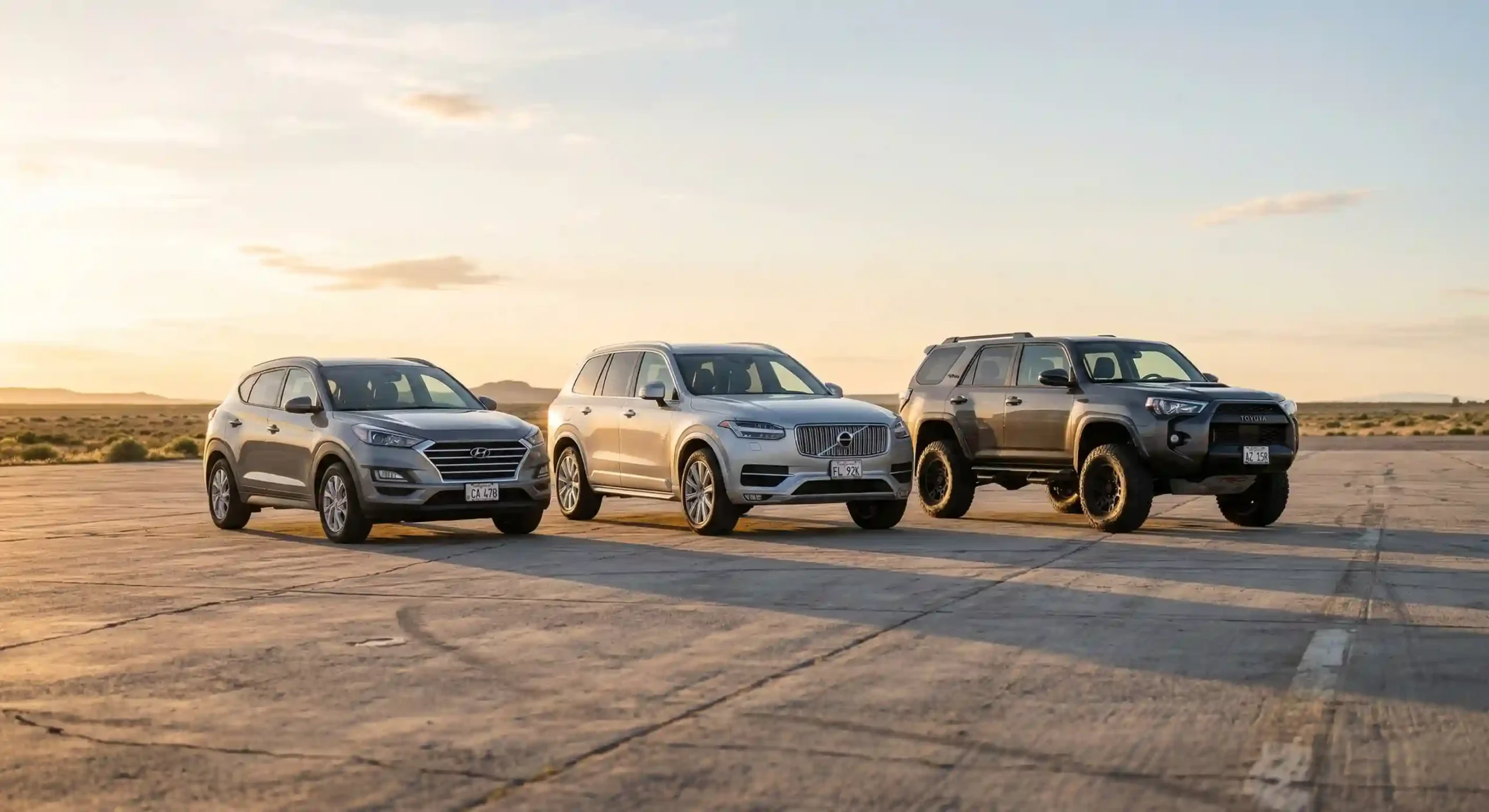
The 5 Best SUVs to Buy in 2026 (Quick List)
- Toyota RAV4 Hybrid – best all-round compact SUV, from $31,900, up to 43 mpg combined (EPA).
- Hyundai Tucson Hybrid – best compact hybrid value, from $30,950 (FWD SE) or $32,200 (AWD Blue), 36–38 mpg combined (AWD), IIHS 2026 Top Safety Pick+, 10-year/100,000-mile powertrain warranty.
- Subaru Forester – best compact AWD for snow, from $29,995 with all-wheel drive standard on every trim, IIHS 2026 Top Safety Pick+.
- Kia Telluride (2027) – best 3-row value, from $39,190, seats up to eight, IIHS 2026 Top Safety Pick+ (built after June 2026).
- Toyota Grand Highlander Hybrid – best for families who need an adult-usable third row, from $45,610, 34–36 mpg combined (EPA).
Prices are manufacturer starting MSRPs excluding destination. Each model’s full case, plus the best off-road, hybrid and entry luxury picks, follows below.
📌 Best SUVs 2026 – Quick Market Intelligence
Verified Facts at a Glance
| Best value 3-row SUV under $45K | Kia Telluride (2027) – from $39,190, up to 8 seats, 10-yr/100K powertrain warranty (original owner) |
| Best hybrid 3-row SUV | Hyundai Palisade Hybrid – 29–34 mpg combined EPA vs V6 at 19–21 mpg |
| Best compact SUV for fuel economy | Toyota RAV4 Hybrid – 38–43 mpg combined EPA, from $31,900 |
| Best compact AWD for winter and trails | Subaru Forester – symmetrical AWD standard every trim, no upgrade cost |
| Best family cargo hauler | Toyota Grand Highlander Hybrid – 34–36 mpg combined EPA, up to 97.5 cu ft cargo (Toyota) |
| Best body-on-frame SUV | Toyota 4Runner – from $42,270, i-FORCE MAX hybrid available, NHTSA 4 stars |
| Longest powertrain warranty | Hyundai and Kia – 10-yr/100,000-mile powertrain coverage (original owner) |
| Best entry luxury compact SUV | Lexus NX – from $44,175 (NX 350h), IIHS 2026 Top Safety Pick+ |
| Hybrid payback period (avg) | About 3.5–5 years at $4.47/gal, 15,000 mi/year (EPA + EIA baseline) |
| Analysis | Editorial Standard Verified ✔️ | Sources: IIHS.org, NHTSA.gov, FuelEconomy.gov, EIA, OEM pricing |
How We Ranked Every SUV on This List
NextCarReview did not road-test these vehicles. Rankings are built from published manufacturer pricing and specifications, EPA FuelEconomy.gov ratings, NHTSA and IIHS crash-test results, and reliability data from named outlets, all linked in this guide.
Every model here was assessed across five criteria: EPA-rated fuel economy (sourced from FuelEconomy.gov), Starting MSRP (from manufacturer press materials, subject to dealer confirmation), Safety ratings (verified against IIHS and NHTSA), Ownership risk from manufacturer warranty terms and NHTSA recall data, and Real-world family utility: cargo volume in cubic feet, towing capacity in pounds, and an honest assessment of whether a third row works for adult passengers or only for children.
We define “affordable” in this guide as a starting MSRP under $55,000 before any incentive. Models above that are noted as premium or luxury. Every price carries a “confirm with dealer” advisory because market conditions change. Models not confirmed for U.S. sale as of October 2026 are excluded. Every safety rating cited was current as of October 2026. Verify your specific trim at IIHS.org before purchase because ratings can change between model year updates.
Fuel economy figures are EPA-rated under standardized test conditions. Real-world results vary by driving style, terrain, and temperature. Hybrid fuel savings calculations use the U.S.
Energy Information Administration’s national average regular gasoline price of $4.465/gallon (week of September 28, 2026, rounded to $4.47) and 15,000 annual miles as stated baseline assumptions. Your actual savings will differ based on local conditions. Verify all EPA figures at FuelEconomy.gov.
Which SUV Size Is Right for You? The Decision Nobody Else Helps You Make
This is the question that determines everything else, and almost no major automotive ranking site addresses it before jumping to a list of models. The right answer comes down to three things: how many people you carry regularly, how much cargo you need with seats up, and whether you want a third row that adult passengers can actually use for a full day or one that only works for children on a short trip.
Compact SUVs like the Toyota RAV4 hybrid seat five adults comfortably, start under $32,000, and deliver the best fuel economy in the SUV category, the right choice for individuals, couples, and families of four who want maximum versatility at a sensible price. Midsize 2-row SUVs like the Honda Passport add towing muscle and rear seat room without the bulk of a 3-row.
Midsize 3-row SUVs, the Kia Telluride, Hyundai Palisade, and Toyota Grand Highlander, seat seven to eight, but only the Grand Highlander and Palisade offer a third row genuinely comfortable for adult passengers on a longer trip. If you regularly carry six or seven adults, the choice between those two models essentially defines your 2026 decision.
Compact SUV – Who Should Buy One
You carry four or five people at most. You park in city environments or tight suburban lots. You want the best possible fuel economy without giving up SUV cargo flexibility. Your budget is under $43,000. The Toyota RAV4 Hybrid from $31,900 at up to 43 mpg combined, the Hyundai Tucson Hybrid at 36–38 mpg combined (AWD), and the Subaru Forester with standard Symmetrical AWD on every trim are the three strongest options in this class for 2026.
Midsize 3-Row SUV – Who Should Buy One
You have a family of five or more, or you regularly carry six people. You want a minivan alternative with SUV driving dynamics and towing capability. Your budget is $40,000–$55,000. Be honest about the third row. If you need adults in row three for more than occasional short trips, only the Toyota Grand Highlander and Hyundai Palisade deliver that at this price point. Every other 3-row SUV in this segment has a third row that works for children and not much else.
Body-on-Frame SUV – Who Should Buy One
You drive off-road regularly, not just unpaved parking lots, but genuine trails with elevation changes, loose surface, and recovery scenarios. You tow loads over 5,000 lbs. You plan to keep the vehicle for 12-plus years and want the durability that comes with a frame-over-body construction. The Toyota 4Runner, from $42,270 on toyota.com, is the primary option in this class at the mainstream price point.
For a family of six or seven that prioritizes maximum passenger comfort and road-trip cargo space, a minivan like the Toyota Sienna Hybrid or Honda Odyssey still offers more interior volume and easier third-row access than any midsize SUV. The Toyota Sienna Hybrid achieves 36 mpg combined EPA in front-wheel drive trim, matching the front-drive Grand Highlander Hybrid on fuel economy.
The 3-row SUV wins on towing capability, driving dynamics, and the preference most buyers have for not driving a minivan. Be clear about which trade-off actually matters to your family before committing to a 3-row SUV on the basis of third-row space.
2026 SUV Comparison Chart: Every Model by Size and Starting Price
This chart lists every SUV covered in this guide by size class and 2026 starting price, cheapest first, so you can compare SUV pricing for 2026 side by side before reading the rankings.
| Model | Size class | Starting MSRP | Combined mpg |
|---|---|---|---|
| Subaru Forester | Compact, 2 rows | $29,995 | See FuelEconomy.gov |
| Hyundai Tucson Hybrid | Compact, 2 rows | $30,950 | 36–38 (AWD) |
| Toyota RAV4 Hybrid | Compact, 2 rows | $31,900 | 38–43 |
| Subaru Forester Hybrid | Compact, 2 rows | $34,730 | See FuelEconomy.gov |
| Hyundai Santa Fe Hybrid | Small 3-row | $36,150 | 34–36 |
| Kia Sorento Hybrid | Small 3-row | $38,890 | 34–37 |
| Kia Telluride (2027) | Midsize 3-row | $39,190 | 19–22 |
| Mazda CX-90 | Midsize 3-row | $39,300 | 25 |
| Honda Pilot | Midsize 3-row | $42,195 | 20–22 |
| Toyota 4Runner | Body-on-frame | $42,270 | 21–23 |
| Hyundai Palisade Hybrid | Midsize 3-row | $43,660 | 29–34 |
| Lexus NX 350h | Entry luxury compact | $44,175 | 39–40 |
| Toyota Highlander (gas) | Midsize 3-row | $46,270 | 24 (Toyota estimate) |
| Toyota Grand Highlander Hybrid | Midsize 3-row (largest here) | $45,610 | 34–36 |
| Toyota Highlander Hybrid | Midsize 3-row | $48,020 | 35 (Toyota estimate) |
Source: OEM pricing (MSRP excluding destination; Subaru adds $1,450 destination), EPA FuelEconomy.gov, and Toyota’s manufacturer-estimated ratings for the 2026 Highlander (Toyota, Subaru). Confirm pricing with your dealer.
Best 3-Row and 7-Seater SUVs in 2026 – Ranked
Most affordable 3-row hybrid SUVs in 2026
If you want three rows and hybrid fuel economy for the least money, these are the starting points, ranked by base price (prices as listed in this guide; EPA combined mpg from FuelEconomy.gov for the 2026 model year).
| Model | Starting price | EPA combined | Third row |
|---|---|---|---|
| Hyundai Santa Fe Hybrid | $36,150 | 34-36 mpg | Small, best for kids |
| Kia Sorento Hybrid | $38,890 | 34-37 mpg | Small, best for kids |
| Hyundai Palisade Hybrid | $43,660 | 29-34 mpg | Adult-usable |
| Toyota Grand Highlander Hybrid | $45,610 | 34-36 mpg | Adult-usable |
The Santa Fe Hybrid and Sorento Hybrid are the cheapest ways into a 3-row hybrid, but their third rows suit children. If adults will ride in the back, the Palisade Hybrid and Grand Highlander Hybrid cost about $4,800 to $9,500 more.
Here is the third-row truth that every ranking site skips. Most 3-row SUVs technically have a third row. But “technically has a third row” and “adults can sit back there for more than 20 minutes” are very different things. The Ford Explorer’s third row fits shorter passengers. The Mazda CX-90 and Kia Sorento’s third rows are similarly tight.
If you regularly carry six or seven adults, only the Toyota Grand Highlander and Hyundai Palisade deliver a third row where a six-foot adult will not actively suffer for a full day. That distinction is the most important data point in this section. For a full comparison of third-row legroom measurements and real loading capacity, see our best 7-seater SUVs for large families in 2026.
Kia Telluride – Best Overall 3-Row Value
The Telluride is now sold as the redesigned 2027 model, which starts at $39,190 (MSRP, excluding destination; confirm with dealer), seats up to eight, and tows up to 5,000 lbs with the gas engine (4,500 lbs for the new hybrid, which starts at $46,490). The 10-year/100,000-mile powertrain warranty for original owners reduces five-year financial risk in a way that no competitor at this price point matches. Toyota and Honda offer 5-year/60,000-mile powertrain coverage on new vehicles.
The Telluride’s cabin finish and perceived quality are strong for its price. EPA rates the 2027 gas Telluride at 19–22 mpg combined and the hybrid at 31–35 mpg. The 2027 Kia Telluride earns an IIHS 2026 Top Safety Pick+ award (vehicles built after June 2026), which requires good-rated pedestrian AEB as standard equipment.
Toyota Grand Highlander Hybrid – Best for Families Who Need All Three Rows
The 2026 Toyota Grand Highlander Hybrid is EPA-rated at 36 mpg combined with FWD and 34 mpg with AWD. At 15,000 miles per year and $4.47 per gallon, the AWD hybrid saves roughly $940 a year in fuel over the AWD gas Grand Highlander (23 mpg). It is one of the few 3-row SUVs where a full-size adult can realistically occupy the third row for a complete road trip day.
Toyota rates the 2.5-liter hybrid to tow 3,500 lbs (5,000 lbs for Hybrid MAX and gas models). NHTSA 5-star overall rating. Toyota Safety Sense 3.0 standard across all trims. For a detailed look at third-row legroom and cargo volume behind each row, see our 2026 Toyota Grand Highlander family space and cargo review.
Hyundai Palisade Hybrid – Best Hybrid 3-Row MPG
The 2026 Hyundai Palisade Hybrid is the first hybrid version of Hyundai’s flagship 3-row SUV, delivering 29–34 mpg combined per EPA versus the V6 model’s 19–21 mpg. Comparing AWD versions (29 vs 20 mpg), that difference saves approximately $1,040 per year in fuel at the current national average price.
The redesigned 2026 exterior gives it a more upright, substantial presence, and the cabin quality steps noticeably toward premium territory at the upper trims. Starting at $43,660 (MSRP, excluding freight; confirm with dealer), with Hyundai quoting 329 hp and an estimated 4,000-lb tow rating. The Palisade Hybrid competes directly with the Grand Highlander Hybrid: the Palisade edges ahead on starting price and an IIHS 2026 Top Safety Pick+ award (built after November 2025); the Grand Highlander wins on EPA fuel economy.

| Model | Type | Starting MSRP | MPG (EPA) | Seats | Towing (lbs) | 3rd row Adults | Best For |
|---|---|---|---|---|---|---|---|
| Kia Telluride (2027) | 3-row SUV | $39,190 | 19–22 combined | 7–8 | 5,000 | ✅ yes | Best overall value |
| Hyundai Palisade Hybrid | 3-row Hybrid | $43,660 | 29–34 combined | 7–8 | 4,000 (est.) | ✅ yes | Best hybrid 3-row MPG |
| Toyota Grand Highlander Hybrid | 3-row Hybrid | $45,610 | 27–36 combined | 7–8 | 3,500 (MAX 5,000) | ✅ yes | Best family space + mpg |
| Honda Pilot | 3-row SUV | $42,195 | 20–22 combined | 7–8 | 5,000 | ⚠️ adequate | Proven V6, IIHS Top Safety Pick |
| Ford Explorer | 3-row SUV | See ford.com | 19–24 combined | 6–7 | 5,000 (Active) | ❌ tight | Standard tow package on Active |
| Kia Sorento Hybrid | Small 3-row Hybrid | $38,890 | 34–37 combined | 6–7 | 1,654 (unbraked) | ❌ kids only | Best budget 3-row hybrid |
| Hyundai Santa Fe Hybrid | Small 3-row Hybrid | $36,150 | 34–36 combined | 6–7 | 2,000 | ❌ kids only | Best affordable 3-row hybrid |
| Mazda CX-90 | 3-row / PHEV option | $39,300 | 25 combined | 7–8 | 3,500–5,000 | ❌ tight | Best driving dynamics 3-row |
Source: EPA FuelEconomy.gov, OEM pricing and specifications (MSRP excluding destination, checked October 2026). Confirm all pricing with your dealer before purchase.
If carrying adults in the third row is a genuine requirement, test that row in person before you purchase. Sit a six-foot passenger directly behind a six-foot driver in the third row with the second row in a normal driving position. If they cannot sit with their knees clear of the seatback ahead, that third row will not work for your use case on longer trips. Among midsize 3-row SUVs under $50,000, the Toyota Grand Highlander and Hyundai Palisade are the most likely to pass this check; most others are better suited to children in row three.
Best Compact SUVs in 2026 – The Category Most Rankings Skip
The compact SUV is one of the most popular vehicle categories in the United States. And yet many “best SUVs 2026” rankings put the spotlight on bigger, pricier models instead.
That is a significant gap for buyers doing research, because the best compact SUV in your price range might be the right answer for your situation even if the guides you find push you toward bigger, more expensive options.
Hyundai Tucson Hybrid – Best Compact Hybrid Warranty Value
The 2026 Hyundai Tucson Hybrid delivers 36–38 mpg combined per EPA ratings (AWD), with 231 total system horsepower. It starts at $30,950 for the new front-drive SE (EPA had not posted a separate FWD rating at the time of writing) or $32,200 for the AWD Blue SE (MSRP, excluding freight; confirm with dealer). It includes standard AEB across all trim levels, an IIHS 2026 Top Safety Pick+ award, and Hyundai’s 10-year/100,000-mile powertrain warranty. For buyers who want strong fuel savings plus the longest powertrain coverage in a compact size, the Tucson Hybrid is the clear value recommendation in this class for 2026.
Toyota RAV4 Hybrid – Best All-Round Compact SUV
The 2026 Toyota RAV4, redesigned for this model year and starting at $31,900 (MSRP, excluding destination), is now sold only as a hybrid or plug-in hybrid. EPA rates the hybrid at 43 mpg combined with FWD and 38–42 mpg with AWD, and Toyota quotes 226 hp (FWD) or 236 hp (AWD). It keeps the RAV4’s wide dealer network and Toyota Safety Sense 4.0 standard across all trims.
For a compact SUV you can buy, maintain, and sell years from now with the fewest complications, the RAV4 Hybrid remains the benchmark in its class. For a detailed comparison of fuel economy, total ownership cost, and all-weather capability, see our best hybrid SUV under $45,000, forester vs RAV4 hybrid 2026.
Subaru Forester – Best Compact AWD for Snow States
The 2026 Subaru Forester delivers Subaru’s Symmetrical AWD system as standard equipment on every trim, not a paid upgrade the way all-wheel drive is on most competitors. Add standard EyeSight driver assistance with AEB across all trims, 8.7 inches of ground clearance (9.3 on Wilderness), an IIHS 2026 Top Safety Pick+ award and a 5-star NHTSA rating, and the Forester makes a compelling case for buyers in Minnesota, Wisconsin, Michigan, Montana, and Colorado who need winter traction without paying extra for it.

Buyers in Minnesota, Wisconsin, Michigan, Montana, and Colorado should know that the Subaru Forester and Subaru Crosstrek are among the few compact SUVs in this price range that include Symmetrical AWD as standard equipment on every trim at no added cost. Many competitors, including Toyota, Honda, and Hyundai, charge extra for AWD on their entry trims. In states where winter driving is a regular reality, that standard AWD distinction carries real safety and cost implications over a full ownership period.
Best Hybrid SUVs Under $45,000 – Does the Fuel Savings Actually Add Up?
Yes, for most buyers. Here is the specific math. The 2026 Toyota Grand Highlander Hybrid with AWD is EPA-rated at 34 mpg combined versus 23 mpg for the AWD gas model. At 15,000 miles per year and $4.47 per gallon, the hybrid costs approximately $1,970 in annual fuel versus $2,912 for the gas version.
That is a saving of about $940 per year on fuel alone. The entry hybrid lists for $3,350 more than the entry gas model on toyota.com, making the payback period about three and a half years. After payback, those savings are yours for every remaining year of ownership.
The same pattern runs across the class. The 2026 Hyundai Palisade Hybrid at 29–34 mpg combined saves approximately $1,040 annually (AWD vs AWD) versus the V6 Palisade at 19–21 mpg. The 2026 Kia Sorento Hybrid at 34–37 mpg combined is the most fuel-efficient vehicle in the small 3-row class. For buyers considering a plug-in hybrid variant, note that the federal clean vehicle credit ended for vehicles acquired after September 30, 2025, so check your state’s incentive program instead.
Several states offer additional PHEV rebates that can meaningfully shift the total cost calculation. For buyers weighing a hybrid SUV against a full electric vehicle, our best electric and hybrid cars 2026 guide covers that comparison with a five-year cost framework.
| Model | Hybrid MPG (EPA) | Gas Model MPG (EPA) | Est. Annual Fuel Cost | Est. Annual Savings vs gas |
|---|---|---|---|---|
| Toyota Grand Highlander Hybrid | 27–36 combined | 22–24 combined | ~$1,970/yr | ~$942/yr |
| Hyundai Palisade Hybrid | 29–34 combined | 19–21 combined | ~$2,309/yr | ~$1,040/yr |
| Kia Sorento Hybrid | 34–37 combined | 23–26 combined | ~$1,970/yr | ~$709/yr |
| Hyundai Tucson Hybrid | 36–38 combined | 26–28 combined | ~$1,860/yr | ~$716/yr |
| Hyundai Santa Fe Hybrid | 34–36 combined | 21–24 combined | ~$1,970/yr | ~$942/yr |
| Kia Sportage Hybrid | 35–42 combined | 24–28 combined | ~$1,914/yr | ~$662/yr |
Source: EPA FuelEconomy.gov, U.S. Energy Information Administration national average regular gasoline $4.465/gal (week of Sept. 28, 2026), 15,000 mi/year baseline. Cost and savings columns compare AWD hybrid vs AWD gas ratings (GH 34 vs 23, Palisade 29 vs 20, Sorento 34 vs 25, Tucson 36 vs 26, Santa Fe 34 vs 23, Sportage 35 vs 26). Real-world savings vary by location and driving pattern.
All fuel cost estimates in the table above use the U.S. Energy Information Administration’s national average regular gasoline price of $4.465 per gallon (week of September 28, 2026, rounded to $4.47) and 15,000 annual miles as the calculation baseline. Your actual savings will differ based on your local gas price, annual mileage, and driving mix of city versus highway.
The purpose of this table is to show the relative ranking of fuel savings across models, not to predict a precise dollar figure for your specific situation. Verify all EPA fuel economy figures at FuelEconomy.gov.
Best Off-Road SUVs in 2026 – Real Capability vs Marketing
A body-on-frame SUV and a unibody crossover are fundamentally different tools for different purposes. A unibody crossover, which describes almost every SUV on this page, bonds the body and frame into one structure, making it lighter, more fuel-efficient, and more comfortable on pavement. A body-on-frame SUV like the 2026 Toyota 4Runner is built like a truck: a separate body sits on a rigid steel frame, which delivers better durability under extreme stress, higher towing ratings, and the ability to absorb trail flex and impact without structural damage.
The trade-offs are a firmer on-road ride and notably lower fuel economy. If your adventures genuinely involve sustained off-road trails, the 4Runner’s case is strong. If off-road means an unpaved parking lot at a trailhead, a capable crossover handles that without difficulty.
Toyota 4Runner – The Body-on-Frame Benchmark
The 2026 Toyota 4Runner starts at $42,270 (MSRP, excluding destination; confirm with dealer), with four-wheel drive available and an i-FORCE MAX hybrid option. EPA rates it at 21–23 mpg combined depending on drivetrain and powertrain.
NHTSA rates the 2026 4Runner 4 stars overall, with a 3-star rollover rating for 4WD versions, a reminder that tall body-on-frame SUVs trade some stability for capability. For buyers who plan to keep an SUV for a decade or more and regularly use it in demanding conditions, the body-on-frame durability case for the 4Runner remains strong in its class.
Subaru Crosstrek – Best Compact Off-Road Option Under $35,000
The 2026 Subaru Crosstrek offers Symmetrical AWD standard on every trim at 8.7 inches of ground clearance, genuinely capable on maintained dirt roads, fire roads, heavy snow, and light trails. What it cannot do is match the Toyota 4Runner on technical terrain, steep approach angles, or sustained rock crawling.
If your off-road needs sit between a city crossover and a dedicated off-road truck, the Crosstrek is the right balance of real capability and everyday usability. See our 2026 Subaru Crosstrek off-road capability guide for specific terrain assessments.

| Ground Clearance | Realistic Use Case | Representative 2026 models |
|---|---|---|
| Under 7 inches | City roads and light gravel only | Most non-AWD compact cars |
| 7.0–8.7 inches | Maintained dirt roads, light trails, moderate snow | Subaru Forester (8.7 in), Subaru Crosstrek (8.7 in) |
| 8.7–9.0 inches | Moderate off-road trails with confidence | Subaru Forester Wilderness (9.3 in), Jeep Grand Cherokee |
| 9.0+ in with skid plates and locking differential | Serious sustained trail use | Toyota 4Runner TRD Pro, Ford Bronco Badlands |
All-wheel drive improves traction on slippery or loose surfaces, but ground clearance, approach angle, departure angle, and drivetrain hardware, including skid plates, locking differentials, and low-range gearing, determine real off-road performance. A crossover with AWD and 6.5 inches of ground clearance will high-center on terrain that a Subaru Forester navigates easily.
A Subaru Forester will get stuck on trails that a Toyota 4Runner handles without engaging its low-range transfer case. Match the hardware to the actual terrain you plan to drive on, not the marketing description.
Safety Ratings and Long-Term Reliability – What the Window Sticker Does Not Show You
Safety ratings are not interchangeable across testing bodies. The Insurance Institute for Highway Safety (IIHS) and NHTSA run different tests, use different crash scenarios, and issue different ratings. A model can earn a 5-star NHTSA rating and still not qualify for IIHS Top Safety Pick+ status, as the 2026 Honda CR-V and Toyota Grand Highlander show. Both matter, but they measure different things.
Long-term reliability is harder to verify than crash results, so this guide does not rank SUVs on third-party lifespan or repair-frequency estimates. What you can check is manufacturer coverage: Hyundai and Kia offer 10-year/100,000-mile powertrain warranties for original owners, Toyota and Honda offer 5-year/60,000-mile powertrain coverage, and Toyota covers hybrid batteries for 10 years or 150,000 miles.
For families planning to keep an SUV through the full ownership cycle, check open recalls by VIN at NHTSA.gov and compare warranty terms before you buy.
What the IIHS Top Safety Pick+ Designation Actually Requires
For 2026, the IIHS Top Safety Pick+ designation requires good ratings in the small overlap front, moderate overlap front and side crash tests, acceptable or good headlights as standard, good pedestrian front crash prevention as standard, and an acceptable or good vehicle-to-vehicle front crash prevention 2.0 rating as standard.
Critically, because those front crash prevention ratings must apply to standard equipment, automatic emergency braking (AEB) has to be standard on every trim level, not just upper trims. Before buying any 2026 SUV, check the specific trim you plan to purchase against the IIHS database at IIHS.org, not just the model-level headline.
The IIHS Top Safety Pick+ designation requires front crash prevention as standard equipment, not just on upper trims. Some awards also apply only to vehicles built after a certain date (for example, the 2026 Palisade built after November 2025). A model can earn Top Safety Pick+ at the headline level while earlier-built vehicles or specific configurations do not qualify. Always verify your specific trim at IIHS.org before purchase. Ratings can change between model year updates. The difference in real-world crash avoidance performance between a base trim without AEB and a trim with full ADAS can be substantial.
| Model | IIHS Status | AEB Standard All Trims | NHTSA Overall | NHTSA Rollover | Powertrain Warranty |
|---|---|---|---|---|---|
| Toyota 4Runner | Not on 2025/2026 award lists | Yes | 4-star | 3-star (4WD) | 5 yr / 60K mi |
| Honda CR-V | Not on 2025/2026 award lists | Yes | 5-star | 4-star | 5 yr / 60K mi |
| Honda Pilot | Top Safety Pick (2025 award) | Yes | 5-star | 4-star | 5 yr / 60K mi |
| Toyota Grand Highlander Hybrid | Not on 2025/2026 award lists | Yes | 5-star | 4-star | 5 yr / 60K mi |
| Hyundai Palisade Hybrid | 2026 Top Safety Pick+ (built after Nov 2025) | Yes | 5-star | 4-star | 10 yr / 100K mi |
| Kia Telluride (2027) | 2026 Top Safety Pick+ (built after June 2026) | Yes | Not yet rated | Not yet rated | 10 yr / 100K mi |
| Subaru Forester | 2026 Top Safety Pick+ | Yes (EyeSight std) | 5-star | 4-star | 5 yr / 60K mi |
| Hyundai Tucson Hybrid | 2026 Top Safety Pick+ | Yes | 5-star | 4-star | 10 yr / 100K mi |
Source: IIHS.org 2025 and 2026 Top Safety Pick lists, NHTSA.gov (2026 model year; 2027 for Telluride), OEM warranty terms. Ratings current as of October 2026. Verify at IIHS.org before purchase as ratings can change between model year updates.

Entry Luxury Compact SUVs in 2026 – Is the $44,000 Step Worth Taking?
The gap between a well-equipped mainstream compact SUV and an entry luxury compact is roughly $10,000–$15,000 in starting price. What you actually get for that money is worth spelling out clearly. A top-grade Toyota RAV4 Hybrid (toyota.com lists the upper grades at $39,900 to $43,300) gives you 41 mpg combined per EPA with AWD, Toyota Safety Sense 4.0 across all trims, and a genuinely competitive interior for the money.
The 2026 Lexus NX, starting at $44,175 for the NX 350h FWD (MSRP, excluding destination; confirm with dealer), adds a more upscale cabin with better material quality, an IIHS 2026 Top Safety Pick+ award, a 6-year/70,000-mile powertrain warranty, and the Lexus dealer service experience. EPA rates the NX 350h at 39–40 mpg combined.
The honest question is whether that difference matters on a 12-minute school run in stop-and-go traffic. It matters more on longer drives, where the NX’s materials, sound insulation and luxury-brand features are designed to set it apart from the RAV4. For buyers who spend significant time in their vehicle and value how it feels over many years, the step to the NX is defensible.
Our full Lexus NX 2026 review covers which ADAS features are standard at each trim level, what total cost of ownership looks like versus the mainstream compact class over five years, and whether the resale value premium justifies the initial price step.
Best overall 3-row value: Kia Telluride (2027) from $39,190: 10-year/100K powertrain warranty, seating for up to eight, IIHS 2026 Top Safety Pick+ (built after June 2026).
Best hybrid 3-row SUV: Hyundai Palisade Hybrid at 29–34 mpg combined, saves ~$1,040/year over the AWD V6 model at $4.47/gal.
Best family cargo hauler: Toyota Grand Highlander Hybrid: 34–36 mpg combined EPA, adult-usable 3 rows, 3,500 lb towing (5,000 lb Hybrid MAX).
Best compact SUV for efficiency: Toyota RAV4 Hybrid at 38–43 mpg combined from $31,900.
Best compact AWD for winter states: Subaru Forester: Symmetrical AWD standard on every trim at no extra cost, IIHS 2026 Top Safety Pick+.
Best body-on-frame SUV: Toyota 4Runner from $42,270: available 4WD and i-FORCE MAX hybrid, built for sustained trail use.
Best entry luxury compact: Lexus NX from $44,175, IIHS 2026 Top Safety Pick+, refined cabin above the mainstream class.
Shopping for a 2026 Hyundai Tucson Hybrid, Subaru Forester or Toyota Highlander for Sale
Three of the SUVs most often shopped from this list are the Hyundai Tucson Hybrid and Subaru Forester in the compact class and the Toyota Highlander in the midsize class. Here is what each costs new for 2026 and what to confirm on a dealer listing before you buy.
Hyundai Tucson Hybrid Compact SUV
The 2026 Tucson Hybrid starts at $30,950 for the front-drive SE and $32,200 for the AWD Blue SE (MSRP, excluding freight). On a for-sale listing, confirm whether the vehicle is front-drive or AWD, because the 36–38 mpg combined EPA figures quoted in this guide are for AWD versions and EPA had not posted a separate FWD rating at the time of writing.
Subaru Forester Compact SUV
Subaru lists the 2026 Forester from $29,995 and the 2026 Forester Hybrid from $34,730, plus $1,450 destination and delivery. Subaru quotes a combined range of 581 miles on a tank for the hybrid. All-wheel drive is standard on every Forester, so there is no AWD upgrade to look for on the window sticker.
Toyota Highlander Mid-Size SUV
The 2026 Highlander is not in our ranked list, but it is a common alternative to the Grand Highlander. Toyota prices it from $46,270 for the gas XLE and $48,020 for the Hybrid XLE, and all-wheel drive is now standard on every version. The gas model uses a 265-hp 2.4-liter turbo four (24 mpg combined, Toyota estimate, 5,000-lb towing); the hybrid makes 243 net hp (35 mpg combined, Toyota estimate, 3,500-lb towing). It seats seven with standard captain’s chairs, or eight with the optional bench on select grades. Note that the cheapest Grand Highlander Hybrid ($45,610) lists for less than the cheapest Highlander Hybrid and has the more adult-friendly third row. For a direct rival comparison, see our 2026 Toyota Highlander vs Honda Pilot guide.
What to Check on Any SUV for Sale
- Confirm the model year on the listing: the Telluride on sale now is the redesigned 2027 model, and dealers may still hold earlier stock.
- Compare the advertised price against the manufacturer MSRP on the window sticker, and ask for the out-the-door price including destination.
- Check open recalls by VIN at NHTSA.gov, and confirm the exact trim and build date against IIHS.org if a safety award matters to you.
Comparing two compacts head to head? Our 2026 RAV4 Hybrid vs CR-V Hybrid comparison goes deeper, and our best 3-row SUVs of 2026 guide covers more seven- and eight-seat options.
Frequently Asked Questions: Best SUVs 2026
What is the difference between a compact SUV and a midsize SUV?
Which 3-row SUVs in 2026 have a third row that adults can actually use?
Is a 3-row SUV or a minivan better for a large family in 2026?
Is a hybrid SUV worth buying over a regular gas SUV in 2026?
Which hybrid SUV gets the best fuel economy under $45,000 in 2026?
Does the Subaru Crosstrek have real off-road capability or is it just marketing?
What is the best SUV for snow and winter driving in 2026?
Which 2026 SUVs have automatic emergency braking standard on every trim?
What is the most reliable SUV to buy in 2026?
How does the Kia and Hyundai 10-year warranty compare to Toyota and Honda?
What are the 5 best SUVs to buy in 2026?
Which 2026 SUVs have all-wheel drive standard?
⚠️ Professional Notice:
All MSRP figures in this article are manufacturer starting prices excluding destination, checked in October 2026, and are subject to change. Confirm current pricing and availability with your local dealer before making any purchase decision. EPA fuel economy figures are produced under standardized test conditions, real-world results will vary based on driving habits, weather, load, and road conditions. Hybrid fuel savings calculations use the U.S.
Energy Information Administration’s national average regular gasoline price of $4.465/gallon (week of September 28, 2026) and 15,000 annual miles as stated baseline assumptions; actual savings depend on local conditions. Individual vehicle reliability depends on maintenance history; check open recalls by VIN at NHTSA.gov.
Safety ratings referenced in this article were current as of October 2026. Check IIHS.org and NHTSA.gov for the most current ratings before purchase. The Kia and Hyundai 10-year/100,000-mile powertrain warranty applies to original owners on new vehicle purchases, confirm specific terms at time of purchase. NextCarReview.com does not receive compensation from any manufacturer in exchange for rankings or editorial coverage.
- FuelEconomy.gov – EPA fuel economy ratings for all hybrid and SUV models in this article
- IIHS.org – 2026 and 2025 Top Safety Pick and Top Safety Pick+ awards and criteria
- NHTSA.gov/ratings – 5-Star Safety Ratings, New Car Assessment Program data (2026 model year)
- Toyota.com and Toyota Newsroom – RAV4, Grand Highlander, 4Runner pricing and specifications
- Hyundai and Kia media sites – Tucson, Palisade, Santa Fe, Telluride, Sorento pricing and specifications
- Toyota Newsroom: 2026 Highlander – pricing, standard AWD, powertrains, manufacturer-estimated mpg, towing, seating
- Subaru media: 2026 pricing update – 2026 Forester ($29,995) and Forester Hybrid ($34,730) MSRP, $1,450 destination
- U.S. Energy Information Administration (EIA) – national average regular gasoline price ($4.465/gal, week of Sept. 28, 2026) used in all fuel savings calculations
- OEM pricing and press materials (checked October 2026): Honda CR-V, Subaru Forester, Lexus NX, Mazda CX-90, Ford Escape – starting MSRP, powertrain specs, towing capacity, warranty terms
For more, see our SUV buying guide.
Prices, ratings and specs change between model years and trims. Verify them for the exact model you are considering:

Morgan Reyes is the founder and editor-in-chief of NextCarReview, which Morgan launched in August 2024. A 2022 graduate of Columbia University, Morgan is based in New York and writes and edits the site’s reviews, comparisons and buying guides. Morgan does not road-test vehicles. Every article is built from published primary data: EPA FuelEconomy.gov ratings, NHTSA crash ratings, recalls and owner complaints, IIHS results, and manufacturer specifications and pricing, with each figure cited and checked before publication. Contact: admin@nextcarreview.com