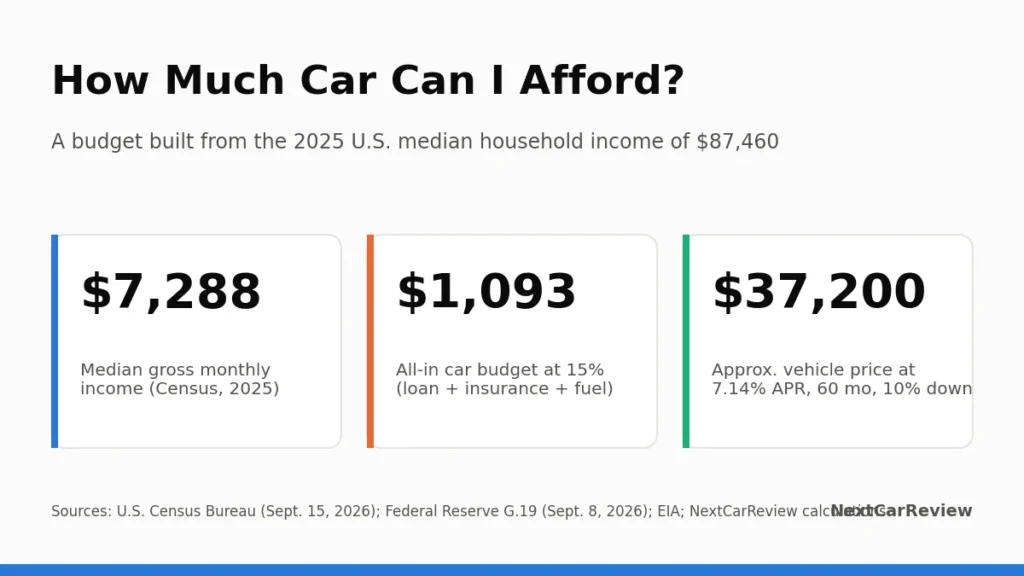
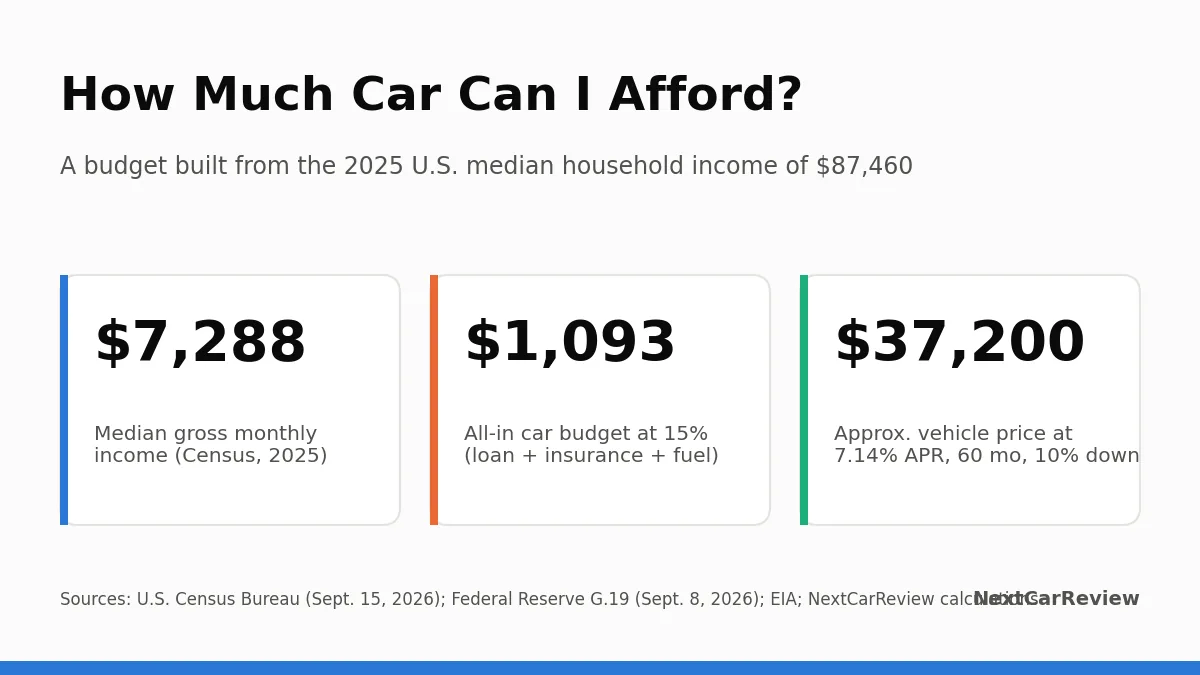
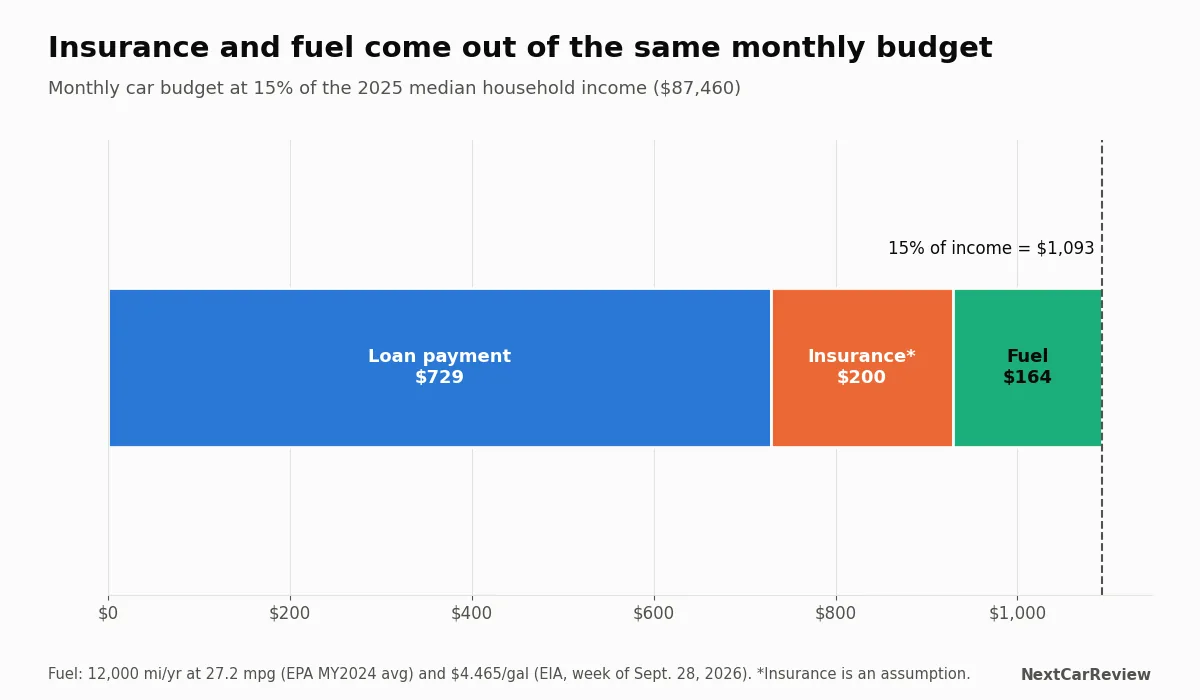
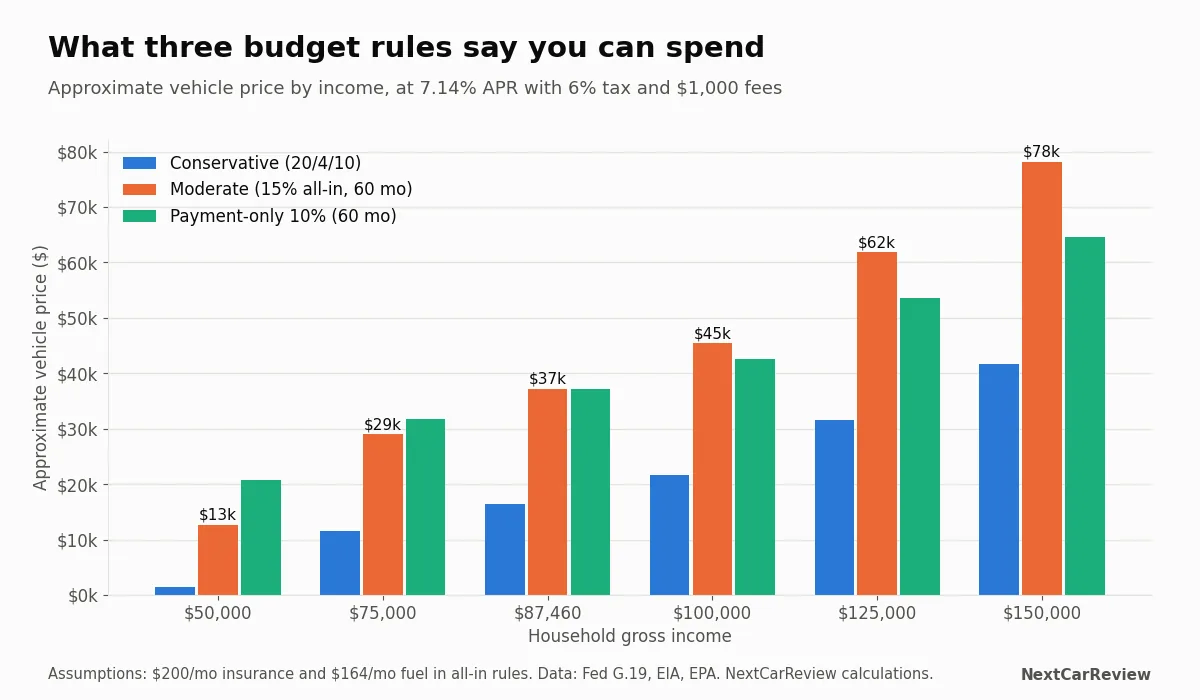
A practical ceiling is to keep total car costs (loan payment + insurance + fuel) at 10% to 15% of gross income. At the 2025 U.S. median household income of $87,460 ($7,288 a month), 15% is about $1,093 a month. After an assumed $200 for insurance and about $164 for fuel, that leaves about $729 for the loan, enough for a vehicle priced around $37,200 with 10% down, 60 months and a 7.14% APR.
The stricter 20/4/10 rule (20% down, 48 months, 10% all-in) points to roughly $16,500 at the same income, well below the $41,705 average amount financed on new-car loans in 2026.
Income data comes from the U.S. Census Bureau; loan rates and terms from the Federal Reserve G.19 release; fuel prices from the EIA; price trends from BLS CPI data. NextCarReview does not lend money, sell insurance or test financial products for this guide; see our sourcing policy.
Most buyers answer “how much car can I afford?” with whatever monthly payment a dealer can hit. That is backwards. Lenders approve loans based on what you can technically carry, which is often more than what fits comfortably alongside rent, savings and everything else. A better approach starts from your income, subtracts the running costs a loan payment never shows, and then converts the remaining payment back into a vehicle price. This guide walks through that math step by step, using the same formulas as the NextCarReview car payment calculator.
Step 1: Pick a Budget Rule That Fits Your Situation
No federal agency sets a percentage. The CFPB’s auto loan guidance is to decide your budget before shopping, focus on the total cost of the loan, and compare offers. The percentages below are common personal-finance rules of thumb, and each has a different risk level.
| Rule | What it caps | Term / down payment | Best for |
|---|---|---|---|
| Conservative: 20/4/10 | Loan + insurance + fuel at 10% of gross income | 48 months, 20% down | Buyers prioritizing savings and low debt |
| Moderate: 15% all-in | Loan + insurance + fuel at 15% of gross income | 60 months, 10% down | Most households with stable income and an emergency fund |
| Payment-only 10% | Loan payment alone at 10% of gross income | 60 months, 10% down | A quick upper bound; ignores running costs |
Step 2: Subtract the Costs a Loan Payment Hides
Fuel and insurance are not optional, and they scale with the car you choose. For fuel, a vehicle averaging 27.2 mpg (the EPA’s estimated real-world average for model year 2024 vehicles) driven 12,000 miles a year uses about 441 gallons. At the EIA’s U.S. average of $4.465 a gallon for regular (week of September 28, 2026), that is about $164 a month.
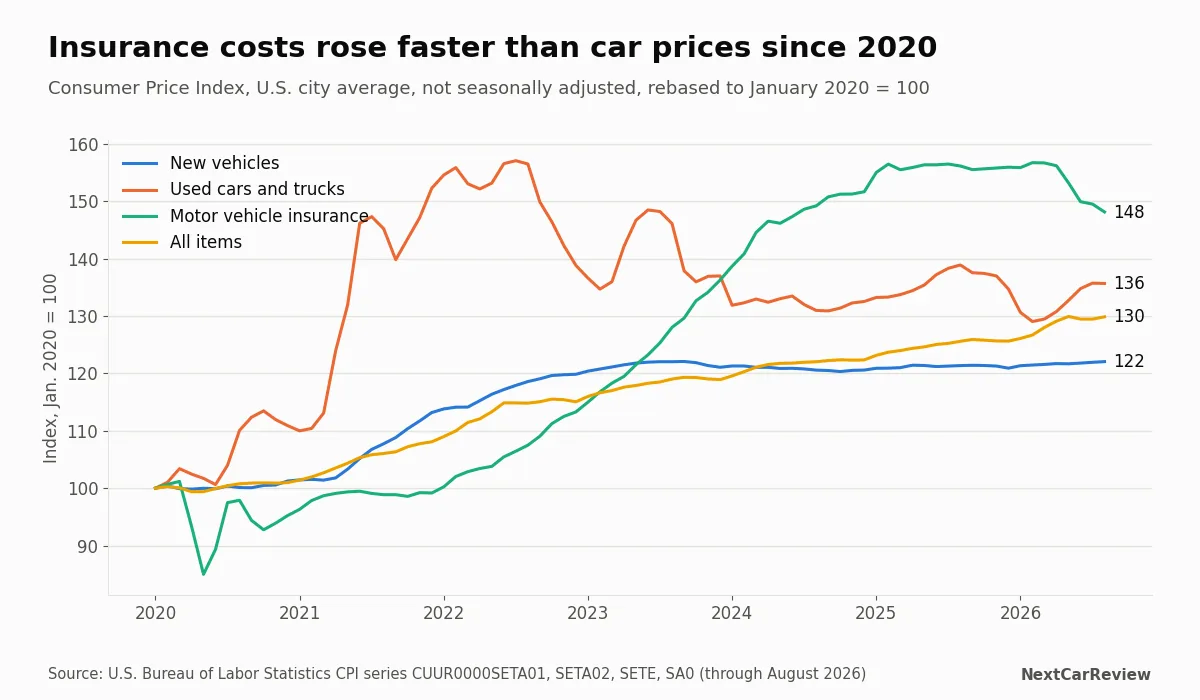
Insurance varies too much by driver, state and vehicle for a single national figure to be useful, so the examples here assume $200 a month as a placeholder. Replace it with a real quote, or with an estimate from the NextCarReview auto insurance calculator, which adjusts for age, vehicle type, coverage level, driving record and mileage. Insurance matters more than it used to: the BLS motor vehicle insurance price index in August 2026 was about 48% higher than in January 2020, compared with about 22% for new-vehicle prices.
Step 3: Convert the Payment Into a Price
The car payment calculator computes a payment from a price. To go the other way, solve the same amortization formula for the principal:
Maximum amount financed = payment × (1 − (1 + r)−n) / r, where r is the APR divided by 12 and n is the term in months.
The calculator defines the amount financed as price × (1 + sales tax) + fees − down payment − trade-in. Rearranged, price = (amount financed − fees) / (1 + tax − down-payment share) when the down payment is a percentage of price and there is no trade-in.
Worked example: median household, moderate rule
- Gross monthly income: $87,460 / 12 = $7,288
- 15% all-in budget: $1,093
- Minus insurance ($200) and fuel ($164): loan payment = $729
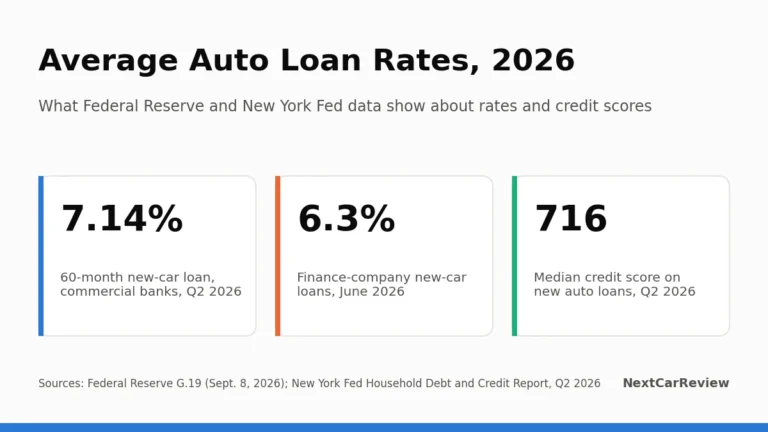
- At 7.14% APR (the Fed’s Q2 2026 average for 60-month bank loans), r = 0.00595 and n = 60: maximum financed = $729 × (1 − 1.00595−60) / 0.00595 = $36,698
- With 6% sales tax, $1,000 in fees and 10% down: price = ($36,698 − $1,000) / (1.06 − 0.10) = $37,186, with a down payment of about $3,719
| Rule | Monthly budget | Loan payment | Max financed | Approx. vehicle price |
|---|---|---|---|---|
| Conservative (20/4/10) | $729 | $365 | $15,188 | $16,497 |
| Moderate (15% all-in, 60 mo) | $1,093 | $729 | $36,698 | $37,186 |
| Payment-only 10% (60 mo) | $729 | $729 | $36,685 | $37,172 |
Median household income ($87,460), 7.14% APR, 6% tax, $1,000 fees. All-in rules subtract $200 insurance and $164 fuel. NextCarReview calculations.
Enter a price, your state’s tax rate, down payment and APR, then compare the payment with the budget you worked out above. Open the calculator →
Reality Check: How Today’s Average Loan Compares
The Federal Reserve’s G.19 data show finance-company new-car loans averaged $41,705 financed at 6.3% over 67 months in June 2026. That payment is about $740 a month, or 10.2% of the median household’s gross monthly income for the loan alone. In other words, the typical new-car loan already exceeds the conservative rule before insurance or fuel is counted, and it relies on a term of more than five and a half years to get there.
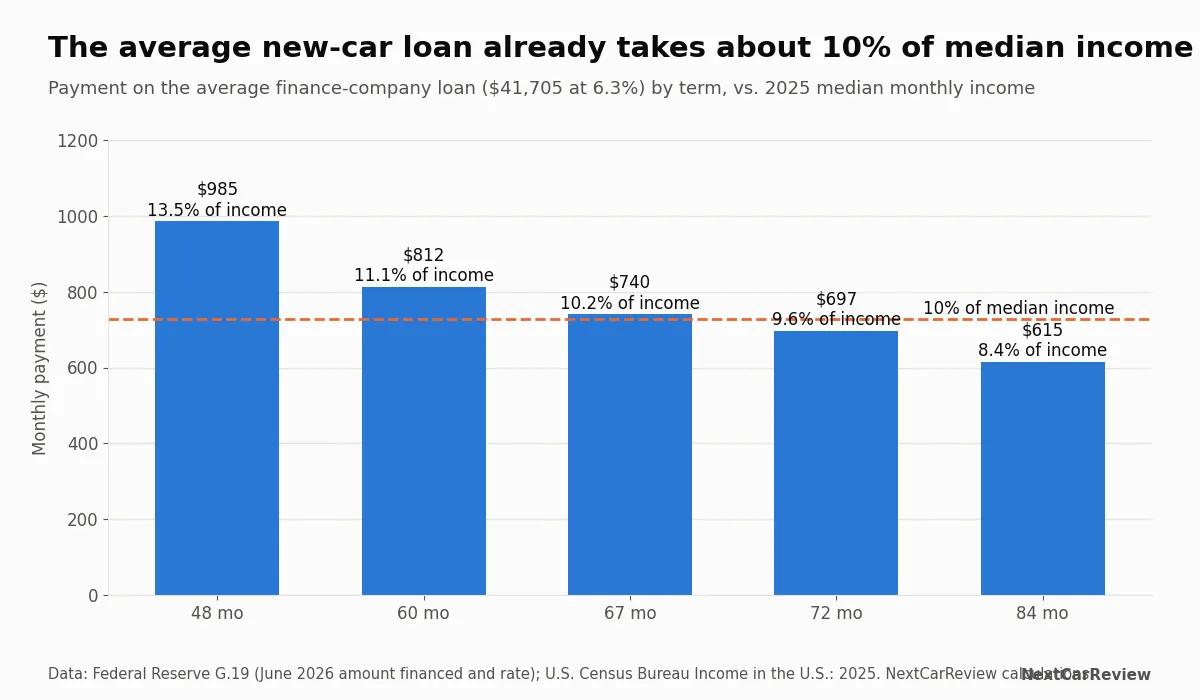
That gap explains why so many buyers end up with long loans. Stretching the term is the easiest way to make a price fit a payment, but it adds interest and increases the time you owe more than the car is worth. If the price you want does not fit your rule at 60 months, the safer levers are a larger down payment, a less expensive trim or a certified used vehicle. Our payment calculator walkthrough shows how each input moves the result.
Pros and Cons of Budgeting by Income
| Pros | Cons |
|---|---|
| Anchors the decision before a salesperson frames it as a monthly payment | Rules of thumb ignore other debts, housing costs and local prices |
| Forces insurance and fuel into the budget early | Strict rules can rule out a new car for many median-income households |
| Works backward from the same math lenders use | APR, tax and insurance assumptions must be replaced with your real numbers |
Who This Approach Fits
- First-time buyers setting a ceiling before they shop (see our first-car guide).
- Households with other debts: use the conservative rule, because your debt-to-income ratio also affects the rate you are offered.
- Buyers with timing flexibility: pairing a firm budget with the right moment to buy can stretch it further; see the best time to buy a car.
Five Ways to Afford More Without Breaking the Rule
- Raise the down payment, which reduces both the amount financed and the interest on it.
- Get pre-approved so the APR in your math is real; the CFPB notes that rate-shopping inquiries within 14 to 45 days are generally treated as one.
- Negotiate the price, not the payment. The CFPB lists the APR, loan term, trade-in value, optional add-on products and dealer fees as negotiable.
- Compare insurance quotes on the specific models you are considering before you buy.
- Choose a vehicle with better fuel economy; at $4.465 a gallon, every 5 mpg matters.
Car Finance Guides
Run your own numbers: auto loan calculator, car payment calculator and auto insurance calculator. More in this series:
Frequently Asked Questions
How much car can I afford on my salary?
A moderate rule of thumb caps total car costs (loan, insurance and fuel) at about 15% of gross income. At the 2025 U.S. median household income of $87,460, that is about $1,093 a month, which supports a vehicle of roughly $37,200 with 10% down, a 60-month loan at 7.14% APR, $200 a month for insurance and about $164 for fuel.
What is the 20/4/10 rule for buying a car?
It is a widely used personal-finance rule of thumb, not a regulation: put at least 20% down, finance for no more than four years, and keep total monthly vehicle costs, including insurance and fuel, under 10% of gross income. It is conservative by design.
Should my car payment be 10% of my income?
Many buyers use 10% of gross monthly income as a ceiling for the loan payment alone. Remember that insurance, fuel and maintenance are on top of that, so a 10% payment can mean 15% or more of income goes to the car in total.
Does the CFPB say how much I should spend on a car?
The CFPB does not set a percentage. Its guidance is to decide what you can afford before shopping, look at the total cost of the loan rather than the monthly payment, get pre-approved and compare offers.
Is a longer loan a good way to afford more car?
It lowers the payment but raises total interest. On $41,705 at 6.3%, stretching from 60 to 84 months cuts the payment from about $812 to about $615, but you pay interest for two more years and stay owing more than the car is worth for longer.
What should I include besides the loan payment?
Insurance, fuel or charging, maintenance, registration and, in many states, annual property tax on the vehicle. BLS price data show motor vehicle insurance costs up about 48% since January 2020, so get an insurance quote before you commit to a car.
⚠️ Professional Notice:
This article is general educational information, not financial or credit advice. Budget percentages are common rules of thumb, not lender or government standards. Income figures are 2025 Census medians, rates are Federal Reserve averages, fuel uses the EIA national average for the week of September 28, 2026, and insurance is a placeholder assumption. Your own income, debts, state taxes, fees and quotes will change the result. Consult a qualified financial professional for advice on your situation.
NextCarReview does not receive compensation from any lender, dealer or insurer for this coverage.
Data Sources and Verification
- U.S. Census Bureau: Income, Poverty and Health Insurance Coverage in the United States: 2025 (Sept. 15, 2026)
- U.S. Census Bureau: Income in the United States: 2025 (P60-289)
- Federal Reserve G.19 Consumer Credit, Terms of Credit (Sept. 8, 2026)
- U.S. EIA Gasoline and Diesel Fuel Update (week of Sept. 28, 2026)
- EPA Automotive Trends Report highlights (average real-world fuel economy)
- U.S. Bureau of Labor Statistics: CPI data, series SETA01, SETA02, SETE (through Aug. 2026)
- CFPB: Auto loans consumer tools
- CFPB: What should I know before I shop for a car or auto loan?
- CFPB: What things can I negotiate when shopping for a car or auto loan?
Figures were checked against the sources above between September 15 and October 3, 2026. Rates, prices and laws change; verify before you rely on them.

Morgan Reyes is the founder and editor-in-chief of NextCarReview, which Morgan launched in August 2024. A 2022 graduate of Columbia University, Morgan is based in New York and writes and edits the site’s reviews, comparisons and buying guides. Morgan does not road-test vehicles. Every article is built from published primary data: EPA FuelEconomy.gov ratings, NHTSA crash ratings, recalls and owner complaints, IIHS results, and manufacturer specifications and pricing, with each figure cited and checked before publication. Contact: admin@nextcarreview.com