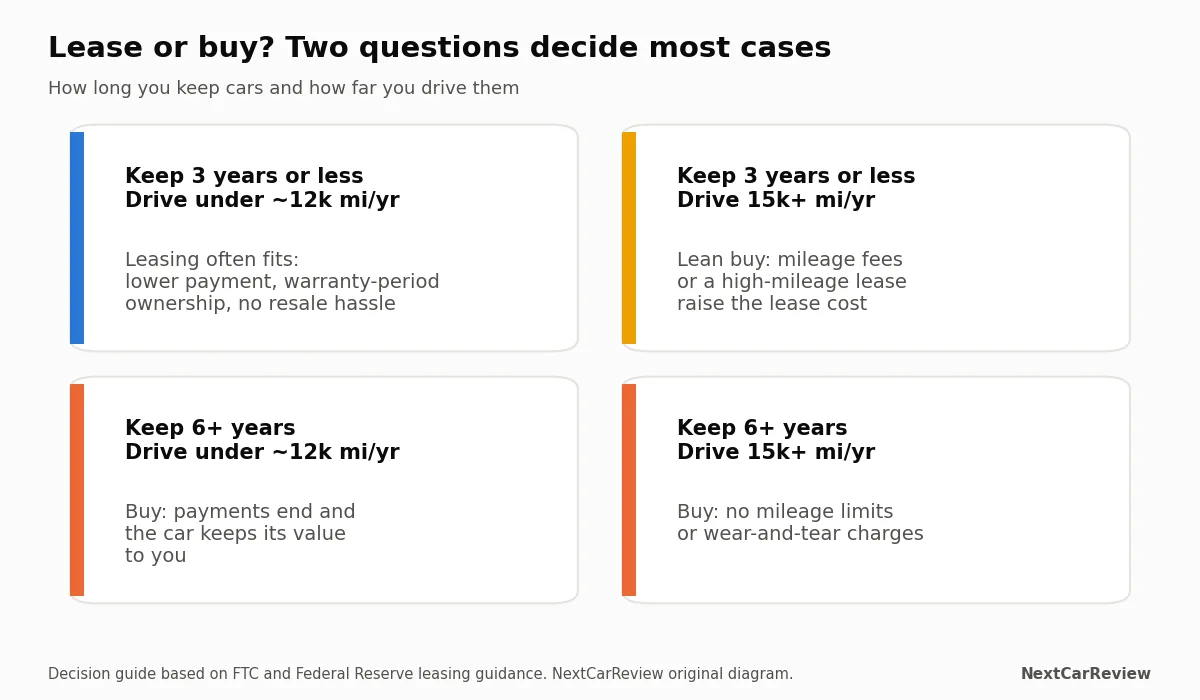
Lease if you replace cars every two to three years, drive predictable miles within the allowance (the FTC says most standard leases allow 15,000 a year or less) and value a lower payment. Buy if you keep cars six years or more, drive a lot, or want no wear-and-tear or mileage charges.
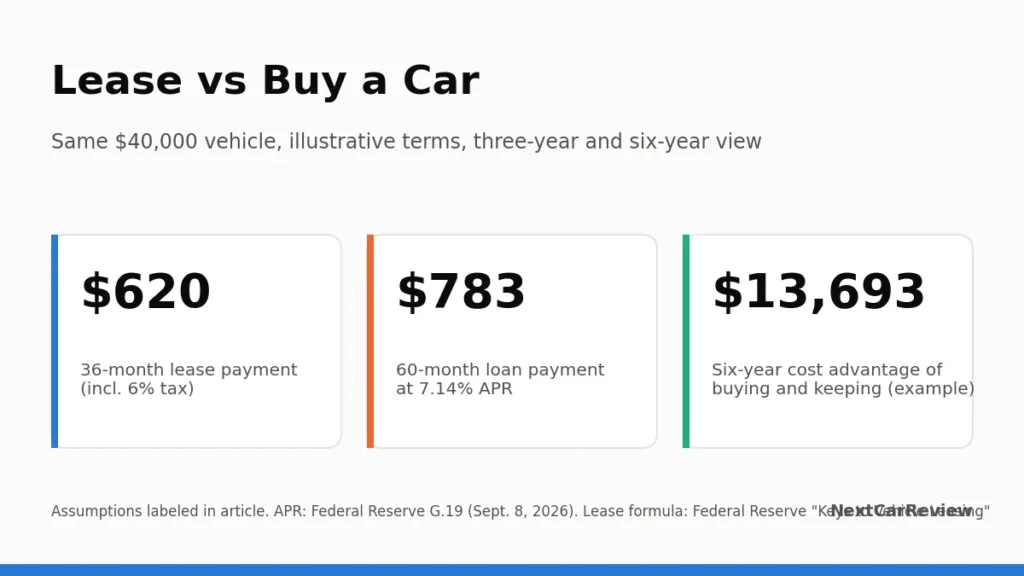
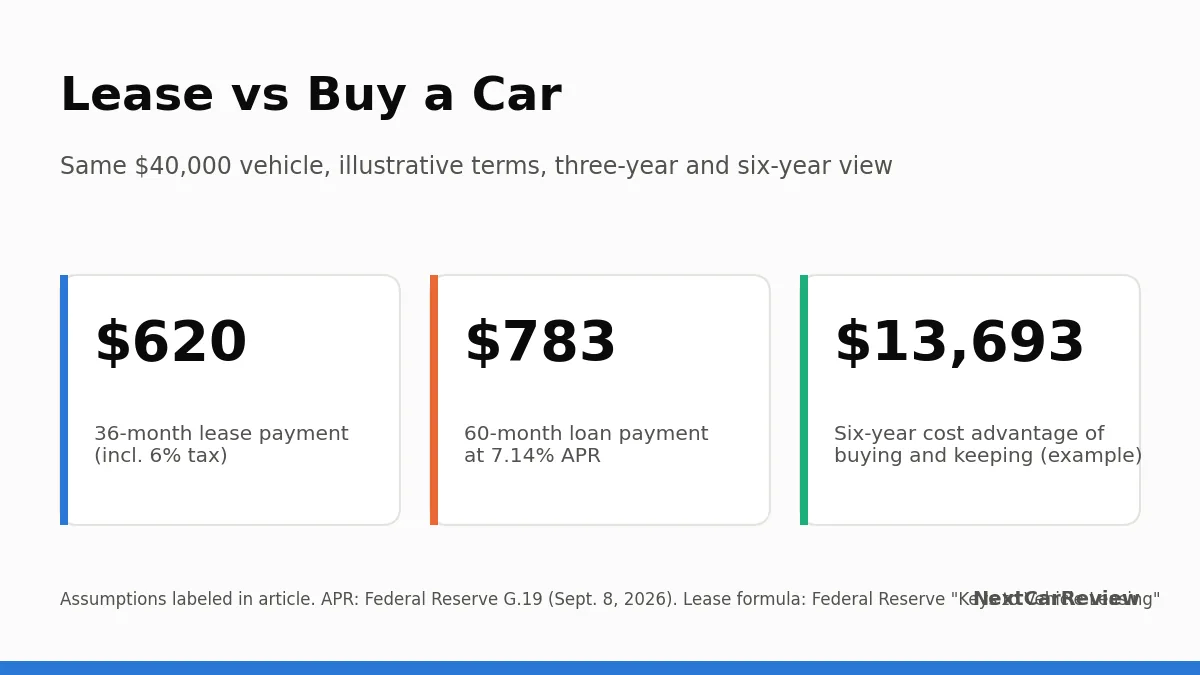
In an illustrative $40,000 example, the lease payment is about $620 a month versus $783 on a 60-month loan at 7.14% APR. Net three-year costs are close ($24,329 vs $26,438), but over six years buying and keeping costs about $13,693 less than leasing twice.
Lease mechanics come from the FTC and the Federal Reserve’s Keys to Vehicle Leasing; loan rates from the Federal Reserve G.19 release. NextCarReview does not lend money, sell insurance or test financial products for this guide; see our sourcing policy.
Leasing and buying are two ways to pay for the same car. With a loan you pay for the whole vehicle and own what is left when the loan ends. With a lease you pay for the part of the car’s value you use up, plus a finance charge, and hand it back. Neither is automatically the smarter money move; the right answer depends on how long you keep cars, how far you drive and how much the monthly payment matters to your budget. NextCarReview does not have a dedicated lease calculator yet, so this guide shows the lease formula by hand and uses the car payment calculator for the buy side.
How a Lease Payment Is Calculated
The Federal Reserve’s leasing guide breaks the base monthly payment into two parts:
- Depreciation fee = (adjusted capitalized cost − residual value) / number of months
- Rent charge = money factor × (adjusted capitalized cost + residual value)
The adjusted capitalized cost is the negotiated price plus capitalized fees (such as an acquisition fee) minus any down payment or trade-in. The residual value is the lessor’s estimate of what the car will be worth at lease end; it is set by the lessor, not negotiated. In many states, sales tax is then added to each monthly payment rather than charged on the full price; the Federal Reserve model lease form shows monthly sales/use tax added to the base payment.
Worked example: 36-month lease on a $40,000 vehicle
- Negotiated price $40,000 + $695 acquisition fee − $2,000 down = adjusted cap cost $38,695
- Residual value 58% of $40,000 = $23,200 (illustrative)
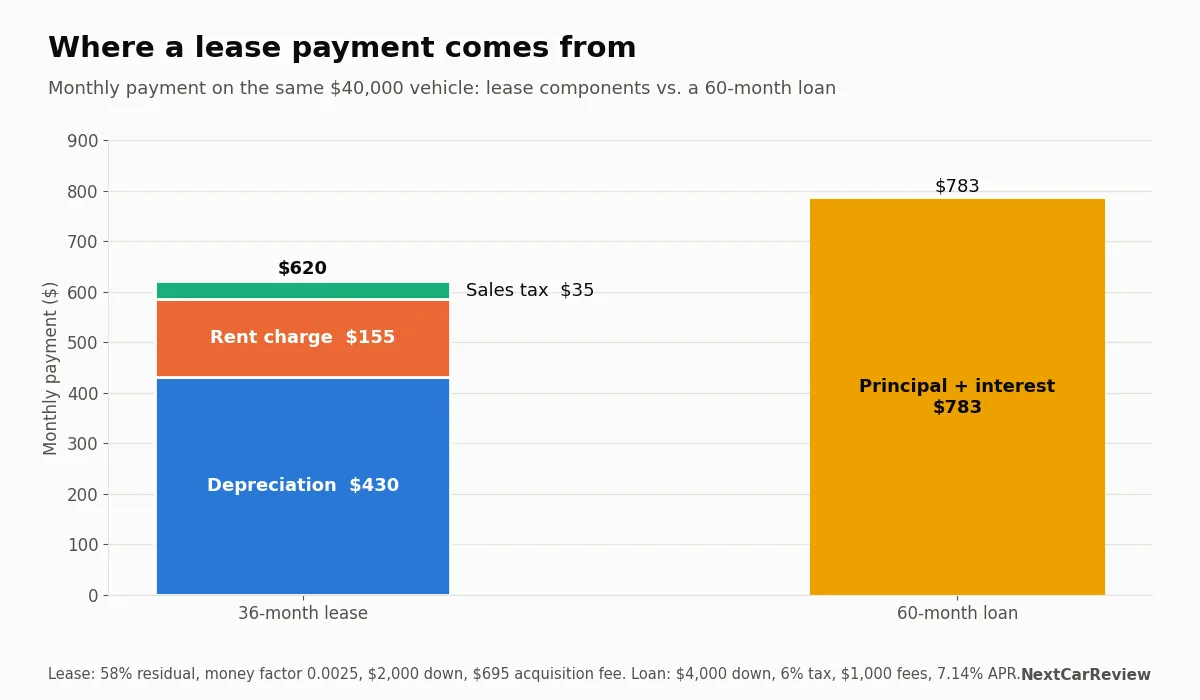
- Depreciation fee = ($38,695 − $23,200) / 36 = $430.42
- Rent charge = 0.0025 × ($38,695 + $23,200) = $154.74
- Base payment $585.15 + 6% tax = $620.26 a month
About the money factor: because the rent formula charges interest on the average of the starting and ending balances, multiplying the money factor by 2,400 approximates an APR (0.0025 × 2,400 = 6.0%). The Federal Reserve cautions that a money factor is not a lease rate and cannot be converted by simply moving the decimal point, so use the 2,400 shortcut only to compare a lease offer with a loan quote.
The Buy Side of the Same Car
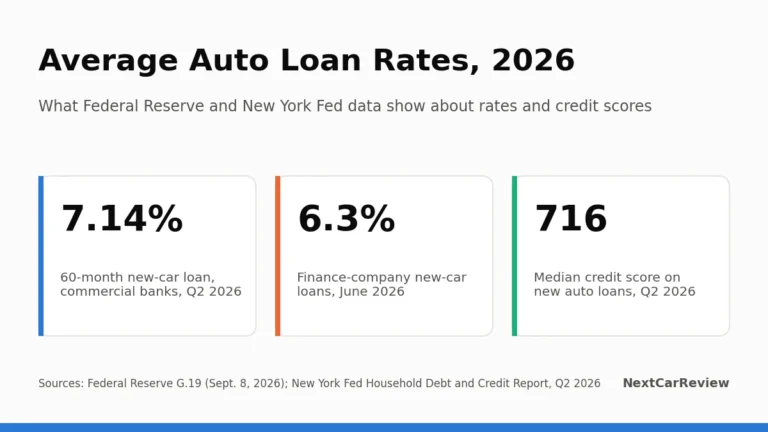
Financing the same $40,000 vehicle with $4,000 down, 6% sales tax and $1,000 in fees means borrowing $39,400. At the Federal Reserve’s Q2 2026 average of 7.14% for a 60-month new-car loan at commercial banks, the payment is P × r(1 + r)n / ((1 + r)n − 1) = $782.77 a month, the same formula the payment calculator uses.
Enter the vehicle price, your state tax rate, down payment and APR to compare the loan payment with any lease quote. Open the calculator →
Total Cost: Three Years vs Six Years
Monthly payments alone favor leasing. A fair comparison counts what you keep. If the car is worth its 58% residual ($23,200) after three years, the loan balance then is about $17,459, leaving about $5,741 of equity. If you keep it six years and it is worth an assumed 40% of its price, you own a $16,000 asset and have no payment in year six.
| Scenario | Lease | Buy |
|---|---|---|
| Monthly payment | $620 | $783 |
| Cash at signing | $2,000 | $4,000 |
| Net cost after 3 years | $24,329 | $26,438 (after $5,741 equity) |
| Net cost after 6 years | $48,659 (two identical leases) | $34,966 (after $16,000 vehicle value) |
Illustrative only. Excludes maintenance, repairs, insurance differences, disposition fees and the hassle of selling. Residual and 6-year values are assumptions.
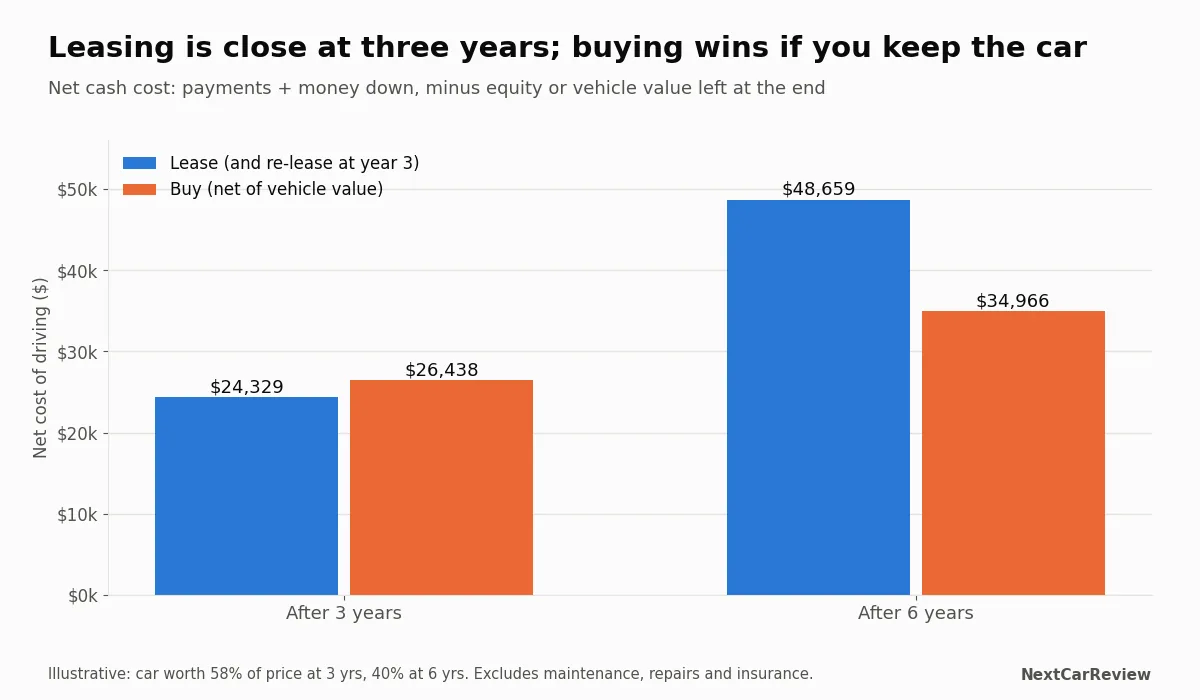
Two caveats cut each way. Leasing keeps you in warranty-period cars, which limits repair risk, and some manufacturers subsidize residuals or money factors on leases, which can make a specific lease deal unusually cheap. Buying, meanwhile, carries no excess-wear charge and no mileage cap. Current subsidized offers are tracked in our lease deals roundup and, for electric models, the best EV lease deals for 2026.
Mileage and Wear: The Hidden Lease Costs
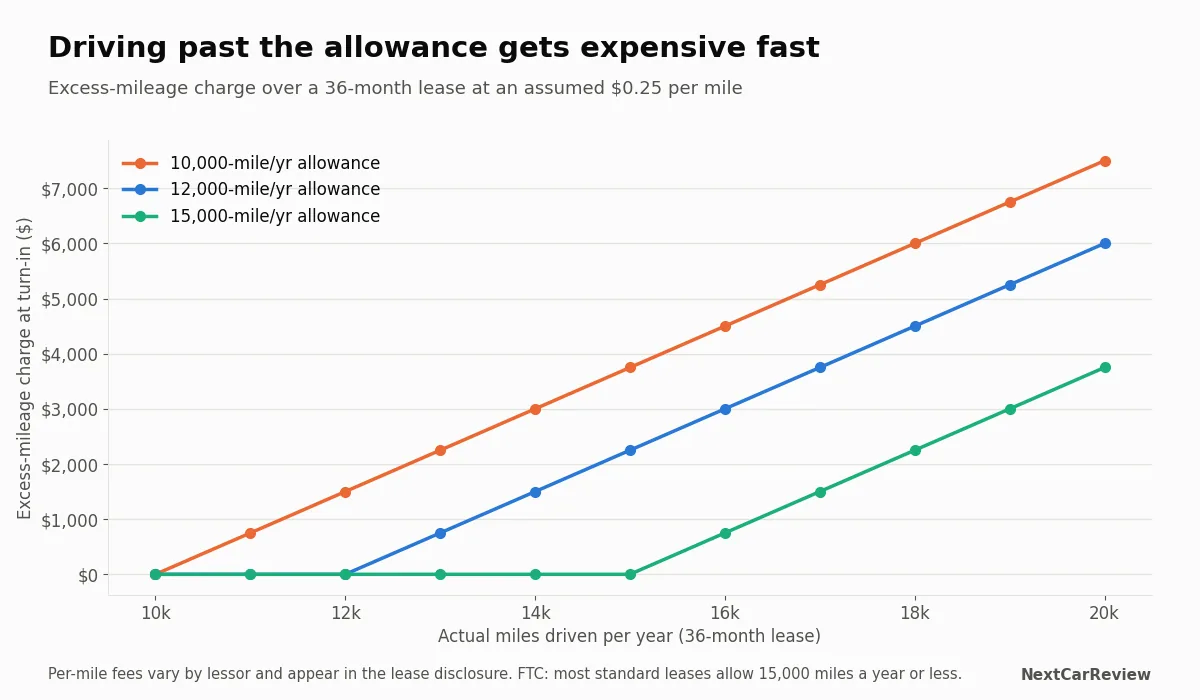
The FTC notes that you are responsible for excess wear, damage and missing equipment when you return a leased car, and that you must service it to the manufacturer’s schedule. Driving past the allowance triggers a per-mile charge that is spelled out in the lease disclosure required by the Consumer Leasing Act and Regulation M.
The Third Option: Buying Out Your Lease
Most leases include a purchase option at a price stated in the contract, typically tied to the residual value plus any purchase-option fee. That turns the lease into a hedge. If the car is worth more than the buyout price at lease end, you can buy it (or, where the lessor allows, sell it) and capture the difference; if it is worth less, you hand it back and the lessor absorbs the loss. In the example above, the buyout would be about $23,200 plus any fee. Financing that buyout is simply a used-car loan, so compare the lessor’s offer with outside lenders using the auto loan calculator. Because used-car loans are usually priced higher than new-car loans, run the numbers at a realistic used-car APR rather than the new-car averages.
The Consumer Leasing Act and its Regulation M require lessors to disclose, before you sign, the amount due at signing, the payment schedule, the total of payments, how the payment is calculated, early termination conditions, excess wear and mileage charges, and whether and at what price you can buy the vehicle. Read those boxes as carefully as the payment.
Pros and Cons
| Leasing | Buying | |
|---|---|---|
| Monthly payment | Lower for the same car | Higher, but ends when the loan is paid |
| Long-run cost | Higher if you lease continuously | Lower if you keep the car several years |
| Flexibility | Early termination can be costly | Sell or trade any time (watch negative equity) |
| Mileage / wear | Allowance and wear charges apply | No limits; affects only resale value |
| Repairs | Usually within factory warranty | Out-of-warranty repairs become yours |
Who Each Option Fits
- Lease: drivers who want a new car every few years, drive under the allowance, can deduct business vehicle use (ask a tax professional), or want to avoid selling a used car.
- Buy: drivers who keep cars until the wheels fall off, commute long distances, modify their vehicles, or want the lowest lifetime cost. Choosing a model that holds value helps; see our list of the best cars for resale value.
Before You Sign Either Deal
- Negotiate the vehicle price first; it is the capitalized cost on a lease and the amount financed on a loan.
- Ask for the money factor and residual in writing, and convert the money factor with the 2,400 shortcut to compare it with a loan APR.
- Check the per-mile charge, disposition fee and early termination formula in the lease disclosure.
- Get a loan pre-approval so you can compare both options on real terms.
Car Finance Guides
Run your own numbers: auto loan calculator, car payment calculator and auto insurance calculator. More in this series:
Frequently Asked Questions
Is it cheaper to lease or buy a car?
Over a short horizon the two can be close; over a long one, buying and keeping the car is usually cheaper because payments end. In this article’s example, net cost after three years is about $24,329 to lease versus $26,438 to buy and sell, but after six years it is about $48,659 for two leases versus $34,966 to buy and keep.
What am I paying for when I lease a car?
The FTC explains that a lease payment covers the vehicle’s expected depreciation during the lease, plus a rent charge, taxes and fees. You do not build ownership, and you return the car at the end unless you buy it.
How do I convert a money factor to an interest rate?
A common approximation is to multiply the money factor by 2,400, so 0.0025 is roughly a 6% APR. The Federal Reserve cautions that the money factor is not itself a lease rate and cannot be converted by moving the decimal point, so treat this only as a comparison shortcut.
What happens if I drive more miles than my lease allows?
You pay an excess-mileage charge at turn-in, stated in your lease disclosure. The FTC notes most standard leases allow 15,000 miles a year or less, and a higher allowance usually raises the payment.
Can I end a car lease early?
Usually, but the FTC warns that early termination can carry a substantial charge. Your lease must disclose how that charge is calculated.
Do I need GAP coverage on a lease?
Some leases include GAP coverage or a GAP waiver, and some lessors require it. Check the lease contract before buying a separate policy so you do not pay twice.
⚠️ Professional Notice:
This article is general educational information, not financial, tax or legal advice. The lease and loan examples use illustrative assumptions (residual value, money factor, fees, tax rate and future vehicle values) chosen to show the method; real offers vary by lessor, lender, vehicle, state and credit. The loan APR is the Federal Reserve G.19 average for Q2 2026. Read your lease disclosure and loan contract, and consult a qualified professional for advice on your situation.
NextCarReview does not receive compensation from any lender, dealer or insurer for this coverage.
Data Sources and Verification
- FTC: Financing or Leasing a Car (July 2022)
- Federal Reserve Board: Keys to Vehicle Leasing, more information about the rent charge
- Federal Reserve Board: Vehicle Leasing frequently asked questions
- CFPB: Consumer Leasing Act (Regulation M) examination procedures
- Federal Reserve G.19 Consumer Credit, Terms of Credit (Sept. 8, 2026)
- CFPB: What are the different ways to buy or finance a car or vehicle?
Figures were checked against the sources above between September 15 and October 3, 2026. Rates, prices and laws change; verify before you rely on them.

Morgan Reyes is the founder and editor-in-chief of NextCarReview, which Morgan launched in August 2024. A 2022 graduate of Columbia University, Morgan is based in New York and writes and edits the site’s reviews, comparisons and buying guides. Morgan does not road-test vehicles. Every article is built from published primary data: EPA FuelEconomy.gov ratings, NHTSA crash ratings, recalls and owner complaints, IIHS results, and manufacturer specifications and pricing, with each figure cited and checked before publication. Contact: admin@nextcarreview.com