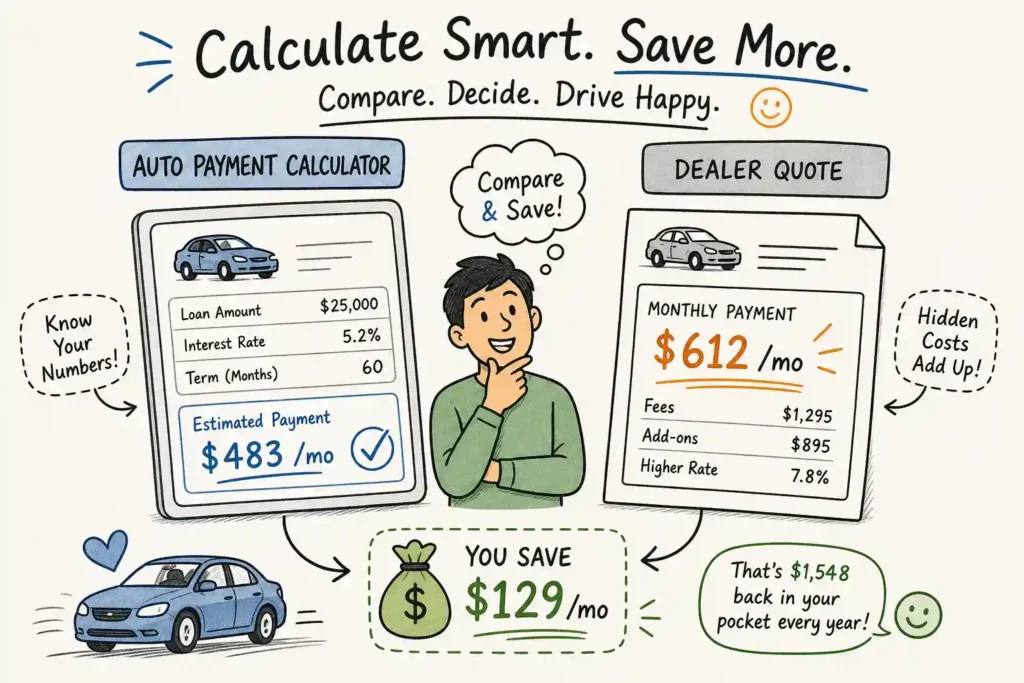
Dealer quotes often exceed initial consumer estimates because dealers calculate financing based on the complete out-the-door price, including taxes, registration, and documentation fees. Auto car payment calculators allow buyers to determine their actual monthly payments and total financing costs before negotiating at a dealership.
Monthly payments are determined by the loan principal, interest rate, loan term, down payment, and trade-in value. Buyers can lower total financing costs by improving their credit scores, applying trade-ins to reduce taxable purchase amounts, and selecting shorter loan terms to minimize total interest paid.
The number a dealer quotes you often does not match the number you calculated at home. The gap is not random, and it does not move in your favor. Most buyers walk in knowing the sticker price and a rough monthly target. The dealer works from the full out-the-door figure: taxes, registration, documentation fees, and optional products all folded in before the payment is run. Before you sit across from anyone, run an auto car payment calculator to build your own complete number first.
Data cross-verified by our NCR Research Lab, Lead Technical Analyst & Editorial Collective
A car payment calculator closes that gap before you negotiate. It forces you to work from complete numbers, not partial ones. At NextCarReview, our built-in payment estimator draws on pricing data and 3, 5 year resale projections across 35+ brands to ground every scenario in real market figures rather than dealer worksheets or manufacturer estimates. (We use “auto car payment calculator” and “car payment calculator” interchangeably throughout this guide, both refer to the same amortization-based tool.)
By the end of this article, you will know how to calculate your own accurate monthly payment, understand every input that moves the number, and apply three specific tactics to reduce what you pay in total. Those are not abstract concepts. They are dollar figures you can verify before you walk into a showroom.

How to Use an Auto Car Payment Calculator
The math behind a monthly payment, simplified

Every auto loan calculator runs the same amortization formula: M = P × [r(1+r)^n] / [(1+r)^n − 1]. M is your monthly payment, P is the loan principal, r is your APR divided by 12, and n is the total number of payments. You do not need to run the formula by hand, but understanding what it represents helps you see why changing one variable shifts everything else.
A straightforward example: a $20,000 loan at 6% APR over 60 months produces a monthly payment of roughly $386. The early payments in that schedule are mostly interest, with principal making up a small fraction. The final payments are almost entirely principal. That front-loading matters if you are planning to pay off the loan early, because every dollar of extra payment in year one saves more than the same dollar in year four.
Why dealer quotes look different from your estimate
Dealers do not start from the vehicle price. They start from the out-the-door total, which includes sales tax, documentation fees, title, registration, and anything you agreed to in the finance office. If you put only the vehicle price into a car finance calculator and ignore those additions, your number will always read lower than theirs.
This is not a sales tactic designed to deceive you. It is a difference in inputs. The buyer who understands every line item in the out-the-door price can compare their estimate against the dealer’s worksheet directly, rather than guessing which number to challenge.
Every Input That Moves Your Monthly Payment
Sale price, down payment, and trade-in: the three levers with the most pull
The amount you actually finance follows a straightforward formula: vehicle price plus taxes plus fees plus any add-ons, minus trade-in value, minus down payment, minus any manufacturer rebates. Each subtraction reduces the principal you are paying interest on for the life of the loan.
The trade-in is worth more than most buyers realize. In many US states, your trade-in reduces the taxable purchase price, not just the loan balance. On a $32,000 family SUV with a $6,000 trade-in, that reduction in taxable amount alone can lower your tax bill by $350, $500, depending on your state rate. That savings does not show up on the window sticker, but it shows up when you calculate the real out-the-door number.
APR by credit score and loan term: real 2026 numbers
Your credit score determines your APR tier, and the difference between tiers is significant. Here is where 2026 new car loan rates sit across the major credit bands:
| Credit Tier | Score Range | New Car APR (2026) |
|---|---|---|
| Excellent | 781+ | 4.55%, 4.66% |
| Good | 661, 780 | 6.23%, 6.89% |
| Fair | 601, 660 | 9.57%, 9.67% |
| Poor | 501, 600 | 13.17%, 13.44% |
Loan term shapes the monthly cost just as sharply as APR. On a $25,000 loan at 6% APR, the 36-month payment runs about $761. At 60 months, it drops to roughly $483. At 72 months, it falls further but costs significantly more in total interest over the life of the loan. The monthly figure feels more comfortable at 72 months. The total cost does not.
Real Worked Examples for Three Types of Buyers

First-time buyer: keeping the payment realistic on a practical sedan
Take a 2026 Honda Civic starting at $24,695. Negotiate to $23,500, put 10% down ($2,350), and finance at 6.89% APR over 60 months. Add 6% state sales tax ($1,410), documentation fees of $450, and registration of $200. Your financed amount lands around $23,210, and the resulting monthly payment comes to approximately $459.
Based on NextCarReview’s resale data, the Civic retains roughly 70, 75% of its value at three years, one of the stronger retention rates in the compact sedan segment. That equity position matters if life circumstances change and you need to sell or trade before the loan term ends. It is a number worth confirming before you sign, not after.
Our 2026 Honda Civic sedan vs hatchback comparison covers the full pricing and trim breakdown for both body styles if you are still deciding which configuration fits your budget best.
Family SUV shopper: balancing safety data and financing cost
A 2026 Toyota RAV4 priced at $31,500 with a $6,000 trade-in illustrates how each input stacks. After applying the trade-in against both the loan principal and the taxable purchase price in a 6% sales tax state, the financed amount drops to approximately $28,000. At 6.89% APR, the 60-month payment runs about $553 per month. Extending to 72 months brings it to around $468, an $85 monthly difference that translates to more total interest paid over the life of the loan.
The RAV4 retains approximately 75, 83% of its value after three years, one of the strongest projections in the compact SUV segment. The RAV4 has earned Top Safety Pick recognition from the IIHS, and NextCarReview’s TCO breakdown shows that better-equipped safety trims tend to hold more of their value at resale, which reduces net ownership cost over five years. The safer trim is not just safer. It often costs less in the long run.
Our full details of Toyota RAV4 guide covers every trim, safety feature, and resale projection referenced in this scenario.
EV considerer: where TCO changes the calculation completely
The federal EV purchase tax credit ended on September 30, 2025, so 2026 buyers purchasing new electric vehicles should not factor any federal purchase incentive into their payment calculation. A 2026 EV priced around $45,000 finances at face value. At 6.89% APR over 60 months with 10% down (financing approximately $40,500), the monthly payment works out to roughly $800.
That monthly figure reads higher than a comparable gasoline vehicle. The full cost picture usually tells a different story. NextCarReview’s TCO analysis across popular 2026 EV models shows estimated fuel and maintenance savings in the range of $2,500, $4,000 over three years compared to equivalent gas-powered vehicles, based on national average fuel prices and typical maintenance cost differentials. Run the monthly car payment estimator first, then overlay the operating cost comparison. The calculator number is only part of the decision.
Our federal EV tax credit guide covers exactly what changed after the September 2025 repeal and how it affects your financing math. And our best electric and hybrid cars 2026 guide covers every strong EV option at every price point if you are still comparing models before running your own numbers.
Mistakes That Make Your Estimate Wrong From the Start
Forgetting what goes into the real out-the-door price
Documentation fees average $350, $500 nationally in 2026. Registration and title add another $100, $400 depending on your state. On a $35,000 purchase, state sales tax alone can add $2,000, $2,500. Most buyers input the vehicle price and stop there, which means their estimate can be $3,000, $5,000 short of the real financed amount before interest is calculated.
Rolling fees and taxes into a 72-month loan means paying interest on your paperwork costs for six years. That is avoidable if you know the full number going in. Use the out-the-door total, not the sale price, as your starting point in any auto car payment calculator.
Fixating on the monthly payment instead of total interest paid
The dealer often leads with the monthly payment because it is the easiest number to make feel manageable. A 72-month loan on a $30,000 vehicle at 7% APR produces a lower monthly figure than a 48-month loan on the same vehicle. The difference in total interest between those two terms can run into the thousands of dollars. The buyer watching only the monthly number misses that gap entirely.
Total financing cost is the number that actually matters. Run your payment calculator for multiple terms side by side, not just the one the dealer presents. The comparison is usually clear once you see it.
Three Moves That Lower Your Payment or Your Total Loan Cost
Improving your credit score before you apply is the highest-leverage action available if you have time. Going from a fair-credit APR of 9.67% to a good-credit APR of 6.89% on a $28,000 loan over 60 months saves over $1,200 in total interest. That is the output of the amortization formula applied to real 2026 rates, not a theoretical projection.
If you have three to six months before your purchase, paying down revolving balances and disputing any reporting errors are concrete, measurable steps. Moving from the low 620s to the high 680s is achievable in that window for many borrowers, results vary, but that kind of improvement is enough to cross into the good-credit tier and change your rate meaningfully.
Use your trade-in as both a down payment and a tax reduction tool. On a $32,000 purchase with a $7,000 trade-in in a state with a 7% sales tax rate, the tax reduction on the trade-in value alone comes to roughly $490. Stack that against the reduced loan principal, and the trade-in is worth materially more than the number applied to your balance sheet.
Finally, if the monthly difference between a 60-month and 48-month loan on your target vehicle is under $80, the shorter term almost always wins on total cost. Run both scenarios in the calculator before you commit. The total interest savings from 12 fewer payments is money that stays in your pocket. The monthly payment comfort zone has a price attached to it that most buyers do not see until it is too late to change.
If you are weighing a lease instead of a loan, our best lease deals guide covers current market terms across every segment, and our best EV lease deals 2026 guide covers how leasing an electric vehicle can change the monthly math compared to the loan scenarios above.
Compare Dealer Quote With Your Auto Car Payment Calculator Result

What to look for when the quote does not match your estimate
When the dealer’s worksheet diverges from your calculation, the gap almost always sits in one of four places: the selling price shifted from what was negotiated, fees were bundled rather than itemized, the APR differs from your pre-approval rate, or the trade-in was applied after taxes were calculated rather than before. Go through each line. If you know which input changed, you know exactly where to push back, and that specificity changes the conversation.
Using NextCarReview’s verified pricing and resale data as your reference point
Your calculation is only as accurate as the inputs behind it. NextCarReview covers 35+ brands with pricing data, resale projections, and TCO analyses across 12 vehicle categories. Before you negotiate, check the model review page for the vehicle you are considering. The resale projection shows you what you will actually be holding at year three. The TCO breakdown tells you whether the vehicle is worth financing at the price being quoted.
Walk into the dealership with that picture complete, and the dealer’s worksheet becomes a document you can read line by line rather than a number you react to. That is the difference between a buyer who controls the negotiation and one who responds to it.
Frequently Asked Questions About Auto Car Payment Calculators
How much would monthly payments be on a $30,000 car loan?
How much is a $70,000 car payment for 72 months?
What is the average car payment on a $100,000 car?
How do I calculate my monthly auto payment?
What factors influence the total cost of a car loan?
Where can I find an auto car payment calculator tool?
What is a typical auto loan interest rate for new vehicles?
How to use an auto car payment calculator online?
How much car can I afford based on monthly payments?
Your Number First, Their Quote Second
Every worked example in this article started with a real vehicle price and a complete set of inputs: taxes, fees, credit tier, loan term, trade-in. The monthly payment that comes out of that process is yours to defend. The number a dealer presents without that context is not yours to accept by default.
Run the numbers before you negotiate. Use NextCarReview’s payment calculator, model reviews, and resale projections to make sure every input reflects verified data rather than assumptions. Improving your credit score, leveraging the full value of your trade-in, and selecting the right loan term each carry specific dollar figures you can calculate in advance.
Run an auto car payment calculator first, then defend that number at the dealer. It is not a convenience feature. It is the difference between walking in informed and walking out having paid more than you needed to. Know your number before you hear theirs.
⚠️ Professional Notice:
All APR figures, monthly payment examples, and cost estimates in this article are based on NCR research lab data and publicly available 2026 auto lending benchmarks. Actual rates and payments vary by lender, credit profile, vehicle, loan term, state, and market conditions at the time of financing. This article does not constitute financial or lending advice. Consult a qualified lender or financial advisor before committing to any auto loan.
Resale value projections and total cost of ownership figures are estimates based on historical market data and may not reflect actual future resale value or costs. Tax reduction figures from trade-ins vary by state; not all states apply this reduction. Verify your specific state’s tax treatment of trade-in value before finalizing any purchase calculation. NextCarReview.com does not receive compensation from any lender, dealer, or financial institution in exchange for rankings or editorial coverage.
Data Sources and Verification
- NCR research lab payment estimator – pricing data and 3 and 5 year resale projections across 35-plus brands, 2026
- 2026 US new car loan APR benchmarks – credit tier rate bands aggregated across major auto lenders, September 2026
- State sales tax and trade-in tax treatment documentation – state department of revenue records, multiple states
- Federal EV tax credit documentation – repeal effective date and rules, September 30, 2025
- NCR total cost of ownership analysis – fuel, maintenance, and resale modeling for 2026 EV and gas vehicle comparisons
- IIHS Top Safety Pick documentation – safety rating and resale value correlation data

The NCR Research Team is NextCarReview’s editorial collective specializing in automotive data analysis, EPA fuel economy research, and IIHS safety evaluation. Every specification in our guides is cross-verified against NHTSA.gov, EPA Fuel Economy.gov, and OEM press materials before publication.