GAP (guaranteed asset protection) pays the difference between your loan or lease balance and the insurance payout if the car is totaled or stolen. The CFPB calls it an optional product that generally cannot be required to get a loan, and says you can cancel it and may be eligible for a refund when you pay off, sell or refinance.
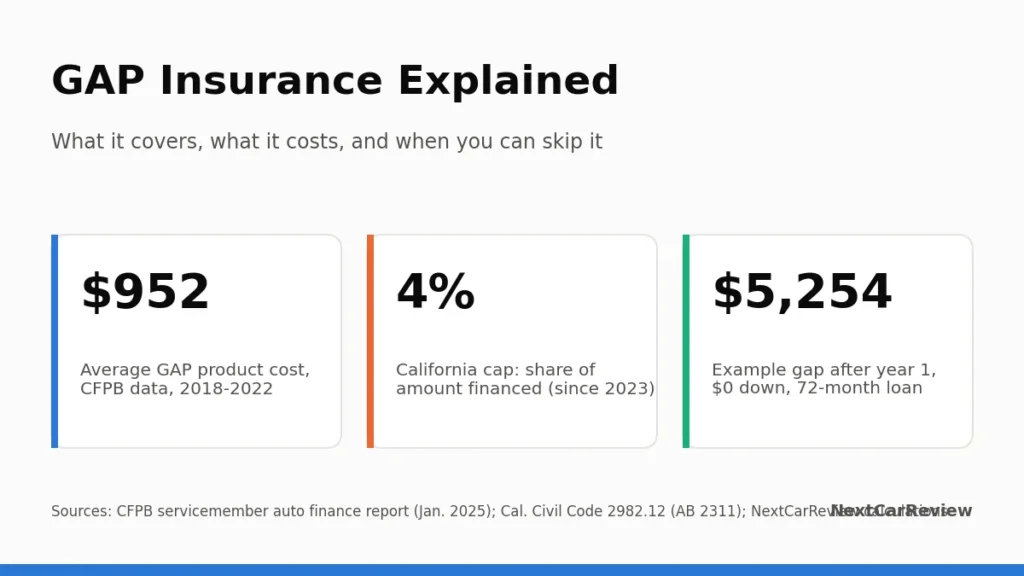
CFPB loan data put the average GAP product sold with servicemembers’ auto loans at $952 (2018-2022), and the CFPB says costs were similar for other borrowers. It is most valuable when you put little down, take a 60- to 84-month loan or roll in negative equity: in this article’s example, a $0-down 72-month buyer owes about $5,254 more than the car is worth after one year. A buyer with 20% down on a 48-month loan never needs it.
Product rules come from the CFPB, cost data from CFPB’s auto finance data pilot, and price caps from California and Texas law. NextCarReview does not lend money, sell insurance or test financial products for this guide; see our sourcing policy.
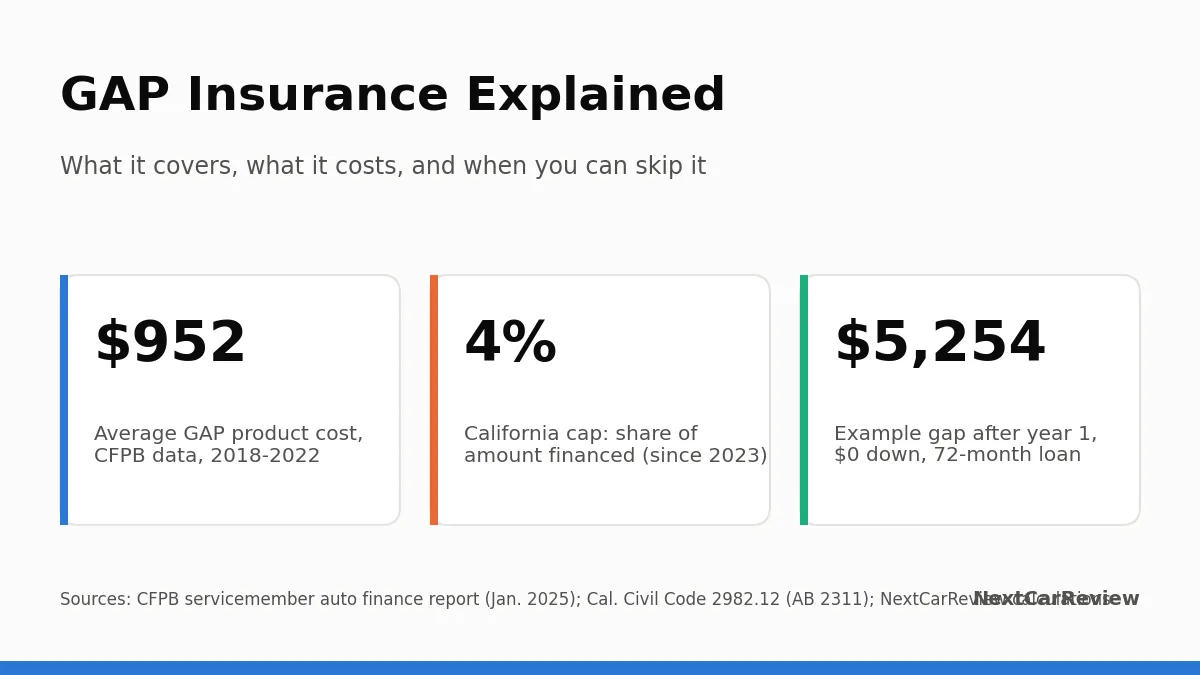
When a financed car is totaled, your auto insurer pays its actual cash value, not what you owe. In the first years of a long loan those two numbers can be thousands of dollars apart, and the lender still expects the balance. GAP exists to cover that difference. Whether it is worth buying depends on how big your gap is likely to be, how long it lasts, and how much you pay for the coverage. The math below uses the same amortization formula as the NextCarReview auto loan calculator.
What GAP Covers and What It Does Not
| Usually covered | Usually not covered |
|---|---|
| Difference between the loan or lease payoff and the insurer’s total-loss payment | Your collision or comprehensive deductible (some contracts cover it; many do not) |
| Total loss from a covered collision, theft or other covered peril | Missed payments, late fees and past-due amounts |
| Negative equity rolled in from a prior car (subject to contract limits) | Extended warranties or other add-ons financed into the loan |
| Anything if you lack the required physical damage coverage |
Terms vary by contract. Some GAP contracts cap the payout or exclude certain amounts; read the contract before buying.
GAP comes in two forms. A GAP waiver or debt cancellation agreement is sold by the dealer or lender as part of the financing contract. GAP insurance (sometimes called loan/lease payoff coverage) is an endorsement on an auto insurance policy and is regulated by your state insurance department. The CFPB recommends comparing the price from your auto insurer with what the dealer or lender offers.
How Big Is Your Gap? A Worked Example
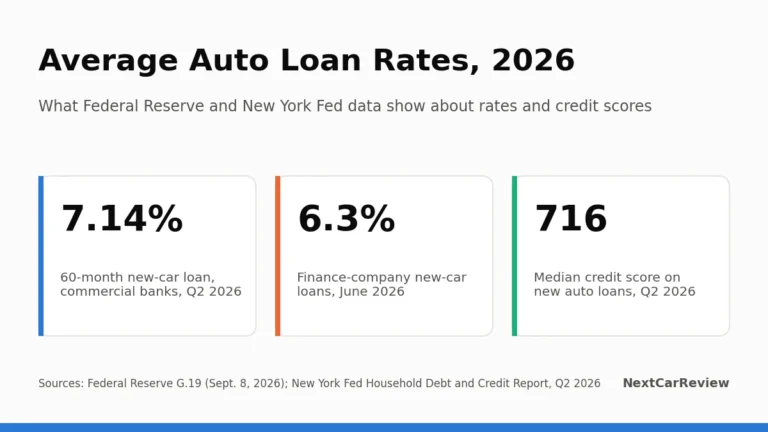
Take a $40,000 vehicle with 6% sales tax and $1,000 in fees, financed at 6.3% APR (the Federal Reserve’s June 2026 average for finance-company new-car loans). Assume the car loses 20% of its value in year one and 15% a year after that; real depreciation varies widely by model, so treat this only as an illustration.
Balance after k payments = P(1 + r)k − payment × ((1 + r)k − 1) / r, with r = APR / 12. The gap is that balance minus the vehicle value.
| Scenario | Amount financed | Gap after 12 months | Gap after 24 months | Months underwater |
|---|---|---|---|---|
| $0 down, 72 months | $43,400 | $5,254 | $3,509 | 38 |
| $0 down + $5,000 rolled-in negative equity, 72 mo | $48,400 | $9,546 | $7,047 | 44 |
| 20% down, 48 months | $35,400 | $0 | $0 | none |
Illustrative depreciation path; NextCarReview calculations using standard amortization.
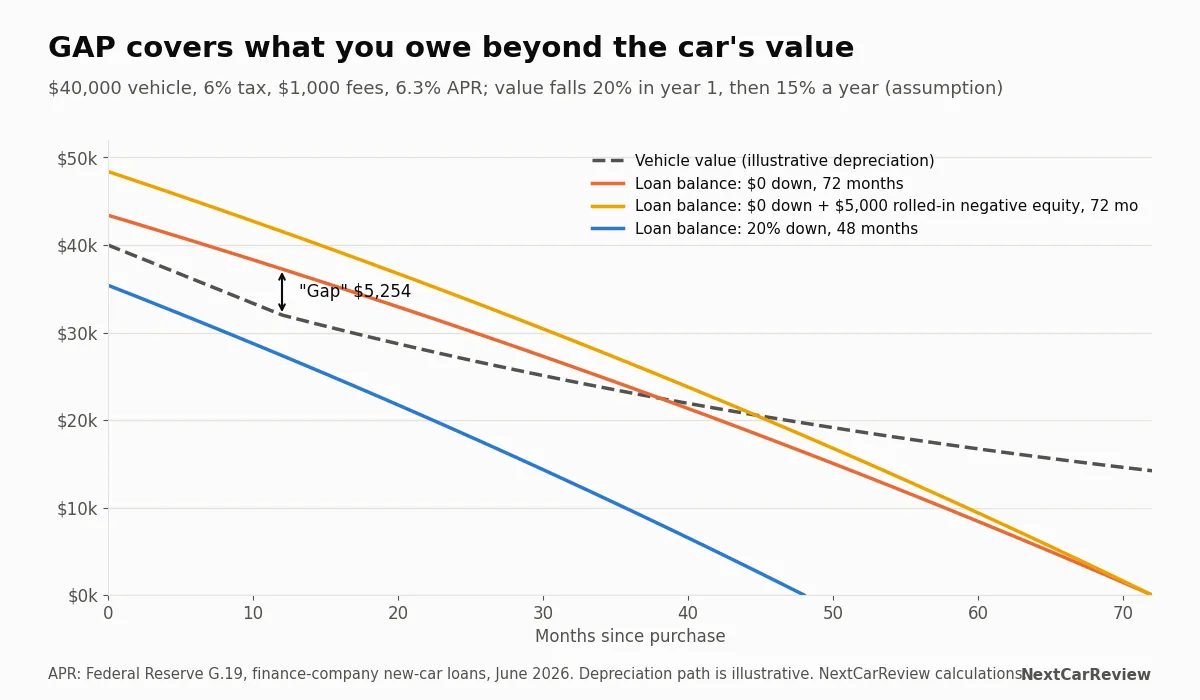
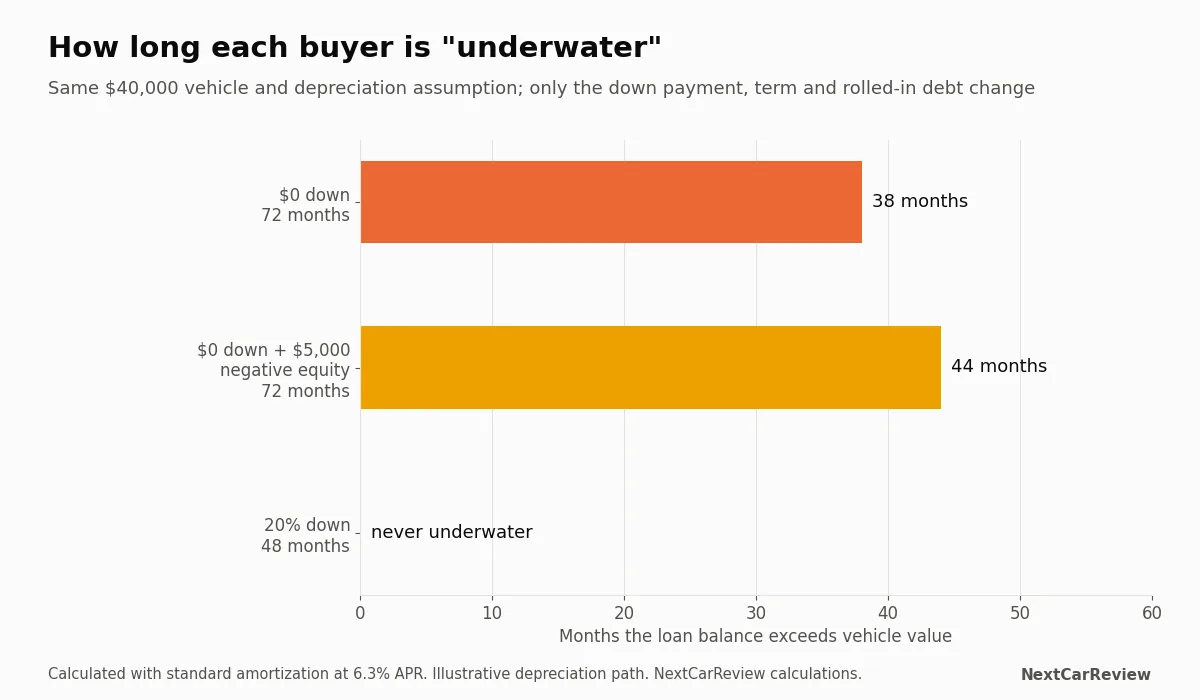
The $0-down buyer starts underwater because tax and fees are financed, and stays there for 38 months. Rolling $5,000 of negative equity from a trade-in extends that to 44 months with a peak gap near $9,546. The CFPB’s auto finance data show this is common: average negative equity on trade-ins financed into new-vehicle loans was about $5,900 for servicemembers and slightly less for other borrowers.
Run your loan through the auto loan calculator, read the remaining balance from the amortization schedule, and compare it with a current market value estimate for your car. Open the calculator →
What GAP Costs
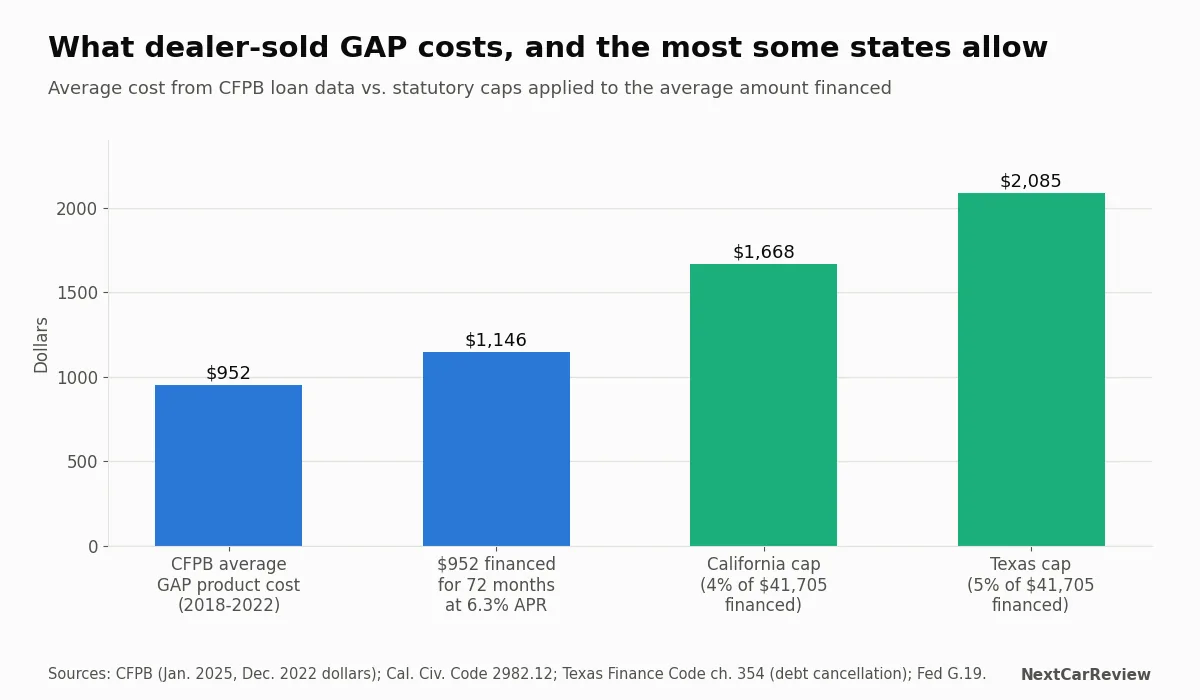
In the CFPB’s auto finance data pilot covering loans from 2018 to 2022, GAP products bought by servicemember borrowers averaged $952 in inflation-adjusted (December 2022) dollars, rising from $897 in January 2018 to $946 in December 2022; the CFPB says add-on costs were similar for other borrowers. Financing that $952 for 72 months at 6.3% brings the total to about $1,146 with interest, roughly $194 that you avoid by paying for the product up front.
Some states cap the price. California’s AB 2311 (Civil Code section 2982.12, effective January 1, 2023) limits a GAP waiver charge to 4% of the amount financed and bars its sale when the amount financed is less than 70% of the vehicle’s MSRP (new) or average retail value (used). Texas caps debt cancellation agreements on retail installment contracts at 5% of the amount financed. Applied to the average new-car amount financed of $41,705, those caps are about $1,668 and $2,085.
Refunds: The Step Most Owners Miss
GAP is priced to cover the risky early years of a loan. Once your balance falls below the car’s value, the coverage has little left to do. The CFPB says you may be eligible for a refund of the unused portion if you sell, refinance or pay off the loan early, and you can cancel optional products at any time. In a 2022 report the CFPB found some servicers did not request refunds of “unearned” GAP fees after early payoff or repossession, and some miscalculated refunds on other financed add-ons such as extended warranties. If you pay off or refinance, request the GAP refund in writing and keep a copy.
Pros and Cons of GAP
| Pros | Cons |
|---|---|
| Can prevent owing thousands on a car you no longer have | Dealer-sold GAP is often financed, so you pay interest on it |
| Most useful in exactly the high-risk years of a long loan | Payout caps and exclusions vary by contract |
| Cancellable, with possible refunds of unused coverage when you exit the loan | Unnecessary once you owe less than the car is worth |
| Price capped in some states (e.g., 4% in California) | Overlaps with GAP already included in some leases |
Who Should Consider GAP
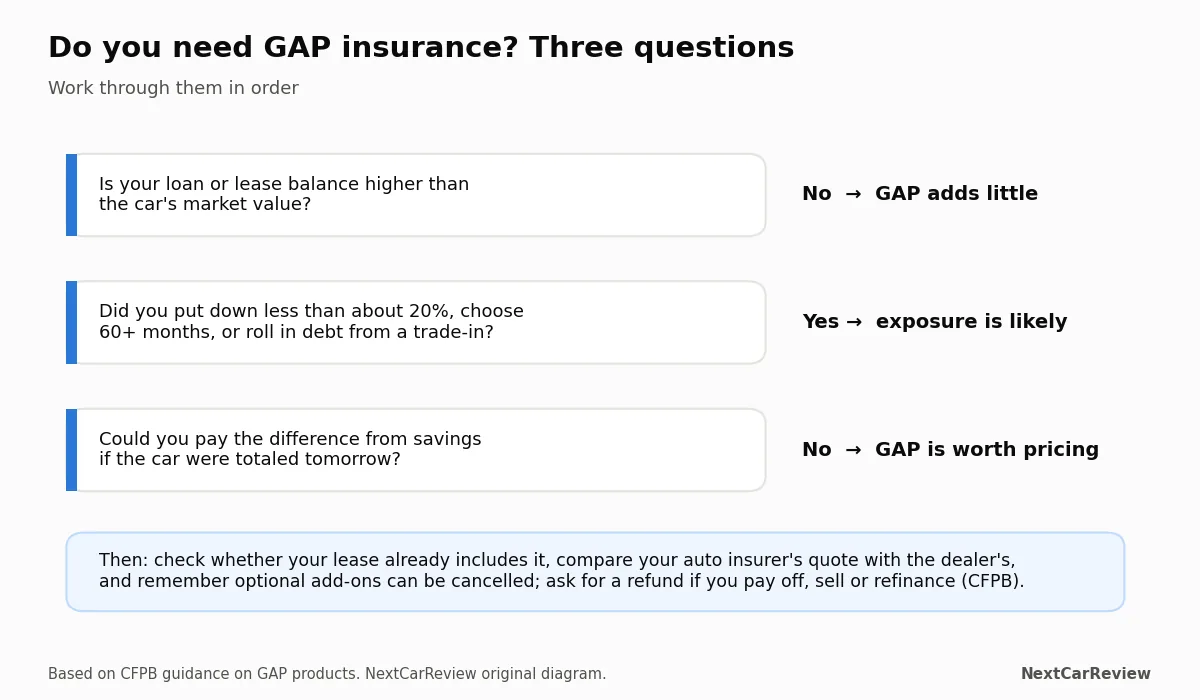
- Buyers putting less than about 20% down, financing taxes and fees, or taking terms of 60 months or longer.
- Anyone rolling negative equity into a new loan.
- Drivers of models that depreciate quickly.
- Buyers taking long promotional loans, such as 0% financing for 72 months, where little principal is paid early.
If you already carry collision and comprehensive coverage, ask your insurer for a GAP or loan/lease payoff quote alongside your regular policy; our guide to getting the cheapest auto insurance quotes covers how to compare insurers. For the full set of financing terms to check before you sign, see the car loan calculator guide.
Car Finance Guides
Run your own numbers: auto loan calculator, car payment calculator and auto insurance calculator. More in this series:
Frequently Asked Questions
What does GAP insurance cover?
The CFPB describes GAP (guaranteed asset protection) as an optional product intended to cover the difference between what you owe on your auto loan and what your insurer pays if the car is stolen or totaled. Standard auto insurance pays only up to the vehicle’s value.
How much does GAP insurance cost?
In CFPB loan-level data for 2018 to 2022, GAP products bought by servicemember borrowers averaged $952 (in December 2022 dollars), and the CFPB says costs were similar for other borrowers. If that amount is financed for 72 months at 6.3%, the total cost with interest is about $1,146. GAP added to an auto insurance policy is priced separately by the insurer, so compare quotes.
Is GAP insurance required?
Generally no. The CFPB says that in most situations you cannot be required to buy GAP, an extended warranty or credit insurance to get an auto loan. If a lender says GAP is mandatory, ask to see it in the contract; a required charge must be included in the disclosed APR. Some leases require or already include GAP coverage.
Can I cancel GAP insurance and get a refund?
Yes. The CFPB says you can cancel optional add-on products and may be eligible for a refund of the unused portion if you pay off, sell or refinance the loan. The CFPB has also reported cases where servicers failed to request GAP refunds after early payoff, so ask for the refund in writing.
Is there a limit on what a dealer can charge for GAP?
Some states cap it. California limits a GAP waiver charge to 4% of the amount financed under Civil Code section 2982.12, effective 2023, and Texas caps debt cancellation agreements at 5% of the amount financed. Check your state’s rules.
When can I skip GAP insurance?
When you owe less than the car is worth, for example after a down payment of about 20% on a shorter loan, or once you have paid the balance below the car’s value. In this article’s example, a buyer with 20% down on a 48-month loan is never underwater.
⚠️ Professional Notice:
This article is general educational information, not insurance, financial or legal advice. GAP products differ by contract and state, and some are insurance while others are debt cancellation agreements regulated under finance law. The depreciation path in the examples is an assumption; cost data come from CFPB loan-level research covering 2018-2022; state caps are summarized from California and Texas law and may change. Read your contract and consult your state insurance department or a licensed professional for advice on your situation. NAIC consumer materials are linked for reference only.
NextCarReview does not receive compensation from any lender, dealer or insurer for this coverage.
Data Sources and Verification
- CFPB: What is Guaranteed Asset Protection (GAP) insurance? (reviewed Mar. 8, 2024)
- CFPB: Am I required to purchase an extended warranty, GAP insurance, or credit insurance to get an auto loan?
- CFPB blog: Overcharging for add-on products on auto loans (May 2, 2022)
- CFPB: Auto lending to servicemembers report, add-on product costs (Jan. 2025)
- CFPB Data Spotlight: Negative equity findings from the auto finance data pilot (June 2024)
- California AB 2311 (2022), Civil Code section 2982.12: GAP waivers
- Texas OCCC: Review of debt cancellation agreements (motor vehicle sales finance)
- NAIC: A Consumer’s Guide to Auto Insurance (linked for reference; not reproduced)
- Federal Reserve G.19 Consumer Credit, Terms of Credit (Sept. 8, 2026)
Figures were checked against the sources above between September 15 and October 3, 2026. Rates, prices and laws change; verify before you rely on them.

Morgan Reyes is the founder and editor-in-chief of NextCarReview, which Morgan launched in August 2024. A 2022 graduate of Columbia University, Morgan is based in New York and writes and edits the site’s reviews, comparisons and buying guides. Morgan does not road-test vehicles. Every article is built from published primary data: EPA FuelEconomy.gov ratings, NHTSA crash ratings, recalls and owner complaints, IIHS results, and manufacturer specifications and pricing, with each figure cited and checked before publication. Contact: admin@nextcarreview.com