In this article 11 sections
This trouble code means your engine runs colder than it should, and the cooling system is usually the reason. So we explain what it means, the warning signs you will notice, the real 2026 repair costs, and the easy checks you can run at home. In short, you decide fast whether to grab a wrench or book the shop.
Figures cross-checked against EPA, NHTSA, IIHS and manufacturer sources. See our sourcing policy.
A P0128 code means your engine is not warming up fast enough, and most of the time a stuck-open thermostat is the reason. So the good news lands right away. Certainly this is one of the cheaper, simpler codes you will ever chase.
Your car still runs, and it drives fine. But the check engine light nags at you, and the heater feels weak on cold mornings. This code shows up across trucks, sedans, and SUVs alike, and it worries drivers more than it should.
Here is our promise. First, we walk you through what the code means in plain words. Then we cover the symptoms, the causes, and the real cost to fix it. After that, you can try a few home checks before you spend a dime. So stick with us, and by the end you will know exactly what to do next.
If your scan returned a lean fuel fault or another sensor code alongside P0128, our P0171 code guide covers the vacuum and fuel delivery diagnosis that sometimes runs parallel to a cooling system fault on the same vehicle. And for Nissan owners with a companion air-fuel sensor code, our P1148 Nissan fix guide covers the related sensor path step by step.
What Does P0128 Mean?
P0128 Code – Quick Diagnostic Intelligence
What does P0128 mean in plain terms? It means your coolant never gets as warm as the thermostat is supposed to hold it. So the car’s computer flags a problem and turns on the light.
Coolant Below Thermostat Regulating Temperature
Your engine likes to run hot, but not too hot. So the thermostat controls that sweet spot. When the coolant temp below the thermostat regulating temperature drags on too long, the computer notices, and it sets the code.
Think of the thermostat as a gate. First it stays shut until the engine warms up. Then it opens to let coolant flow. But a bad gate stays open, so the engine cooling never lets the heat build.
How the ECU Detects It
The engine control unit watches your coolant temperature all the time. Certainly it knows how fast the engine should warm up. When the engine running cold pattern lasts too long, the ECU acts. So the code appears through your car’s onboard diagnostics system.
This is smart, quiet work happening in the background. Meanwhile, you just feel a weak heater. The computer, however, sees the numbers and calls it out fast.
Symptoms of a P0128 Code

P0128 code symptoms show up in small, annoying ways at first. And most drivers notice the light before anything else. But a few other clues follow close behind.
Check Engine Light
The check engine light is the loudest warning here. But it glows steady, not flashing. So you have time to plan your fix. Still, do not ignore it for weeks, because small problems grow into bigger ones when left alone.
Slow Warm-Up and Cold Cabin Heat
Cold mornings expose this one fast. So your heater blows cool air far too long. Meanwhile, the temperature gauge crawls up slowly, or never reaches the middle. As a result, your commute feels chilly and unpleasant.
Reduced Fuel Economy
A cold engine burns more fuel. Meanwhile, your car thinks it is still warming up, so it dumps in extra gas. As a result, your miles per gallon slip.
Common Causes of P0128

A P0128 thermostat fault tops the list of causes. But it is not the only culprit, and coolant and sensors play a part too. So let us break down the usual suspects.
Stuck-Open Thermostat
A p0128 stuck open thermostat is the number one cause by a wide margin. The gate never closes, so coolant flows before the engine is ready. As a result, the engine stays cool and the code sets. So most repairs start right here.
Faulty Coolant Temp Sensor
Sometimes the thermostat is fine, but the sensor lies. A bad p0128 coolant temperature sensor sends the wrong reading to the computer. So the ECU thinks the engine is cold when it is not. Likewise, this one is cheaper to swap than a thermostat.
Low Coolant Level
Low coolant can trip this code too. First, air pockets form when the level drops. So the sensor reads air instead of fluid. Above all, check your coolant first, because a top-off might be all you need.
How to Diagnose P0128 Yourself

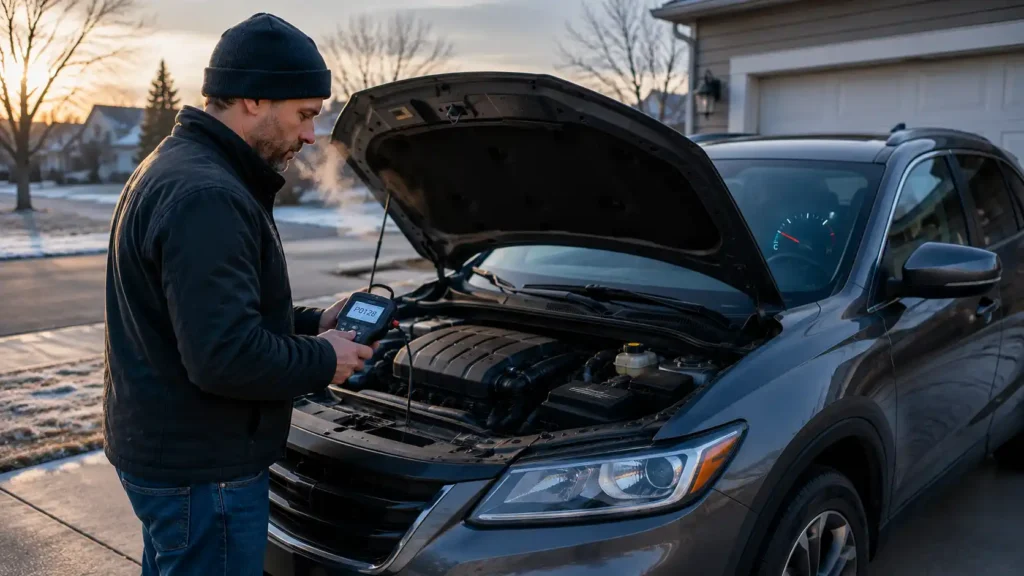
A P0128 code is one of the friendliest codes for a home mechanic. So you need only a few basic tools. Roll up your sleeves, and follow these steps in order.
Check Coolant Level
Start with the easy stuff. First, pop the hood when the engine is cold. Then look at the coolant reservoir. If it sits below the line, top it off with the right mix. So you rule out the cheapest cause first.
Monitor Warm-Up Temperature
Grab a cheap scan tool for this step. Then watch the coolant temperature as the engine warms. Then a healthy engine usually settles near its thermostat rating, often around 190 to 205 degrees Fahrenheit depending on the make. But a stuck-open thermostat typically leaves it well below that. So the numbers tell the story of your engine cooling.
Test the Coolant Temp Sensor
Now check the sensor with a multimeter. And its resistance should change as the engine heats up. But if the reading stays flat, the sensor is likely dead. So you found your problem without a trip to the shop.
How Much Does It Cost to Fix P0128?
P0128 repair cost stays gentle compared to most engine codes. Parts are common, and labor is short. So you rarely face a scary bill here.
| Repair | Parts (2026) | Labor | Total Range |
|---|---|---|---|
| Thermostat replacement | $40 to $120 | $110 to $280 | $150 to $400 |
| Coolant temp sensor | $20 to $80 | $80 to $170 | $100 to $250 |
| Coolant flush and refill | $30 to $60 | $70 to $140 | $100 to $200 |
| Full diagnostic scan | N/A | $75 to $150 | $75 to $150 |
These are editorial estimates, not quotes. Costs vary by vehicle make, model year, region, and shop. Warranty or service-campaign repairs may cost you nothing.
Thermostat ($150 to $400)
The thermostat replacement cost lands between $150 and $400 for most cars. Certainly the part itself is cheap. So most of the money goes to labor. Bigger engines with tucked-away thermostats cost more, but the range holds for daily drivers.
Sensor ($100 to $250)
A sensor swap runs lighter on your wallet. So the p0128 repair cost here sits around $100 to $250. Likewise, the sensor is small and easy to reach on many models. Certainly this is the friendliest fix on the list.
Vehicle-Specific Notes
P0128 on Dodge and Jeep models shows up often, and the pattern rarely surprises us. So brand quirks matter here, and a few notes save you time and guesswork.
P0128 on Dodge/Jeep
On Dodge and Jeep models the thermostat is the usual suspect. For example, Stellantis TSB 07-006-24 Rev. A covers a thermostat that sticks open and sets P0128 on some 2024-2025 Jeep Compass models, and the fix is a new thermostat under warranty. So check for open bulletins by VIN, then start with the thermostat on these rigs.
Our early review of the 2025 Jeep Grand Cherokee covers the cooling system context and service schedule for this generation. And our 2023 Jeep Grand Cherokee review covers the same generation, so ask a dealer to check your VIN for any open cooling-system bulletins.
P0128 on Honda
Honda bulletins point both ways. Honda service bulletin A13-044 says a thermostat valve on some 2012-2013 Civics can stick open and set P0128, while older Honda bulletins fixed false P0128 codes with a PCM software update. So check for bulletins and software updates first, then test the thermostat and sensor.
Our 2017 Honda Civic full review covers that generation’s engines and maintenance needs. And our 2025 Honda Civic Hybrid review covers the current generation for owners of newer models.
Can You Drive With a P0128 Code?
A P0128 code will not leave you stranded on the road. Your engine still runs and shifts fine, so short trips are safe. But do not treat this light as background noise for months.
Driving Safely With a P0128 Code
You can drive, yet you pay a hidden tax. Meanwhile, poor gas mileage and a cold cabin follow you every day. So the smart move is a quick p0128 code fix before winter bites. In short, a small repair now beats a cold, costly commute later.
How to Prevent P0128
A good p0128 code fix also stops the next one from creeping back. So prevention is simple and cheap, and a little care goes a long way.
First, flush your coolant on schedule. But old fluid turns acidic and eats at parts. So fresh coolant protects your thermostat and sensor. In addition, check your reservoir level every month, and top it off when it dips.
Meanwhile, watch your temperature gauge on every drive. When it climbs slower than usual, act early. So you catch trouble before the light ever glows. In short, small habits keep this code off your dash for good.
Conclusion
A P0128 code sounds scary, but it is one of the kindest codes your car can throw. Most of the time, a cheap thermostat sets everything right. So you fix it fast and drive warm again.
First, start with the coolant. Then check the thermostat, and test the sensor. So you spend money only where it counts. Above all, we built this guide to save you both cash and cold mornings.
Want more help with your dash lights? Read our full library of DTC guides next, and tackle your next code with the same confidence.
Frequently Asked Questions About the P0128 Code
What does code P0128 mean?
Can I drive with a P0128 code?
How much does it cost to fix P0128?
Will a new thermostat fix P0128?
Can low coolant cause P0128?
Is P0128 an emissions failure?
Related guides: browse all trouble code guides.
⚠️ Professional Notice:
All repair cost figures in this article are editorial estimates. Real costs vary by vehicle make, model year, engine type, geographic region, parts brand, and whether work is performed at a dealership, independent shop, or at home. Always obtain multiple quotes before authorizing any repair.
Diagnostic steps and specifications outlined in this guide are general procedures. Target coolant temperatures (approximately 195 degrees Fahrenheit) vary by manufacturer and model. Consult your vehicle’s factory service manual for the correct regulating temperature and diagnostic specifications before performing any test. Emissions test outcomes for P0128 vary by state and testing program. NextCarReview.com does not receive compensation from any parts manufacturer, retailer, or repair chain in exchange for rankings or editorial coverage.
Data Sources and Verification
- OBD-II DTC definitions – Society of Automotive Engineers (SAE) J2012 standard P0128 coolant temperature below thermostat regulating temperature documentation
- OEM service bulletins on NHTSA: Stellantis TSB 07-006-24 Rev. A (thermostat stuck open, P0128); Hyundai TSB 18-01-012 (thermostat replacement, P0128); Honda bulletin A13-044 (2012-2013 Civic, P0128)
- Repair cost ranges – editorial estimates; get written quotes for your vehicle
- Labor rate data – 2026 US independent shop and dealership labor rate benchmarks
- Open recalls and service campaigns by VIN – NHTSA recalls lookup

Morgan Reyes is the founder and editor-in-chief of NextCarReview, which Morgan launched in August 2024. A 2022 graduate of Columbia University, Morgan is based in New York and writes and edits the site’s reviews, comparisons and buying guides. Morgan does not road-test vehicles. Every article is built from published primary data: EPA FuelEconomy.gov ratings, NHTSA crash ratings, recalls and owner complaints, IIHS results, and manufacturer specifications and pricing, with each figure cited and checked before publication. Contact: admin@nextcarreview.com