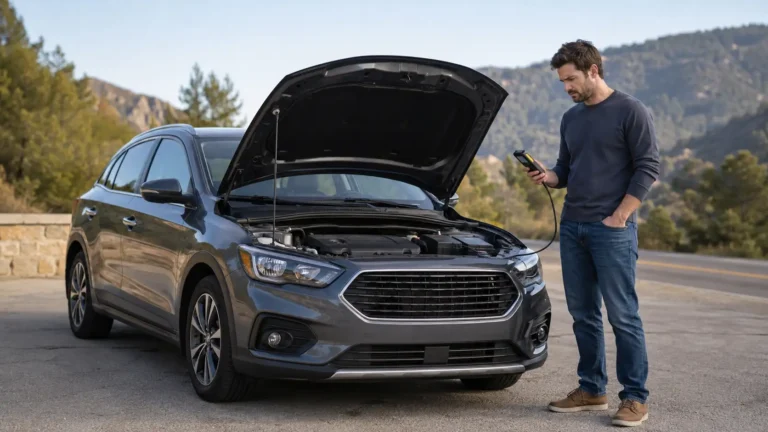

P1148 is a Nissan-specific code indicating your Bank 1 Air-Fuel Ratio sensor has failed to let the engine enter closed-loop control. This isn’t just a “check engine light.” It’s a warning that your fuel management system is stuck running rich on fixed maps instead of real-time data.
Left unaddressed, you’re burning 8 to 15% more fuel and accelerating catalytic converter damage. Most common cause: a worn AFR sensor ($230 to $420 repair). Second most common: corroded wiring or an exhaust leak upstream of the sensor.
DIY-friendly for those with basic tools, but proper diagnosis (heater circuit testing, smoke test) prevents replacing the wrong part. Don’t ignore it. This code will fail your emissions test and the converter replacement costs 5 to 10× more than the sensor.
Verified for accuracy by our Lead Technical Analyst.
Sources: Nissan TSB Portal (NHTSA), EPA OBD I/M Program, SAE J1979, CA BAR
Here’s the thing about P1148. It’s not just a “check engine light problem.” It’s a warning that your engine’s air-fuel management system has lost the feedback loop it depends on to run efficiently.
Miss it long enough and you’re not looking at a $175 sensor replacement anymore. You’re looking at a $2,200 catalytic converter job.

Most articles online lump P1148 in with generic oxygen sensor codes and call it a day. That’s a problem, because P1148 is a Nissan manufacturer-specific code. It behaves differently, it has model-specific Technical Service Bulletins (TSBs) on file with NHTSA, and it involves a sensor type that generic O2 sensor diagnostics don’t fully cover.
This guide is built specifically for Nissan owners: Altima, Frontier, Maxima, Quest, Armada. This guide includes model-year callouts, verified repair costs, and a step-by-step diagnostic process that mirrors what an ASE-certified Nissan technician actually does. No filler.
📌 P1148 Nissan: Quick Intelligence Summary (2026)
Key Facts at a Glance
| Code Type | Nissan Manufacturer-Specific (P1xxx series) |
| Affected System | Bank 1 Air-Fuel Ratio (AFR) Sensor / Closed-Loop Control |
| Most Common Cause | Faulty AFR Sensor (90,000–120,000 mile lifespan typical) |
| Repair Cost Range | $230–$420 (independent shop) | $280–$500 (dealership) |
| DIY Difficulty | 3/10. Basic tools required, 45 to 60 minutes |
| Drivability Impact | Reduced MPG (8–15% loss), rough idle, potential stalling |
| Emissions Test | Automatic failure in OBD I/M states (CA, NY, TX, etc.) |
| Warranty Coverage | Yes (if within 5yr/60k powertrain warranty period) |
| Active Nissan TSBs? | Yes, verified at NHTSA.gov TSB database |
| NextCar Analysis | Editorial Standard Verified ✔️ | Sources: NHTSA TSB Portal, SAE J1979, EPA OBD I/M |
What Is the P1148 Nissan Code?
P1148 is a Nissan manufacturer-specific diagnostic trouble code (DTC) indicating that the Air-Fuel Ratio (AFR) Sensor on Bank 1 has failed to allow the engine to enter closed-loop control mode. In plain terms: your engine’s main feedback sensor isn’t giving the Engine Control Module (ECM) the data it needs to properly balance air and fuel during normal operation. The result is poor fuel economy, rough running, and catalytic converter damage if left unchecked.
To understand why this matters, break the code down digit by digit:
- P = Powertrain (engine or transmission-related)
- 1 = Manufacturer-specific code (not a universal SAE-defined code)
- 1 = Fuel and air metering system
- 48 = Specific fault identifier (AFR sensor closed-loop failure, Bank 1)

That first “1” after the “P” is critical. Unlike P0 codes (which have universal definitions across all makes), a P1 code’s meaning is set by the manufacturer. On a Nissan, P1148 specifically points to the wideband AFR sensor and the closed-loop transition failure. On a different brand, P1148 means something entirely different. Every diagnostic step in this guide is Nissan-specific for exactly this reason.
Bank 1 refers to the side of the engine containing Cylinder #1. On Nissan’s inline four-cylinder engines (like the QR25DE in the Altima and Frontier), Bank 1 is the entire engine, since there is only one bank. On V6 and V8 Nissans (like the VQ35DE in the Maxima or the VK56DE in the Armada and Titan), Bank 1 is the front/right bank when viewed from the driver’s seat.
Open-Loop vs. Closed-Loop Control: The System Behind P1148
This is the part most articles skip, and it’s exactly why those articles leave you confused about what P1148 actually means. Every Nissan engine runs through two fuel management modes depending on operating conditions.

Open-loop control kicks in during cold starts. The engine is cold, the AFR sensor hasn’t reached operating temperature yet, and the ECM doesn’t trust its readings. So instead of using live sensor data, the ECM pulls from pre-programmed fuel maps, fixed instructions baked into the software. The engine runs richer than necessary during this phase, which is why cold starts produce more emissions.
Closed-loop control is the normal operating mode once the engine warms up, typically after 1 to 3 minutes of running. At this point, the AFR Sensor (Bank 1) reaches its operating temperature and starts sending live exhaust data back to the ECM. The ECM then continuously adjusts fuel injection in real time, targeting the stoichiometric air-fuel ratio of 14.7:1, the chemically ideal balance where all fuel is burned completely.
P1148 triggers when the ECM expects the transition to closed-loop to happen, but it doesn’t. The engine has warmed up, conditions look right, but the AFR sensor isn’t delivering the signal quality the ECM needs to trust it. Rather than guessing, the ECM logs P1148 and stays in open-loop, which means the engine keeps running on those fixed fuel tables. That’s why you see higher fuel consumption, rougher running, and increased exhaust emissions.
Your short-term fuel trim (STFT) and long-term fuel trim (LTFT) readings on a live data scanner will both read abnormally when P1148 is active. The ECM cannot make real-time corrections because it has no reliable feedback to correct from.
Nissan’s AFR Sensor vs. a Standard O2 Sensor: Why This Distinction Changes Your Diagnosis
Here’s where most generic diagnostic guides go wrong, and it’s a meaningful mistake. Nissan’s Bank 1 upstream sensor is a wideband Air-Fuel Ratio (AFR) sensor, not the narrowband oxygen sensor found on older vehicles or used for downstream monitoring. These two sensor types work on completely different principles.

A narrowband oxygen sensor produces a voltage that swings between roughly 0.1V (lean) and 0.9V (rich). It tells the ECM which side of stoichiometric you’re on, but not by how much. It’s essentially a binary signal. A wideband AFR sensor like the one Nissan fits upstream on Bank 1 measures the precise air-fuel ratio across a wide range, typically 10:1 to 23:1. It gives the ECM a continuous, precise reading rather than a simple lean/rich toggle. This is why Nissan’s closed-loop control is more responsive and accurate than older systems.

Using a generic narrowband O₂ sensor test procedure on Nissan’s wideband AFR sensor will produce misleading readings. The voltage ranges are different, the resistance specifications are different, and the operating logic is different.
Always test the AFR sensor heater circuit to Nissan’s specified resistance range (typically 1.8 to 3.4 ohms for the heater element) using a multimeter. Do not use the 10 to 40 ohm range for narrowband sensors. Using the wrong spec can lead you to replace a perfectly functional sensor.
The AFR sensor also contains an internal heater element that brings the sensor up to operating temperature faster, usually within 20 to 30 seconds. If that heater circuit fails (which is a distinct failure mode from the sensor element itself), the sensor never reaches operating temperature and the ECM cannot enter closed-loop, triggering P1148. This is worth testing separately before condemning the full sensor.
What Causes P1148 on a Nissan? Root Causes Ranked by Frequency
Cause #1: Faulty AFR Sensor, Bank 1 (Most Common)
The wideband AFR sensor has a finite lifespan. Most Nissan sensors perform reliably to around 90,000 to 120,000 miles under normal conditions. But heat cycling, contaminated fuel, oil consumption, and coolant leaks all accelerate degradation. When the sensor element wears out, it produces sluggish or inaccurate readings that the ECM rejects, preventing the closed-loop transition.
Cause #2: Damaged Wiring Harness or Corroded Connector
The wiring harness running to the AFR sensor sits close to the exhaust manifold, a brutally hot environment over time. Heat causes the insulation to crack, and moisture causes connector pins to corrode. Either condition disrupts the signal between the sensor and the ECM. Before you replace the sensor, spend five minutes inspecting the connector for green oxidation, bent pins, or visible wire damage.
Cause #3: Exhaust Leak Upstream of the AFR Sensor
An exhaust leak upstream of (before) the AFR sensor introduces outside air into the exhaust stream. The sensor reads this diluted exhaust as “very lean”, a false reading that causes the ECM to question the data quality and refuse to enter closed-loop. A smoke test, or simply running the engine cold and listening for ticking near the manifold, can identify this.
Cause #4: MAF Sensor Contamination
The Mass Airflow Sensor (MAF sensor) measures incoming air volume and feeds this data to the ECM for fuel calculation. A dirty or failing MAF sensor sends the ECM incorrect air-intake data, which cascades into incorrect fuel trim targets and can prevent the AFR sensor’s readings from making sense to the ECM. Spraying the MAF sensor wires with dedicated MAF cleaner (never brake cleaner) is a low-cost first check.
Cause #5: ECM Software Fault
Rare, but documented. On several affected model years (see TSB section below), Nissan issued software updates for the ECM to correct closed-loop control logic errors. If your vehicle is on the TSB list and the AFR sensor tests healthy, an ECM reprogram at a Nissan dealership using the CONSULT-III diagnostic system is the next step.
P1148 by Nissan Model: Year-Specific Guidance & TSB Registry
Nissan issued Factory Technical Service Bulletins (TSBs) for P1148 on multiple model lines. A TSB is an official Nissan document sent to dealerships that identifies a known repair procedure for a recurring fault, it is not a recall, but it tells your technician exactly what to do. All TSBs listed here are verifiable at nhtsa.gov/recalls. Search by year and model.
| Model | Year(s) | TSB Number | Issue |
|---|---|---|---|
| Nissan Altima | 2005–2006 | NTB05-096a | AFR sensor signal irregularity / ECM software update |
| Nissan Maxima | 2004 | NTB04-078 | Closed-loop control logic fault / ECM reprogram |
| Nissan Quest | 2004 | NTB04-078 (4AT) / NTB04-082 (5AT) | Separate procedures for 4-speed vs. 5-speed transmission |
| Nissan Armada / Titan | 2004 | NTB04-080 | VK56DE engine AFR sensor recalibration |
Nissan Frontier 2005: Dedicated Guide
The 2005 Nissan Frontier is one of the most commonly searched vehicles for P1148, yet most diagnostic guides don’t address it specifically. Here’s what Frontier owners need to know. The 2005 Frontier came with two engine options, and Bank 1 sensor location differs between them:
- QR25DE (2.5L 4-cylinder): Single bank engine. The AFR Sensor is on the exhaust manifold, passenger side, before the catalytic converter. One sensor to test.
- VQ40DE (4.0L V6): V-configuration engine. Bank 1 is the right/front bank (driver’s side when viewed from the front of the truck). Sensor 1 is upstream of the catalytic converter on that bank. Do not confuse Bank 1 and Bank 2. Replacing the wrong sensor wastes time and money.

On high-mileage 2005 Frontiers (130,000+ miles is common on these trucks), the AFR sensor wiring harness is a frequent culprit before the sensor itself. Heat cycling from the VQ40DE runs hot and degrades the insulation over time. Check the connector at the sensor first before ordering a replacement sensor.
How to Fix P1148 Nissan: Step-by-Step Diagnostic & Repair Guide
Estimated total diagnostic time: 1–2 hours (DIY)
Step 1: Confirm the Code and Pull Freeze Frame Data
Connect your OBD-II scanner and confirm P1148 is stored. Then pull the freeze frame data, this snapshot shows exactly what the engine conditions were when the code triggered: engine temperature, RPM, load, and fuel trim values. (New to OBD-II diagnostics? This guide assumes basic scanner familiarity.)
If the fuel trim numbers are heavily positive (ECM adding lots of fuel trying to compensate), that points toward a lean condition from an exhaust leak or failing sensor. If they’re near zero but the code is set, suspect a sensor heater circuit failure.
Step 2: Inspect the AFR Sensor Wiring and Connector
Before touching the sensor, locate the Bank 1 AFR sensor connector and inspect it visually. Look for green corrosion on the pins, cracked or melted wire insulation, and connector tabs that aren’t fully seated. Repair any visible damage before proceeding. A $15 connector pigtail often fixes what looks like a $200 sensor problem.
Step 3: Test the AFR Sensor Heater Circuit
With the sensor connector unplugged and ignition off, set your multimeter to resistance (ohms) and probe the heater circuit pins. Refer to Nissan’s wiring diagram for your model (typically pins 1 and 2). Nissan’s AFR sensor heater resistance specification is approximately 1.8 to 3.4 ohms. A reading outside this range means the heater element has failed. Replace the sensor.
Step 4: Check for Exhaust Leaks Upstream of the Sensor
Start the cold engine and listen carefully near the exhaust manifold for a ticking or hissing sound that diminishes as the engine warms up. That’s a classic manifold leak signature. Alternatively, a smoke machine fed into the exhaust (engine off) will reveal leaks visually. Any leak upstream of the AFR sensor must be fixed before replacing the sensor, otherwise the new sensor will read the same diluted exhaust and P1148 will return.
Step 5: Clean or Test the MAF Sensor
Disconnect the MAF sensor and spray the sensing wires (the fine wires inside the housing) with dedicated MAF cleaner. Let it dry fully before reconnecting. If MAF-related codes are also stored (P0100 to P0103), test the MAF sensor’s voltage output with the engine running and compare to spec. A reading outside Nissan’s expected voltage range at idle confirms MAF failure.
Step 6: Replace the AFR Sensor (If Confirmed Faulty)
Use a genuine Nissan AFR sensor or a Denso OEM-equivalent. Denso supplies the original equipment sensors for most Nissan applications. Nissan’s ECM is calibrated to a specific sensor signal curve, aftermarket wideband sensors sometimes produce signal outputs that fall slightly outside this calibration range, causing the ECM to reject the data and re-trigger P1148 even with a brand-new part installed.
Apply anti-seize compound to the sensor threads (sparingly, keeping it off the first two threads to avoid contaminating the sensor element). Torque to Nissan’s spec, typically 33 ft-lbs.
Step 7: Clear the Code, Warm Up, and Verify Closed-Loop Entry
Clear the stored DTC with your scanner. Start the engine and monitor live data while it warms up. Watch the closed-loop status indicator, it should switch from “Open Loop” to “Closed Loop” within 1 to 3 minutes of normal idle. Take a 15-minute test drive with scanner connected, monitoring STFT and LTFT. Both should sit within ±5% at steady cruise speed.
Repair Costs and the Real Price of Ignoring P1148

| Repair Scenario | Parts Cost | Labor Cost | Total (Shop) | Total (DIY) |
|---|---|---|---|---|
| AFR Sensor Replacement (OEM) | $110–$210 | $120–$210 | $230–$420 | $110–$210 |
| Wiring Harness Repair | $15–$45 | $80–$150 | $95–$195 | $15–$45 |
| Exhaust Manifold Gasket | $25–$80 | $180–$350 | $205–$430 | $25–$80 |
| ECM Reprogramming (Dealership) | $0 | $100–$300 | $100–$300 | N/A |
| Catalytic Converter (if ignored) | $800–$1,800 | $400–$700 | $1,200–$2,500 | $800–$1,800 |
Driving with an active P1148 code wastes approximately 8 to 15% more fuel than a properly functioning closed-loop system, because the ECM defaults to a rich open-loop fuel map. On a vehicle averaging 25 MPG and 15,000 miles annually at $3.50/gallon, that works out to roughly $150 to $280 in excess fuel cost per year, before you even factor in component damage risk.
More critically: raw, unburned fuel from a rich-running engine accelerates catalytic converter degradation. A catalytic converter failure on a Nissan V6 runs $1,200 to $2,500 at a shop, including labor. That’s 5 to 10 times the cost of the AFR sensor that caused it.
If you’ve had P1148 active for more than 10,000 miles, ask your technician to check catalytic converter efficiency while diagnosing the AFR sensor. Codes P0420 (Bank 1) or P0430 (Bank 2) appearing alongside P1148 are a strong signal that converter damage has already begun.
Emissions test implications: P1148 sets the oxygen sensor and fuel system OBD readiness monitors to “Not Ready” status. In states that use OBD I/M testing (California, New York, Texas, and most others), your vehicle will fail the emissions inspection regardless of actual tailpipe emissions.
Preventive Maintenance: Keeping P1148 Away
Replace your AFR sensor as part of a scheduled maintenance check at 100,000 miles if no code has appeared. Proactive replacement costs less than reactive repair and prevents the catalytic converter risk entirely. This preventive approach applies to all Nissan models, from the budget-friendly 2025 Versa to the full-size Titan.
Inspect the AFR sensor wiring harness annually on any Nissan with 80,000+ miles, particularly near the exhaust manifold where heat damage accumulates. Use Top Tier certified fuel where available. Fuel quality directly affects sensor contamination rates over time. And if your Nissan has documented oil consumption (a known characteristic on some VQ-series engines at high mileage), check that oil isn’t fouling the AFR sensor element.
Go to an independent shop if: The root cause isn’t clear after visual inspection, or if you need a smoke test for exhaust leaks.
Go to a Nissan dealer if: Your vehicle is on the TSB list and ECM reprogramming is required, or if it’s still within warranty coverage.
Frequently Asked Questions: P1148 Nissan
What does P1148 mean on a Nissan?
What is the difference between P1148 and P0148?
¿Qué significa el código P1148 en un Nissan?
Can I drive my Nissan with P1148 active?
Will a tune-up fix P1148?
What Nissan models are most commonly affected by P1148?
What is P1148 on a 2004 Nissan Quest?
Is P1148 covered under Nissan’s powertrain warranty?
How much does it cost to fix P1148 on a Nissan?
Can I fix P1148 myself?
Will P1148 cause my car to fail an emissions test?
⚠️ Professional Notice:
This guide is provided for educational purposes. NextCarReview is not liable for any damages, injuries, or financial losses resulting from actions taken based on this content. Vehicle diagnostics and repairs involve inherent risks, always follow manufacturer specifications, use proper safety equipment, and consult a qualified ASE-certified technician when in doubt. OBD-II diagnostic procedures described here are standardized industry practices but individual vehicle conditions vary. Verify all Technical Service Bulletin information directly through the official NHTSA TSB database before proceeding with repairs.

The NCR Research Team is NextCarReview’s editorial collective specializing in automotive data analysis, EPA fuel economy research, and IIHS safety evaluation. Every specification in our guides is cross-verified against NHTSA.gov, EPA Fuel Economy.gov, and OEM press materials before publication.