
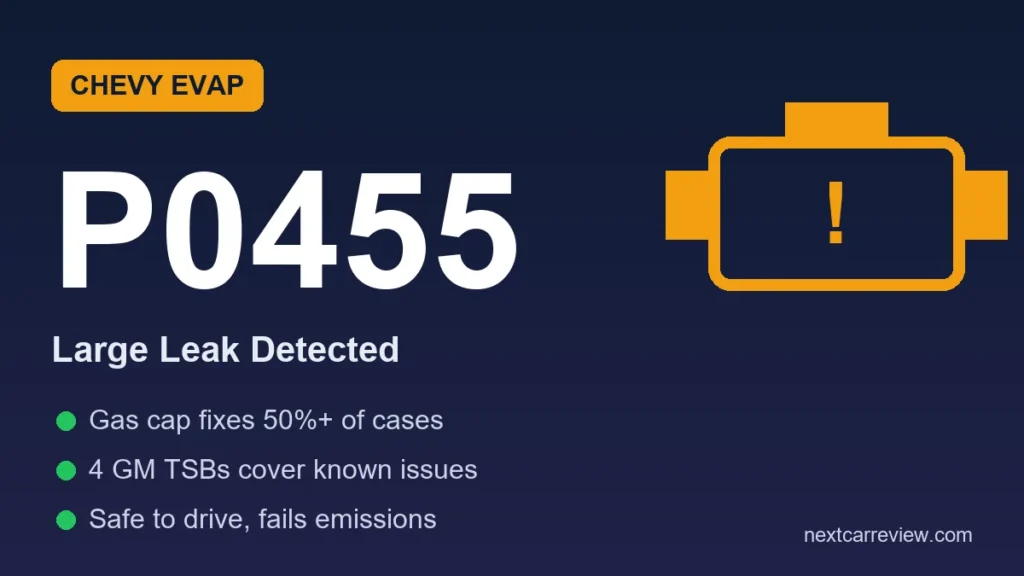
P0455 on a Chevy means the ECM detected a large EVAP system leak. A loose or cracked gas cap is the cheapest cause to rule out first, at about $10-$30. Four GM TSBs cover vent solenoid water intrusion, filler hose fractures, and dust clogging on Silverado, Tahoe, and Sierra trucks. P0455 does not affect engine performance and is safe to drive, but a lit check engine light typically fails an OBD-II emissions inspection.
GM EVAP TSBs verified against NHTSA database. Repair costs from RepairPal and GM dealer data. See our sourcing policy.
What Does P0455 Mean on a Chevy?
What Does P0455 Mean on a Chevy: Quick Diagnostic Intelligence
P0455 on a Chevrolet means the ECM detected a large leak in the EVAP (Evaporative Emission Control) system. “Large leak” means a hole equivalent to 0.040 inches or bigger. The EVAP system captures fuel vapors from the tank and routes them into the engine to be burned. When the ECM runs its self-test, it closes the vent solenoid, opens the purge valve, and monitors the fuel tank pressure sensor. If the system cannot pull down to the expected vacuum, which GM attributes to a large leak or a purge blockage, it sets P0455.
On Chevy trucks and SUVs, the vent valve and charcoal canister sit under the vehicle near the spare tire. That placement exposes them to road debris, water spray, and corrosion. On models with a screw-on cap, a worn seal or a cap that is not fully closed can create a large leak even when the cap looks tight.
P0455 does not affect engine performance. The engine runs normally, power stays the same, and fuel economy barely changes. But the check engine light stays on, and in states with OBD-II emissions inspections that is typically a failure.
Common Causes on Chevy (Ranked Cheapest to Most Expensive)
These causes are listed from the cheapest fix to the most expensive. GM publishes no breakdown of P0455 causes by frequency, so start with the cap and work forward, as its TSB 21-NA-124 checklist does.
- Loose, damaged, or missing gas cap ($10-$30). The rubber seal cracks, the cap does not click tight, or someone drove off without replacing it. On capless Chevy models, debris can jam the spring-loaded filler door. Always check the cap first before spending money on anything else.
- Stuck-open EVAP vent solenoid ($100-$300 at a shop). The vent valve sits near the spare tire on trucks. Road spray, dust, and corrosion cause it to stick open. When the vent stays open, the ECM cannot seal the system for its leak test. GM TSB 09-06-04-028D covers water intrusion on 2007-2010 Tahoe, Suburban, and Avalanche models.
- Stuck purge valve ($100-$300 at a shop). The purge solenoid sits on the intake manifold near the throttle body. GM lists a purge valve stuck closed as a cause of P0455; a valve stuck open is listed as a cause of the small-leak code P0442.
- Cracked or disconnected EVAP hoses ($80-$250 at a shop). Rubber hoses run from the engine bay to the rear of the vehicle. Heat, age, and rodent damage cause cracks and disconnections. On 2013-2015 Silverado and Sierra trucks, GM TSB 15-NA-019 covers a fractured fuel filler vent hose connector (GM part 22802073).
- Cracked or saturated charcoal canister ($250-$600 at a shop). The canister stores fuel vapors when the engine is off. Overfilling the gas tank or a stuck vent valve can saturate it with liquid fuel. GM TSB 23-NA-073 covers dust clogging the canister on 2019-2025 Silverado and Sierra trucks. The retrofit filter kit (GM part 86792068) is a customer-pay repair.
- Fuel tank pressure sensor, filler neck, or wiring ($150-$500 at a shop). Less common but possible. Corroded wiring at the vent solenoid connector is often overlooked. Check the connector before replacing the valve itself.
GM Technical Service Bulletins for P0455
The four GM TSBs below list P0455 among their codes on Chevrolet vehicles. A TSB is not a recall. It tells dealers how to diagnose a known issue, but the repair cost may or may not be covered depending on warranty status.
- TSB 09-06-04-028D (2007-2010 Tahoe, Suburban, Avalanche, Yukon, Escalade). Water intrusion corrodes the EVAP vent solenoid. Fix: replace with revised valve (GM part 20995472) and secure its vent pipe to the fuel filler pipe so water is less likely to get in.
- TSB 15-NA-019 (2013-2015 Silverado and Sierra, except Regular Cab). The fuel filler vent hose connector fractures, causing a fuel odor and EVAP leak. Fix: replace vent hose assembly (GM part 22802073).
- TSB 21-NA-124 (2000-2023 GM gasoline vehicles). Diagnostic guide listing seven critical EVAP connection points to inspect before replacing any parts. Covers purge tube connections, the chassis EVAP line, canister connections, the vent valve line, the fuel tank load line jumper, and whether the fuel cap is properly closed.
- TSB 23-NA-073 (2019-2025 Silverado 1500 and Sierra 1500; 2020-2025 Silverado and Sierra 2500 HD/3500 HD). Dust clogs the charcoal canister and vent solenoid in dusty conditions. Fix: retrofit external filter (GM part 86792068). This is a customer-pay alteration, not a warranty repair.
We found no NHTSA safety recall tied to code P0455 itself; GM has handled these EVAP conditions through TSBs, which are not recalls. Check your VIN at NHTSA.gov/recalls to confirm no open recalls exist for your specific vehicle.
How to Diagnose P0455 on a Chevy (Step by Step)
Start with the cheapest check and work forward. Many P0455 codes on Chevy clear after a simple gas cap fix.
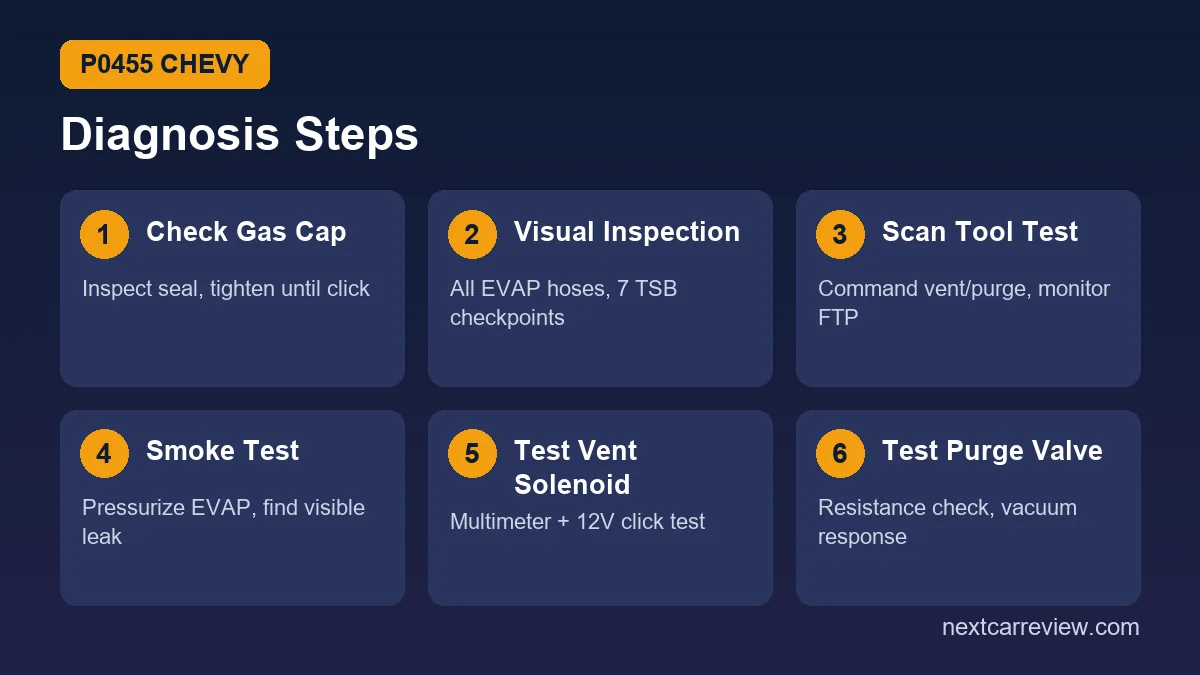
Step 1: Check the Gas Cap (5 Minutes, Free)
Inspect the rubber seal for cracks, warping, or debris. Tighten the cap until it clicks (3-4 turns). On capless models, inspect the spring-loaded filler door for debris or damage. Clear the code with an OBD2 scanner, then drive normally for several days. If P0455 does not return once the EVAP monitor has run, the cap was likely the problem.
Step 2: Visual Inspection (30 Minutes)
Inspect every EVAP hose from the engine bay to the rear of the vehicle. Look for cracks, disconnections, or rodent damage. TSB 21-NA-124 lists seven critical connection points: purge tube to purge valve, purge tube to chassis line, chassis line to canister, fuel tank load line to canister, vent valve line to vent valve, the fuel tank load line jumper connection, and the fuel cap being properly closed. Check for fuel odor near the rear of the vehicle.
Step 3: Scan Tool Testing (Requires Bidirectional Scanner)
Command the vent valve closed and the purge valve to 0%. Monitor the fuel tank pressure sensor. The system should hold vacuum. If pressure drops rapidly, a leak exists downstream. Then command the purge valve open and watch for a pressure change. No change means the purge valve may be stuck closed. Command the vent valve closed again. If fuel tank pressure does not change, the vent valve may be stuck open.
Step 4: Smoke Test ($100-$200 at a Shop)
A smoke machine pressurizes the EVAP system. Smoke exits at the leak point. For P0455 (large leak), smoke is usually visible without difficulty. This is the most reliable method to pinpoint the exact leak location and avoid replacing parts unnecessarily.
Step 5: Component Testing
Test the vent solenoid with a multimeter for proper resistance. Apply 12V directly to confirm it clicks and seals. Do the same for the purge valve. Check fuel tank pressure sensor readings with a scanner. On Silverado and Tahoe trucks, the vent solenoid is near the spare tire at the rear chassis. The purge valve is in the engine bay on the intake manifold near the throttle body.
P0455 Chevy Repair Costs
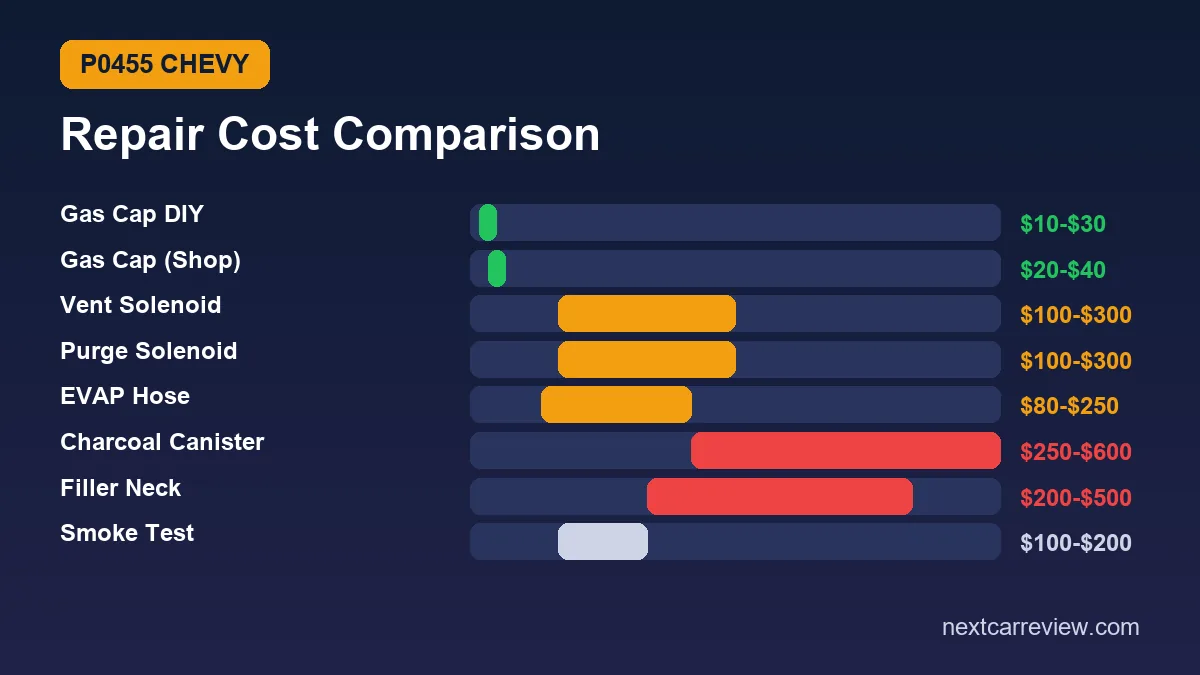
Costs vary by component and whether you do the work yourself. The gas cap fix is the cheapest and most common. Labor rates assume $100-$150/hour at a US shop.
| Repair | DIY Parts | Shop Total |
|---|---|---|
| Gas cap replacement (OEM quality) | $10-$30 | $20-$40 |
| EVAP vent solenoid replacement | $40-$120 | $100-$300 |
| EVAP purge solenoid replacement | $40-$100 | $100-$300 |
| EVAP hose repair or replacement | $10-$60 | $80-$250 |
| Charcoal canister replacement | $80-$300 | $250-$600 |
| Fuel filler neck replacement | $50-$150 | $200-$500 |
| Smoke test (diagnostic only) | N/A | $100-$200 |
Typical total cost for diagnosis plus repair runs $200-$600. The most expensive scenario (charcoal canister plus diagnostic) can reach $800. Always get a smoke test before authorizing valve or canister replacements.
P0455 vs P0456 on Chevy
Both codes indicate an EVAP leak, but the leak size and diagnostic approach differ. P0455 is a large leak (over 0.040 inches). P0456 is a very small leak (about 0.020 inches). Paradoxically, P0455 is easier to diagnose because the bigger hole shows up clearly on a smoke test. P0456 requires careful, close inspection of every seal and joint.
| Feature | P0455 (Large Leak) | P0456 (Very Small Leak) |
|---|---|---|
| Leak size | Over 0.040 inches | About 0.020 inches |
| Typical causes | Missing cap, disconnected hose, stuck-open valve | Worn seals, hairline cracks, aging gaskets |
| Smoke test visibility | Smoke pours out visibly | May need very close inspection |
| Diagnostic difficulty | Easier | Harder |
| Common fix | Replace cap, fix disconnected hose, replace valve | Replace cap seal, tighten connections, replace gaskets |
If both P0455 and P0456 appear together, start with the large leak, which is easier to find on a smoke test.
Which Chevy Models Get P0455 Most Often?
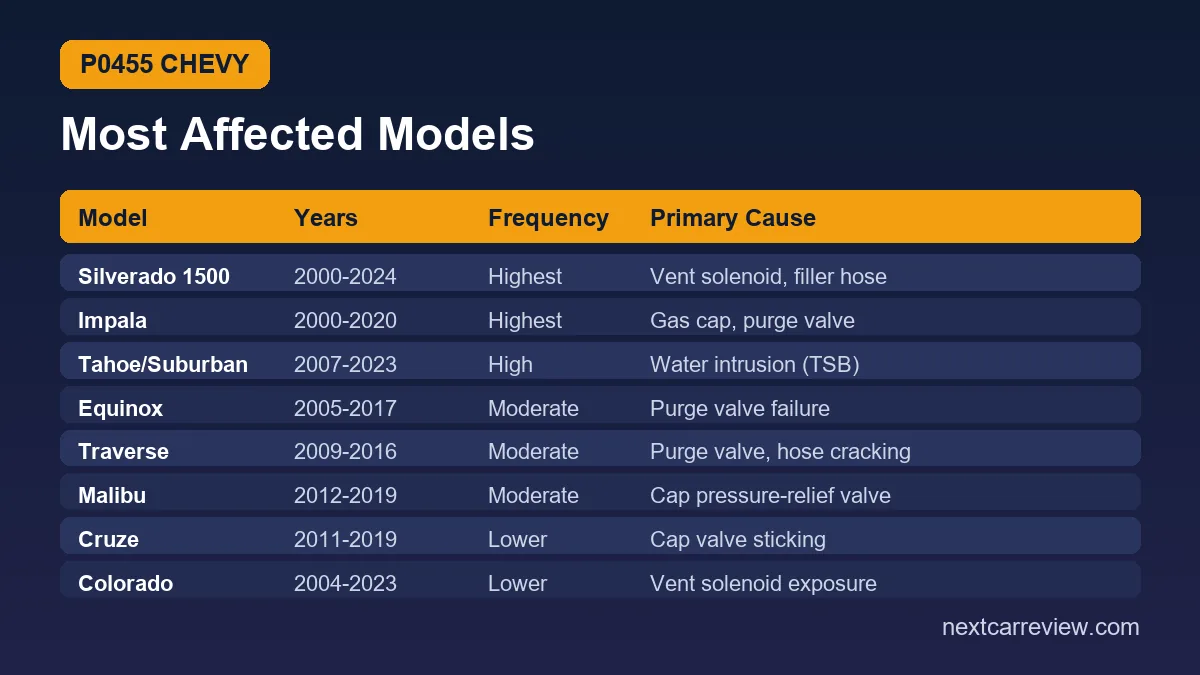
P0455 appears across the entire Chevrolet lineup, but trucks and full-size SUVs see it most frequently due to undercarriage exposure. The frequency ratings below summarize owner and repair-database reports (Go-Parts, ServiceSage Auto), not official failure-rate data.
| Model | Years | Frequency | Primary Cause |
|---|---|---|---|
| Silverado 1500 | 2000-2024 | Highest | Vent solenoid exposure, filler hose (TSB) |
| Impala | 2000-2020 | Highest | Gas cap, purge valve failure |
| Tahoe/Suburban | 2007-2023 | High | Water intrusion at vent valve (TSB) |
| Equinox | 2005-2017 | Moderate | Purge valve failure |
| Traverse | 2009-2016 | Moderate | Purge valve, hose cracking |
| Malibu | 2012-2019 | Moderate | Cap pressure-relief valve |
| Cruze | 2011-2019 | Lower | Cap pressure-relief valve sticking |
| Colorado | 2004-2023 | Lower | Vent solenoid exposure |
Is It Safe to Drive a Chevy with P0455?
Yes. P0455 does not affect engine power, transmission shifting, or braking. The EVAP system is completely separate from the engine’s lubrication, cooling, and combustion systems. The check engine light stays on, and fuel vapors escape into the atmosphere instead of being captured, but the vehicle drives normally.
However, P0455 causes an automatic emissions test failure in every state that requires testing. It also keeps the check engine light on, which can mask other codes that may indicate a more serious problem. If you smell raw gasoline (not just faint vapors), get the vehicle inspected immediately. A raw fuel smell could indicate a fuel line or tank issue rather than a simple EVAP leak.
Common Misdiagnoses to Avoid
P0455 is easy to misdiagnose when owners or shops replace parts without proper testing first.
- Replacing the gas cap when you hear a “whoosh” at the filler. That whoosh usually means the cap IS sealing. Strong pressure or vacuum at the filler can point to a restricted or stuck vent valve instead, so test the vent solenoid before buying another cap.
- The “parts cannon” approach. Replacing the gas cap, purge valve, and vent solenoid one after another without a smoke test. Owners on repair forums often report buying parts that did not fix the problem. A $100-$200 smoke test pinpoints the exact leak location.
- Replacing the wrong valve. On some Chevy platforms, the vent valve and purge valve look similar. Always verify the component location for your specific model year before ordering parts.
- Ignoring wiring and connectors. Corroded connectors at the vent solenoid cause intermittent failures. Replacing the solenoid without fixing the wiring means the code returns.
- Ignoring model-specific TSBs. A 2014 Silverado owner who replaces the vent valve may miss the fractured filler vent hose (TSB 15-NA-019). A 2009 Tahoe owner who replaces the vent valve without relocating it (TSB 09-06-04-028D) will see water intrusion again.
P0455 with Other EVAP Codes on Chevy
P0455 often appears alongside other EVAP-related codes. The combination tells you which component is most likely at fault.
- P0455 + P0449: The vent solenoid circuit has an electrical fault AND the system leaks. Fix P0449 first. If the vent valve cannot close, the system cannot seal for the leak test, which can trigger P0455. Once the vent circuit is fixed, recheck whether P0455 returns. See the P0449 Code Chevy guide for vent circuit diagnosis.
- P0455 + P0446: The vent control system is not performing correctly AND the system leaks. A restricted vent path or corroded vent valve is a common cause; GM TSBs 09-06-04-028D and 23-NA-073 list P0446 alongside P0455. See the P0446 Code Chevy guide for vent performance diagnosis.
- P0455 + P0442: Start with the large leak. GM’s TSB 21-NA-124 uses the same seven-point connection check for both codes.
- P0455 + P0496: P0496 points to excessive purge flow, often a purge valve stuck open. Confirm with a scan tool before replacing the purge solenoid.
- P0455 alone: Start with the gas cap. If the cap is good, get a smoke test.
P0455 on the Chevy Silverado
The Silverado is frequently reported with P0455, partly because its vent solenoid sits near the spare tire. Road debris, water, mud, and salt all attack the valve and its electrical connector. Three GM TSBs specifically cover Silverado EVAP issues: 15-NA-019 (filler hose, 2013-2015), 21-NA-124 (diagnostic checklist, 2000-2023), and 23-NA-073 (dust filter, 2019-2025).
On Silverado trucks, the vent solenoid is accessible from underneath the vehicle near the spare tire mount. The purge valve is in the engine bay on the intake manifold. If your Silverado operates in dusty conditions and gets P0455 repeatedly, ask your dealer about TSB 23-NA-073’s retrofit filter kit (GM part 86792068). It is a customer-pay part, not covered under warranty.
Frequently Asked Questions
Can I pass an emissions test with P0455 on my Chevy?
Will P0455 cause my Chevy to stall or lose power?
Is there a recall for P0455 on Chevy Silverado or Tahoe?
What is the difference between P0455 and P0449 on a Chevy?
Why does my Chevy keep throwing P0455 after I replaced the gas cap?
How much does it cost to fix P0455 on a Chevy?
⚠️ Professional Notice:
This guide covers P0455 (EVAP System Large Leak Detected) specifically on Chevrolet vehicles. Information is based on GM technical documentation and verified repair data. Always confirm diagnosis with a qualified technician before authorizing repairs.
Cost figures are published estimates and vary by vehicle, region and shop. Always get a written quote before authorizing a repair. NextCarReview.com does not receive compensation from any parts manufacturer, retailer, dealer or repair chain for editorial coverage.
Data Sources and Verification
- GM Technical Service Bulletins 09-06-04-028D, 15-NA-019, 21-NA-124, 23-NA-073 verified via NHTSA TSB database
- NHTSA recall database checked for P0455-related recalls on Chevrolet (none found)
- GM part numbers verified: 20995472 (revised vent valve), 22802073 (filler hose), 86792068 (dust filter kit)
- Repair cost ranges from RepairPal, AutoZone, and independent shop surveys
- Model-year frequency data from Go-Parts.com EVAP diagnostic database and ServiceSage Auto
- EVAP system operation details from GM service documentation and ScannerDanner technical forum

Morgan Reyes is the founder and editor-in-chief of NextCarReview, which Morgan launched in August 2024. A 2022 graduate of Columbia University, Morgan is based in New York and writes and edits the site’s reviews, comparisons and buying guides. Morgan does not road-test vehicles. Every article is built from published primary data: EPA FuelEconomy.gov ratings, NHTSA crash ratings, recalls and owner complaints, IIHS results, and manufacturer specifications and pricing, with each figure cited and checked before publication. Contact: admin@nextcarreview.com


