In this article 16 sections
Short answer: the BYD Sealion 6 (often searched as the BYD Sea Lion 6) is a plug-in hybrid SUV, not a full EV. In Philippine FWD form it makes 217 PS (214 hp) combined and BYD rates its 18.3 kWh Blade battery at 105 km (65 mi) of electric range (NEDC), while Australian Extended Range versions with a 26.6 kWh battery are rated at up to 140 km (87 mi). It is not sold in the US, so it has no EPA or NHTSA ratings.
The BYD Sealion 6 (sold as the Seal U DM-i in the UK and Europe) is a midsize plug-in hybrid SUV that pairs a 1.5-liter gas engine with one or two electric motors and a BYD Blade LFP battery. It is sold in markets such as the Philippines, Australia, the UK and the Middle East, but not in the United States, so it has no EPA or NHTSA ratings. This guide covers engine and powertrain specs by market, the charging setup, official range figures, towing, cargo space, and how it compares with US-market rivals such as the Toyota RAV4 Plug-in Hybrid, Mitsubishi Outlander PHEV, Tesla Model Y and Hyundai Ioniq 5.
Key numbers (official BYD figures, which vary by market): Philippines FWD: 217 PS (214 hp) combined / 325 Nm (240 lb-ft) / 0-100 km/h in 8.3 sec / 18.3 kWh Blade battery / 105 km (65 mi) EV range on the NEDC cycle / priced from ₱1,598,000. Australia Premium Extended AWD: 1.5-liter turbo, 253 kW (339 hp) / 26.6 kWh / 128 km (80 mi) EV range / 0-100 km/h in 5.5 sec. Boot: 425 L (15.0 cu ft) / 1,440 L (50.9 cu ft) folded, per BYD. Best for drivers who want electric commuting without depending on public chargers.
Figures cross-checked against EPA, NHTSA, IIHS and manufacturer sources. See our sourcing policy.
This guide explains everything published about the BYD Sealion 6 plug-in hybrid SUV: what powers it, how far it goes on electricity, how it charges, how big it is, and how it compares with rivals.
BYD built its global reputation on fully electric models such as the Atto 3, Dolphin, Seal and Han. The Sealion 6 is different. It is a plug-in hybrid aimed at buyers who like the idea of electric driving but are not ready to rely on charging alone. In several markets, including Australia and the Philippines, it quickly became one of BYD’s most important models.
One important note for US readers: BYD does not sell passenger cars in the United States, and Chinese-built EVs face steep US tariffs. That means the Sealion 6 has no EPA fuel economy or range rating, no NHTSA safety rating and no US price. All figures below come from BYD’s official sites in specific markets or from named outlets, and we say which market each number applies to.
BYD Sealion 6 Review
Design Features
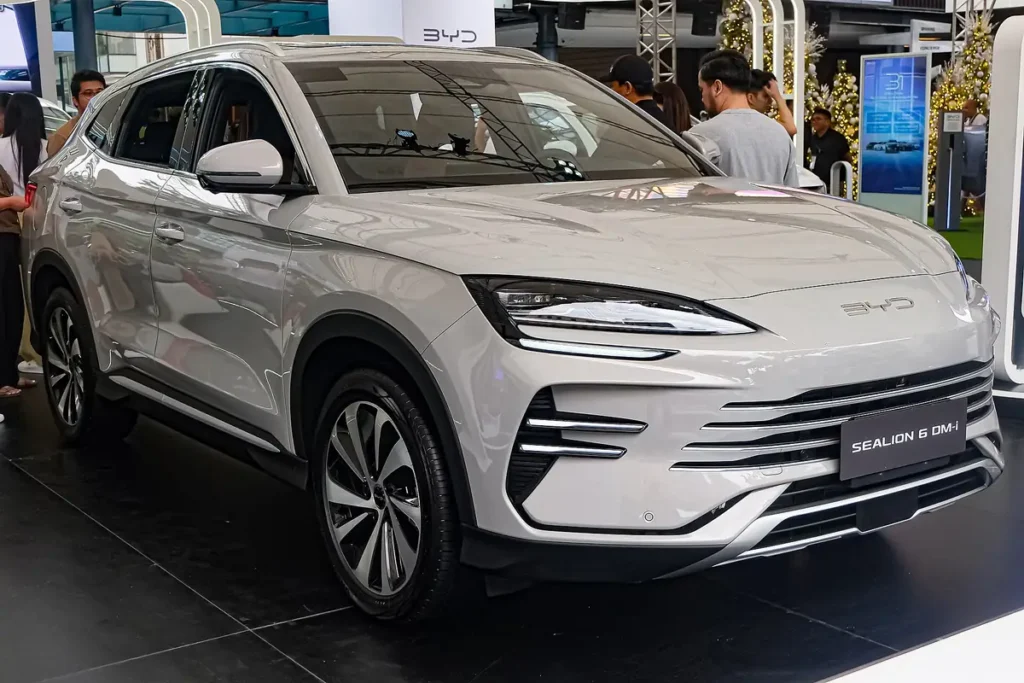
Many automakers style their SUVs to look aggressive. BYD instead uses what it calls its “Ocean Aesthetics” design language for its Ocean-series models, and the Sealion 6 follows it with a smooth, rounded face.
Up front there is no large honeycomb grille, just a slim, smooth grille line flanked by LED headlights. Because there is a gas engine under the hood, the Sealion 6 has a longer, sloping hood than BYD’s pure EVs, with a subtle power bulge. BYD lists 19-inch aerodynamic wheels on many versions.
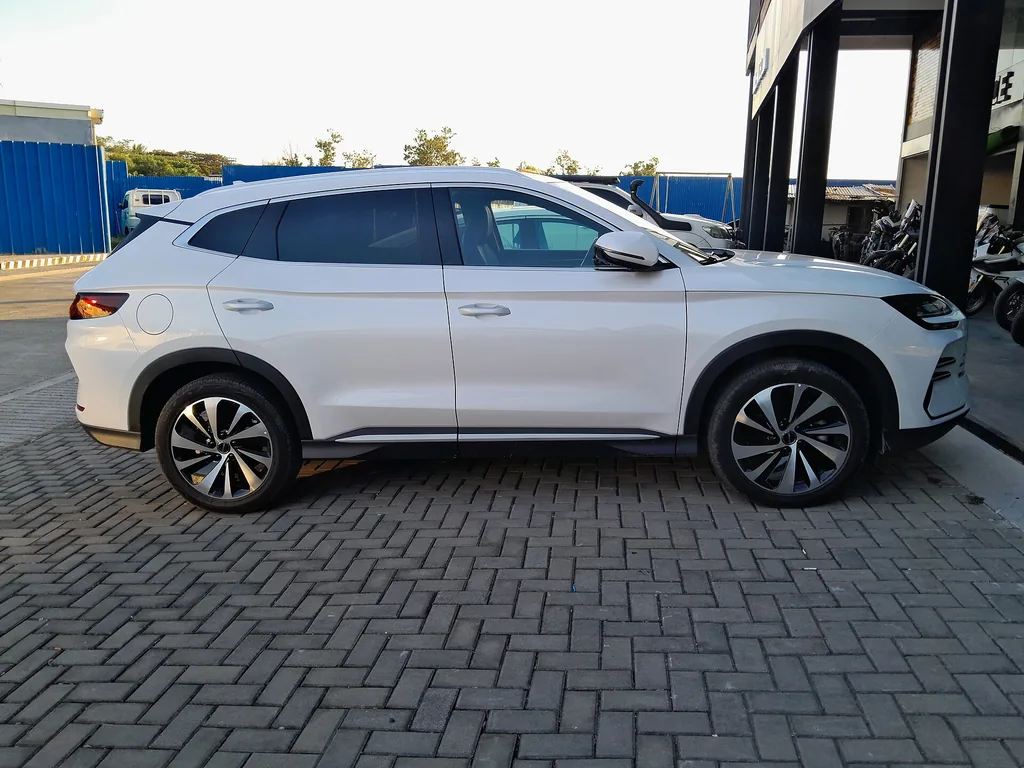
The body is midsize: BYD Philippines lists the car at 4,775 mm (188.0 in) long, 1,890 mm (74.4 in) wide and 1,670 mm (65.7 in) tall on a 2,765 mm (108.9 in) wheelbase. That makes it a little longer than a US-market Toyota RAV4.
Hybrid Technology
Some buyers are still hesitant about fully electric vehicles, which is why BYD built the Sealion 6 as a plug-in hybrid (PHEV) rather than a conventional hybrid. A conventional hybrid has a small battery charged only by the engine and braking. A plug-in hybrid has a much larger battery that you charge from the grid, so it can drive meaningful distances on electricity alone before the engine is needed. We cover how BYD’s DM-i system works in the next section.
How We Evaluated the BYD Sealion 6
NextCarReview did not road-test the BYD Sealion 6. Earlier versions of this page included first-person driving impressions and “real-world” range figures that we cannot verify, and those have been removed. This version is a research guide built from these sources:
- BYD’s official market sites: BYD Cars Philippines, BYD Automotive Australia and BYD’s international (Egypt) Sealion 6 page, for specifications and prices.
- Named automotive outlets (Drive, CarExpert, Chasing Cars, Zecar, Carwow, Top Gear Philippines) for market-specific figures that BYD does not list on its own pages, such as towing capacity and charging rates.
- FuelEconomy.gov (EPA) for the US-market rivals in the comparison section.
Because the Sealion 6 is not sold in the US, NHTSA has no complaint or recall data for it, so this guide does not include an owner-complaints section. Owners in other markets should check their national recall database, such as Australia’s Product Safety recalls site, and contact their BYD dealer.
BYD Sealion 6 Specs at a Glance
| Spec | BYD Sealion 6 (official BYD figures) |
|---|---|
| Type | Midsize plug-in hybrid SUV (DM-i), five seats |
| Engine | 1.5L (FWD) or 1.5L turbo (AWD) |
| Combined output | 217 PS / 214 hp (Philippines FWD) to 253 kW / 339 hp (Australia Premium Extended AWD) |
| Battery | 18.3 kWh or 26.6 kWh LFP Blade |
| Electric range | 105 km / 65 mi (NEDC, FWD) to 140 km / 87 mi (Australia, Dynamic Extended) |
| 0-100 km/h | 8.3 sec (Philippines FWD) to 5.5 sec (Premium Extended AWD) |
| Length / wheelbase | 4,775 mm (188.0 in) / 2,765 mm (108.9 in) |
| Cargo | 425 L (15.0 cu ft) / 1,440 L (50.9 cu ft) folded |
| Charging | Up to about 7 kW AC, about 18 kW DC (Australia) |
| Starting price | ₱1,598,000 (Philippines); from A$42,990 (Australia, as reported); not sold in the US |
Sources: BYD Cars Philippines, BYD Automotive Australia and BYD international model pages; Drive and CarExpert for Australian pricing and charging. Details by market follow below.
BYD Sealion 6 Engine and Powertrain Specs
There is a lot of confusion online about what is under the hood, partly because BYD sells different versions in different countries. The Sealion 6 uses BYD’s DM-i (often marketed as “Super DM-i” or “Super Hybrid”) system, which pairs a 1.5-liter gas engine with a front electric motor and a BYD Blade lithium iron phosphate (LFP) battery. All-wheel-drive versions add a rear motor and a turbocharged 1.5-liter engine.
The gas engine is not doing most of the work most of the time. In the DM-i system, the electric motor drives the wheels in most situations, and the engine mainly runs as a generator. At higher, steady speeds the engine can also drive the wheels directly through a single fixed gear. So the car is designed to feel closer to an EV than a traditional hybrid.
Here are BYD’s official figures for two key versions, plus Australian-market AWD figures as reported by local outlets:
| Specification | FWD (Philippines, BYD Cars Philippines) | AWD Premium (Australia, 2024–25 launch spec, per Drive/CarExpert) | AWD Premium Extended (Australia, BYD Automotive) |
|---|---|---|---|
| Engine | 1.5L high-efficiency, naturally aspirated | 1.5L turbo | 1.5L turbo |
| Engine output | 106 PS (105 hp), 135 Nm (100 lb-ft) | Not listed by BYD | Not listed by BYD |
| Front electric motor | 197 PS (194 hp), 325 Nm (240 lb-ft) | Front and rear motors | Front and rear motors |
| Combined system output | 217 PS (214 hp), 325 Nm | 238 kW (319 hp), 550 Nm (406 lb-ft) | 253 kW (339 hp) |
| Transmission | E-CVT (single-ratio DM-i drive unit) | E-CVT | E-CVT |
| 0-100 km/h (0-62 mph) | 8.3 seconds | 5.9 seconds | 5.5 seconds |
| Battery | 18.3 kWh LFP Blade | 18.3 kWh LFP Blade | 26.6 kWh LFP Blade |
| EV-only range (BYD figure) | 105 km / 65 mi (NEDC) | 81 km / 50 mi | 128 km / 80 mi (BYD: 20%–100% state of charge) |
| Drivetrain | Front-wheel drive | All-wheel drive | All-wheel drive |
| Analysis | Sources: BYD Cars Philippines and BYD Automotive Australia model pages; Drive and CarExpert for the 2024–25 Australian AWD figures. Checked October 2026. Specs change by market and model year, so confirm with your local BYD dealer. | ||
In Australia, BYD also sells front-wheel-drive Essential and Dynamic versions rated at 160 kW (215 hp), with 0-100 km/h times of 8.5 to 8.9 seconds, and a Dynamic Extended Range version that BYD rates at 140 km (87 mi) of electric range. In the UK, the equivalent Seal U DM-i is sold in Boost, Comfort and Design trims, with outlets such as Carwow listing up to 78 miles of WLTP electric range for the larger-battery Comfort model.
Several numbers in earlier versions of this page were wrong or mixed from different markets: the FWD engine is rated at 106 PS and 135 Nm in the Philippines (not 98 hp and 122 Nm), the Philippine-spec 0-100 km/h time is 8.3 seconds (not 8.5), and the 26.6 kWh battery belongs to Extended Range versions, not the original 5.9-second AWD Premium.
The 325 Nm of electric torque is available from a standstill, which is why reviewers describe the FWD Sealion 6 as responsive off the line compared with conventional gas SUVs of similar size.
Similarities with Atto 3
If the Sealion 6 reminds you of a larger BYD Atto 3, that is not far off. It shares some of the Atto 3’s character lines, including sharp creases on the front fenders and rear, along with a similar rotating center screen inside.
Additional Features
BYD lists 19-inch aerodynamic alloy wheels on many versions. The Philippine-market car has a 360-degree camera system and a radar-based driver-assistance suite, which BYD says includes adaptive cruise control with stop-and-go, traffic sign recognition and intelligent speed control. Exact equipment varies by trim and country.
Practicality
BYD Philippines lists 173 mm (6.8 in) of ground clearance and a curb weight of 1,830 kg (4,034 lb) for the FWD model. That is typical for a road-focused crossover rather than an off-roader. Black lower cladding and rear privacy glass are fitted on the versions shown in BYD’s official images.
BYD Sealion 6 Charging Port Location and Charging Guide
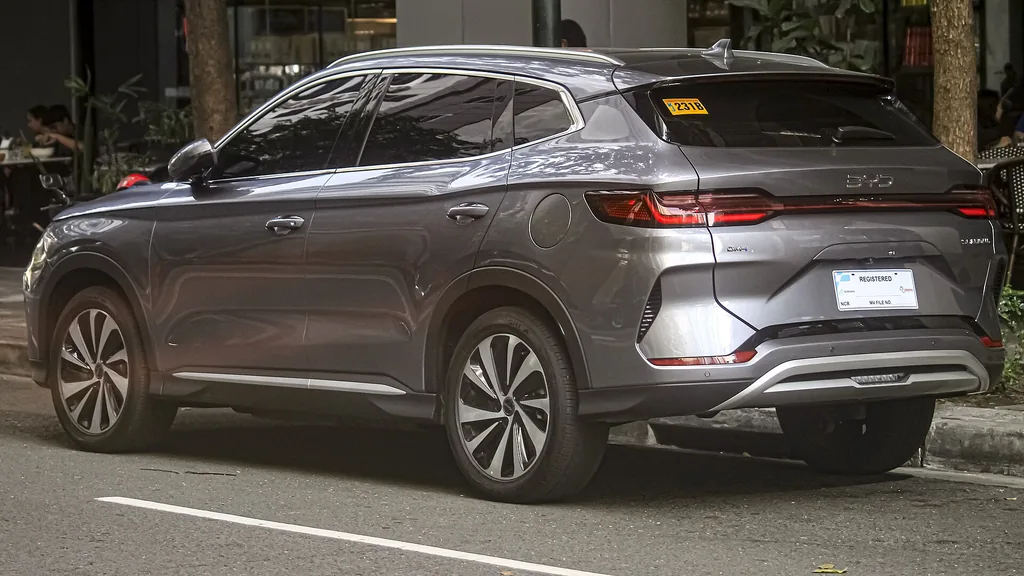
This is the question we get most often. The Sealion 6 has two flaps on its rear quarter panels: the fuel filler on one side and the charging port on the other. Earlier versions of this page placed the charging port on the right rear quarter panel. We could not confirm that from an official BYD source for every market, so check the owner’s handbook for your car (BYD Australia publishes the Sealion 6 handbook online) or look before you buy a cable or reserve a public charger bay.
In Australia, charger suppliers such as EVSE Australia list a Type 2 socket for AC charging and a CCS2 socket for DC fast charging. Connector types differ in some other markets.
Charger Types and Compatibility
The Sealion 6 supports three ways to charge. These are Australian-market figures, as reported by Drive, CarExpert and EVSE Australia:
| Charger Type | Power Rating | Connector (Australia) | Approx. Charge Time (18.3 kWh battery) |
|---|---|---|---|
| Portable charger in a standard outlet (10 A) | About 2.3 kW | Type 2 via portable charger | About 8 hours (EVSE Australia) |
| Home wallbox (AC) | Up to 7 kW (some markets quote 6.6 kW) | Type 2 | About 2.5–3 hours |
| DC fast charging | Up to 18 kW | CCS2 | Roughly 30–40 minutes for a large top-up |
For most owners, a 7 kW home wallbox is the practical choice for overnight charging. Some BYD dealers and markets have offered a wall charger with the car; confirm what is included, and whether installation is covered, when you buy.
What’s Different About BYD’s Charging
The Sealion 6 uses BYD’s Blade LFP battery chemistry, which differs from the nickel-based (NMC) cells in many EVs. LFP batteries generally tolerate regular charging to 100% better than NMC batteries, and BYD does not tell owners to cap daily charging at 80%. That lets you use the full electric range day to day, though following BYD’s own manual is always the safest guide.
The Sealion 6 also supports Vehicle-to-Load (V2L), which lets you power appliances from the car using an adapter. Published figures for V2L output vary: some outlets cite up to 3.3 kW, while others list around 2.2–2.4 kW for some markets. Check the rating for your market before relying on it for a specific appliance.
Charging Speed in Context
The 18 kW DC rate is low compared with full EVs, which commonly accept 150 kW or more. That is normal for plug-in hybrids with small batteries, and it matters less because you can always continue on gas. The US-market Mitsubishi Outlander PHEV, for comparison, also offers DC charging, while the Toyota RAV4 Plug-in Hybrid has historically offered AC charging only.
BYD Sealion 6 Interior, Cargo and Features
Rear Design
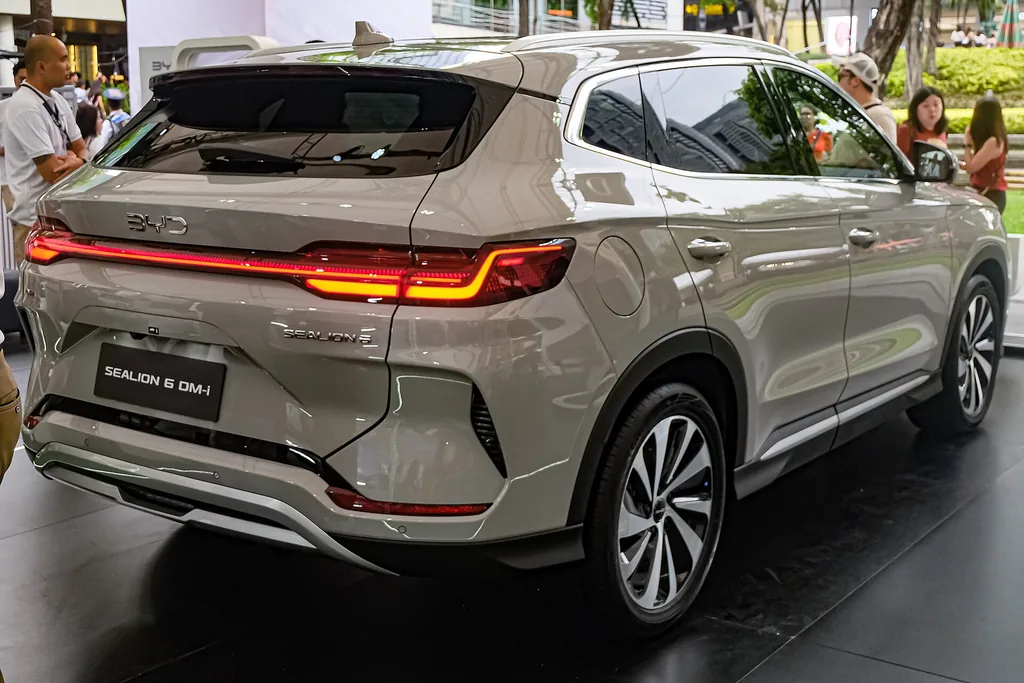
At the back, a full-width light bar is mounted fairly low across the tailgate, with sculpted lines around it, giving the rear a slightly wagon-like look. BYD uses a simple “BYD” badge rather than the “Build Your Dreams” script used on some earlier models, along with a “DM-i” badge.
What DM-i Means
BYD’s DM-i name stands for “Dual Mode intelligent” (sometimes translated as “Dual Motor”), describing the combination of electric drive with a 1.5-liter engine. In practice it means the car runs as an EV first and a hybrid second.
Tailgate and Cargo Space
A power tailgate is fitted on the versions shown in BYD’s materials. BYD’s international and Australian pages list 425 liters (15.0 cu ft) of cargo space with the rear seats up and 1,440 liters (50.9 cu ft) with the 60/40 split rear seats folded. BYD Philippines lists 552 liters, which likely reflects a different measuring method. Either way, the space is in line with other midsize SUVs.
The load floor sits relatively high, which some reviewers note makes lifting heavy items in a little harder. There is an under-floor storage area beneath the cargo floor on some versions.
Towing
Towing capacity varies by version and market. Carwow lists 1,300 kg (2,866 lb) braked for the UK Seal U DM-i Design AWD, Australian outlets list 1,300 kg for the original AWD Premium, and Australian reports put the FWD Dynamic at 750 kg (1,653 lb) braked. Earlier versions of this page listed 1,500 kg for all versions, which we could not confirm. Check your exact model’s rating before buying a trailer.
Dashboard and Screen
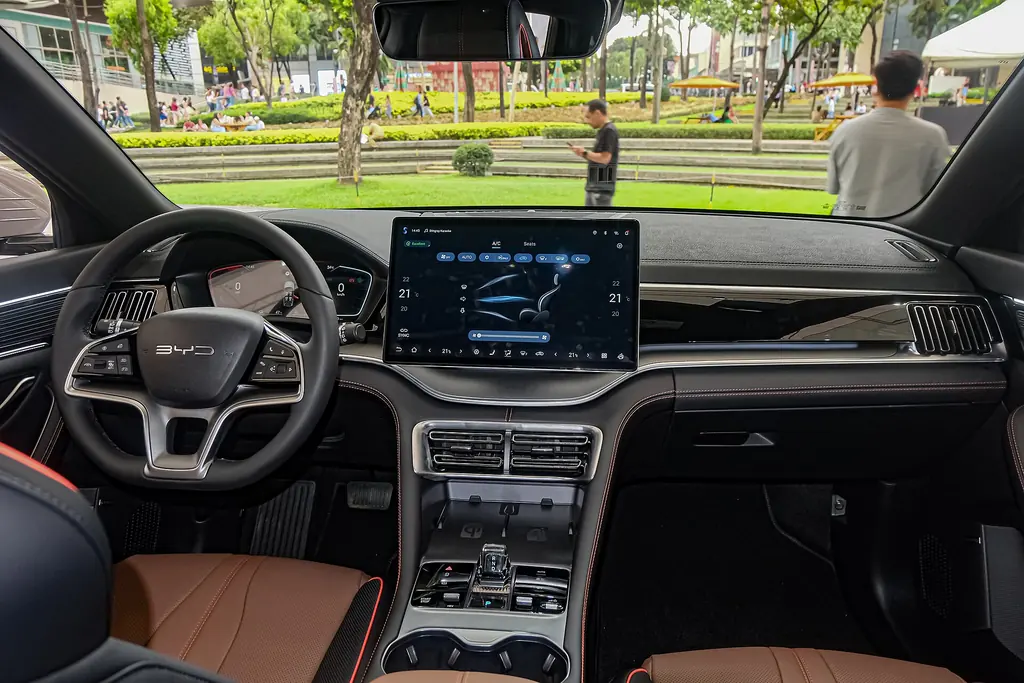
The interior carries over the ocean theme from the exterior, but with a more conventional layout than the Atto 3’s sculpted dashboard. The air vents are vertical at the sides and horizontal in the middle.
Higher-spec versions get a 15.6-inch touchscreen that can rotate between landscape and portrait, while BYD Australia lists a 12.8-inch screen on the entry Essential. The digital instrument display behind the steering wheel is customizable, including a darker theme.
Seats and Trim
BYD lists heated and ventilated front seats with power adjustment and memory on many versions, along with a large panoramic roof. Interior colors and stitching vary by market and paint color.
Connectivity
BYD Philippines lists wireless Apple CarPlay and Android Auto plus dual 15-watt wireless phone chargers, which helps keep your phone topped up while running wireless smartphone mirroring. There are also USB-A and USB-C ports up front, a hidden storage shelf under the center console, and a crystal-style gear selector.
Controls
Physical buttons around the gear selector handle functions such as hazard lights, drive modes, the EV/HEV mode switch, auto brake hold and climate. Reviewers note they sit flush, so they are harder to find by feel than conventional switches. Drive modes typically include Eco, Normal, Sport and Snow.
Steering Wheel
The steering wheel is more conventional in shape than the Atto 3’s and adjusts for both reach and rake. Steering wheel buttons control the infotainment, driver-assistance features and instrument display.
Audio and Comfort
BYD Philippines lists a 10-speaker Infinity sound system. Front seats are powered on the versions BYD shows, and higher trims add more comfort features, so compare trim sheets carefully.
Second Row Comfort
In the second row, BYD fits USB-A and USB-C charging ports, rear air vents, map pockets and a center armrest. The 2,765 mm wheelbase gives generous rear legroom for the class, and reviewers report good headroom even with the panoramic roof.
BYD Sealion 6 Driving and Fuel Economy: What Reviewers Report
Driving Experience
Since we did not drive the Sealion 6, this section summarizes published reviews. Outlets such as Drive, CarExpert and Top Gear Philippines generally describe it as quiet and smooth in town, where it runs on electric power most of the time, with steering and handling typical of a family crossover rather than a sporty SUV.
Ride and Suspension
The Sealion 6 uses independent suspension front and rear. Some reviewers describe the ride as on the firm side, especially on rough roads, which is common for heavier plug-in hybrids that must carry an engine, battery and fuel tank.
Driver-Assistance Features
BYD markets the driver-assistance features as intelligent cruise control and related systems. On the Philippine-market car, BYD lists adaptive cruise control with stop-and-go, a 360-degree camera, a six-radar sensor setup, traffic sign recognition and intelligent speed control. In Australia and New Zealand, ANCAP awarded the 2024 Sealion 6 a five-star safety rating under its 2023–2025 protocols, with scores of 88% for adult occupant protection, 86% for child occupant protection, 83% for vulnerable road user protection and 75% for safety assist. ANCAP rated its reverse AEB as marginal. Check ANCAP’s site for the variants the rating covers.
Fuel Economy
The main reason to buy a plug-in hybrid is fuel savings. Unlike a regular hybrid, the Sealion 6 can run on electricity alone for its rated EV range. BYD’s Egypt site lists fuel consumption of 6.4 L/100 km (about 37 mpg) in hybrid operation, while Australian outlets cite an official combined figure of 1.3 L/100 km for the AWD Premium, a number that assumes the battery starts full and is not comparable to US EPA ratings.
Practical Usage
In practice, if your round-trip commute is well inside the electric range, for example 25 miles a day, you can do most daily driving on electricity and only use gas on longer trips, as long as you charge every night. If you rarely plug in, a plug-in hybrid carries the weight of a battery it barely uses, and its fuel economy falls toward that of an ordinary hybrid.
Hold and Charge Modes
Like most plug-in hybrids, the Sealion 6 lets the driver choose between EV-priority and hybrid operation, and it can use the engine to maintain or raise the battery level, for example before entering a city zone. The exact charge limits and modes vary by software version, so check your owner’s manual.
BYD Sealion 6 Range: Real World vs EPA
The short answer: there is no EPA rating for the BYD Sealion 6, because it is not sold in the US. Earlier versions of this page listed an “EPA equivalent estimate” and real-world range figures from “independent testing” that we could not trace to a source, so they have been removed.
What exists are BYD’s own figures under the test cycles used in each market. The older NEDC cycle, still quoted in the Philippines, is the most optimistic. The WLTP cycle used in Europe is more realistic but still a lab test. Australia’s figures are quoted by BYD with a stated state-of-charge window. US EPA testing is typically the strictest of the three, so a US rating would likely be lower than any of these numbers.
| Market / Test Standard | Version | EV-Only Range (BYD or named source) | Total Range (gas + electric) |
|---|---|---|---|
| Philippines (NEDC, BYD Cars Philippines) | FWD, 18.3 kWh | 105 km (65 mi) | “Beyond 1,000 km” (621 mi) |
| International (BYD Egypt site) | 18.3 kWh | From 70 km (43 mi) | Up to 1,080 km (671 mi) |
| Australia (BYD Automotive) | Essential FWD | 92 km (57 mi), 25%–100% state of charge | Not listed on page |
| Australia (BYD Automotive) | Dynamic Extended FWD | 140 km (87 mi), 20%–100% state of charge | Not listed on page |
| Australia (BYD Automotive) | Premium Extended AWD, 26.6 kWh | 128 km (80 mi), 20%–100% state of charge | Not listed on page |
| UK (WLTP, per Carwow) | Seal U DM-i Comfort, 26.6 kWh | 78 mi (126 km) | Not listed |
| UK (WLTP, per Carwow) | Seal U DM-i Design AWD, 18.3 kWh | 43 mi (69 km) | Not listed |
Source: BYD Cars Philippines, BYD Egypt and BYD Automotive Australia model pages; Carwow for UK WLTP figures. Checked October 2026. No EPA rating exists for this vehicle.
Why Range Drops at Highway Speeds
Like any electric vehicle, a plug-in hybrid uses more energy at highway speeds because aerodynamic drag rises sharply with speed. So city and suburban drivers usually get closer to the official electric range than drivers who spend most of their time at 70 mph or more.
On the highway, the DM-i system also tends to bring the engine in more often, and at steady cruising speeds the engine can drive the wheels directly. In other words, long highway trips run mostly as a hybrid rather than an EV, which is why total-range claims above 1,000 km depend heavily on how you drive.
Climate Impact on Range
Cold weather reduces the electric range of all battery-powered vehicles, because battery chemistry slows in the cold and cabin heating draws power. LFP batteries are generally more sensitive to cold than NMC batteries. Running the air conditioning in hot weather also reduces range, though usually by less. Expect noticeably less than the official electric range in winter.
Our Range Verdict
We did not run our own range test. Based on the official figures, the 18.3 kWh Sealion 6 should cover a typical daily commute of 20 to 40 miles on electricity in mild weather if you charge every night, and the larger 26.6 kWh Extended Range versions add useful extra margin. For long trips, plan on hybrid operation.
Advantages Over a Full Electric Vehicle
A key advantage of a plug-in hybrid over an EV is that you do not need to find a charger to finish a trip. When the battery runs low, the Sealion 6 continues as a hybrid on gas. Combined with a full battery and fuel tank, BYD quotes total ranges of 1,000 km (about 620 miles) or more in some markets, which is longer than many gas-only SUVs can manage on one tank.
Vehicle-to-Load (V2L) Capability
The Sealion 6’s V2L feature can power camping gear, small appliances or tools from the car’s battery, using an adapter in the charging port. As noted above, published output figures range from about 2.2 kW to 3.3 kW depending on the source and market, so check your car’s rating before plugging in high-draw appliances such as space heaters or air conditioners.
Pricing and Value
Pricing depends on the market. BYD Cars Philippines lists the Sealion 6 DM-i from ₱1,598,000, though some Philippine listings show lower promotional prices. In Australia, outlets report pricing from A$42,990 for the Essential before on-road costs. There is no US price because the car is not sold in the US, and we have removed the “about $32,000 USD equivalent” figure from earlier versions of this page.
Is the BYD Sealion 6 Hybrid or Fully Electric?
It is a plug-in hybrid, not a full electric car. The Sealion 6 carries both a gas engine and at least one electric motor, and it can drive on either. This is the single most common point of confusion about the car.
BYD calls the system DM-i. The 1.5-liter engine spends much of its time acting as a generator for the electric motor rather than driving the wheels directly, and the electric motor does most of the driving. As a result, the car feels electric in normal driving even when the engine is running.
Yes, it uses fuel. Once the drive battery is depleted, the Sealion 6 keeps going as a hybrid on gas, so it does not leave you stranded the way a fully discharged EV would. But it is not designed to run with the drive battery removed or failed, because the electric motor does the driving.
If you want a fully electric BYD in a similar size class, look at the Sealion 7, which is a battery-electric SUV. The comparison below covers the difference.
How Long Does It Take to Charge a BYD Sealion 6?
On a home AC wallbox, the Sealion 6 accepts up to about 7 kW (6.6 kW in some markets), which fills the 18.3 kWh battery in roughly 2.5 to 3 hours from low. That is comfortably an overnight charge.
On DC fast charging, the maximum rate is much lower than a full EV, at about 18 kW. A substantial top-up takes roughly half an hour. This is normal for a plug-in hybrid: the battery is small, so it does not need high-power charging, and the gas engine covers long trips.
A portable charger in a standard household outlet will also work, but expect around eight hours or more. Most owners simply plug in overnight and rarely use DC charging.
Connector types depend on your market. Check the port on your own car before buying a cable or assuming a public charger will fit. Do not assume a Tesla Supercharger will work with this vehicle.
BYD Sealion 6 vs Sealion 7: Which Should You Buy?
These are not trim levels of the same car. They are different vehicles with different powertrains, and choosing between them mostly comes down to one question: do you have reliable charging?
The Sealion 6 is the plug-in hybrid. It has a small battery, a gas engine and no range anxiety. The Sealion 7 is a fully electric SUV with a much larger battery, no engine and far more electric range. So the Sealion 7 is the better choice if you can charge at home every night and your trips fit its range.
Choose the Sealion 6 if you do not have off-street parking, if you regularly drive long distances between charging stops, or if you want electric running for the commute without committing to a full EV. Choose the Sealion 7 if your daily driving is well within its range and charging is easy.
On running costs, the Sealion 6 only wins if you actually plug it in. An unplugged plug-in hybrid carries the weight of a battery it rarely uses, and its fuel economy suffers. Be honest about your charging habits before you decide.
Comparison with Rivals
In markets such as the Philippines, the Sealion 6’s most obvious rival is the Toyota Corolla Cross Hybrid, which is cheaper and smaller but is a conventional hybrid that cannot plug in. Toyota’s RAV4 and Honda’s CR-V are closer in size but are typically priced higher in those markets. Other plug-in hybrid rivals in Asia and Australia include the Ford Territory, Chery Tiggo plug-in models and the Mitsubishi Outlander PHEV. Model availability and equipment differ by country, so compare local trim sheets.
How the Sealion 6 Compares with US-Market Plug-in Hybrids
For US readers wondering how the Sealion 6 stacks up against plug-in hybrid SUVs you can actually buy, here are EPA electric-range figures for the closest US models. Remember that the Sealion 6 figures are BYD’s non-EPA numbers, so they are not directly comparable.
| Model | Electric range | Gas-only fuel economy | Rating source |
|---|---|---|---|
| BYD Sealion 6 (FWD, 18.3 kWh) | 105 km / 65 mi (NEDC) | 6.4 L/100 km (about 37 mpg) per BYD Egypt | BYD, non-EPA |
| 2026 Mitsubishi Outlander PHEV | 44 mi | 27 mpg combined | EPA |
| 2025 Toyota RAV4 Plug-in Hybrid | 42 mi | 38 mpg combined | EPA |
| 2026 Ford Escape PHEV | 37 mi | 40 mpg combined | EPA |
| 2026 Kia Sportage Plug-in Hybrid | 33 mi | 36 mpg combined | EPA |
| 2026 Hyundai Tucson Plug-in Hybrid | 32 mi | 35 mpg combined | EPA |
Source: FuelEconomy.gov (EPA) for US models; BYD Cars Philippines and BYD Egypt for the Sealion 6. Checked October 2026.
BYD Sealion 6 vs Tesla Model Y vs Hyundai Ioniq 5
Many shoppers also compare the Sealion 6 with the Tesla Model Y and Hyundai Ioniq 5, although those are fully electric. Here is how they differ in principle, using US EPA ratings for the two EVs:
| Feature | BYD Sealion 6 (FWD) | 2026 Tesla Model Y | 2026 Hyundai Ioniq 5 |
|---|---|---|---|
| Powertrain | Plug-in hybrid (1.5L + electric) | Full battery-electric | Full battery-electric |
| Electric range | 105 km / 65 mi (NEDC, BYD) | 321 mi (Standard RWD) to 357 mi (Long Range RWD), EPA | 245 mi (Standard Range) to 318 mi (RWD), EPA |
| Gas backup | Yes | No | No |
| DC fast charging | About 18 kW | Supercharger network, much faster | 800-volt system, among the fastest in class |
| Sold in the US | No | Yes | Yes |
| Best for | Drivers without reliable charging | Drivers with home charging who want Supercharger access | Drivers who want quick DC charging and V2L |
Source: FuelEconomy.gov for Tesla and Hyundai; BYD Cars Philippines for the Sealion 6. Checked October 2026. Earlier versions of this table used WLTP figures and “USD equivalent” prices that we could not verify; they have been removed.
The Tesla Model Y and Hyundai Ioniq 5 go much farther on electricity and charge far faster. But you need home charging or regular access to fast chargers to live with them. If you have no home charging, a pure EV can be harder to own.
The Hyundai Ioniq 5’s 800-volt architecture supports some of the fastest DC charging in its class. Like the Tesla, though, it has no gas fallback.
The Sealion 6’s advantage is flexibility: electric driving for daily commutes plus gas range for road trips. That makes it a sensible first step for buyers who cannot yet commit to full-time charging, in the markets where it is sold.
Technology and Assurance
BYD makes its own Blade LFP batteries and markets them heavily on safety, highlighting nail-penetration testing in its promotional materials. LFP chemistry is generally considered more resistant to thermal runaway than nickel-rich chemistries. BYD’s warranty terms vary by market, so check the battery and vehicle warranty where you buy.
Interior quality is one of the Sealion 6’s most-praised attributes in reviews, with a clean layout and seating for five. For the full DM-i system deep dive, see our dedicated BYD Sealion 6 DM-i full review.
BYD Sealion 6 Buying Checklist
Because specifications differ so much between countries and model years, run through these checks before you sign:
- Battery size: confirm whether the car has the 18.3 kWh or 26.6 kWh battery, since it changes the electric range significantly.
- Engine type: FWD versions use a naturally aspirated 1.5-liter, while AWD versions use a 1.5-liter turbo. Check the window sticker or spec sheet.
- Charging hardware: confirm the AC and DC connector types for your market and whether a wall charger, and its installation, are included.
- Towing: check the braked towing rating for your exact version, as published figures range from 750 kg to 1,300 kg.
- V2L: ask whether the V2L adapter is included and what its maximum output is in your market.
- Warranty: compare the vehicle and battery warranty terms offered by your local BYD distributor.
- Recalls: check your national recall database and ask the dealer whether any campaigns or software updates apply to the car.
- Charging at home: make sure you can plug in most nights. Without regular charging, a plug-in hybrid’s fuel savings shrink.
If you are in the US, none of these apply directly, because the Sealion 6 is not sold here. The closest US alternatives are plug-in hybrid SUVs such as the Mitsubishi Outlander PHEV, Toyota RAV4 Plug-in Hybrid, Ford Escape PHEV, Kia Sportage Plug-in Hybrid and Hyundai Tucson Plug-in Hybrid. See our Toyota SUV models guide for the RAV4 Plug-in Hybrid, our best electric and hybrid cars of 2026, and whether the federal EV tax credit ended before you shop.
BYD Sealion 6 Pros and Cons
| Pros | Cons |
|---|---|
| Official electric range of 105 km (NEDC) or up to 140 km (Australian Extended Range figure) | Not sold in the US; no EPA or NHTSA ratings |
| Gas engine removes range anxiety on long trips | DC charging is slow at about 18 kW |
| Quick AWD versions (0-100 km/h in 5.5–5.9 sec) | Towing capacity is modest (750–1,300 kg depending on version) |
| Well-equipped cabin: 15.6-inch rotating screen, wireless CarPlay/Android Auto, dual wireless chargers on many trims | Flush console buttons are hard to use by feel, per reviews |
| LFP Blade battery tolerates regular full charging | Fuel savings depend on plugging in regularly |
Who Should Buy the BYD Sealion 6?
| Best for | Pick | Why |
|---|---|---|
| Daily commuters with home charging | Sealion 6 FWD | Electric range covers most commutes; gas for weekends |
| Drivers who want more electric range | Dynamic Extended / Premium Extended (Australia) | 26.6 kWh battery, BYD-rated 128–140 km EV range |
| Performance on a budget | AWD Premium versions | 0-100 km/h in 5.5–5.9 seconds |
| Drivers who can always charge at home | BYD Sealion 7 instead | Fully electric, no gas engine |
| US buyers | Mitsubishi Outlander PHEV or Toyota RAV4 Plug-in Hybrid | The Sealion 6 is not sold in the US |
In the markets where it is sold, the BYD Sealion 6 offers a strong balance of price, electric range and flexibility. This guide has covered its powertrain specs by market, charging setup, official range figures, towing, cargo space and how it compares with plug-in hybrid and electric rivals.
So who is the Sealion 6 for? It is the right pick if you want EV-style driving for daily commutes without the charging logistics a pure EV requires, and you live in a market where BYD sells it. In the Philippines, it starts at ₱1,598,000. US buyers cannot buy it new and should look at US-market plug-in hybrids such as the Mitsubishi Outlander PHEV or Toyota RAV4 Plug-in Hybrid.
Considering a specific version? Drop a comment with your market and the variant you are looking at, and we will point you to our matching long-form review.
FAQ: BYD Sealion 6 2026
Is BYD Sealion fully electric?
Is BYD a Chinese car?
Is Toyota using BYD batteries?
Where is the BYD Sealion 6 charging port located?
What kind of charger does the BYD Sealion 6 use?
How big is the engine in the BYD Sealion 6?
What is the towing capacity of the BYD Sealion 6?
How much cargo space does the BYD Sealion 6 have?
Is the BYD Sealion 6 better than the Tesla Model Y?
Is the BYD Sealion 6 sold in the US?
What is the range of the BYD Sealion 6?
How much does the BYD Sealion 6 cost?
⚠️ Professional Notice:
Powertrain specifications come from BYD’s official market websites (Philippines, Australia and BYD’s international site) or, where noted, from named outlets. Range figures are BYD’s own figures under NEDC, WLTP or Australian test conditions. They are not EPA ratings, and actual range varies with speed, climate, state of charge and driving style. NextCarReview did not road-test this vehicle and has removed earlier “real-world” figures that could not be verified.
Prices (₱1,598,000 in the Philippines; from A$42,990 in Australia, as reported) are subject to change, and there is no US price because BYD does not sell the Sealion 6 in the US. Towing capacity, V2L output and included-charger terms vary by market and version and should be confirmed with your local BYD dealer.
US-market competitor figures come from FuelEconomy.gov. Safety ratings for the Sealion 6 are not available from IIHS or NHTSA; the ANCAP five-star rating applies to Australia and New Zealand. NextCarReview.com does not receive compensation from any manufacturer in exchange for rankings or editorial coverage.
Data Sources and Verification
- BYD Cars Philippines: Sealion 6 DM-i – FWD specs, NEDC range, dimensions, features, price
- BYD Automotive Australia: Sealion 6 – Australian variants, power, battery, electric range, 0-100 times
- BYD international (Egypt): Sealion 6 DM-i – cargo volume, combined range, fuel consumption
- BYD Sealion 6 Owner’s Handbook (Australia, 2024) – charging and operating details
- Drive and CarExpert – Australian pricing, AWD launch specs, charging rates, towing
- Carwow – UK Seal U DM-i WLTP range and towing
- EVSE Australia – connector types and charge times
- ANCAP – five-star safety rating and test scores
- EPA FuelEconomy.gov – US-market rival ratings (the Sealion 6 has no EPA rating)
For more, see our EV and hybrid guide.
BYD Cars Philippines: Sealion 6 DM-i; BYD Automotive Australia: Sealion 6; BYD international: Sealion 6 DM-i; Drive: Sealion 6 price and specs; CarExpert: 2026 Sealion 6 review; Carwow: BYD Seal U; EVSE Australia: Sealion 6 charging; ANCAP: Sealion 6 rating; Toyota bZ3 (BYD battery) background; FuelEconomy.gov plug-in hybrid ratings. Checked October 2026. Written by Morgan Reyes; NextCarReview does not road-test vehicles.

Morgan Reyes is the founder and editor-in-chief of NextCarReview, which Morgan launched in August 2024. A 2022 graduate of Columbia University, Morgan is based in New York and writes and edits the site’s reviews, comparisons and buying guides. Morgan does not road-test vehicles. Every article is built from published primary data: EPA FuelEconomy.gov ratings, NHTSA crash ratings, recalls and owner complaints, IIHS results, and manufacturer specifications and pricing, with each figure cited and checked before publication. Contact: admin@nextcarreview.com