
Update, October 2026: The $7,500 federal clean vehicle tax credit (and the $4,000 used-EV credit) ended for vehicles acquired after September 30, 2025, under the One Big Beautiful Bill Act. No new EV bought today qualifies. Any older mention of the federal credit on this page is historical. Check your state’s rebates at AFDC.energy.gov and see the federal EV tax credit ended for details.

The BYD Sealion 6 DM-i is a mid-size plug-in hybrid SUV sold in Australia, New Zealand and other markets (as the Seal U DM-i in Europe). BYD Australia quotes up to 92 km (57 miles) of electric range and 1,092 km (about 680 miles) of combined range on the Australian test cycle for the base Essential. It is not sold in the US, BYD has announced no US launch, and current US tariffs and rules make a 2026 arrival unlikely.
The BYD Sealion 6, also called the BYD Sealion 6 DM-i (and sold as the Seal U DM-i in Europe), is a plug-in hybrid electric vehicle (PHEV) that has done well in several markets. CarExpert reports it became Australia’s top-selling PHEV in 2024 with 6,198 deliveries. BYD is one of the world’s largest makers of plug-in vehicles, which is why American shoppers keep asking whether the Sealion 6 will come here. This BYD Sealion 6 review sets out what the vehicle offers, how it compares with the PHEV SUVs you can actually buy in the US, such as the Toyota RAV4 Plug-in Hybrid (formerly RAV4 Prime), and what stands in the way of a US launch.
Bottom line for US buyers: BYD has not announced US sales of the Sealion 6, has no US price and no EPA ratings. The “$35,000” figure in this article’s headline was an early estimate that never came from BYD. Chinese-built electric vehicles face a 100% US tariff, and a Commerce Department rule bars Chinese-controlled automakers from selling connected vehicles in the US from model year 2027. Treat any 2026 US launch as very unlikely.
How We Evaluated the BYD Sealion 6
NextCarReview did not road-test the Sealion 6, and it is not available in the US to test. The specifications in this article come from BYD Australia’s official Sealion 6 page; safety results come from ANCAP and Euro NCAP; Australian pricing and charging details are as reported by CarExpert (named where used). US competitor data comes from FuelEconomy.gov and Toyota’s US newsroom, and the trade and regulatory context comes from the US Commerce Department. Because Australian range and fuel figures use a different test procedure from the EPA, we flag them as non-US figures throughout.
Why the BYD Sealion 6 Suits America
On paper, the Sealion 6 matches what many American families want from a PHEV: a mid-size footprint, a long electric range and plenty of standard equipment. Here is how it lines up, with the important caveats:
- Affordability: In Australia the range starts at A$42,990 before on-road costs for the Essential (CarExpert). No US price exists, and the 100% tariff on Chinese-built EVs would make a direct import far more expensive than a currency conversion suggests.
- Tax Incentives: None. It is not sold in the US, and the federal clean vehicle credit ended for vehicles acquired after September 30, 2025, so no new PHEV qualifies anyway.
- Long Range: BYD Australia quotes 92 km (57 miles) of electric range and 1,092 km (about 680 miles) combined for the Essential, and up to 140 km (87 miles) of electric range for the Dynamic Extended Range. These are Australian test-cycle figures; EPA ratings would very likely be lower.
- Family Features: A 425-liter (15 cu ft) boot that expands to 1,440 liters (51 cu ft), and five-star ANCAP and Euro NCAP safety ratings.
BYD’s success abroad shows there is demand for an affordable, long-range PHEV. Whether that ever reaches the US depends on trade policy, not the product.

Ocean-Inspired Design
The BYD Sealion 6 follows BYD’s “Ocean” family styling, setting it apart from rugged-looking SUVs like the Jeep Compass. BYD Australia lists the dimensions as 4,775 mm long (188.0 in), 1,890 mm wide (74.4 in) and 1,670 mm tall, on a 2,765 mm (108.9 in) wheelbase. That makes it slightly longer than a 2025 Honda CR-V, which Honda lists at 184.8 inches. All Australian versions ride on 19-inch wheels with 235/50 R19 tires, which BYD says are shaped to reduce aerodynamic drag. A full-width rear light bar and simple “BYD” lettering give it a cleaner look than older BYD models.
Super DM-i Hybrid Technology
The BYD Sealion 6 DM-i uses BYD’s DM-i plug-in hybrid system, which BYD describes as primarily electric: the motor and LFP “Blade” battery do most of the driving, and the gas engine mainly assists or generates power when the battery is low. The Australian lineup, per BYD Australia:
| Variant (Australia) | Drive | System power / torque | 0–100 km/h | Battery | Electric range* |
|---|---|---|---|---|---|
| Essential | FWD, 1.5L | 160 kW (215 hp) / 300 Nm | 8.5 sec | 18.3 kWh | 92 km (57 mi) |
| Dynamic Extended Range | FWD, 1.5L | 160 kW (215 hp) / 300 Nm | 8.9 sec | 26.6 kWh | 140 km (87 mi) |
| Premium | AWD, 1.5L turbo | 238 kW (319 hp) / 550 Nm | 5.9 sec | 18.3 kWh | 81 km (50 mi) |
| Premium Extended Range | AWD, 1.5L turbo | 253 kW (339 hp) / 550 Nm | 5.5 sec | 26.6 kWh | 128 km (80 mi) |
*BYD Australia figures under Australian (ADR 81/02) testing; not EPA ratings. Lineup and naming have changed during 2025–2026, so check BYD Australia for the current grades.
It operates in three main modes:
- Pure EV Mode: The motor drives the wheels on battery power, ideal for city driving with no tailpipe emissions.
- HEV Series Mode: The engine acts as a generator, feeding the motor and battery.
- HEV Parallel Mode: At higher speeds or under heavy load, the engine can drive the wheels directly alongside the motor.
Earlier versions of this article listed 0–60 mph times of 8.5 and 5.9 seconds; those are BYD’s 0–100 km/h (0–62 mph) claims for the Essential and Premium. BYD Australia quotes combined fuel use of 1.1 L/100 km for the Essential, a figure that assumes regular charging. For a sense of real-world use, CarExpert’s James Wong reported 4.8 L/100 km (about 49 mpg) in a 2025 Essential after several days of commuting with a depleted battery, and roughly 70–75 km of electric range in freeway driving.
Charging and Infrastructure
According to CarExpert, the Sealion 6 accepts up to 6.6 kW on AC power and up to 18 kW on DC fast charging. At 6.6 kW, an 18.3 kWh battery takes roughly three hours from empty; 18 kW DC is slow by EV standards and best treated as a convenience rather than a road-trip tool. Australian cars use the CCS2 connector; a US model would need CCS1 or NACS (Tesla-style) hardware, which BYD has not announced.
In practice, most PHEV owners charge at home overnight, so a Level 2 home charger matters more than public fast charging. Regenerative braking recovers energy while slowing, which helps the electric range in town.
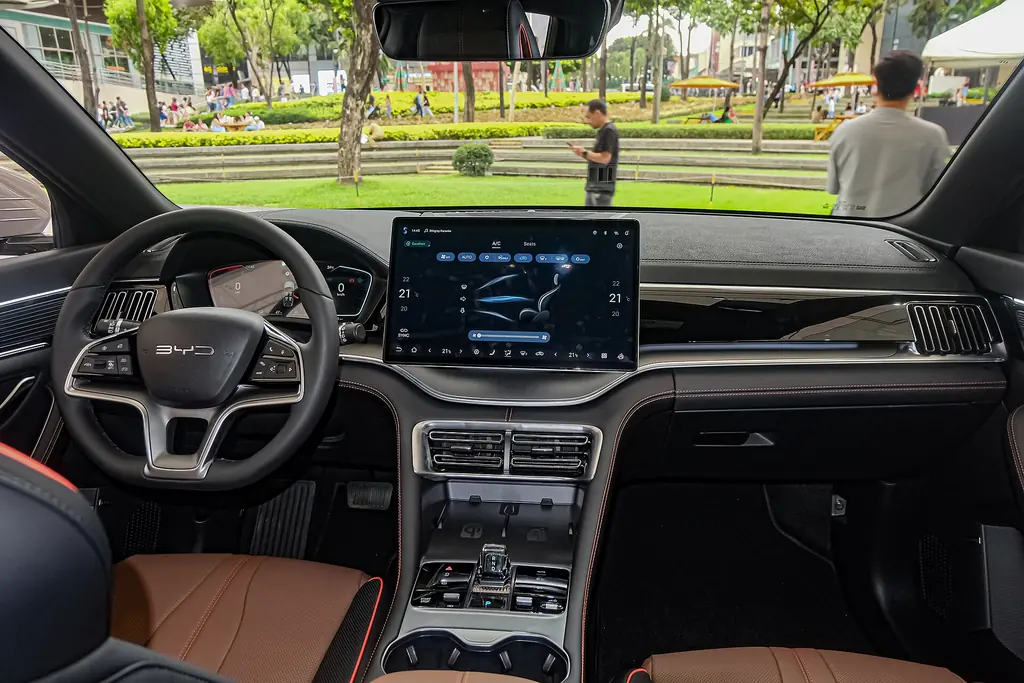
Premium Interior and Technology
The Sealion 6’s equipment list is generous for the price in its home markets, but several headline features are limited to the top grade. Per BYD Australia:
- Rotating Touchscreen: 15.6 inches on the Premium, 12.8 inches on the Essential, with Apple CarPlay and Android Auto.
- 12.3-Inch Digital Cluster: Standard instrument display.
- 10-Speaker Infinity Audio: Premium only.
- Panoramic Sunroof: Standard across the 2025 Australian lineup, according to CarExpert.
- Heated/Ventilated Front Seats and two wireless charging pads: Premium only.
- Other kit: Keyless entry, NFC card key and BYD digital key, dual-zone climate with rear vents, and over-the-air (OTA) software updates.
The 425-liter boot expands to 1,440 liters with the rear seats folded. CarExpert notes the cabin has solid insulation from wind and road noise, though the orange stitching in the Essential “might polarise” buyers. Unlike the more unconventional BYD Atto 3 interior, the Sealion 6’s layout is straightforward.

Safety and Driver Assistance
The Sealion 6 has strong results from the two crash-test programs that have rated it. Neither NHTSA nor the IIHS has tested it, because it is not sold in the US.
| Program | Result | Scores (adult / child / vulnerable road users / safety assist) |
|---|---|---|
| ANCAP (Australia/NZ), Sept 2024 | 5 stars | 88% / 86% / 83% / 75% |
| Euro NCAP (Seal U), 2023 | 5 stars | 90% / 86% / 83% / 77% |
ANCAP based its rating on Euro NCAP testing of the electric Seal U plus additional PHEV-specific tests. Standard equipment listed by ANCAP and BYD Australia includes:
- Airbags: Dual frontal, side chest and side head airbags, plus a front-center airbag that helps protect front occupants in side impacts.
- Autonomous Emergency Braking: Including pedestrian, cyclist, motorcycle, junction and reversing scenarios. ANCAP rated reverse AEB performance as only marginal.
- ADAS: Adaptive cruise control, lane keep assist, emergency lane keeping, blind spot detection, traffic sign recognition and a 360-degree camera.
The 360-degree camera and front and rear parking sensors help in tight city parking.
Driving Experience
Published reviews describe the Sealion 6 as a comfortable daily driver rather than a sporty SUV. CarExpert reports BYD retuned the suspension after early criticism, making it “a bit firmer and tighter than before,” with less body movement over bumps but “a little less forgiving over the sharper hits.” Selectable drive modes include Eco and Sport, and BYD Australia lists Snow mode on the front-drive grades and Mud, Sand and Snow modes on the AWD Premium.
The real-world economy figure CarExpert recorded (4.8 L/100 km with a flat battery) is good for a mid-size SUV, but the best results come from charging regularly and driving within the electric range.
Practicality for American Lifestyles
The Sealion 6 has the basics a US family would look for. Its 425–1,440-liter (15–51 cu ft) cargo space is smaller than a Honda CR-V’s, which Honda lists at 39.3 cu ft behind the rear seat and 76.5 cu ft maximum (US measurements use a different method, so treat the comparison as approximate). Vehicle-to-load (V2L) is standard, according to CarExpert, which lets you power devices from the battery for camping or tailgating. The second row has a reclining backrest, rear vents and USB-A and USB-C ports. However, there is no spare wheel; a tire repair kit is supplied instead.
Pros and Cons
| Pros | Cons |
|---|---|
| Long claimed electric range (57–87 miles, Australian cycle) | Not sold in the US; no announced US launch |
| Five-star ANCAP and Euro NCAP ratings | Range figures are not EPA-rated and will likely be lower in US testing |
| Generous standard kit, panoramic roof, V2L | Slow 18 kW DC charging |
| Quick AWD Premium (5.5–5.9 sec 0–100 km/h) | Best features (15.6-inch screen, ventilated seats) are Premium only |
| Strong real-world fuel use reported by CarExpert | No spare wheel; firmer ride after suspension retune |
Pricing and Value
In Australia, CarExpert lists the 2025 Sealion 6 at A$42,990 (Essential), A$46,990 (Dynamic Extended Range) and A$52,990 (Premium), before on-road costs. BYD has not announced US pricing, and earlier claims in this article that a $7,500 tax credit could bring the price to $27,500 were wrong on two counts: the vehicle is not sold here, and the federal credit ended for vehicles acquired after September 30, 2025.
For comparison, Toyota lists the 2026 RAV4 Plug-in Hybrid from $41,500 MSRP for the SE grade (excluding destination), down from $43,865 for the 2025 model. Any US-market Sealion 6 imported from China would carry the 100% Section 301 tariff on Chinese EVs, which makes a sub-$35,000 US price hard to see.
Competitor Comparison
Because the Sealion 6 has no EPA ratings, a like-for-like comparison is not possible. The table shows the US-market PHEV SUVs you can buy, with official US figures, next to BYD’s Australian claims:
| Vehicle | Electric range | Total range | Notes |
|---|---|---|---|
| BYD Sealion 6 DM-i (Australia) | 57–87 mi (Australian cycle) | ~680 mi (Essential, Australian cycle) | Not sold in US; from A$42,990 |
| Toyota RAV4 Plug-in Hybrid (2026) | 52 mi (Toyota estimate, SE/XSE) | Not yet EPA-rated | 324 hp; from $41,500 MSRP |
| Mitsubishi Outlander PHEV (2026) | 44 mi (EPA) | 420 mi (EPA) | Standard AWD, three rows |
| Kia Sportage Plug-in Hybrid (2026) | 33 mi (EPA) | 470 mi (EPA) | AWD |
| Hyundai Tucson Plug-in Hybrid (2026) | 32 mi (EPA) | 420 mi (EPA) | AWD |
| Ford Escape PHEV (2025) | 37 mi (EPA) | 560 mi (EPA) | FWD; 40 mpg in hybrid mode |
| Jeep Wrangler 4xe (2026) | 22 mi (EPA) | 370 mi (EPA) | Off-road capability |
EPA figures from FuelEconomy.gov; Toyota figures from the Toyota USA newsroom. On paper, the Sealion 6’s claimed electric range is the longest here, but Australian-cycle numbers typically overstate EPA results, so the real gap to the 2026 RAV4 Plug-in Hybrid is likely small. The RAV4 also has more power than the front-drive Sealion 6 grades and is actually on sale.
Market Context and U.S. Potential
Three barriers stand between the Sealion 6 and US showrooms:
- Tariffs: A 100% Section 301 tariff on electric vehicles imported from China took effect September 27, 2024 (Commerce Department fact sheet).
- Connected-vehicle rule: The Commerce Department’s final rule, issued January 2025, prohibits sales of connected vehicles by manufacturers owned or controlled by China or Russia starting with model year 2027 software, with hardware restrictions from model year 2030 (BIS).
- BYD’s own position: BYD Americas CEO Stella Li told Fortune in May 2024 that the company does “not have plans to sell in the U.S.,” calling it “a very protective market.” Reports in 2025 also said BYD had put plans for a large Mexico car plant on hold.
BYD does operate in the US commercial-vehicle market (electric buses and trucks), but its passenger cars are sold elsewhere. For US shoppers, the realistic takeaway is to judge the Sealion 6 as a sign of where affordable PHEVs are heading, and to cross-shop the PHEVs above.
Which One Is Right for You
| Best for | Pick |
|---|---|
| US buyers who want the longest electric range | 2026 Toyota RAV4 Plug-in Hybrid |
| US buyers who need a third row | Mitsubishi Outlander PHEV |
| US buyers on a tighter budget | Kia Sportage or Hyundai Tucson Plug-in Hybrid (compare current prices) |
| Off-road use | Jeep Wrangler 4xe |
| Australian/NZ buyers wanting value and range | BYD Sealion 6 Essential or Dynamic Extended Range |
| Australian/NZ buyers wanting performance | BYD Sealion 6 Premium (AWD) |
FAQ for U.S. Buyers
Is the BYD Sealion 6 fully electric?
What is the BYD Sealion 6 price?
How does it compare to the RAV4 Plug-in Hybrid (formerly RAV4 Prime)?
Is BYD Chinese?
When will it launch in the U.S.?
Is the Sealion 6 safe?
Conclusion
The BYD Sealion 6 DM-i offers a long claimed electric range, five-star safety results and a generous equipment list at a competitive price in the markets where it is sold. For US shoppers, though, it is not an option: BYD has no announced US launch, the $35,000 figure was never an official price, and tariffs and federal connected-vehicle rules stand in the way. BYD’s US site at BYD’s website covers its commercial vehicles; passenger cars like the Sealion 6 are not offered here. If you want a PHEV SUV today, the 2026 Toyota RAV4 Plug-in Hybrid and the other models in the comparison above are the realistic choices.
For more, see more electric car coverage.
Specs, prices and safety ratings change between model years and trims. Verify them for the exact 2026 Byd you are considering:
BYD Australia: Sealion 6 specifications · ANCAP: BYD Sealion 6 rating · Euro NCAP: BYD Seal U · CarExpert: 2025 Sealion 6 price and specs · CarExpert: 2026 Sealion 6 review · Toyota: 2026 RAV4 PHEV · Toyota: 2025 RAV4 Plug-in Hybrid · Toyota: RAV4 Plug-in Hybrid pricing · FuelEconomy.gov · Commerce Department tariff fact sheet · BIS connected vehicles rule · Fortune: BYD on US sales. Checked October 2026. Written by Morgan Reyes; NextCarReview does not road-test vehicles.

Morgan Reyes is the founder and editor-in-chief of NextCarReview, which Morgan launched in August 2024. A 2022 graduate of Columbia University, Morgan is based in New York and writes and edits the site’s reviews, comparisons and buying guides. Morgan does not road-test vehicles. Every article is built from published primary data: EPA FuelEconomy.gov ratings, NHTSA crash ratings, recalls and owner complaints, IIHS results, and manufacturer specifications and pricing, with each figure cited and checked before publication. Contact: admin@nextcarreview.com