
In this article 9 sections
The window sticker on a new car is the Monroney label, required by the Automobile Information Disclosure Act (15 U.S.C. 1232). It lists make, model and identification numbers, final assembly point, the receiving dealer, shipping details and the suggested retail price with options and destination charges, plus NHTSA safety ratings. The EPA fuel economy label can be part of the same sticker or a separate label.
No federal database lets you pull a sticker by VIN. Ask a brand dealer or the manufacturer, check an owner portal if your brand has one, and use a VIN decoder and FuelEconomy.gov to rebuild the key specs.
Paste any 17-character VIN into the NextCarReview VIN decoder to see the year, make, model, engine and plant data that NHTSA’s vPIC database holds for it.
Rules come from 15 U.S.C. 1232 and 1233 (Automobile Information Disclosure Act), the EPA/DOT Fuel Economy and Environment label guide and the FTC. NextCarReview does not sell vehicle history reports and does not rank paid report services; see our sourcing policy.
This is general information. Decoded details come from manufacturer submissions to NHTSA; always confirm a specific vehicle with its title, the manufacturer or a dealer.
A window sticker answers questions that are hard to settle from a used listing: which options the car left the factory with, what it originally cost and where it was assembled. Federal law has required this label on new cars for decades, but it was never meant to be a permanent record, so getting one for a car you are buying later takes some legwork. Start with what the VIN itself can tell you using our free VIN decoder.
What Is a Monroney Label?
The window sticker is commonly called the Monroney label. Under 15 U.S.C. 1232, every manufacturer of new automobiles distributed in commerce must securely affix a label to the windshield or a side window of each new car (15 U.S.C. 1232).
What Information Does the Window Sticker Show?
| Required item (15 U.S.C. 1232) | What it tells you |
|---|---|
| Make, model and serial or identification numbers | Identifies the exact vehicle; the VIN should match the car |
| Final assembly point | Where the vehicle was assembled |
| Name and location of the dealer it was delivered to | The receiving dealership |
| City or town of delivery | Delivery location |
| Method of transportation (if driven or towed) | How it reached the dealer |
| Suggested retail price, prices of installed options and accessories, transportation charges, and the total | Original MSRP and options as built |
| NHTSA safety rating information, or a statement that none is available | Crash-test star ratings where tested |
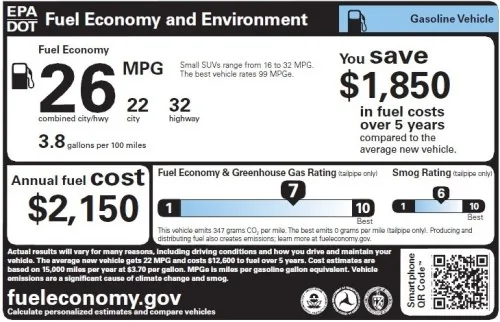
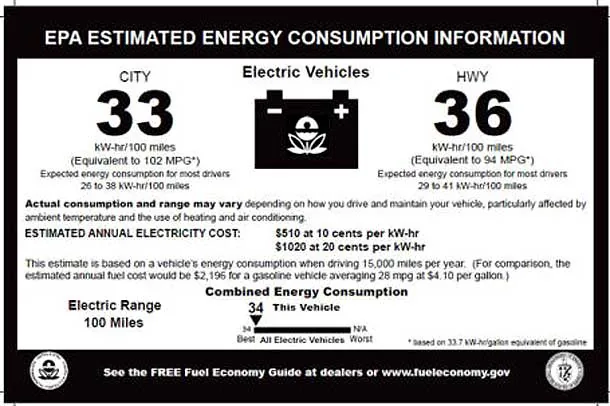
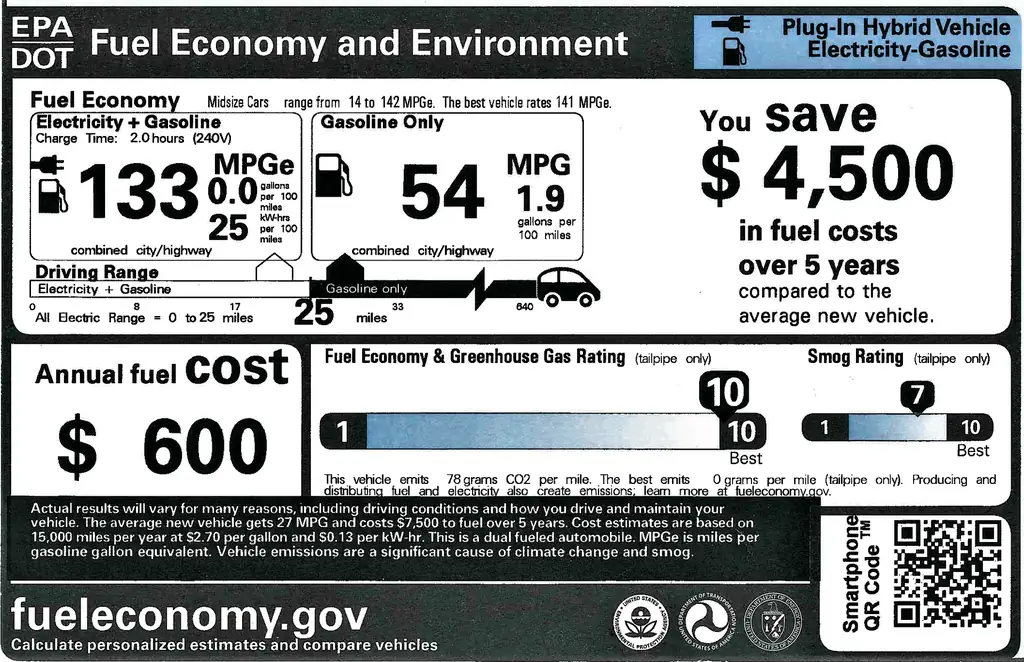
The fuel economy part of the sticker comes from EPA and DOT. FuelEconomy.gov explains its elements: the vehicle’s technology and fuel type, city/highway/combined MPG (or MPGe), the best and worst fuel economy in its class for that model year, five-year fuel cost savings or spending versus the average new vehicle, a fuel consumption rate per 100 miles, estimated annual fuel cost based on 15,000 miles a year, 1-10 ratings for fuel economy and greenhouse gas emissions and for smog, CO2 grams per mile, and a QR code linking to FuelEconomy.gov (FuelEconomy.gov).
Is It Illegal to Remove a Window Sticker?
Before delivery, yes. Under 15 U.S.C. 1233, a manufacturer that willfully fails to affix the label can be fined up to $1,000, and any person who willfully removes, alters or makes the label illegible before the car is delivered to the actual custody and possession of the ultimate purchaser can be fined up to $1,000, imprisoned up to one year, or both, with each vehicle counted as a separate offense (15 U.S.C. 1233). Once the buyer takes delivery, the sticker is theirs to keep or discard, which is why many used cars no longer have one.
How Can You Get a Window Sticker by VIN?
There is no federal VIN-to-sticker database. Practical options, roughly in order:
- Ask the seller. Original owners sometimes keep the sticker with the purchase paperwork.
- Ask a dealer for that brand. Dealers can often look up how a vehicle was built from the VIN.
- Contact the manufacturer’s customer service with the VIN and ask whether it can provide a copy of the original label or a build sheet.
- Check the manufacturer’s owner portal. Some brands show original equipment or a sticker for vehicles added to an owner account; availability varies by brand and model year.
- Rebuild the key facts yourself. Decode the VIN for model year, engine, body and plant with our VIN decoder, then look up the model’s official fuel economy label data on FuelEconomy.gov.
Be cautious with third-party sites that generate "replica" stickers: a reconstructed sticker is not the original label, and pricing or options on it may not reflect how a specific car was built.
What Can a VIN Decoder Tell You Without the Sticker?
| Detail | From the VIN / decoder | From the original sticker |
|---|---|---|
| Model year, make, model | Yes (position 10 and the manufacturer’s filing) | Yes |
| Engine type, body style | Usually (positions 4-8) | Yes |
| Assembly plant | Yes (position 11) | Yes (final assembly point) |
| Trim and options | Sometimes, depending on the manufacturer’s coding | Yes, itemized with prices |
| Original MSRP | No | Yes |
| EPA fuel economy | Look up the model on FuelEconomy.gov | Yes |
How Do You Check a Window Sticker Against the Car?
If a seller hands you a sticker, treat it as a claim to verify, not proof. Compare the VIN printed on the label with the VIN on the dashboard and the door jamb; they must match exactly, all 17 characters. Check that the engine, drivetrain and body style on the sticker agree with what a VIN decoder returns for that VIN, and that the listed options are actually on the car. Look up the model year’s fuel economy on FuelEconomy.gov and compare it with the sticker’s figures. A mismatch on any of these points suggests the sticker belongs to a different vehicle, or was reconstructed, and the listing deserves a closer look.
What About Used Cars?
Used cars sold by dealers carry a different federal disclosure: the FTC’s Buyers Guide. It says whether the car is sold as-is or with a warranty and what share of repair costs the dealer will pay, and it reminds buyers to get promises in writing and to get a vehicle history report (FTC). The Buyers Guide does not list original options or price, so a window sticker, when you can find one, fills that gap. Pair it with a history check, such as the steps in our accident history guide.
Frequently Asked Questions
What is a Monroney label?
It is the window sticker federal law requires on new cars. Under the Automobile Information Disclosure Act (15 U.S.C. 1232), every manufacturer of new automobiles must affix a label to the windshield or a side window showing the make, model and identification numbers, final assembly point, the dealer it was shipped to, transportation details, and the suggested retail price with options and transportation charges.
Can I get a window sticker by VIN?
There is no federal database of window stickers. Options include asking a dealer for that brand, contacting the manufacturer’s customer service, or using a manufacturer’s owner portal where one offers a sticker or build sheet. Our free VIN decoder and FuelEconomy.gov can rebuild many of the key facts.
Is it illegal to remove a window sticker?
Before the car is delivered to its buyer, yes. Under 15 U.S.C. 1233, anyone who willfully removes, alters or makes illegible the label before delivery to the ultimate purchaser can be fined up to $1,000, imprisoned up to one year, or both, for each vehicle.
What is on the fuel economy part of the window sticker?
The EPA/DOT Fuel Economy and Environment label shows city, highway and combined MPG (or MPGe), fuel consumption per 100 miles, estimated annual fuel cost, five-year fuel cost savings or spending versus the average new vehicle, fuel economy and greenhouse gas and smog ratings on a 1-10 scale, and a QR code linking to FuelEconomy.gov.
Do used cars have a window sticker?
Used cars sold by dealers must display the FTC Buyers Guide instead, which states whether the car is sold as-is or with a warranty. The original Monroney label is required only on new cars, though some owners keep it.
⚠️ Professional Notice:
Window-sticker rules summarized from 15 U.S.C. 1232-1233 and FuelEconomy.gov as of October 2026. Manufacturer lookup services change; ask the brand directly.
NextCarReview.com is not affiliated with NHTSA, NMVTIS, NICB or any vehicle history company and receives no compensation from them.
VIN & Vehicle History Guides
Decode any VIN free: NextCarReview VIN decoder. More in this series:
Data Sources and Verification

Morgan Reyes is the founder and editor-in-chief of NextCarReview, which Morgan launched in August 2024. A 2022 graduate of Columbia University, Morgan is based in New York and writes and edits the site’s reviews, comparisons and buying guides. Morgan does not road-test vehicles. Every article is built from published primary data: EPA FuelEconomy.gov ratings, NHTSA crash ratings, recalls and owner complaints, IIHS results, and manufacturer specifications and pricing, with each figure cited and checked before publication. Contact: admin@nextcarreview.com