In this article 17 sections
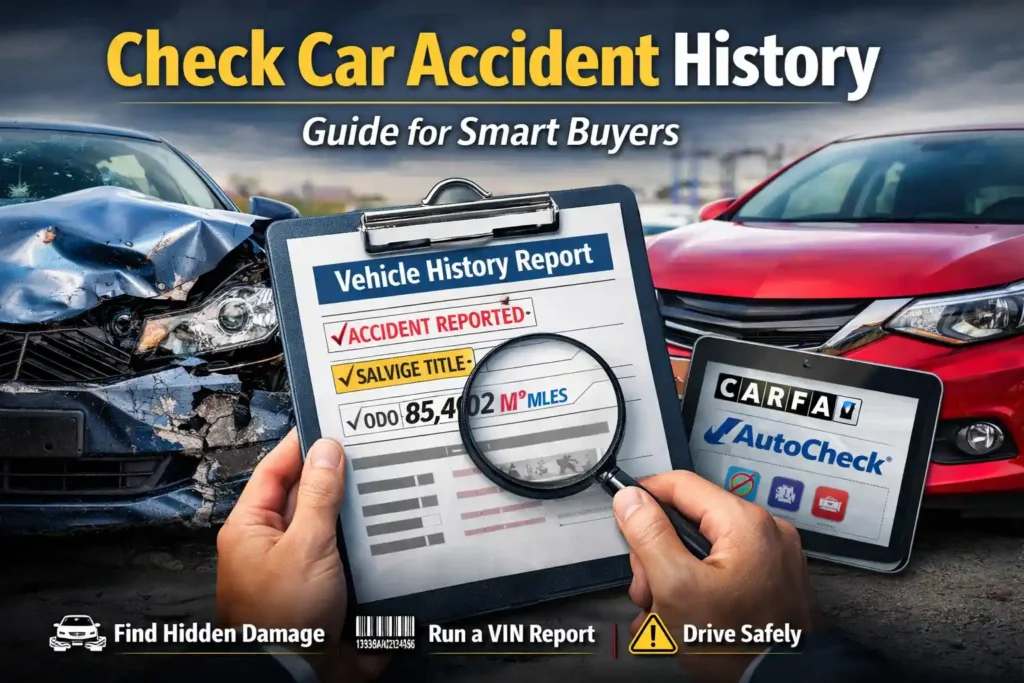
To check car accident history, get the 17-digit VIN, run the free NICB VINCheck for theft, salvage and flood records, then buy a vehicle history report (Carfax, AutoCheck or an NMVTIS-approved provider). For your own car, ask your insurer for your claims record. No report shows every accident, so also inspect the car and hire a mechanic.
Buying a used car is a big decision, and many cars have hidden problems. Some sellers try to hide a car’s past, and a shiny car can still have serious frame damage. The most important step before you pay is to check the car’s accident history.
Skipping this step can cost you money and put you in an unsafe car. A car that was in a serious crash may not protect you in the next one, and a crashed car is worth less. A history check helps you decide whether to buy and what price to pay.
This guide shows exactly how to check accident history on a car with a VIN, which tools are free, what each report covers, and how to look for damage with your own eyes. You do not need to be an expert. Follow the steps.
Why It Is Vital to Check Car Accident History
First, safety. Modern cars are built to crumple in a crash, and once they crumple they are never exactly the same. If the repair was poor, the car may not protect you in a new accident.
Second, value. You can use the history to negotiate. If you find a minor accident, ask for a discount, and if you find a major one, you may decide to walk away.
Third, future repairs. Hidden damage causes problems later. A bent frame ruins tires quickly, and electrical issues can start months after you buy. Taking time to check car accident history protects your wallet and your family.

How to Start: The VIN
The journey begins with the Vehicle Identification Number, or VIN. Every car has a unique 17-character VIN, like a fingerprint. You can find it in a few places.
- On the dashboard on the driver’s side, visible through the windshield.
- On the sticker inside the driver’s door jamb.
- On the insurance card or title document.
Write it down and compare it with the number on the car. This number unlocks all the data. If a seller will not give you the VIN, walk away.
How to Check Car Accident History Free
You can start with free checks, but they have limits. Use them to catch the worst problems before you pay for a full report.
- NICB VINCheck: The National Insurance Crime Bureau’s free tool tells you whether a participating insurer has reported the vehicle stolen and not recovered, or reported it as a salvage or flood-damaged vehicle (NICB VINCheck). It does not show minor accidents, odometer readings or ownership history.
- NHTSA recall lookup: Enter the VIN at nhtsa.gov/recalls to see open safety recalls. This is not an accident check, but a recall can explain a problem.
- Dealer-provided report: Many dealers include a report for free. Check the date, because a stale report may miss recent events.
Free checks mainly find thefts and write-offs. For accidents and repairs, you need a full report.
Using a Car Accident History Report
A vehicle history report gathers data reported by state motor vehicle agencies, insurers, salvage yards, police and repair shops. Carfax and AutoCheck are the two best-known paid providers. They can show:
- Accident records and damage reports.
- Number of owners.
- Service history.
- Odometer readings.
You can also buy a report from an NMVTIS-approved provider. NMVTIS, the National Motor Vehicle Title Information System, is the federal database of title, brand and odometer records, and in some cases theft data. It is the only vehicle history database to which all states, insurance carriers and junk and salvage yards must report, per AAMVA. Only approved providers can sell NMVTIS reports, and the official list is on the Bureau of Justice Assistance site. NMVTIS flags title brands such as salvage, rebuilt and flood, but it is not an accident report.
When you read a report, look for red flags. Words like “Salvage,” “Rebuilt” or “Flood” are bad news. They mean the car was declared destroyed before. Also check the details: was an airbag deployed, was it a head-on collision, and where was the damage?

Physical Inspection: Use Your Eyes
Reports are great, but they are not perfect. If someone hits a fence and fixes it at home, or pays a shop in cash, there is no report. So look at the car yourself.
Paint and Color
Walk around the car slowly. Does the paint match on every panel? A repainted door can look slightly darker or lighter. Also look at the reflection. Factory paint is smooth, and a bad paint job can look wavy like an orange peel. Mismatched paint is a warning.
Panel Gaps
Factory gaps between doors and fenders are even. If a gap is wide at the top and tight at the bottom, the panel is crooked, which can happen after a crash. Check that the doors close easily. If you have to slam a door, the frame might be bent.
Bolts and Fasteners
Open the hood and look at the bolts that hold the fenders. Factories paint over these bolts. If the paint is chipped or the heads are scratched, someone removed the fender, which may have been to fix accident damage.
Tires and Wheels Tell a Story
Tires should wear evenly. If the inside of a tire is bald and the outside is new, the alignment is off, and a bad crash can bend the suspension. Alignment problems can be expensive to fix.
Also look at the wheel wells. Fresh black spray may hide rust or welds. If it looks wet or too new, be suspicious.
The Interior Check
Get inside the car. A smell of mildew or mold can be a flood sign. A strong air freshener may be masking a smell. Pull the seatbelt all the way out and look for water stains. Water damage destroys electronics.
Look at the steering wheel. If the airbag cover is loose or a different color, it may have been replaced. Turn the car on and watch the dashboard lights. The airbag light should glow for a moment and then go out. If it never lights, it could be broken or covered.

Professional Help: The Mechanic
The report looks fine and so does the car. Now call a professional. A mechanic can put the car on a lift and check the frame rails, and can look for clamp marks left by frame-straightening machines. Shops set their own price for a pre-purchase inspection, so ask before you book.
If a seller says no to an independent mechanic, leave. This step is non-negotiable.
Check Your Own Car’s Accident History: Insurance Claims
Insurance companies hold a lot of accident data. When a claim is made, it is recorded, and some of that data reaches history reports. If you want to know your own claims record, ask your insurer or request your CLUE report.
A CLUE (Comprehensive Loss Underwriting Exchange) report is a consumer report of auto and property claims history, generally covering up to seven years and tied to a specific vehicle, per the Washington Office of the Insurance Commissioner. You are entitled to one free copy a year from LexisNexis at personalreports.lexisnexis.com.
The cash rule applies. If a driver pays cash for repairs and no claim is filed, insurance never records it. That is why reports are not 100% complete.
Before you buy, call your own insurance agent with the VIN and ask for a quote. A very high price can be a sign of a problem history, so ask why. It is a quick extra research tool.
USA Car Accident History Specifics
If you are buying in the US, titling rules vary by state. Some sellers try “title washing,” moving a salvage-title car to another state to get a clean title. This is fraud. NMVTIS exists to help stop it, because it tracks title and brand data across state lines.
A car that moved through several states in a short time is a red flag. Always look at the location history in the report.
What If You Find an Accident?
Is the deal dead? Not always. It depends on the damage.
Minor Accidents
A scratched bumper or dented door is cosmetic. You can buy the car, but ask for a lower price.
Major Accidents
If airbags deployed, be careful. If the frame was bent, walk away. If it was a flood car, run.
The Rebuilt Title
Some cars are repaired and given a “Rebuilt” title. They are cheap but hard to sell later. Some lenders will not finance them, and some insurers limit coverage. Unless you are a mechanic, avoid these.
Step-by-Step Buying Guide
Follow these steps in order.
- Ask the Seller: Ask, “Has this car been in an accident?”
- Get the VIN: Write it down correctly and check it against the car.
- Run the Free Check: Use NICB VINCheck first.
- Buy the Report: Get a full report from Carfax, AutoCheck or an NMVTIS-approved provider.
- Inspect the Body: Look for paint lines and gaps.
- Check the Tires: Look for uneven wear.
- Hire a Mechanic: Get a professional opinion.
- Negotiate: Use the history to get a better price.
Comparison Table: Accident History Checks
Here is a quick look at your options. Prices change, so confirm the current price with each provider.
| Feature | NICB VINCheck (free) | NMVTIS-approved report | Carfax / AutoCheck | Insurer / CLUE report |
|---|---|---|---|---|
| Cost | Free (five searches per 24 hours per IP address) | Set by provider | Typically tens of dollars per report | Free once a year (CLUE) |
| What it shows | Unrecovered theft, salvage and flood-damage reports from participating insurers | Title, brand and odometer data, and in some cases theft data | Reported accidents, owners, service, odometer | Claims on your own vehicle, up to about 7 years |
| Minor accidents | No | No | Sometimes, if reported | Only if a claim was filed |
| Best for | First check on any VIN | Title brands and odometer fraud | Full picture before buying | Your own car |
Use this table to choose. Start free, then pay if you are serious.
Common Scams
Scammers are smart, so you need to be smarter.
The VIN Swap
They show you a clean report for a different car. Always check the VIN plate on the car itself and make sure it matches the paper.
Curbstoning
A dealer pretends to be a private seller. If they have many cars for sale, they are a dealer.
The Masking Tape
Tape or stickers over dashboard warning lights. Turn the car on and watch for all the lights to glow for a second.
Conclusion
Knowledge is power. When you check car accident history before you buy, you take control. Use the VIN to run the free NICB check, buy a full report, use your eyes to spot repairs, and use a mechanic to verify the frame.
If a deal feels wrong, walk away. There are millions of cars out there, and the right one is waiting for you.
Related guides: the NextCarReview tools page and Best Time to Buy a Car.
FAQs
How do I check a car’s accident history?
Can I check car accident history for free?
Does NMVTIS show accident history?
How do I find my own car’s accident history?
Can I find out what damage a car has had?
Why does a history report miss some accidents?
Can accident history be removed from a car’s record?
For official rules, ratings and consumer guidance on this topic, see:
Sources
- AAMVA: NMVTIS for the general public and consumers
- Washington Office of the Insurance Commissioner: CLUE report
- LexisNexis Personal Reports (free annual CLUE report)
- NICB VINCheck (free theft, salvage and flood lookup)
- NMVTIS: National Motor Vehicle Title Information System
- FTC: buying a used car from a dealer

Morgan Reyes is the founder and editor-in-chief of NextCarReview, which Morgan launched in August 2024. A 2022 graduate of Columbia University, Morgan is based in New York and writes and edits the site’s reviews, comparisons and buying guides. Morgan does not road-test vehicles. Every article is built from published primary data: EPA FuelEconomy.gov ratings, NHTSA crash ratings, recalls and owner complaints, IIHS results, and manufacturer specifications and pricing, with each figure cited and checked before publication. Contact: admin@nextcarreview.com