In this article 12 sections
Your 2025 Toyota Camry is shaking at idle or clunking on acceleration. Before you hand it to a dealer and pay $120 just for a diagnosis, you need to know what you are actually dealing with.
This guide covers exactly what a failing engine mount (also called a motor mount) feels like on the 2025 Camry, how to inspect it yourself in three steps, what it costs to fix in US dollars, and the one question nobody else answers directly: is it safe to keep driving?
checked against published technical sources covering Toyota powertrain systems, engine mount diagnosis, and ASE repair standards.
Sources:
Toyota Owners Documentation |
RepairPal US Cost Estimator |
NHTSA.gov |
SAE International
Editorial review date: February 2026
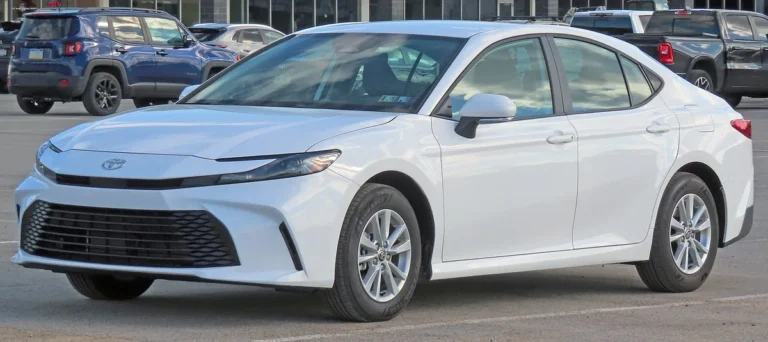
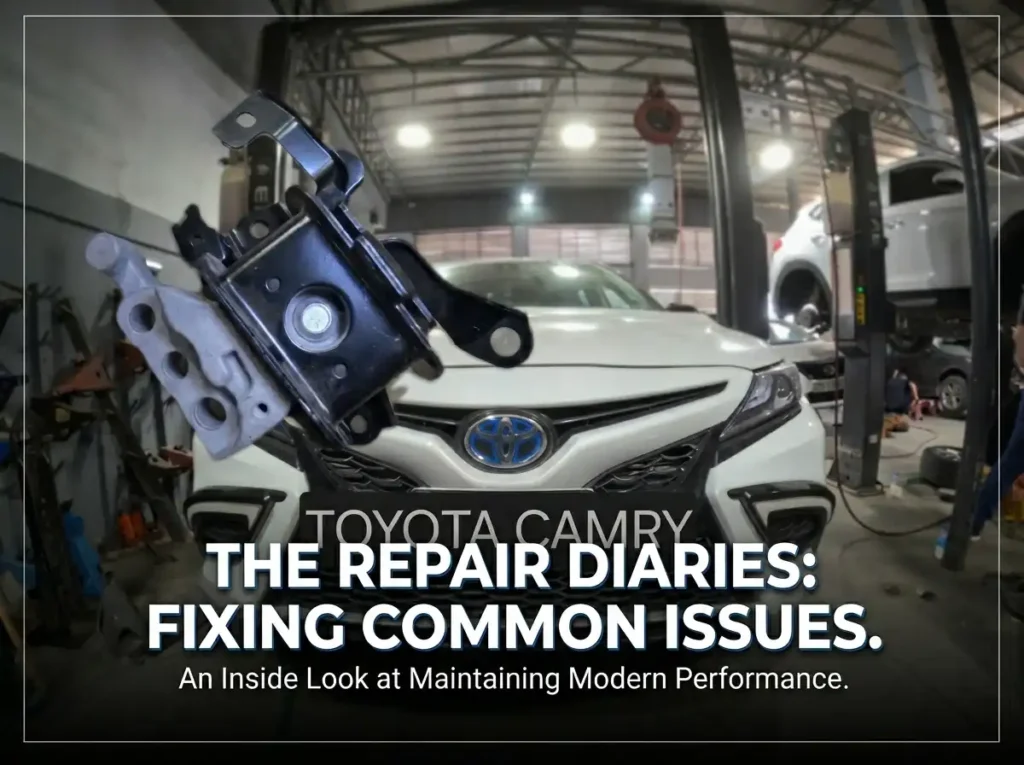
Every 2025 Toyota Camry is a hybrid: a 2.5-liter four-cylinder with Toyota’s fifth-generation hybrid system (225 hp FWD, 232 hp AWD). Its engine and transaxle sit on several rubber-isolated mounts. When any one of these fails, the rubber isolator inside the mount breaks down, allowing the engine to move more than it should. That movement is what you feel as vibration in the cabin, and what you hear as a clunking noise during acceleration or gear changes.
Quick answer: A failing engine mount on the 2025 Camry Hybrid shows up as uneven idle vibration and a clunk when you shift or accelerate. RepairPal estimates replacement at $793 to $878. Toyota’s 36-month/36,000-mile basic warranty covers defects but not normal wear, so call a dealer first if you are inside it. Short-term driving is usually fine; stop if the engine moves more than about an inch.
RepairPal estimates an engine mount replacement on a 2025-2026 Camry at $793 to $878 for parts and labor, with regional variation. If your Camry is within Toyota’s standard 3-year/36,000-mile bumper-to-bumper warranty, the repair may cost you nothing at all at a Toyota dealership.
📌 2025 Toyota Camry Engine Mount – Quick Intelligence Summary
Verified Facts at a Glance
| Number of engine Mounts | Several engine and transaxle mounts; see Toyota repair information |
| Average Replacement Cost (US) | $793 to $878 (RepairPal, 2025-2026 Camry) |
| OEM part Cost | Varies by mount; ask a Toyota dealer |
| Labor Time | Varies by mount position |
| Toyota Warranty Coverage | 3yr/36,000-mile bumper-to-bumper – may cover mount failure |
| Top Symptom | Cabin vibration at idle + clunking noise on acceleration |
| DIY inspection | Yes – 3-step visual, movement, and sound check |
| Safe to drive? | Short-term yes, long-term no – see H2-5 for full answer |
| Camry Hybrid Note | All 2025 Camrys are hybrids – see dedicated callout |
| Recommended Parts | Toyota Genuine Parts for warranty-period vehicles |
| Cost Source | RepairPal estimator for the 2025-2026 Camry |
| analysis | Editorial Standard Verified ✔️ | sources: Toyota.com, RepairPal, NHTSA, SAE |

Symptoms of a Failing Engine Mount on the 2025 Camry
Engine mount symptoms are easy to misread. Some feel like a tire balance problem. Others get confused with spark plug issues. This section explains exactly what mount failure feels like on the 2025 Camry – and how to tell it apart from other causes of vibration.
Vibrations at Idle – What Normal Feels Like vs What Failure Feels Like
Every internal combustion engine produces some vibration. In a healthy 2025 Camry, the rubber isolators inside each engine mount absorb that movement before it reaches the cabin. You might feel a faint, even pulse at a red light – that is normal.
When a mount’s rubber isolator starts to crack or deteriorate, it loses its ability to absorb engine movement. The vibration that was being dampened now travels directly through the chassis into the seats, steering wheel, and floor. It feels uneven and pronounced rather than smooth and faint.
If the vibration disappears when you put the car in neutral but returns in drive, that is a strong indicator the engine mount is involved. The extra load on the powertrain in drive stresses the failing mount further.
Clunking and Knocking Noises – When They Happen and What They Mean
A clunking noise during acceleration or when shifting gears is one of the clearest signs of engine mount failure. This happens because a worn mount allows the engine to move significantly during the torque surge of acceleration – and that movement causes contact between engine components and the chassis or surrounding brackets.
The noise is most obvious at low speeds, during initial acceleration from a stop, or when shifting from park to drive. A single loud clunk when engaging drive is a common early symptom. Multiple clunks on hard acceleration typically means the mount is more advanced in its failure.
If the clunking is accompanied by a metallic rattle that changes with engine RPM, the harmonic balancer may also need attention – this is a separate component and a separate repair, which we cover in the diagnosis section below.
Visible Engine Movement – The Half-Inch Test
Open the hood and have someone sit in the driver’s seat. Ask them to shift from park to drive while you watch the engine from outside. A healthy mounting system shows minimal movement – less than half an inch total.
If the engine visibly rocks or lurches more than half an inch when the transmission engages, the mount holding the most stress is likely worn or broken. You may also see cracked or torn rubber on the mount itself during this visual inspection.
Rough Idle – When It Is the Mount and When It Is Something Else
A rough idle on the 2025 Camry is not always caused by the engine mount. Worn spark plugs, a clogged throttle body, dirty fuel injectors, and vacuum leaks can all produce a rough idle without any mount involvement at all.
The key distinction is this: if the rough idle is accompanied by a clunking noise or visible engine movement, the mount is likely a contributor. If the rough idle is smooth and even but just feels unsteady, start with spark plugs and throttle body cleaning before assuming it is a mount problem.
| Symptom | Most Likely Cause | Urgency Level | DIY or shop? |
|---|---|---|---|
| Vibration at idle, worsens in drive | Worn engine mount rubber isolator | Medium – address within 30 days | DIY inspect, shop to replace |
| Clunking on acceleration from stop | Failing front engine mount | High – address within 1-2 weeks | Shop |
| Clunking when shifting park to drive | Worn transmission mount | Medium-high | Shop |
| Metallic rattle changing with RPM | Warped harmonic balancer | High – can cause engine damage | Shop immediately |
| Rough idle only, no clunk or movement | Spark plugs, throttle body, injectors | Medium | DIY or shop |
| Vibration + noise from belt area | Worn accessory drive belt bearing | Medium – belt failure risk | Shop |
| Visible engine movement over 0.5 inch | Broken or severely worn mount | High – safety risk | Shop immediately |
How to Diagnose Engine Mount Problems on Your 2025 Camry

You do not need a lift or specialty tools for the initial inspection. The 3-step DIY check below will tell you whether you have a mount problem, which mount is most likely involved, and whether you need a shop right away or have time to schedule a visit.
Step 1: Visual Check – What to Look For in the Engine Bay
With the engine cold, open the hood and locate the engine mount brackets. On the 2025 Camry, the front mounts sit on either side of the engine block where it connects to the subframe. Look directly at the rubber isolator – the visible rubber portion between the metal bracket and the engine.
Cracks, tears, or separation in the rubber are clear signs of failure. Also look for oil contamination on or around the mount. Oil from a leaking valve cover gasket or engine seal soaks into the rubber isolator and dramatically accelerates its breakdown – a mount near an oil leak may fail years before its expected service life.
Step 2: Movement Test – The Two-Person Inspection
Have someone sit in the driver’s seat with the engine running and foot on the brake. Ask them to shift slowly between park, reverse, neutral, and drive while you watch the engine from outside the engine bay – safely clear of moving components.
Watch for engine movement greater than half an inch in any direction. Pay attention to which side of the engine moves most – the side with the most movement indicates which mount is under the most stress. A healthy mount holds the engine nearly still through this cycle.
Step 3: Sound Inspection – Listening for Metal Contact
With the engine running, listen carefully near each mount location. A mechanic’s stethoscope pressed against the mount bracket will amplify any metal-on-metal contact sounds. If you do not have a stethoscope, a long wooden dowel pressed against the bracket with your ear on the other end works as a basic alternative.
A healthy mount is quiet. A failing mount produces a thudding or knocking sound that changes when the engine is revved briefly. Note exactly where the sound originates – this narrows down which mount needs replacement.
Using an OBD-II Scanner – Which Fault Codes to Look For
An OBD-II scanner – a diagnostic tool that reads fault codes stored by your Camry’s onboard computer – will not directly detect a failing engine mount. Mounts do not have sensors. However, if a severely failing mount is causing the engine to move enough to affect sensor readings, you may see misfire codes in the P0300 to P0308 range.
Codes P0300 through P0308 indicate random or cylinder-specific engine misfires. These codes can appear alongside mount failure when excessive engine movement disrupts fuel delivery or ignition timing. Always cross-reference any misfire code with a physical inspection before replacing ignition components – a failing mount can mimic misfire symptoms without any spark plug or coil fault present.
Ruling Out the Harmonic Balancer and Accessory Belt
The harmonic balancer (also called a harmonic damper) is a weighted disc on the front of the crankshaft that absorbs engine vibration. When it warps or the rubber damping layer separates, it creates vibration that can feel very similar to a mount problem – but it is a completely different repair with different cost implications.
The distinction: harmonic balancer vibration tends to be RPM-dependent and most noticeable at highway speeds. Engine mount vibration is most noticeable at idle and low-speed acceleration. If your vibration gets worse above 60 mph rather than at idle, the harmonic balancer and the accessory drive belt bearing deserve priority inspection.
the 3-step inspection above is designed for diagnosis only – not replacement. Engine mount replacement requires lifting the engine safely, removing mount hardware, and torquing new bolts to spec. Incorrect installation can create new vibration problems and stress other components.
if your visual check shows broken or oil-soaked rubber, or your movement test shows more than half an inch of engine travel, book an ASE-certified technician (automotive Service Excellence) appointment. This is not a repair to skip or delay more than a few weeks once confirmed.
What Causes Engine Mount Failure on the 2025 Camry
Understanding why mounts fail helps you prevent premature replacement and catch the next problem before it becomes expensive. The Camry shares its fundamental mounting philosophy with Toyota’s broader vehicle lineup – the same rubber isolator technology used across Toyota’s 2025 SUV models applies to the Camry’s mounting system, meaning maintenance lessons transfer across the range.
Normal Wear – How Long Mounts Last in Miles
Under normal US driving conditions, engine mounts usually last many years, but there is no fixed replacement interval in Toyota’s maintenance schedule. City driving with frequent stop-and-go acceleration puts more stress on mounts than highway driving. Mounts on high-mileage vehicles simply reach the end of their rubber’s service life – the isolator loses elasticity, hardens, and eventually cracks.
The 2025 Camry is a new enough vehicle that age-related wear is not the primary concern for most owners yet. For 2025 model year vehicles, premature failure from oil contamination or driving habits is the more likely culprit when symptoms appear early.
Oil Contamination – The Accelerated Failure Nobody Talks About
Oil contamination is a common reason mounts fail early. Engine oil that leaks from a valve cover gasket, crankshaft seal, or timing cover soaks directly into the rubber isolator inside the nearest engine mount.
Oil is a solvent for rubber. A mount soaked in engine oil can fail far earlier than a clean one. If your Camry has any known oil leaks and you are experiencing vibration, inspect the mount nearest the leak first.
every 2025 Toyota Camry is a hybrid; Toyota dropped the gas-only version for this generation. The electric motors deliver torque instantly, which loads the mounts differently from an older gas-only Camry.
if you drive the 2025 Camry hybrid and experience vibration or clunking, confirm with a Toyota-trained technician that the inspection accounts for the hybrid-specific mount arrangement. Procedures written for older gas-only Camrys may not match this model, so use 2025-specific repair information and a technician trained on Toyota hybrids.
2025 Camry Engine Mount Replacement Cost (USD)

RepairPal estimates an engine mount replacement on a 2025-2026 Camry at $793 to $878 per job. Per-mount part and labor costs are not published, so the table below shows what to ask for in a quote. Actual costs vary by region – dealer labor rates in metropolitan areas typically run higher than independent shop rates.
How Many Engine Mounts Does the 2025 Camry Have?
The engine and hybrid transaxle are supported by several mounts. Ask the shop to name the exact mount that failed, since the layout differs from older gas-only Camrys.
When one mount fails, the others absorb additional stress to compensate. This is why mechanics recommend replacing mounts in pairs – replacing only the failed mount leaves the vehicle unbalanced, and the remaining worn mounts will fail faster under the added load, creating new vibration within months.
Parts Cost – OEM vs Aftermarket in US Dollars
| Feature | Toyota Genuine Parts (OEM) | Premium Aftermarket | Budget Aftermarket |
|---|---|---|---|
| Part Cost (per mount) | $80 to $180 | $45 to $90 | $20 to $45 |
| Warranty | Toyota parts warranty (ask your dealer) | 1 year limited | 90 days to 1 year |
| Rubber Compound Quality | OEM specification – matched to Camry NVH tuning | Comparable – varies by brand | Lower grade – may affect ride quality |
| Fit Guarantee | Direct fit – no modification needed | Direct fit (reputable brands) | May require fitment verification |
| recommendation | Best choice for warranty-period vehicles | Good value for post-warranty vehicles | Avoid on primary driving vehicle |
Toyota Genuine Parts are the safest choice for 2025 Camry owners still within the 3-year/36,000-mile warranty period. Using non-OEM parts for a warranty repair can complicate future warranty claims on related components. For vehicles outside warranty, a premium aftermarket mount from brands like anchor, westar, or DEA usually costs less, but confirm it is listed for the 2025 hybrid.
Labor Cost and Total Repair Estimate
| Mount Location | OEM part Cost | Aftermarket Part Cost | Labor Estimate | Total Range |
|---|---|---|---|---|
| Front Mount (driver Side) | Varies | Varies | Varies | Varies |
| Front Mount (passenger Side) | Varies | Varies | Varies | Varies |
| Rear Engine Mount | Varies | Varies | Varies | Varies |
| Transmission Mount | Varies | Varies | Varies | Varies |
| Both Front Mounts (pair) | Varies | Varies | Varies | Varies |
Labor rates vary significantly by location. RepairPal estimates an engine mount replacement on a 2025-2026 Camry at $793 to $878 in total, and independent shops are often cheaper than dealers on labor.
For context on how Toyota’s rubber isolator technology is deployed across its larger platforms, our reviews of the 2025 Toyota Land Cruiser and the 2024 Toyota Tundra cover the same mounting architecture used in Toyota’s body-on-frame lineup – useful context if you are comparing repair expectations across Toyota vehicles.
Use RepairPal’s ZIP code-based cost estimator to get a regional price range specific to your area before calling shops for quotes.
Does Toyota Warranty Cover Engine Mount Replacement?
Toyota’s standard 3-year/36,000-mile bumper-to-bumper warranty covers defects in materials or workmanship – including engine mount failure that results from a manufacturing defect rather than normal wear. Per Toyota’s US warranty documentation, the bumper-to-bumper coverage applies to the entire vehicle including mounting components.
If your 2025 Camry is within the warranty period and the mount failure is not caused by accident damage, oil contamination from a pre-existing leak, or owner-installed modifications, a Toyota dealership should cover the repair at no cost. Bring your ownership documentation and allow the dealer’s service team to diagnose the failure cause before assuming it is or is not covered.
Toyota dealers are not always the most expensive option – but they are not always the cheapest either. For out-of-warranty repairs, get quotes from at least one RepairPal certified independent shop alongside the dealer quote.
when the shop calls with the diagnosis, ask specifically: which mount is failing, are they recommending pair replacement, and what brand of replacement part they plan to use. These three questions give you the information needed to compare quotes accurately.
Toyota Warranty Terms That Apply to a 2025 Camry Mount Claim
Toyota runs several warranty clocks on the 2025 Camry Hybrid, and the one that applies to a mount depends on how the dealer classifies the failure. These are the published terms.
| Coverage | Term | What Toyota says it covers |
|---|---|---|
| Basic new-vehicle | 36 months / 36,000 miles | All components other than normal wear and maintenance items |
| Powertrain | 60 months / 60,000 miles | Engine, transmission/transaxle, front-wheel-drive system, seatbelts and airbags |
| Hybrid-related components | 8 years / 100,000 miles | Repairs that correct defects in materials or workmanship |
| Hybrid battery | 10 years / 150,000 miles | Battery, transferable to later owners |
| ToyotaCare | 2 years / 25,000 miles | Normal factory-scheduled maintenance, plus 24-hour roadside assistance |
A mount that cracks early with no oil leak nearby is a defect question under basic coverage. A mount that has simply worn out after years of use is “normal wear”, and Toyota’s basic terms exclude that. Toyota’s published powertrain list does not name mounts, so ask the service advisor which coverage they are applying and get the answer in writing.
One more point on parts. The FTC says companies cannot void a warranty or deny coverage solely because you used a part made by someone else, but they can deny coverage for damage that the part actually caused. Choosing Toyota Genuine Parts, as suggested earlier, avoids that argument. It is not a legal requirement.
Is It Safe to Drive a 2025 Camry with a Bad Engine Mount?

Here is a direct answer.
The Short Answer – and the Important Qualification
With a mildly worn engine mount, short-term driving is generally safe. The vibration and noise are uncomfortable but not immediately dangerous. If your only symptom is cabin vibration at idle and the movement test shows less than half an inch of engine travel, you have time to schedule a repair within the next two to four weeks without significant risk.
With a severely failed mount – one where the rubber isolator has completely separated or the engine moves more than an inch during the gear shift test – driving is not recommended beyond getting the vehicle to a shop. At this stage, the risk of drivetrain misalignment and component contact becomes real.
What Happens Physically When a Mount Fails Completely
When a mount’s rubber isolator fails entirely, the engine is no longer held in a controlled position within the engine bay. During hard acceleration, the engine can torque significantly to one side. In worst-case complete mount failure, the engine can contact the chassis, firewall, or adjacent components – including brake lines, electrical wiring harnesses, and coolant hoses.
The National Highway Traffic Safety Administration (NHTSA) maintains a database of owner-reported complaints for all vehicles at nhtsa.gov. Checking current complaint records for the 2025 Camry before driving on a suspected failed mount gives you additional context on what other owners have experienced.
Drivetrain misalignment caused by mount failure also affects handling. The vehicle may pull slightly under acceleration. In a sudden maneuver, unexpected engine movement can affect steering response. This is the safety risk that justifies urgency – not dramatic failure, but reduced predictability in the vehicle’s behavior.
How Quickly Does a Bad Mount Get Worse?
This depends heavily on driving style. Highway-only driving with smooth acceleration is much easier on a failing mount than city driving with frequent hard acceleration and braking. A mount showing early symptoms might last three to six months of conservative driving. The same mount under aggressive urban driving could progress to complete failure in four to six weeks.
The financial argument for timely repair is also clear. RepairPal puts a 2025 Camry mount replacement at $793 to $878. If a completely failed mount allows the engine to contact and damage the wiring harness, coolant system, or brake lines, you are looking at repairs that can exceed $2,000. The mount is the cheap part of this equation.
if a failed engine mount contributes to a loss-of-control accident, your insurance company may investigate the vehicle’s maintenance history. A documented, unrepaired mechanical fault known to the owner can complicate at-fault determinations and comprehensive claims. Addressing a known mount failure promptly protects both your safety and your insurance position.
What NHTSA Records Show for the 2025 Camry Hybrid
NHTSA’s public database is a quick way to check whether other owners report the same problem. As of October 9, 2026, it lists 166 complaints for the 2025 Camry Hybrid. None of the complaint narratives uses the words “engine mount” or “motor mount”. That is a small sample and not proof that mounts never fail, but a mount fault is not a documented pattern on this model.
The same database lists these recalls for 2025 Camry Hybrids. None concerns engine mounts, but two involve symptoms that owners can confuse with a mount problem: power loss and warning displays.
| Campaign | Filed | Issue | Remedy |
|---|---|---|---|
| 25V059000 | Feb 2025 | Second-row center seat belt webbing may be damaged | See NHTSA recall report |
| 25V869000 | Dec 2025 | Inverter bolt may not be tight, risking loss of motive power or a short | Dealer replaces inverter, free |
| 26V511000 | Aug 2026 | Instrument cluster may fail at startup, disabling hazard lights and warnings | Dealer software update, free |
If your Camry loses power, shows hybrid system warnings or has a dead display, treat that as a recall question first. Enter your VIN at nhtsa.gov/recalls before booking a mount diagnosis.
How to Make Your 2025 Camry Engine Mounts Last Longer
Engine mounts are wear items – you cannot prevent them from aging. But you can meaningfully extend their service life with a few specific habits and checks.
Driving Habits That Protect Your Mounts
Hard, sudden acceleration from a stop puts the highest torque load on engine mounts. The engine surges rearward under full-throttle launch, stressing the front mounts most severely. Smooth, progressive acceleration reduces this stress significantly over the life of the vehicle.
Similarly, sudden braking followed immediately by hard acceleration – a pattern common in stop-and-go traffic – creates repeated shock loads on the mounting system. Leaving more following distance and anticipating stops reduces this cycle considerably.
Maintenance Checks – What to Inspect and When
Every 15,000 miles: visual inspection of all visible mount rubber for cracks, oil contamination, or separation. Takes 5 minutes with hood open.
Every 30,000 miles: movement test with a helper. Check that engine movement stays under half an inch during the park-to-drive shift test.
Any time an oil leak is repaired: immediately inspect mounts near the leak source for oil contamination. Replace contaminated mounts proactively – they will fail faster than clean ones.
At 60,000 miles: ask your shop for a mount condition assessment as part of routine service. Mounts in the 60k to 100k range are approaching normal end-of-life territory.
Keeping a simple maintenance log – even a notes app on your phone – with dates and mileage of inspections makes it significantly easier to catch mount deterioration early. It also provides documentation of proactive maintenance that can support a warranty claim if you believe a mount failed prematurely due to a manufacturing defect.
If the repair bill has you reconsidering the Camry and thinking about other Toyota options, our guide to the best Toyota pickup trucks covers the tacoma and tundra in detail – both of which use similar powertrain mounting systems and benefit from the same maintenance habits described above. And if you are curious how Toyota’s engineering standards translate across its full lineup, from performance models to daily drivers, our Toyota sports car models guide shows how the same brand disciplines apply across very different vehicle categories.
Checklist Before You Pay for a Mount Repair
- Check recalls. Enter your VIN at nhtsa.gov/recalls. Recall repairs are free.
- Check your clocks. Compare age and mileage with the 36-month/36,000-mile basic term and the 60-month/60,000-mile powertrain term.
- Document the symptom. Photograph cracked or oil-soaked rubber, and note the date, mileage and when the clunk happens (park to drive, launch from a stop, or at idle).
- Rule out cheaper causes. Tire balance, spark plugs and a dirty throttle body can mimic a mount fault, as covered above.
- Ask the dealer to name the part. Which mount, and is the failure defect or wear? Request the answer on the repair order.
- Get a second quote. Use RepairPal’s $793 to $878 estimate as a reference point and ask each shop for its labor hours.
- Ask about the repair warranty. Get the parts and labor coverage period in writing.
Bring the photos, the mileage record and any written quotes to the dealer visit. A documented timeline makes it easier for the service department to judge whether the failure is a defect or normal wear, and easier for you to push back if you disagree.
Frequently Asked Questions: 2025 Toyota Camry Engine Mount
How do I know if my 2025 Toyota Camry has a bad engine mount?
Can a bad engine mount cause a rough idle on the 2025 Camry?
What is the difference between an engine mount and a transmission mount?
What fault codes appear with a bad engine mount on a Toyota Camry?
How much does it cost to replace engine mounts on a 2025 Toyota Camry in the US?
How many engine mounts does the 2025 Toyota Camry have?
Should I use OEM or aftermarket engine mounts on my Camry?
Does Toyota warranty cover engine mount replacement?
Is it safe to drive a 2025 Toyota Camry with a bad engine mount?
How long can I drive with a bad engine mount before it causes more damage?
What happens if I ignore a failing engine mount on my Camry?
Has NHTSA received engine mount complaints for the 2025 Toyota Camry?
Does ToyotaCare cover an engine mount repair on the 2025 Camry?
How long does Toyota cover hybrid parts on the 2025 Camry?
Related guides: more check engine code guides and P0420 Code Explained: Causes, Fixes, and 2026 Repair Costs.
⚠️ professional Notice:
repair cost estimates reflect RepairPal’s estimator for the 2025-2026 Camry and are subject to regional variation. Actual costs depend on your location, shop labor rates, and specific mount configuration. Toyota warranty coverage terms are summarized for general guidance only – consult Toyota’s official warranty documentation at toyota.com/owners and your authorized Toyota dealership for coverage determination on your specific vehicle. Diagnostic guidance in this article is for informational purposes and does not replace professional mechanical inspection. The 2025 Camry hybrid mounting system requires Toyota hybrid-certified technician diagnosis. NextCarReview is an independent publication not affiliated with Toyota Motor Corporation.
Sources
- RepairPal: 2025 Toyota Camry engine mount replacement cost
- Toyota pressroom: Camry goes exclusively hybrid
- Toyota: warranty and owner’s manuals
- NHTSA: 2025 Toyota Camry recalls and complaints
- Toyota: New Vehicle Limited Warranty summary
- FTC: warranties, Magnuson-Moss and repair restrictions
- NHTSA: 2025 Camry Hybrid recalls (data as of Oct 2026)
- NHTSA: 2025 Camry Hybrid complaints (data as of Oct 2026)

Morgan Reyes is the founder and editor-in-chief of NextCarReview, which Morgan launched in August 2024. A 2022 graduate of Columbia University, Morgan is based in New York and writes and edits the site’s reviews, comparisons and buying guides. Morgan does not road-test vehicles. Every article is built from published primary data: EPA FuelEconomy.gov ratings, NHTSA crash ratings, recalls and owner complaints, IIHS results, and manufacturer specifications and pricing, with each figure cited and checked before publication. Contact: admin@nextcarreview.com