
In this article 13 sections
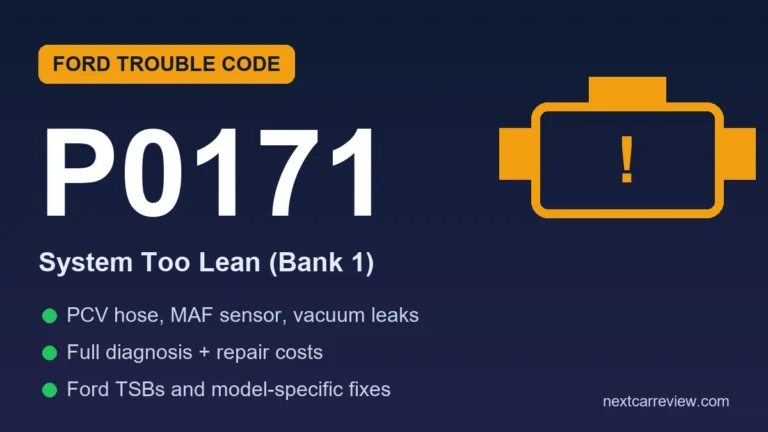
P1450 is a Ford code that means the EVAP system pulled too much vacuum on the fuel tank during its self-test. The engine computer closed the vent, opened the purge valve, and the tank went deeper into vacuum than it should. On many Fords the usual cause is a canister purge valve that sticks or leaks open, and several models have Ford service bulletins, recalls or free repair programs for it. Check your VIN for open recalls before you buy parts.
Facts cross-checked against Ford recall reports and service bulletins published by NHTSA, Ford’s OBD system documentation, EPA warranty rules and published repair estimates. See our sourcing policy.
This guide covers what P1450 means on a Ford, the causes in the order to check them, which Escape, Focus, Fusion and other models have known Ford bulletins, what a repair costs, and whether you can keep driving. Every bulletin and recall below comes from documents Ford filed with NHTSA.
If your scanner also shows a large leak code, our P0455 code guide explains that fault, which is the opposite problem. And our free VIN decoder confirms your exact model year and engine before you look up bulletins.
| Code | P1450 (Ford, Lincoln and Mercury specific) |
| Meaning | Unable to bleed up fuel tank vacuum: excessive vacuum in the EVAP system during the leak test |
| Most common cause | Canister purge valve stuck or leaking open (named in multiple Ford bulletins) |
| Other causes | Blocked or kinked vent line, canister vent solenoid stuck closed, liquid fuel in the charcoal canister, fuel tank pressure sensor fault |
| Safe to drive? | Usually yes for a short time, unless the car stalls, is hard to restart after fueling, or the fuel gauge acts up |
| First step | Check open recalls and programs by VIN, especially on 2012 to 2018 Ford Focus |
What Does P1450 Mean on a Ford?
P1450 Code – Quick Diagnostic Intelligence
P1450 stands for “Unable to Bleed Up Fuel Tank Vacuum.” It is a Ford manufacturer code, so you will see it on Ford, Lincoln and Mercury vehicles rather than on every brand. It comes from the evaporative emissions (EVAP) monitor, the self-test that checks the fuel vapor system for leaks.
Ford’s OBD system operation summary explains how that test works. The engine computer closes the canister vent solenoid to seal the system, then opens the canister purge valve so engine vacuum pulls the tank down to a target of about 8 inches of water. According to Ford, “If the initial vacuum is excessive, a vacuum malfunction is indicated (P1450). This could be caused by kinked vapor lines or a stuck open CPV.” CPV is Ford’s name for the canister purge valve.
Ford runs a second check for a purge valve that leaks when it should be closed. If vacuum keeps building while the valve is commanded shut, the computer also sets P1450. So in plain terms, P1450 means too much vacuum, not a leak. It is the opposite of P0455, where the system cannot build enough vacuum.
When the Test Runs
The EVAP test does not run all the time. Ford’s document lists conditions such as a cold soak of about six hours, a steady highway cruise and an outside temperature of roughly 40 to 100 degrees Fahrenheit. That is why the code may come back days after you clear it, and why a repair takes a few drive cycles to confirm.
P1450 Symptoms
Many drivers only see the check engine light. Ford’s bulletins and recalls also describe these symptoms on specific models:
- Check engine light with P1450 stored, and a failed emissions inspection.
- Hard start, no start or a drop in RPM right after refueling (Ford bulletin 16-0075, Escape and Fusion).
- Inaccurate fuel gauge or distance to empty (Ford bulletin 16-0062 and recall 18V-735, Focus).
- A deformed fuel tank and stalling in the worst cases, from too much vacuum (recall 18V-735, Focus).
- Rough idle or a slow fill at the pump (Ford special service message 46525, 2017 Escape, and bulletin 21-2106, Transit).
Common Causes of P1450 (Check in This Order)
Ford’s own documents point to a short list of parts. Here they are, starting with the checks that cost nothing.

Canister Purge Valve Stuck or Leaking Open
This is the cause Ford names most often. A purge valve that does not seal lets engine vacuum pull on the tank when it should not. Ford’s OBD summary says “a leaking or stuck open CPV generates a P1450,” and bulletins for the Focus, Escape, Fusion and the C-MAX and Fusion hybrids all replace the purge valve to fix it. It is also one of the cheaper parts in the system.
Kinked or Blocked Vent or Vapor Lines
Ford names “kinked vapor lines” as a cause. On 2017 to 2021 Transit vans, bulletin 21-2106 fixes P1450 by rerouting a kinked fresh air vent line near the canister and securing it with a zip tie. Look for crushed, pinched or kinked hoses between the tank, the canister and the vent.
Canister Vent Solenoid Stuck Closed or Its Filter Blocked
The vent solenoid lets fresh air into the canister. Ford states that “a stuck closed CVS generates a P1450.” On trucks and SUVs the vent and its filter sit under the vehicle, where mud, dust or insect nests can block them. Clearing a blocked vent filter can be a very cheap fix.
Liquid Fuel in the Charcoal Canister
Ford special service message 46525 for the 2017 Escape says liquid fuel carried into the canister or purge valve can cause P1450, and Focus bulletin 16-0062 tells technicians to inspect the canister for liquid fuel. Stop filling at the first click of the pump nozzle to avoid pushing fuel into the canister.
Fuel Tank Pressure Sensor
Ford’s OBD summary also lists the fuel tank pressure sensor: “an open power input circuit or stuck check valve generates a P1450.” Check its connector and wiring before you replace it. No Ford bulletin for this cause, so it is less likely than the purge valve.
Ford Recalls, Bulletins and Free Repair Programs for P1450
This is where P1450 differs from a generic code. Several Ford models have documented fixes, and some are free no matter who owns the car now. The summary below comes from the documents Ford filed with NHTSA.

| Document | Vehicles | What Ford says to do |
|---|---|---|
| Recall 18V-735 (Ford 18S32) | 2012 to 2018 Focus with 2.0L GDI and GTDI engines, about 1.28 million US vehicles | Reprogram the engine computer and replace the purge valve, plus the canister, tank and pump module if damaged. Until repaired, Ford told owners to keep at least half a tank of fuel. |
| Recall 26V369 (Ford 26S40), June 2026 | About 258,000 2012 to 2018 Focus | The earlier software fix was not installed correctly on these cars, even though it was recorded as done. Check your VIN again even if 18S32 was completed. |
| Customer satisfaction program 24N07 | 2012 to 2018 Focus built from August 2010 to May 2018 | One-time free purge valve replacement for 15 years with unlimited miles, if the car shows hesitation, rough running or stalling with the check engine light on. It transfers to later owners. |
| Bulletin 16-0075 | 2013 Escape 1.6L and 2.0L; 2013 to 2014 Fusion and MKZ built on or before November 9, 2013 | Replace the canister purge valve for hard start, no start or RPM loss after refueling, with P1450 or P0456. |
| Bulletin 16-0062 | 2012 to 2015 Focus | Replace the purge valve, inspect the canister for liquid fuel, and replace the tank if it is pushed up more than one inch. |
| Bulletin 16-0055 | 2015 to 2016 Focus 1.0L EcoBoost built on or before October 19, 2015 | Reprogram the engine computer. |
| Bulletin 17-0016 | 2016 to 2017 Focus RS 2.3L | Replace the sticking purge valve and reprogram the engine computer. |
| Bulletin 19-2207 | 2013 to 2017 C-MAX Hybrid and Energi, Fusion Hybrid and Energi, MKZ Hybrid | Update the engine computer and install a new purge valve. |
| Bulletin 21-2106 | 2017 to 2021 Transit gas built on or before November 30, 2020 | Reroute a kinked fresh air vent line near the canister. |
Repairs under these bulletins are normally covered while the vehicle is inside Ford’s new vehicle or emissions warranty. Under federal rules, the general emissions warranty is 2 years or 24,000 miles, and specified major emission parts such as the engine computer get 8 years or 80,000 miles, according to the EPA. Purge valves and vent solenoids usually fall under the shorter coverage unless a Ford program extends it, like 24N07 for the Focus.
P1450 on Specific Ford Models
P1450 on the Ford Escape
For the 2013 Escape with the 1.6L or 2.0L engine, Ford bulletin 16-0075 replaces the canister purge valve. For the 2017 Escape, Ford’s special service message 46525 points to liquid fuel in the canister or purge valve. On all-wheel drive Escapes, owners report that reaching the canister area takes more labor, so ask for a quote before approving work.
P1450 on the Ford Focus
The Focus has the most documentation. If you own a 2012 to 2018 Focus, run your VIN on NHTSA’s recall lookup first. Recalls 18V-735 and 26V369 and program 24N07 can make the fix free.
P1450 on the Ford Fusion
The 2013 to 2014 Fusion is covered by bulletin 16-0075, and the Fusion Hybrid and Energi by bulletin 19-2207. Both replace the purge valve.
P1450 on the Ford F-150
No Ford bulletin or recall for P1450 on the F-150. On trucks, start with the vent path: inspect the vent filter and canister vent solenoid for mud or debris, and look for pinched lines, before you move on to the purge valve.
How Much Does It Cost to Fix P1450?
Costs depend on which part failed and whether a recall or program covers it. These are published RepairPal estimates, checked in September 2026, before taxes and fees.

| Repair | Typical cost | Notes |
|---|---|---|
| Recall, bulletin or program repair | $0 if your VIN qualifies | Focus recalls 18V-735 and 26V369, program 24N07, and warranty-covered bulletins |
| EVAP diagnosis and testing | About $61 to $90 | RepairPal national estimate |
| Purge valve, Ford Fusion | About $157 to $188 | RepairPal |
| Purge valve, Ford F-150 | About $207 to $238 | RepairPal |
| Purge valve, Ford Escape | About $292 to $369 | RepairPal |
| Charcoal canister | About $558 to $643 | RepairPal national estimate |
How to Diagnose P1450 Yourself
This check order follows the Ford documents above. It is a guide, not Ford’s official procedure, so use your factory service information for exact steps.
- Check recalls and programs by VIN. Use NHTSA’s recall lookup or Ford’s owner site. This matters most on 2012 to 2018 Focus.
- Look up bulletins for your year and engine. Some fixes are only a software update.
- Inspect the vent and vapor lines near the tank and canister for kinks or crushed sections.
- Check the vent filter and vent solenoid for mud, dust or nests.
- Test the purge valve. With the engine running and the purge valve commanded closed, tank vacuum should not keep rising. If it does, the valve is leaking.
- Check the fuel tank pressure sensor wiring and power.
- Inspect the canister for liquid fuel and the tank for deformation.
- Clear the code and drive normally. The EVAP monitor needs its conditions to rerun, so confirm the repair over several days.
Can You Drive With a P1450 Code?
Usually, yes, for a short time. P1450 is an emissions fault, and many cars drive normally with it. You will fail an emissions inspection until it is fixed.
The exception is when the car stalls, is hard to restart after fueling, or the fuel gauge reads wrong. On the 2012 to 2018 Focus, Ford treated those symptoms as a safety recall, because excessive vacuum can deform the tank and cause stalling. Ford told those owners to keep at least half a tank of fuel until the recall repair was done. If you see those symptoms, get it checked soon.
P1450 vs P0455, P0442, P0456 and P0446
- P1450: too much vacuum. Something is pulling on the tank or blocking the vent.
- P0455: a large leak. The system cannot build enough vacuum, often a loose cap or open line.
- P0442: a small leak, about 0.040 inch or larger.
- P0456: a very small leak, about 0.020 inch. It often appears alongside P1450 in Ford bulletins.
- P0446: an electrical fault in the canister vent solenoid circuit, not a blockage.
How to Prevent P1450
- Stop filling at the first click of the pump nozzle. Topping off can push liquid fuel into the canister.
- Check your VIN for open recalls once a year.
- If you drive on dirt or gravel roads often, have the vent filter area inspected during oil changes.
- Keep a steady eye on the fuel gauge. Sudden jumps can be an early sign on affected Focus models.
The Bottom Line
P1450 means too much vacuum, not a leak, and the canister purge valve is the part Ford names most often. Check your VIN for recalls and programs first, especially on a 2012 to 2018 Focus, then work through the vent path and the purge valve before paying for bigger parts.
Frequently Asked Questions About the P1450 Code
What does P1450 mean on a Ford?
Is P1450 covered by a Ford recall?
What does P1450 mean on a Ford Escape?
Can a gas cap cause P1450?
How much does it cost to fix P1450?
Will P1450 clear on its own?
Related guides: more check engine code guides and P1326 Code on Hyundai and Kia: Knock Sensor Warning, Limp Mode, and….
⚠️ Professional Notice:
Recall and program eligibility depends on your exact VIN. This guide is general information, not a warranty decision; a Ford or Lincoln dealer has the final word on coverage.
Cost figures are published estimates and vary by vehicle, region and shop. Always get a written quote before authorizing a repair. NextCarReview.com does not receive compensation from any parts manufacturer, retailer, dealer or repair chain for editorial coverage.
Data Sources and Verification
- Ford Motor Company, 2013 MY OBD System Operation Summary for Gasoline Engines: fordservicecontent.com (PDF)
- NHTSA recall 18V-735 (Ford 18S32), 2012 to 2018 Focus: static.nhtsa.gov (PDF)
- NHTSA recall 26V369 (Ford 26S40): static.nhtsa.gov (PDF)
- Ford customer satisfaction program 24N07: static.nhtsa.gov (PDF)
- Ford bulletins filed with NHTSA: 16-0075, 16-0062, 16-0055, 17-0016, 19-2207, 21-2106
- EPA, emissions warranty coverage: epa.gov
- Repair cost estimates: RepairPal Ford purge valve, RepairPal canister, RepairPal EVAP diagnosis
- NHTSA recall lookup: nhtsa.gov/recalls

Morgan Reyes is the founder and editor-in-chief of NextCarReview, which Morgan launched in August 2024. A 2022 graduate of Columbia University, Morgan is based in New York and writes and edits the site’s reviews, comparisons and buying guides. Morgan does not road-test vehicles. Every article is built from published primary data: EPA FuelEconomy.gov ratings, NHTSA crash ratings, recalls and owner complaints, IIHS results, and manufacturer specifications and pricing, with each figure cited and checked before publication. Contact: admin@nextcarreview.com