In this article 12 sections
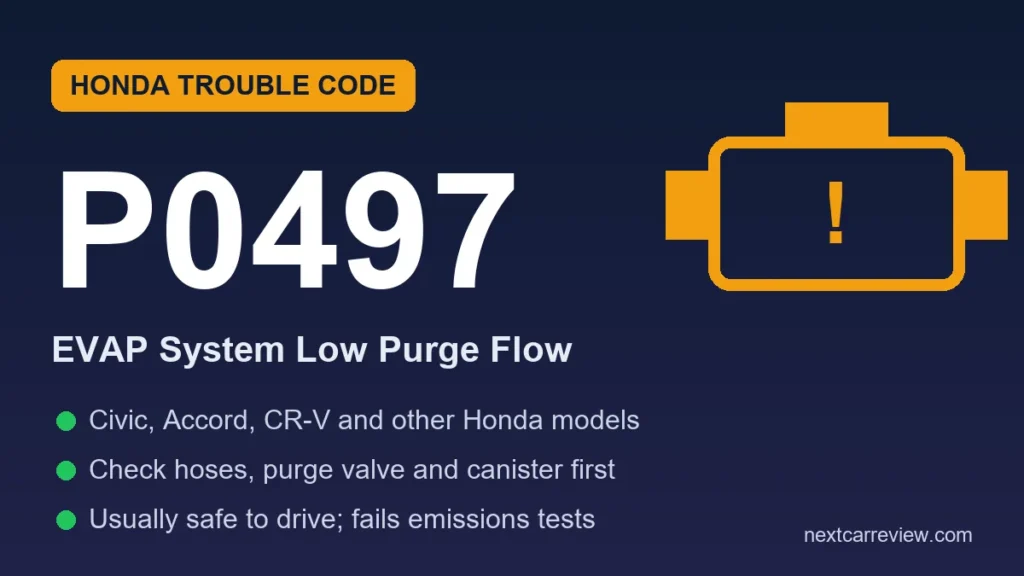
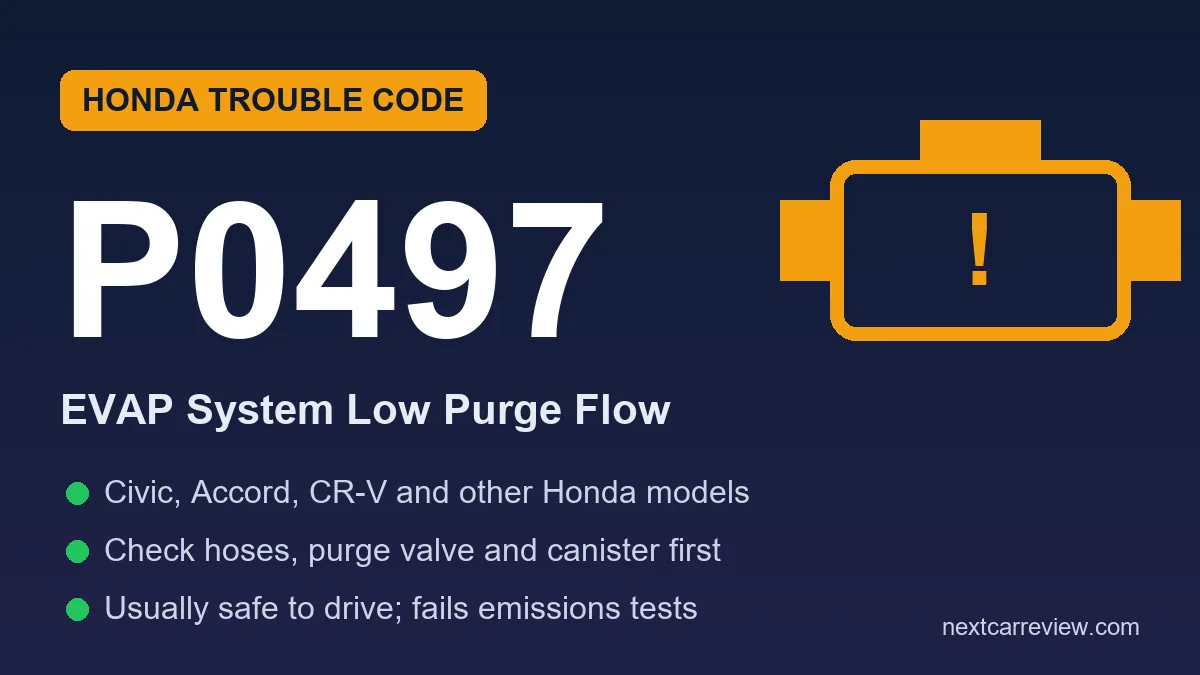
P0497 on a Honda means “Evaporative Emission System Low Purge Flow.” The engine computer opened the purge valve to pull fuel vapor from the charcoal canister into the engine, and it saw less vapor flow than it expected. On the Civic, Accord and CR-V the usual causes are a cracked, kinked or loose purge hose, a sticking purge control solenoid valve, a bad connector at that valve, or a canister damaged by liquid fuel from topping off the tank. It rarely affects how the car drives, but it will fail an emissions inspection, so fix it before your next test.
Facts cross-checked against Honda service bulletins filed with NHTSA, EPA warranty rules and published repair estimates. See our sourcing policy.
This guide explains how a Honda checks purge flow, the causes in the order to check them, the Honda service bulletins that cover the same purge monitor, repair costs from RepairPal, and whether it is safe to drive. Honda has not published a bulletin that names P0497 itself for the Civic, Accord or CR-V, and we say so plainly below rather than guess at one.
For the related purge code on a Toyota, read our P0441 Toyota guide. If your scanner also shows a large leak code, see our P0455 code guide. All of our code guides are listed on the trouble codes hub, and our free VIN decoder confirms your model year and engine before you order parts.
| Code | P0497 (Evaporative Emission System Low Purge Flow) |
| Meaning | Less fuel vapor reached the engine than the computer expected when it opened the purge valve |
| Common causes | Purge hose cracked, kinked or loose; purge valve stuck or sticking; connector or wiring fault; canister damaged by liquid fuel |
| Symptoms | Check engine light; usually no change in how the car drives |
| Bulletins to know | Honda 23-091 (P0441, sticking purge valve on V6 models), 21-081 (P0441 and P04F1 on 2017 to 2021 CR-V), 24-114 (P145E on 2023 to 2024 CR-V Hybrid) |
| Safe to drive? | Usually yes; it will fail an emissions test until repaired |
What Does P0497 Mean on a Honda?
What Does P0497 Mean on a Honda: Quick Diagnostic Intelligence
Your Honda stores fuel vapor from the tank in a charcoal canister instead of letting it escape. When the engine is warm and running, the engine computer (Honda calls it the PCM) opens the purge control solenoid valve, and engine vacuum draws that vapor into the intake to be burned. To confirm the system works, the PCM watches for the result of opening the valve, such as a change in EVAP system pressure or in the air and fuel mixture. If it opens the valve and sees too small a change, it decides purge flow is too low and sets P0497.
P0497 is a generic OBD-II code, so the name is the same on every make. What changes on a Honda is the hardware: the purge control solenoid valve usually sits on or near the intake manifold under the hood, the canister sits near the fuel tank, and newer models add an EVAP leak check module (ELCM) that also measures pressure. Honda does not publish the exact thresholds the PCM uses for this test.
Two related codes help narrow it down. P0441 is the older Honda code for a general purge flow fault, and P0496 means the opposite of P0497: too much purge flow, usually a purge valve stuck open. Honda’s own bulletins also use P04F1, “EVAP System Low Purge Flow Detected,” on some CR-V models.
P0497 Symptoms on a Honda
- Check engine light with P0497 stored. On many cars this is the only sign.
- No real change in how it drives. Low purge flow means vapor stays in the canister, which the engine does not need to run.
- A fuel smell near the car if the canister is full and vapor has nowhere to go.
- A failed emissions inspection, because the EVAP monitor will show a fault or will not complete.
- Other EVAP codes such as P0441, P0455 or P0456, which point toward the same hoses or canister.
If the car is hard to start right after a fill-up, or idles rough, the scanner is more likely to show P0496 (high purge flow), because a valve stuck open lets vapor into the engine when it should not.
Common Causes of P0497 on a Honda (Check in This Order)
1. Topping Off the Fuel Tank
Adding fuel after the pump nozzle clicks off can push liquid fuel into the vapor lines and the charcoal canister. A wet canister cannot pass vapor properly, and the purge test can fail. If you often top off, stop now, and mention it to the shop, because a canister soaked with fuel may need replacing.
2. Purge Hose Cracked, Kinked, Loose or Collapsed
The purge hose runs from the purge valve to the intake and from the valve back toward the canister. Heat and age can crack the rubber, a hose can pop off a fitting after other work under the hood, and a soft hose can collapse under vacuum. Any of these can cut the flow the PCM is looking for. This is the cheapest check, and you can often do it by eye with a flashlight.
3. Purge Control Solenoid Valve Sticking or Stuck Closed
The purge valve is a small electric valve that the PCM pulses open. If it sticks closed or opens only partly, flow is low. Honda’s own bulletin 23-091 shows this failure is real on Honda parts: on the 2019 to 2024 Odyssey, 2019 to 2022 Pilot, 2019 to 2023 Ridgeline and 2019 to 2023 Passport, Honda says “variations in the purge control solenoid valve spring” make the valve wear unevenly and stick at times, setting P0441. The fix in that bulletin is a new valve followed by an EVAP function test. It does not cover the Civic, Accord or CR-V, but the part does the same job.
4. Connector or Wiring at the Purge Valve
A loose plug, a bent or corroded pin, or a chafed wire can stop the valve from opening fully when commanded. Wiring faults often set a separate circuit code, but an intermittent connection can show up only as a flow problem. Honda bulletin 21-081 is a good example of an electrical cause: on the 2017 to 2021 CR-V EX, EX-L and Touring, Honda says “external radio waves” can disturb sensor signals in the harness and set P0441 and P04F1, and the fix is an extra sub cord on the harness.
5. Charcoal Canister Damaged or Saturated
If the canister has soaked up liquid fuel, cracked, or broken down so charcoal gets into the lines, vapor flow drops. Charcoal grains in the purge hose or valve are a strong sign the canister is the source. It is one of the more expensive parts in the system, so rule out the hoses and valve first.
6. EVAP Pressure Sensor or Leak Check Module
The PCM needs an accurate pressure reading to judge flow. A faulty fuel tank pressure sensor, or on newer models the ELCM, can make normal flow look low. Honda bulletin 24-114, for the 2023 to 2024 CR-V Hybrid, shows how sensing can cause a false purge code: a near full fuel tank can create a “false pulse detection” by the ELCM pressure sensor and set P145E, and Honda’s fix is a PGM-FI software update.
7. PCM Software
Because several Honda purge codes have been fixed with software, ask a Honda dealer to check whether any update applies to your VIN before you replace a canister. Updates are quick and are often covered when a bulletin applies.
Honda Recalls and Service Bulletins for P0497
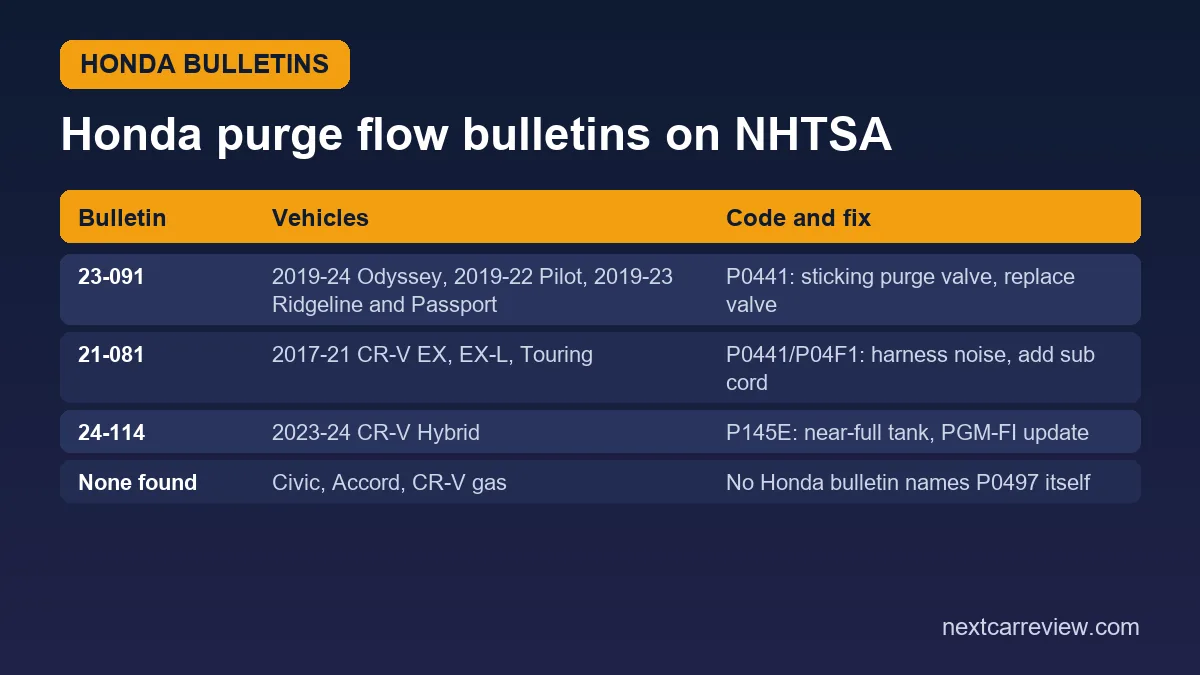
We searched NHTSA’s recall database for the Civic, Accord and CR-V and found no safety recall for purge flow, the purge valve or the EVAP canister. We also found no Honda service bulletin filed with NHTSA that names P0497 for these models. The bulletins below cover the same purge monitor on other Honda models or for closely related codes, and they show what Honda technicians are told to look for.
| Honda document | Vehicles | What it covers |
|---|---|---|
| Service bulletin 23-091 | 2019 to 2024 Odyssey, 2019 to 2022 Pilot, 2019 to 2023 Ridgeline, 2019 to 2023 Passport | P0441: purge control solenoid valve spring variation causes the valve to stick at times; replace the valve and run the EVAP function test |
| Service bulletin 21-081 | 2017 to 2021 CR-V EX, EX-L and Touring | P0441 and P04F1 (low purge flow detected): harness picks up outside radio interference; install a sub cord |
| Service bulletin 24-114 | 2023 to 2024 CR-V Hybrid | P145E (purge flow malfunction 2): false reading from the ELCM pressure sensor with a near full tank; update PGM-FI software |
| NHTSA recalls | Civic, Accord, CR-V | None found for purge flow, purge valve or canister |
Acura owners should know that Honda issued the same sticking purge valve fix as bulletin 23-035 for the 2018 to 2020 and 2022 to 2024 MDX, 2018 RDX and 2018 to 2020 TLX V6.
P0497 on the Honda Civic, Accord and CR-V
P0497 on the Honda Civic
On the Civic, start under the hood at the purge valve and its hoses, because they are easy to reach. Check that the hoses are firmly seated after any intake or air filter work. If the hoses and valve are good and the code returns, have the canister checked for fuel or charcoal. There is no Civic bulletin for P0497 on NHTSA’s site, so a dealer’s normal troubleshooting applies.
P0497 on the Honda Accord
The Accord follows the same order: fuel habits, hoses, purge valve, connector, then canister. RepairPal lists the Accord canister as the most expensive of the three models, so confirm the diagnosis with a smoke test and a commanded valve test before paying for one.
P0497 on the Honda CR-V
On the 2017 to 2021 CR-V EX, EX-L and Touring, ask the dealer about bulletin 21-081 first, especially if P0441 or P04F1 is also stored, because the fix is a wiring sub cord rather than new EVAP parts. On the 2023 to 2024 CR-V Hybrid, ask about the software update in bulletin 24-114 if P145E appears with it.
How to Diagnose P0497 on a Honda
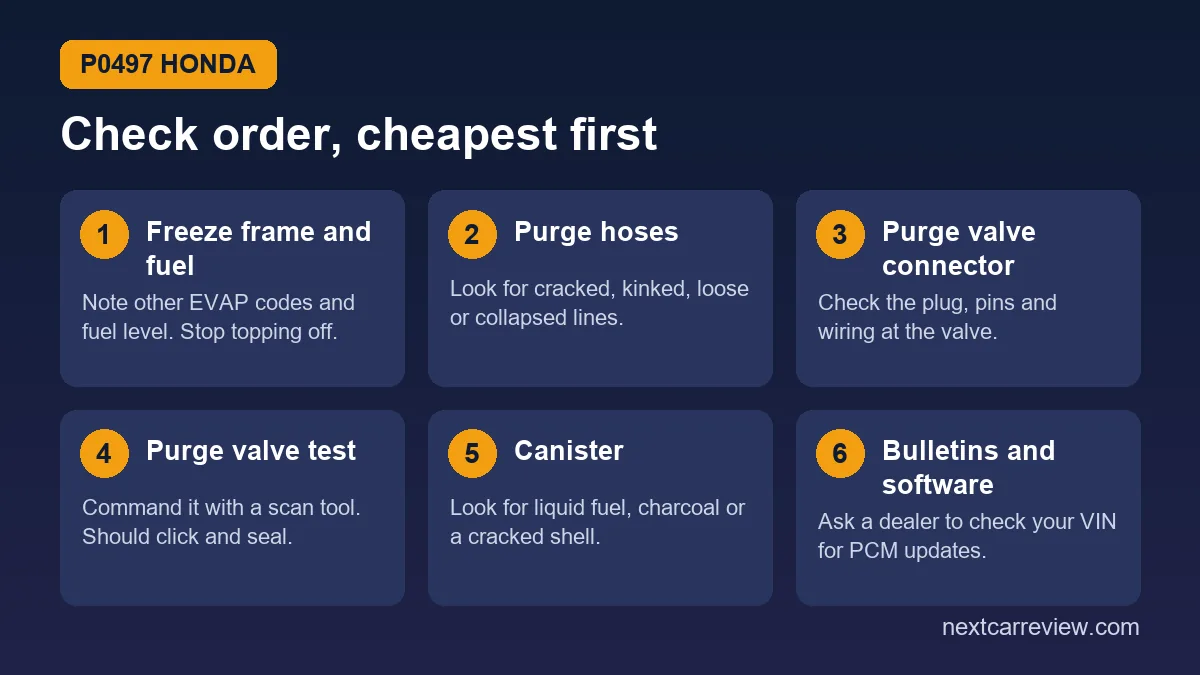
- Read all codes and freeze frame data. Note any P0441, P0496, P04F1, P0455 or P0456, and the fuel level when the code set.
- Think about recent fill-ups. If you topped off the tank, tell the shop, and stop at the first click from now on.
- Inspect the purge hoses from the valve to the intake and back toward the canister for cracks, kinks, loose ends or soft spots.
- Check the purge valve connector for a loose plug, damaged pins or chafed wiring.
- Test the purge valve. With the engine off, a scan tool can command the valve; it should click. Off the car, it should block air when closed and pass air when powered. Honda dealers use the i-HDS EVAP function test.
- Smoke test the EVAP system to find leaks and restrictions the eye cannot see.
- Inspect the canister for liquid fuel, cracks or loose charcoal in the lines.
- Ask a Honda dealer to check your VIN for bulletins and software updates, then clear the code and drive normally for a few days so the EVAP monitor can run again.
How Much Does It Cost to Fix P0497 on a Honda?
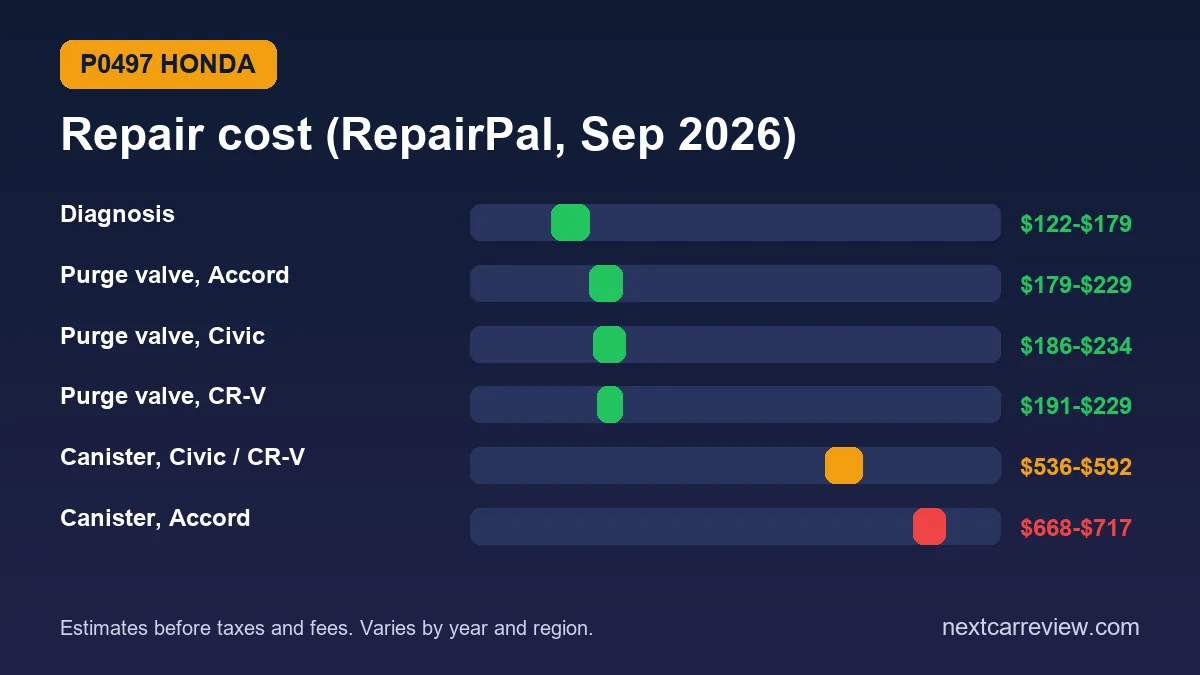
These are RepairPal estimates checked in September 2026, before taxes and fees. Prices vary by model year and region. RepairPal does not list a separate price for a purge hose, but the hose is usually a small part plus a short labor charge.
| Repair | Civic | Accord | CR-V |
|---|---|---|---|
| Check engine light diagnosis | $122 to $179 | $122 to $179 | $122 to $179 |
| Purge valve replacement | $186 to $234 | $179 to $229 | $191 to $229 |
| Fuel evaporative canister replacement | $536 to $577 | $668 to $717 | $536 to $592 |
Your EVAP parts may also be covered by warranty. Honda’s new car warranty covers most parts for 3 years or 36,000 miles, and federal rules require emissions warranty coverage on emission parts. Ask the dealer before paying, and keep records of your repair.
Can You Drive With a P0497 Code?
In most cases, yes. P0497 means fuel vapor is not being burned as often as it should be, which does not harm the engine or change how the car drives. The risks are that a full canister can let vapor escape, you may smell fuel, and the car will fail an emissions inspection. There is one more practical cost: while the check engine light is on for P0497, it cannot warn you about a new, more serious fault. If you smell strong raw fuel, see fuel leaking, or the check engine light starts flashing, stop driving and have the car checked.
P0497 vs Related Honda Codes
- P0496: EVAP high purge flow, usually a purge valve stuck open; can cause hard starting after refueling.
- P0441: EVAP purge flow malfunction, the code in Honda bulletins 23-091 and 21-081.
- P04F1: EVAP system low purge flow detected, used on some CR-V models.
- P145E: EVAP purge flow malfunction 2, covered by bulletin 24-114 on the CR-V Hybrid.
- P0455 and P0456: large and very small EVAP leaks, often from the gas cap, hoses or canister.
The Bottom Line
P0497 on a Honda is an emissions fault, not an engine emergency. Stop topping off the tank, check the purge hoses and connector, test the purge valve, and look at the canister last. Ask a Honda dealer to check your VIN for bulletins and software before paying for a canister.
Frequently Asked Questions About the P0497 Code on Honda
What does P0497 mean on a Honda Civic?
Is P0497 serious?
Can a gas cap cause P0497?
Is there a recall or TSB for P0497 on the Honda CR-V?
How much does it cost to fix P0497 on a Honda?
Can topping off the gas tank cause P0497?
Will P0497 clear itself?
⚠️ Professional Notice:
Bulletin eligibility depends on your exact VIN, and a bulletin for one model does not mean your car has the same fault. This guide is general information; a Honda dealer or qualified technician has the final word on diagnosis and repairs.
Cost figures are published estimates and vary by vehicle, region and shop. Always get a written quote before authorizing a repair. NextCarReview.com does not receive compensation from any parts manufacturer, retailer, dealer or repair chain for editorial coverage.
Data Sources and Verification
- Honda service bulletin 23-091, P0441 sticking purge control solenoid valve, Odyssey, Pilot, Ridgeline and Passport: static.nhtsa.gov (PDF)
- Honda service bulletin 21-081, P0441 and P04F1 on the 2017 to 2021 CR-V: static.nhtsa.gov (PDF)
- Honda service bulletin 24-114, P145E on the 2023 to 2024 CR-V Hybrid: static.nhtsa.gov (PDF)
- Acura service bulletin 23-035, P0441 purge valve on MDX, RDX and TLX: static.nhtsa.gov (PDF)
- RepairPal repair estimates: Civic purge valve, Accord purge valve, CR-V purge valve, Civic canister, Accord canister, CR-V canister, diagnosis
- EPA, emissions warranty coverage: epa.gov
- NHTSA recall lookup: nhtsa.gov/recalls

Morgan Reyes is the founder and editor-in-chief of NextCarReview, which Morgan launched in August 2024. A 2022 graduate of Columbia University, Morgan is based in New York and writes and edits the site’s reviews, comparisons and buying guides. Morgan does not road-test vehicles. Every article is built from published primary data: EPA FuelEconomy.gov ratings, NHTSA crash ratings, recalls and owner complaints, IIHS results, and manufacturer specifications and pricing, with each figure cited and checked before publication. Contact: admin@nextcarreview.com