In this article 11 sections
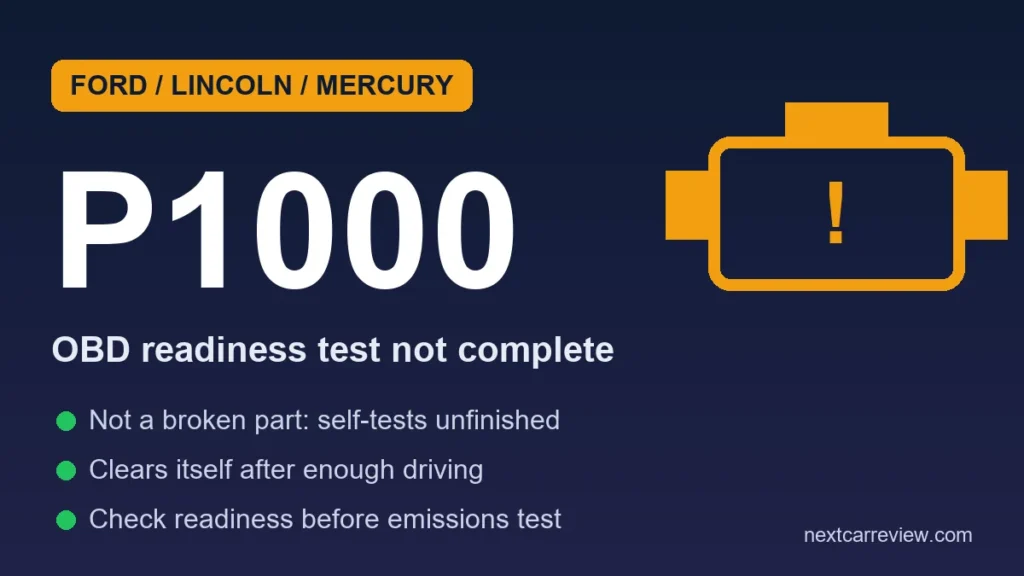
P1000 on a Ford means the OBD system has not finished its self-tests yet. Ford calls it “OBD Systems Readiness Test Not Complete,” and it is a status code, not a part failure. It appears after the battery is disconnected, codes are cleared or the engine computer is reprogrammed, and it goes away on its own once you drive enough for every monitor to run. The catch is emissions testing: most states fail a 2001 or newer vehicle with more than one monitor not ready.
Facts cross-checked against Ford OBD documentation and drive cycle, Ford bulletins on NHTSA, federal emissions rules and state inspection programs. See our sourcing policy.
This guide explains what P1000 means on a Ford, Lincoln or Mercury, Ford’s own drive cycle to clear it, why it sometimes will not clear, what each state’s inspection allows, and when it is worth paying for a diagnosis. The drive cycle comes from a Ford procedure reprinted with Ford’s permission, and the inspection rules come from federal regulations and state agencies.
If P1000 appears together with an EVAP code, our P1450 Ford guide and P0455 code guide explain those faults. And our free VIN decoder confirms your exact model year, which decides how many monitors your state allows to be incomplete.
| Code | P1000 (Ford, Lincoln and Mercury) |
| Ford meaning | OBD Systems Readiness Test Not Complete |
| Is it a fault? | No. It means one or more self-tests have not finished yet |
| Common triggers | Battery disconnect or replacement, clearing codes, engine computer reprogramming, recent repairs |
| How to clear it | Drive normally or follow Ford’s drive cycle until all monitors complete |
| Emissions test | Most states allow only one incomplete monitor on 2001 and newer vehicles |
What Does P1000 Mean on a Ford?
P1000 Code – Quick Diagnostic Intelligence
Your Ford’s engine computer runs a set of self-tests called monitors, for parts such as the catalytic converter, oxygen sensors and EVAP system. Ford’s OBD documentation explains that “a battery disconnection or clearing codes using a scan tool results in the various I/M readiness bits being set to a ‘not-ready’ condition.” As each monitor finishes, its bit is set to ready. P1000 is Ford’s way of saying that not every monitor has finished since the last reset.
Ford’s documentation adds that this “may take one or two driving cycles based on whether malfunctions are detected or not.” Some monitors, such as misfire and fuel system monitoring, run all the time and are considered complete right away. Others, especially the EVAP test, need specific conditions and can take several days.
What Triggers P1000
- Disconnecting, replacing or fully draining the battery. Ford’s owner’s manuals note that after the “battery has recently run down or been replaced, the OBD-II system may indicate that the vehicle is not ready for I/M testing.”
- Clearing trouble codes with a scan tool.
- Reprogramming or updating the engine computer.
- Recent engine or transmission service.
- On some trucks, using Power Take Off mode, which Ford says sets the readiness bits to not ready while it is engaged.
How to Check Readiness Without a Scan Tool
Many Ford owner’s manuals describe a simple check. Turn the ignition to on for 15 seconds without starting the engine. According to Ford, “if the service engine soon indicator blinks eight times, it means that the vehicle is not ready for I/M testing; if the service engine soon indicator stays on solid, it means that your vehicle is ready.” A basic OBD-II scan tool shows exactly which monitors are still incomplete.
How to Clear P1000: Ford’s Drive Cycle
You do not need to repair anything. You need to drive in a way that lets every monitor run. The simplest version, from Ford owner’s manuals, is “15 minutes of steady driving on an expressway or highway followed by 20 minutes of stop-and-go driving with at least four 30-second idle periods,” then parking for at least eight hours with the ignition off and repeating. Ford notes that “a complete check may take several days.”
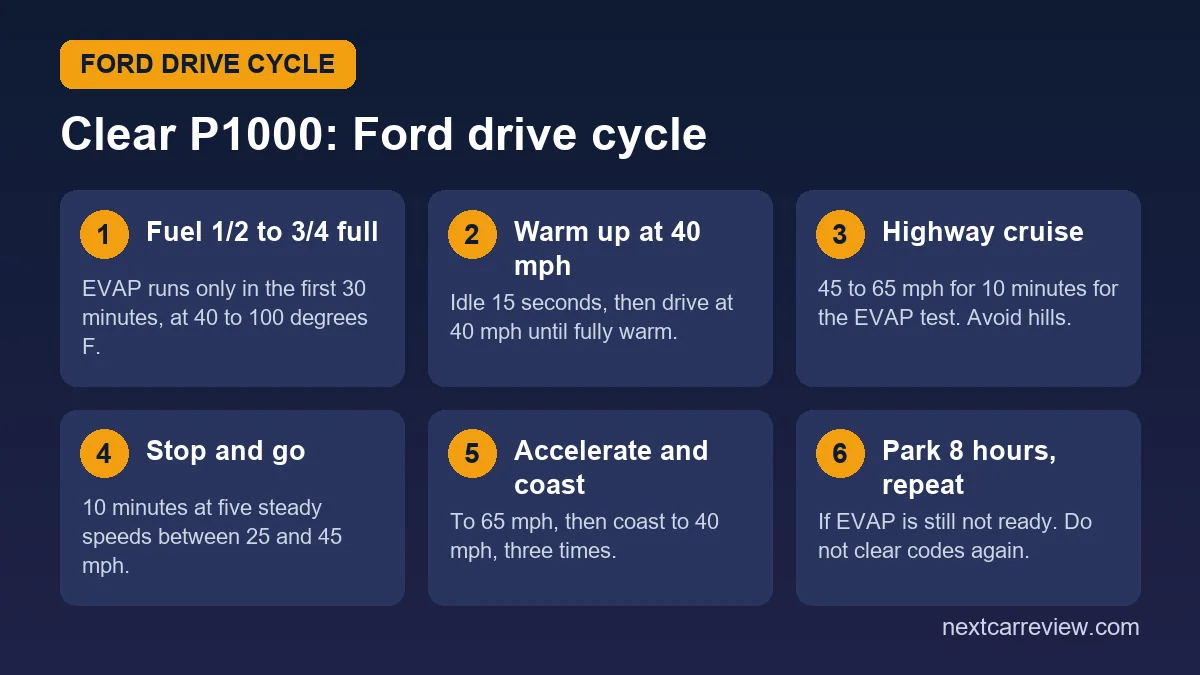
For faster results, Ford’s detailed drive cycle, reprinted with Ford’s permission on OBDII.com, runs each monitor in turn:
- Prepare: keep the fuel tank between one-half and three-quarters full, with three-quarters the best. Ford notes the EVAP monitor only runs in the first 30 minutes of engine operation and not below 40 degrees or above 100 degrees Fahrenheit, or above 8,000 feet.
- Warm up: idle for 15 seconds, then drive at 40 mph until the engine reaches full temperature.
- Oxygen sensor monitor: cruise at 40 mph for up to 4 minutes.
- EVAP monitor: cruise at 45 to 65 mph for 10 minutes, avoiding sharp turns and hills.
- Catalyst monitor: about 10 minutes of stop-and-go driving that includes five different steady speeds between 25 and 45 mph.
- EGR monitor: from a stop, accelerate to 45 mph at one-half to three-quarter throttle, three times.
- Idle check: stop and idle in Drive, or Neutral for a manual, for 2 minutes.
- Transmission check: accelerate to 40 to 50 mph with overdrive switched off and on, five times.
- Misfire learning: from a stop, accelerate to 65 mph, then coast with the throttle closed down to 40 mph, three times.
- If EVAP is still not ready: park for at least 8 hours and repeat the drive without clearing codes.
Drive only where it is safe and legal to do so. Ford’s procedure uses a scan tool to watch the monitors, but normal driving over several days covers the same conditions for most owners.
Why Won’t P1000 Clear on My Ford?
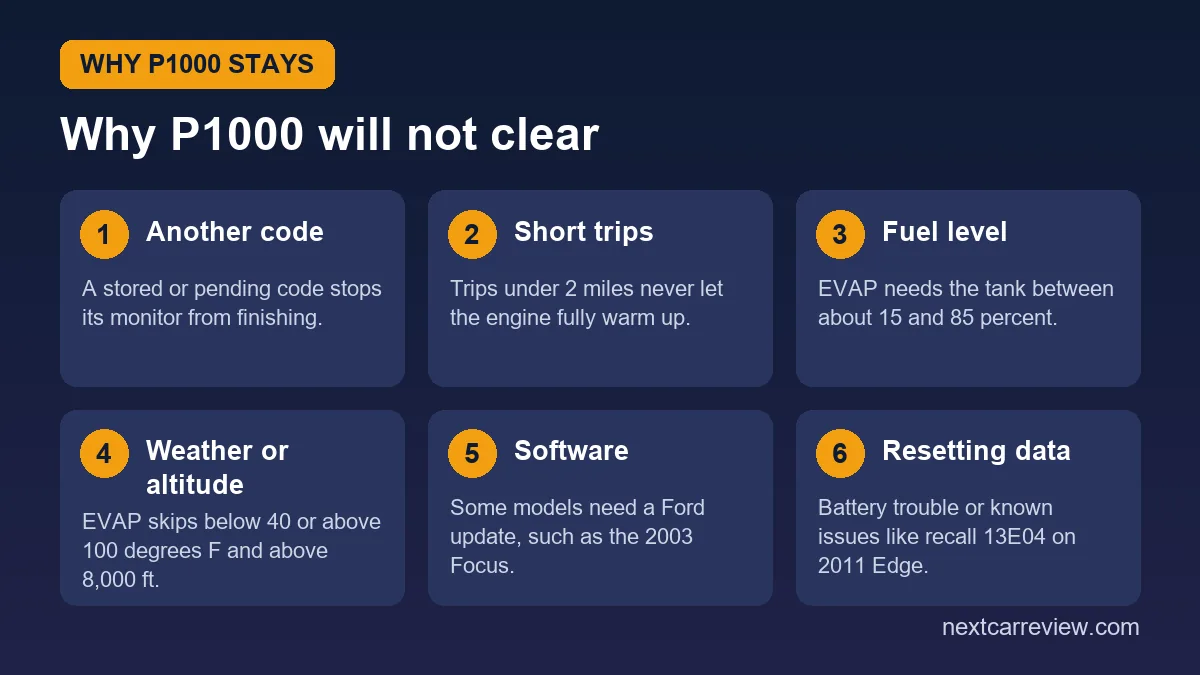
Another Code Is Stored or Pending
Ford’s drive cycle notes that a pending code can stop P1000 from clearing. If a real fault is present, the related monitor will not complete. Read all codes, including pending ones, and fix those first.
Short Trips
California’s Bureau of Automotive Repair gives the example of a vehicle where all trips are less than two miles, so it never fully warms up and the monitors cannot run. Add at least one longer highway drive.
Fuel Level, Weather and Altitude
The EVAP monitor needs the fuel tank between about 15 and 85 percent full and outside temperatures roughly between 40 and 100 degrees Fahrenheit. It is often the last monitor to finish in winter or summer heat.
Known Ford Issues
- Ford bulletin 0615 (2006): P1000 may not clear in high altitude conditions on the 2006 Fusion, Mustang, Mercury Milan and Lincoln Zephyr.
- Ford bulletin 17582 (2004): P1000 resetting after it has already cleared on the 2002 Mercury Cougar.
- 2003 Focus: California’s OBD test reference and the OBD Clearinghouse say monitors may be difficult to complete and point to a PCM update under bulletin 06-7-5.
- 2011 Edge, Explorer and Lincoln MKX with 3.5L and 3.7L engines: California’s OBD test reference says some vehicles clear their OBD data on every engine start and points to Ford emission recall 13E04.
- 2000 to 2002 Fords generally: the OBD Clearinghouse notes EVAP monitors may be difficult to complete and recommends following Ford’s drive cycle.
Will P1000 Fail an Emissions Inspection?
It depends on how many monitors are incomplete and where you live. The federal rule, 40 CFR 85.2222, allows up to two unset monitors on 1996 to 2000 vehicles and no more than one on 2001 and newer vehicles.
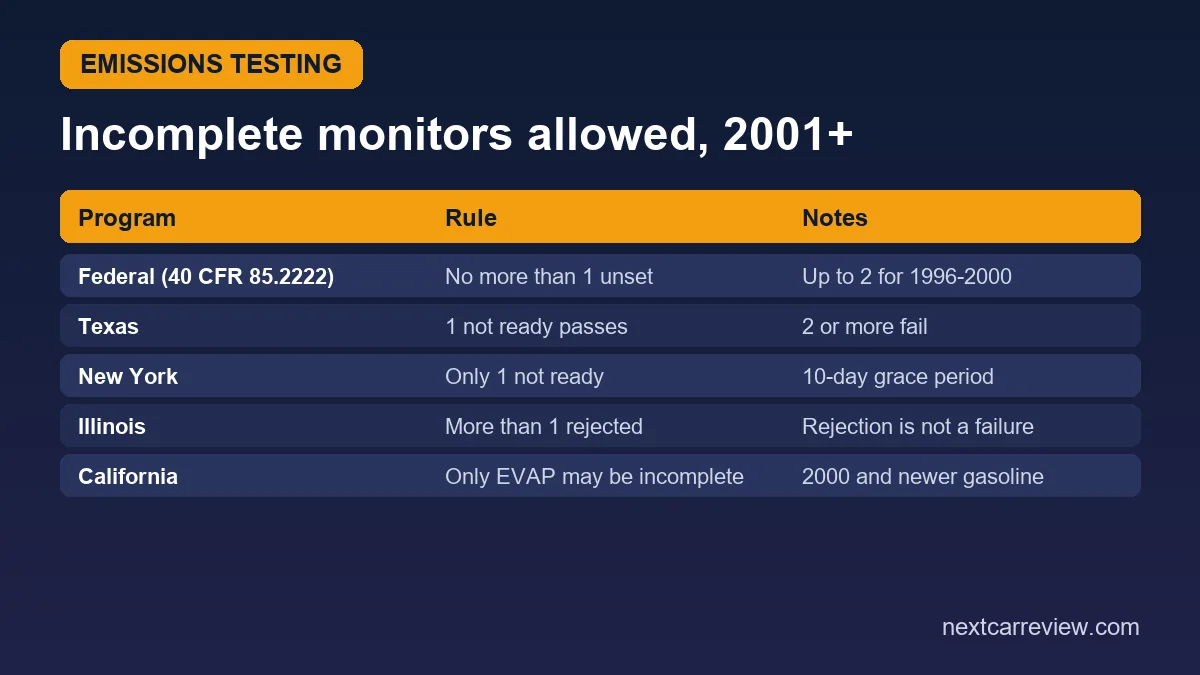
| State | Rule for 2001 and newer gasoline vehicles | Notes |
|---|---|---|
| Federal guideline | No more than one unset monitor | Up to two for 1996 to 2000 |
| Texas | One non-continuous monitor may be not ready | Two or more fail |
| New York | Only one monitor may be not ready | 10-day grace period if readiness was the only problem |
| Illinois | Rejected with more than one not ready | A rejection is not counted as a failure |
| California | Only the EVAP monitor may be incomplete on 2000 and newer | New regulation took effect October 1, 2025; BAR says current criteria stay while it reviews data |
If your Ford was recently serviced or had a new battery, drive it for several days before your test. California’s BAR notes that two weeks is enough time for most properly working vehicles to set their monitors.
How Much Does It Cost to Fix P1000?
Usually nothing, because driving is the fix. If a monitor will not complete after a couple of weeks of normal driving, a diagnosis makes sense. RepairPal estimates about $122 to $179 for check engine light diagnosis and testing on a Ford F-150, and about $71 to $105 for emission system diagnosis and testing. Software updates and emission recalls from Ford are free when your VIN is covered.
Is It Safe to Drive With P1000?
Yes. P1000 itself does not mean anything is wrong with the engine, and driving is how it clears. If any other code is stored, or the engine runs poorly, deal with that code first, because it is the real problem.
P1000 vs Other Readiness Situations
- P1000 alone: self-tests not finished. Keep driving.
- P1000 with another code: the other code is the fault and may be stopping a monitor from completing.
- Monitors never complete: check for a pending code, a software update or a known bulletin for your model.
- Readiness keeps resetting: a battery or charging problem, or a known issue such as Ford recall 13E04 on some 2011 Edge, Explorer and MKX models.
The Bottom Line
P1000 is a waiting code, not a broken part. Drive your Ford normally for several days or follow Ford’s drive cycle, check readiness before an emissions test, and only pay for a diagnosis if a monitor still will not complete after about two weeks or another code appears.
Frequently Asked Questions About the P1000 Code on Ford
What does P1000 mean on a Ford?
How do I clear P1000 on a Ford?
Can I clear P1000 with a scan tool?
How many miles does it take to clear P1000?
Will my Ford pass inspection with P1000?
Does a new battery cause P1000?
Related guides: our OBD-II code library and Is Your 2023 Kia Telluride Transmission Slipping? Here’s the Real F….
⚠️ Professional Notice:
Inspection rules change and vary by state and county. Confirm the current rules with your state inspection program before your test.
Diagnosis costs are published estimates and vary by vehicle, region and shop. Always get a written quote before authorizing work. NextCarReview.com does not receive compensation from any parts manufacturer, retailer, dealer or repair chain for editorial coverage.
Data Sources and Verification
- Ford Motor Company, 2009 MY OBD System Operation Summary for Gasoline Engines: fordservicecontent.com (PDF)
- Ford drive cycle, reprinted courtesy of Ford Motor Company (archived copy): drivecycleford.pdf
- Ford bulletin 0615 summary, NHTSA: api.nhtsa.gov
- Ford bulletin 17582 summary, NHTSA: api.nhtsa.gov
- 40 CFR 85.2222, on-board diagnostic test procedures: ecfr.gov
- Texas DPS, readiness FAQ: dps.texas.gov
- New York DMV, “What do you mean my car’s not ready?”: dmv.ny.gov
- Illinois Air Team FAQ: illinoisairteam.net
- California BAR, OBD test reference and readiness regulations: bar.ca.gov, BAR fall 2025 newsletter
- OBD Clearinghouse, OBD readiness testability issues: obdclearinghouse.com
- RepairPal, P1000 and Ford F-150 diagnosis estimates: repairpal.com, F-150 check engine light diagnosis

Morgan Reyes is the founder and editor-in-chief of NextCarReview, which Morgan launched in August 2024. A 2022 graduate of Columbia University, Morgan is based in New York and writes and edits the site’s reviews, comparisons and buying guides. Morgan does not road-test vehicles. Every article is built from published primary data: EPA FuelEconomy.gov ratings, NHTSA crash ratings, recalls and owner complaints, IIHS results, and manufacturer specifications and pricing, with each figure cited and checked before publication. Contact: admin@nextcarreview.com