In this article 11 sections
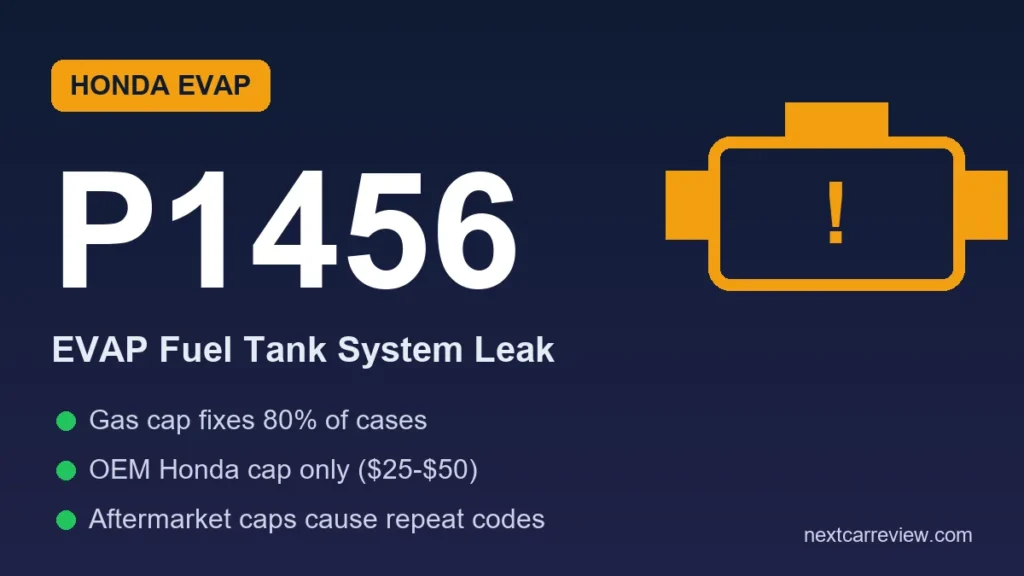
P1456 on a Honda means the EVAP system detected a leak on the fuel tank side, between the gas cap and the two-way valve. This is a Honda-specific code. The good news: a gas cap problem is the most common cause, and forum and technician estimates put it near 80% of P1456 cases. A genuine Honda OEM gas cap costs $25-$50. Honda’s own bulletin says to replace any cap that is not a genuine Honda or Acura part. If the gas cap does not fix it, the fuel filler neck and fuel tank pressure sensor are the next most common causes.
Honda EVAP system codes verified against Honda TSB 99-075 via NHTSA database. See our sourcing policy.
What Does P1456 Mean on a Honda?
What Does P1456 Mean on a Honda: Quick Diagnostic Intelligence
P1456 stands for EVAP Emission Control System Leakage (Fuel Tank System). Honda divides the EVAP system into two zones separated by a two-way valve. The fuel tank side runs from the two-way valve to the gas cap and includes the gas cap, fuel filler neck, fuel tank, fuel tank pressure sensor, and connecting hoses. The canister side runs from the two-way valve through the charcoal canister to the purge valve. P1456 covers the fuel tank side only.
Honda’s system detects leaks by monitoring vacuum decay through the fuel tank pressure sensor. When its enabling conditions are met (typically after a cold start, with the fuel level in a mid range), the PCM closes the system and watches how quickly pressure or vacuum bleeds off. If the fuel tank side cannot hold it, the PCM flags P1456. Exact thresholds vary by model and are listed in Honda service information.
This is a Honda-specific code. Most manufacturers use generic codes like P0442 or P0455 that only indicate leak size (small or large). Honda’s P1456 and its companion P1457 pinpoint the leak location, which makes diagnosis faster and more targeted. Knowing the leak is on the fuel tank side immediately points you to the gas cap as the most likely fix.
Which Honda Models Get P1456 Most Often?
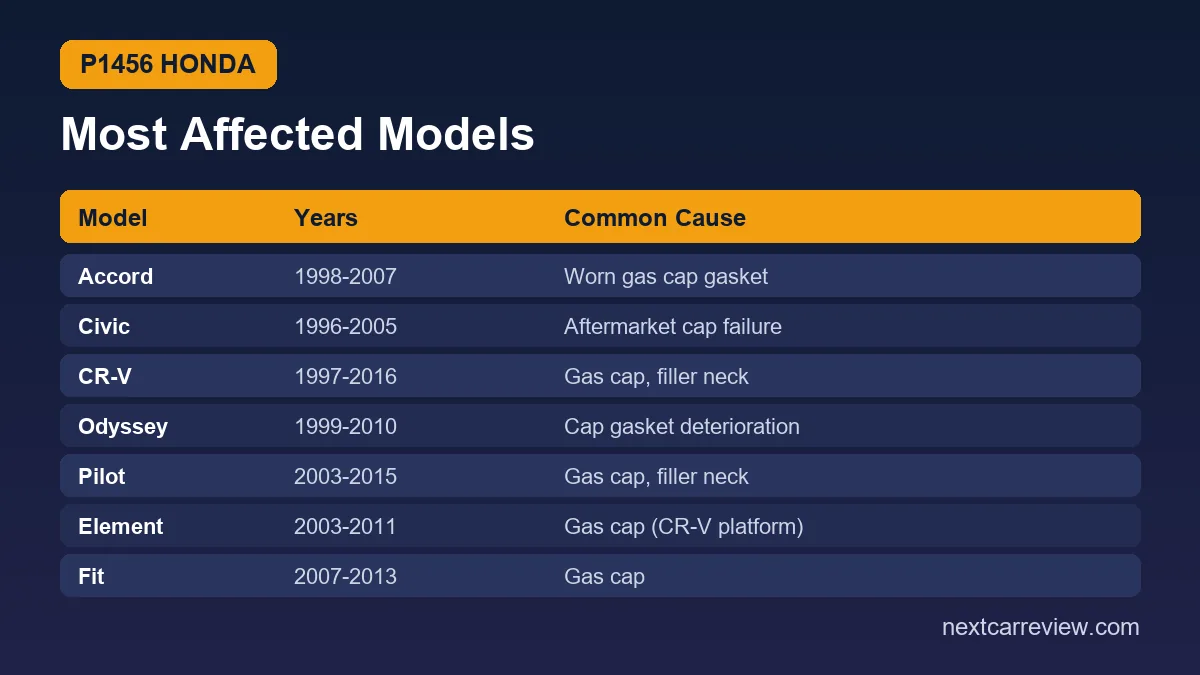
P1456 appears on many Honda and Acura models from the mid-1990s onward, and Honda’s TSB 99-075 covers 1996-2006 models. The Accord, Civic, CR-V, and Odyssey are among the most commonly reported. Unlike P1457 (canister side), P1456 shows no strong regional pattern because the gas cap and filler neck are not exposed to road salt the way the canister side components are.
| Model | Years Affected | Most Common Cause |
|---|---|---|
| Honda Accord | 1998-2007 | Worn gas cap gasket |
| Honda Civic | 1996-2005 | Aftermarket gas cap failure |
| Honda CR-V | 1997-2016 | Gas cap, filler neck corrosion |
| Honda Odyssey | 1999-2010 | Gas cap gasket deterioration |
| Honda Pilot | 2003-2015 | Gas cap, filler neck |
| Honda Element | 2003-2011 | Gas cap (shares CR-V platform) |
| Honda Fit | 2007-2013 | Gas cap |
| Honda S2000 | 2000-2006 | Covered by TSB 99-075 |
| Acura TL, CL, RSX, MDX | 1999-2006 | Same Honda EVAP system |
Common Causes of P1456 on Honda
The causes below are ranked by how often each one triggers P1456 on Honda vehicles, based on Honda TSBs, technician reports, and owner forum data. The percentages are estimates, not Honda figures.
1. Worn or Aftermarket Gas Cap (About 80% of Cases)
The gas cap is the most common cause of P1456 by a wide margin. The rubber gasket on the cap hardens and cracks over time, breaking the seal against the filler neck. Non-Honda gas caps are a common cause of persistent P1456, and Honda’s TSB 99-075 tells technicians to replace any cap that is not a genuine Honda or Acura part. A genuine Honda OEM gas cap costs $25-$50. Always tighten the cap until it clicks at least three times. After replacing the cap, clear the code and drive through two to three complete drive cycles. If the code does not return, the gas cap was the problem.
2. Fuel Filler Neck Damage (About 10% of Cases)
The fuel filler neck is the tube connecting the gas cap opening to the fuel tank. Corrosion, cracks, or a warped sealing surface can allow vapor leaks that trigger P1456. This is more common on older vehicles and those driven in areas with road salt. A filler neck replacement costs $180-$400 at a shop. Inspect the sealing surface where the gas cap seats for pitting, rust, or physical damage.
3. Fuel Tank Pressure Sensor Failure (About 5% of Cases)
The fuel tank pressure sensor is what the PCM uses to detect leaks. If the sensor itself is faulty, it can report a leak that does not actually exist. A replacement costs $130-$270 at a shop. Before replacing the sensor, verify that the actual pressure is stable with a scan tool monitoring live data.
4. EVAP Two-Way Valve Failure (About 3% of Cases)
The two-way valve separates the fuel tank side from the canister side. If the valve leaks internally, it can trigger P1456 (and sometimes P1457 as well). Both codes appearing together is a strong indicator of a two-way valve problem. Replacement costs $110-$230 at a shop.
5. Cracked or Damaged Fuel Tank (Rare)
Physical damage to the fuel tank from road debris or corrosion can cause vapor leaks. This is uncommon and typically has other symptoms like a fuel smell near the rear of the vehicle. A fuel tank replacement is expensive and should only be considered after ruling out all other causes with a smoke test.
Why a Gas Cap Fixes P1456 but Not P1457
The gas cap sits on the fuel tank side of the EVAP system. P1456 is a fuel tank side code. A worn gas cap seal allows vapor to escape exactly where P1456 monitors for leaks. This is why the gas cap fixes so many P1456 cases.
P1457 monitors the canister side, which is physically separated from the gas cap by the two-way valve. A new gas cap has zero effect on canister side leaks. If your Honda has P1457, skip the gas cap and go directly to testing the canister vent shut (CVS) valve. If your Honda has both P1456 and P1457, start with the gas cap for the P1456 side, but know that the canister side needs separate diagnosis.
Honda TSBs for P1456
Honda has published Technical Service Bulletins with specific diagnostic procedures covering both P1456 and P1457.
| TSB Number | Models Affected | Issue | Key Detail |
|---|---|---|---|
| 99-075 (revised Aug 2013) | 1998-02 Accord, 1996-00 Civic, 1998-01 CR-V, 2000-05 Insight, 1999-04 Odyssey, 2003-04 Pilot, 2000-06 S2000 | Official troubleshooting for P1456 and P1457 | NHTSA ref: SB-10053545-3978 |
| 03-001 | 1998-2003 Honda models | EVAP bypass solenoid valve failure from road salt corrosion | Primarily affects P1457 but relevant to P1456 if two-way valve is involved |
Always ask your technician to check for applicable TSBs before starting diagnosis. TSB 99-075 provides Honda’s official step-by-step troubleshooting flow for both P1456 and P1457, including specific test procedures and decision trees.
How to Diagnose P1456 on a Honda
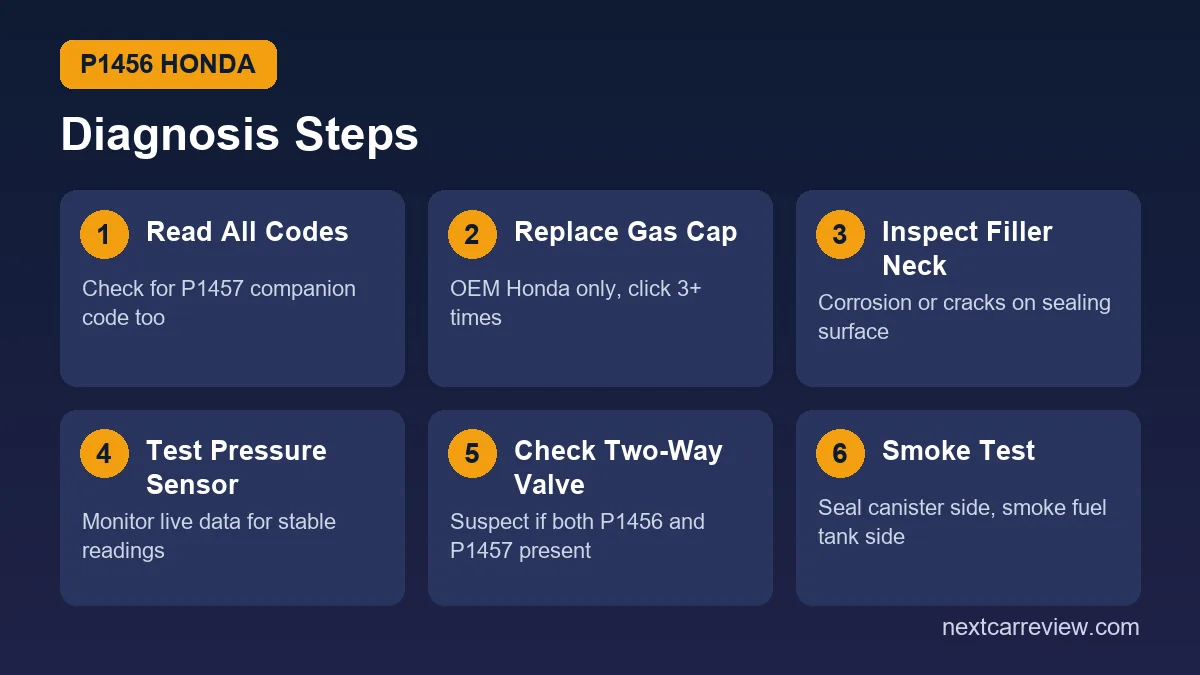
Follow these steps in order. The gas cap is tested first because it fixes the vast majority of cases and costs almost nothing.
Step 1: Read All Codes and Freeze Frame Data
Use an OBD-II scanner to confirm P1456. Record freeze frame data including engine coolant temperature, ambient temperature, and fuel level at the time the code triggered. Check whether P1457 is also stored because both codes together can indicate a two-way valve failure rather than a single-side leak.
Step 2: Inspect and Replace the Gas Cap
Remove the gas cap and inspect the rubber gasket for cracks, stiffness, brittleness, or deformation. Check for debris on the cap seal or filler neck sealing surface. If the cap is worn, aftermarket, or more than five years old, replace it with a genuine Honda OEM cap ($25-$50). Tighten until it clicks at least three times. Clear the code and drive through two to three complete drive cycles. If the code does not return, the gas cap was the problem and no further diagnosis is needed.
Step 3: Inspect the Fuel Filler Neck
If the gas cap replacement did not fix the code, inspect the fuel filler neck. Look for corrosion, cracks, or pitting on the sealing surface where the gas cap seats. Check for rust around the base where the neck connects to the fuel tank. Physical damage or corrosion here allows vapor to bypass even a new gas cap.
Step 4: Test the Fuel Tank Pressure Sensor
Using a scan tool, monitor fuel tank pressure sensor live data. With the engine off and the gas cap sealed, the pressure reading should remain stable. Erratic or drifting readings suggest a faulty sensor. Compare readings to the specifications in your Honda service manual.
Step 5: Check the Two-Way Valve
If P1456 and P1457 are both stored, the two-way valve is a prime suspect. The two-way valve separates the fuel tank side from the canister side. Internal leakage in this valve can affect both zones. Testing typically requires a smoke test to isolate which components are leaking.
Step 6: Smoke Test the Fuel Tank Side
Seal the canister side at the two-way valve and introduce smoke into the fuel tank side. Visually inspect for smoke escaping at the gas cap area, filler neck joints, tank seals, and hose connections. A smoke test costs $80-$150 at a shop and is the definitive way to locate the exact leak source. This test can prevent hundreds of dollars in unnecessary part replacements by confirming the exact failure point.
P1456 Repair Costs on Honda
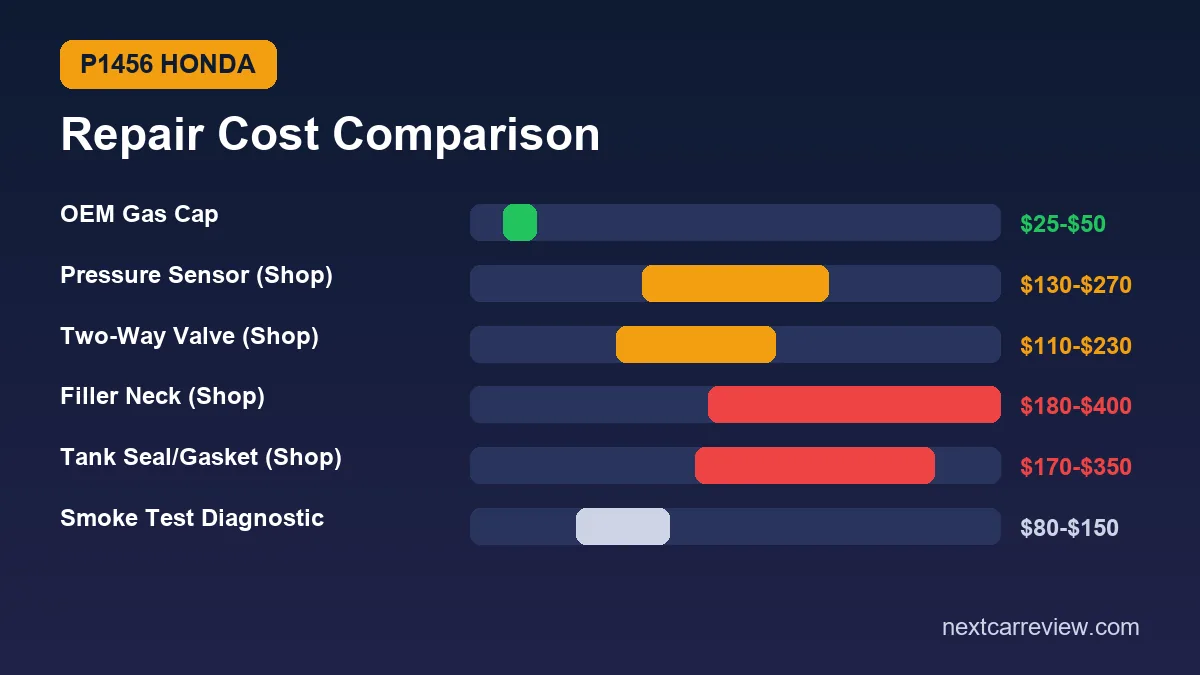
The gas cap is the most common repair and the least expensive. Always start with the gas cap before authorizing more expensive diagnostics or repairs.
| Repair | DIY Cost | Shop Cost | Notes |
|---|---|---|---|
| Gas cap replacement (OEM Honda) | $25-$50 | $25-$50 | Most common fix, always try first |
| Fuel filler neck replacement | $80-$200 | $180-$400 | Second most common cause |
| Fuel tank pressure sensor | $50-$120 | $130-$270 | Verify with live scan data first |
| EVAP two-way valve | $30-$80 | $110-$230 | Suspect if both P1456 and P1457 present |
| Fuel tank seal/gasket | N/A | $170-$350 | Not recommended as DIY |
| Smoke test diagnostic | N/A | $80-$150 | Best money spent before replacing parts |
Honda dealers often charge more than independent shops. For P1456, the gas cap fix is identical whether you buy it at the dealer or online, so there is no advantage to dealer pricing for that repair. For more complex repairs involving the filler neck or pressure sensor, an independent shop with Honda-specific scan tools offers the best value.
P1456 vs P1457: What Is the Difference?
Both codes indicate EVAP system leaks on Honda vehicles, but they point to different sides of the system.
| Feature | P1456 (Fuel Tank Side) | P1457 (Canister Side) |
|---|---|---|
| Leak location | Gas cap to two-way valve | Charcoal canister to purge valve |
| Most common cause | Loose or worn gas cap | CVS valve failure |
| Gas cap fix? | Yes, fixes most cases | No, will not help |
| Cheapest fix | $25-$50 OEM gas cap | $50-$100 CVS valve DIY |
| Regional factor | No regional pattern | Much more common in salt belt states |
Can You Drive With P1456?
Yes, P1456 does not affect engine performance, fuel economy, or drivability. It is strictly an emissions system leak code. However, the check engine light will cause an automatic failure on state emissions and smog inspections. If your state requires emissions testing, you will need to repair P1456 before registration renewal.
Do not clear the code right before an inspection because the EVAP monitor needs to show “Ready” status. After clearing codes, you must complete two to three full cold-start drive cycles for the EVAP monitor to run its self-test and report Ready. If the monitors show “Not Ready,” the inspection station will reject the vehicle even without a check engine light.
Frequently Asked Questions About P1456 on Honda
What is the most common fix for P1456 on a Honda?
Will a new gas cap fix P1456 on my Honda?
What is the difference between P1456 and P0442?
Can P1456 and P1457 appear at the same time?
Does P1456 affect fuel economy or engine performance?
Why does P1456 keep coming back after I replace the gas cap?
⚠️ Professional Notice:
This guide covers P1456 (EVAP Emission Control System Leakage, Fuel Tank System) specifically on Honda vehicles. P1456 is a Honda-manufacturer-specific code. For the canister side companion code, see our guide to P1457 on Honda.
Cost figures are published estimates and vary by vehicle, region and shop. Always get a written quote before authorizing a repair. NextCarReview.com does not receive compensation from any parts manufacturer, retailer, dealer or repair chain for editorial coverage.
Data Sources and Verification
- Honda TSB 99-075 (revised August 9, 2013, NHTSA reference SB-10053545-3978) for official P1456 troubleshooting procedures
- RepairPal estimated costs for Honda Accord, Civic, CR-V, Pilot, and Fit EVAP system repairs
- Honda-Tech, CRVOwnersClub, and OdyClub forum data for real-world repair outcomes and gas cap success rates
- Honda TSB 03-001 (January 28, 2003): EVAP bypass solenoid valve failure
- CarParts.com and TroubleCodes.net for P1456 diagnostic reference data
For official rules, ratings and consumer guidance on this topic, see:
More trouble code guides: All car trouble code guides by make, P1457 Code on Honda, P0507 Code on Honda.

Morgan Reyes is the founder and editor-in-chief of NextCarReview, which Morgan launched in August 2024. A 2022 graduate of Columbia University, Morgan is based in New York and writes and edits the site’s reviews, comparisons and buying guides. Morgan does not road-test vehicles. Every article is built from published primary data: EPA FuelEconomy.gov ratings, NHTSA crash ratings, recalls and owner complaints, IIHS results, and manufacturer specifications and pricing, with each figure cited and checked before publication. Contact: admin@nextcarreview.com