In this article 10 sections
the 2026 toyota Grand Highlander is one of the most well-rounded three-row SUVs on the market, but Toyota sells it in three very different powertrain configurations with a price gap of nearly $18,000 between them. Pick the wrong one and you’ll either overpay for performance you don’t need or leave towing capacity on the table. This guide cuts through all of it: specs, pricing, the powertrain decision framework no competitor bothers to give you, and a five-year ownership cost breakdown that finally answers whether the hybrid premium is actually worth it.
Figures cross-checked against EPA, NHTSA, IIHS and manufacturer sources. See our sourcing policy.
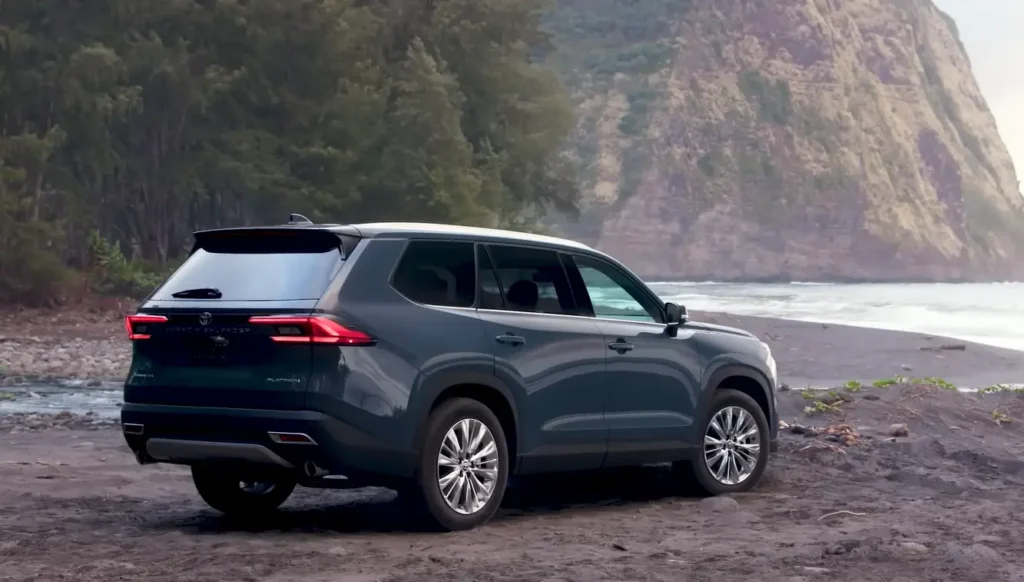
The 2026 toyota Grand Highlander is a three-row mid-size SUV available in non-hybrid, standard Hybrid, and hybrid Max configurations. Launch MSRPs run from $41,360 to $59,275 (excluding DPH) depending on trim and powertrain. The Standard Hybrid achieves 36 MPG combined (best in the lineup) while the hybrid Max produces 362 combined horsepower and tows 5,000 pounds. Toyota Safety Sense 3.0 (TSS 3.0) is standard equipment on every single trim.
For 2026, nothing significant changed from the outgoing model. That is actually a compliment. The Grand Highlander was already a strong package, and Toyota left it alone. If you are comfortable with a lightly used example, a 2024 or 2025 model with remaining warranty coverage is worth considering too.
📌 2026 Toyota Grand Highlander: Quick Intelligence Summary
Key Facts at a Glance
| Starting MSRP | $41,360 (non-hybrid LE) | $44,710 (hybrid LE) |
| Top MSRP | $59,275 (hybrid Max Platinum) |
| Powertrain Options | Non-hybrid (265 hp) | standard Hybrid (245 hp) | hybrid Max (362 hp) |
| Best Fuel Economy | 37 city / 34 highway / 36 combined MPG (std. Hybrid FWD) |
| Max Towing | 5,000 lbs (hybrid Max or non-hybrid) | 3,500 lbs (standard Hybrid) |
| Seating | 7 or 8 passengers (bench vs captain’s chairs) |
| Cargo Space | 21 ft³ (3rd row up) | 58 ft³ (2nd row up) | 98 ft³ (all down) |
| Safety Suite | Toyota Safety Sense 3.0 (standard on all trims) |
| Hybrid Battery Warranty | 10 years / 150,000 miles (hybrid models only) |
| Assembly Location | Princeton, indiana (domestically built) |
| analysis | Editorial Standard Verified ✔️ | sources: Toyota.com, EPA, NHTSA, IIHS |
Which Grand Highlander Powertrain Should You Actually Choose?
This is the question Toyota’s own marketing materials never directly answer, and it is the most important decision you will make with this vehicle. The three powertrain options are not just different engine specs; they represent three genuinely different vehicles with different use cases, different fuel costs, and different long-term ownership profiles.
| Powertrain | Combined Output | Transmission | Best MPG (combined) | Max Towing | 0–60 mph | Price Premium vs non-hybrid |
|---|---|---|---|---|---|---|
| Non-hybrid 2.4L turbo 4-cyl |
265 hp / 310 lb-ft | 8-speed automatic | 24 MPG combined | 5,000 lbs | Not published | Baseline |
| Standard Hybrid 2.5L atkinson-cycle + 3 motors |
245 hp combined | CVT | 36 MPG combined (FWD) | 3,500 lbs | Not published | +$3,350 (LE) / +$1,750 (XLE) |
| Hybrid Max 2.4L turbo + 1 motor (AWD std.) |
362 hp / 400 lb-ft | 6-speed automatic | 27 MPG combined | 5,000 lbs | 6.3 sec (Toyota) | ~$4,700–$6,300 (same trim) |

Per EPA-certified figures at fueleconomy.gov, those numbers are not close to each other. The Standard Hybrid’s 36 MPG combined is 50% better than the non-hybrid’s 24 MPG. That gap is real and it compounds over time. But the standard Hybrid pays for that efficiency by giving up towing capacity: it is rated at 3,500 pounds, not the 5,000 pounds the non-hybrid and hybrid Max both achieve.
Standard Hybrid (245 hp / 36 MPG) – Best For Efficiency-First Families
The Standard Hybrid pairs a 2.5-liter atkinson-cycle four-cylinder with three electric motors through a CVT, producing a combined 245 horsepower stored in a nickel-metal hydride (NiMH) battery pack. That CVT transmission (paired with an additional rear electric motor on AWD models) is what enables the dramatic efficiency gains. Choosing front-wheel drive pushes the EPA combined rating to 36 MPG. Go AWD and you drop to around 34 MPG combined. That 2 MPG difference adds up to roughly $100 per year at average U.S. Fuel prices. Worth knowing before you tick the AWD box.
This powertrain is the right choice if you primarily drive suburban and highway routes, rarely or never tow over 3,500 pounds, and want to minimize fuel costs over a 5-to-8-year ownership period.
Hybrid Max (362 hp / 5,000 lb Tow) – Best For Performance + Towing
The Hybrid Max is a fundamentally different system. Toyota’s hybrid Max pairs the turbocharged 2.4-liter four-cylinder with an electric motor through a 6-speed automatic, producing 362 combined horsepower and 400 pound-feet of torque with standard all-wheel drive. Toyota quotes a 0-60 mph time of 6.3 seconds, and calls it the most powerful midsize SUV it has built. It is legitimately fast for a seven-passenger SUV.
The trade-off is fuel economy. At 27 MPG combined, the hybrid Max is only marginally better than the non-hybrid. It costs $4,700 to $6,300 more than the gas model at the same trim and carries a higher insurance premium due to the elevated MSRP and more complex repair cost profile. Choose the hybrid Max if you need 5,000-pound towing capability AND want substantially quicker highway acceleration for passing and merging (not for the fuel savings).
Non-Hybrid (265 hp / 5,000 lb Tow) – Best For Maximum Towing on a Budget
The non-hybrid grand Highlander uses the same turbocharged 2.4-liter four-cylinder paired with an 8-speed automatic, delivering 265 horsepower and 310 pound-feet of torque. It has more horsepower than the standard Hybrid but less than the hybrid Max. Crucially, it matches the hybrid Max’s 5,000-pound tow rating at a price roughly $4,700–$6,300 lower at the same trim.
If towing a boat, trailer, or camping rig is part of your regular life but peak performance is not a priority, the non-hybrid is the most cost-effective way to get full towing capacity from this platform.
AWD vs FWD – What the Choice Actually Costs You
2026 Grand Highlander Trim Guide: Which One to Buy
identifies the XLE as the best-value trim across both the hybrid and non-hybrid lineups. It adds heated leatherette front seats, a wireless charging pad, a power liftgate, and smartphone-as-key capability over the base LE (all at a price that stays under $50,000 for the non-hybrid and under $48,000 for the hybrid). Here is the full trim-by-trim breakdown, with launch MSRPs (excluding DPH) per Toyota; check Toyota.com for current pricing.
| Trim | Non-hybrid MSRP | Hybrid MSRP | Key Features Gained | Best For | verdict |
|---|---|---|---|---|---|
| LE | $41,360 | $44,710 | 12.3″ touchscreen, TSS 3.0, 7″ gauge display, 6-speaker audio | Minimum-spend buyers | Skip (wireless charging missing) |
| XLE | $44,130 | $45,880 | Heated front seats, wireless charging, power liftgate, smartphone key | Most buyers | ✅ best Value Pick |
| Limited | $48,860 | $52,210 | Leather seats, ventilated fronts, 12.3″ gauge cluster, JBL 11-speaker, 100W inverter | Near-luxury buyers | Strong value at this price |
| Nightshade Edition | N/A | $53,190 | Blacked-out exterior trim, 20″ black wheels, JBL audio (hybrid only) | Style-focused buyers | Style premium (Limited better value) |
| Platinum | $54,545 | $59,275 | AWD standard, full luxury spec, panoramic options available | Maximum-spec buyers | Only if you need AWD standard |

Interior Space, Third Row & Family Practicality
Third Row – Actually Usable by Adults
Here is where the grand Highlander earns its “Grand” designation. Third-row passengers get 33.5 inches of legroom and 37.2 inches of headroom, several inches more legroom than in the standard Toyota Highlander (per Toyota’s published dimensional specifications). That is not a minor difference. It makes the grand Highlander’s third row genuinely usable for adults on road trips, not just a child-only penalty box. That makes row three a realistic place for many adults, not only children.
The third-row seats also recline, which is a meaningful comfort feature on long drives. The two outer second-row seats slide forward for easy access. Third-row passengers get their own USB-C ports. The only omission: no power fold on the third row, though the manual operation is straightforward.

Cargo Space by Configuration
| Configuration | Cargo Volume | Context |
|---|---|---|
| Third row up | 21 ft³ | Groceries, small bags (limited but workable) |
| Third row folded | 58 ft³ | Costco run territory (generous daily use) |
| Both rows folded | 98 ft³ | Approaches Toyota Sienna minivan (101 ft³) – 13 ft³ more than standard highlander |

Technology and Infotainment
Every Grand Highlander gets a 12.3-inch infotainment touchscreen running Toyota’s latest software, with wireless Apple CarPlay and android Auto integration and bluetooth connectivity. The LE and XLE trims use a 7.0-inch digital gauge cluster display; the Limited, nightshade, and platinum trims upgrade to a full 12.3-inch all-digital instrument cluster that you can configure from the steering wheel. The 11-speaker JBL stereo with SiriusXM is reserved for nightshade, Limited, and platinum (it is not available on LE or XLE). Wireless smartphone charging comes standard from XLE upward.

5-Year Cost of Ownership – Is the Hybrid Worth the Premium?
No competitor article calculates this. Every review describes the hybrid’s fuel economy, then moves on. Here is the math that actually answers the question, based on EPA-certified figures from fueleconomy.gov, an illustrative fuel price of $3.50/gallon, and 15,000 miles of annual driving.
| Cost Category | Non-hybrid (XLE) | Standard Hybrid (XLE) | Hybrid Max (Limited) |
|---|---|---|---|
| Base MSRP (XLE / equivalent) | $44,130 | $45,880 | ~$55,190+ |
| Estimated Annual Fuel Cost | ~$2,188 (24 MPG) | ~$1,458 (36 MPG) | ~$1,944 (27 MPG) |
| 5-year Fuel Cost | ~$10,938 | ~$7,292 | ~$9,722 |
| 5-year Fuel Savings vs non-hybrid | – | ~$3,646 saved | ~$1,216 saved |
| Hybrid Purchase Premium | – | +$1,750 | +$11,060+ |
| Net 5-year Position | Baseline | ~$1,896 ahead | ~$9,844 behind |
the most common concern about hybrid ownership is battery replacement cost (a legitimate worry that can run $3,000 to $8,000 on some platforms). Toyota’s hybrid battery warranty covers the grand Highlander’s nickel-metal hydride (NiMH) battery pack for 10 years or 150,000 miles (other hybrid components get 8 years/100,000 miles). That coverage extends beyond the standard 5-year/60,000-mile powertrain warranty by 5 years, effectively eliminating battery replacement risk for most ownership periods. If you buy new and keep the vehicle for up to 10 years, you are covered for the full ownership window.
Federal Hybrid Tax Credit Status
The 2026 toyota Grand Highlander Hybrid does Not qualify for a federal clean vehicle credit. That credit only ever applied to qualifying plug-in hybrids and EVs (conventional hybrids were never eligible), and it ended for vehicles acquired after September 30, 2025. Check your state for any additional incentives. The current federal incentive finder is available at fueleconomy.gov/feg/tax.do.
Safety Ratings, TSS 3.0 & Warranty Coverage
Toyota Safety Sense 3.0 – Standard on Every Trim
Toyota Safety Sense 3.0 (TSS 3.0) is Toyota’s standard driver-assistance suite, fitted to every grand Highlander at every trim level (including the base LE). The package includes automated emergency braking with pedestrian and cyclist detection, blind-spot monitoring with rear cross-traffic alert, adaptive cruise control with lane centering, automatic high-beam headlamps, and a road sign recognition system. Traffic jam assist and front/rear parking sensors with automatic braking are available as options.
Warranty Breakdown – Including Hybrid-Specific Coverage
| Coverage Type | Duration | Notes |
|---|---|---|
| Bumper-to-bumper | 3 years / 36,000 miles | Standard (matches segment) |
| Powertrain | 5 years / 60,000 miles | Standard (matches segment) |
| Hybrid Battery (other hybrid parts 8 yrs/100k) | 10 years / 150,000 miles | Hybrid models only (above segment average) |
| Complimentary Maintenance | 2 years / 25,000 miles | Covers scheduled service (most rivals don’t offer this) |
The complimentary maintenance coverage is worth approximately $500 to $800 in real dollar terms over two years. The kia Telluride and honda Pilot do not include a comparable service program, while the hyundai Palisade comes with 3 years/36,000 miles of complimentary maintenance. Note that Toyota cut ToyotaCare to 1 year/10,000 miles starting with 2027 models. It is not the headline feature, but it is a genuine ownership cost advantage.
How Does the 2026 Grand Highlander Compare to Its Rivals?
| Model | Starting MSRP | Best MPG (combined) | Max Towing | Max HP | 3rd row Adults? | Free Maintenance |
|---|---|---|---|---|---|---|
| Toyota Grand Highlander Hybrid | $44,710 | 36 MPG | 3,500–5,000 lbs | 362 hp | ✅ yes | ✅ 2yr/25k |
| Kia Telluride (2025 V6) | $36,390 | 22 MPG | 5,000 lbs | 291 hp | ✅ yes | ❌ no |
| Hyundai Palisade Hybrid | $43,660 | 34 MPG | 4,000 lbs | 329 hp | ✅ yes | ✅ 3yr/36k |
| Honda Pilot | $42,195 | 22 MPG | 5,000 lbs | 285 hp | ⚠️ tight | ❌ no |
| Mazda CX-90 PHEV | $50,695 | 26 MPG | 3,500 lbs | 323 hp | ⚠️ tight | ❌ no |
The 2025 Kia Telluride started about $8,300 below the hybrid Grand Highlander (the redesigned 2027 Telluride starts at $39,190). If budget is the primary driver and hybrid efficiency is not a priority, the telluride is a genuinely strong alternative. The Hyundai Palisade Hybrid is the grand Highlander Hybrid’s closest direct rival on fuel economy (up to 34 MPG combined vs 36 MPG) with 329 hp, but it is rated to tow an estimated 4,000 pounds, short of the Hybrid MAX’s 5,000. Few rivals combine an adult-usable third row, 36 MPG efficiency, 5,000-pound max towing, and two years of complimentary maintenance in a single package.
Who Should Buy the 2026 Grand Highlander? Final Verdict
Buy the hybrid Max if: you need 5,000-pound towing AND want the quickest acceleration in the lineup. Do not buy it for fuel savings (the premium never fully breaks even on gas costs alone).
Buy the non-hybrid if: you need the full 5,000-lb tow rating, want to keep purchase cost down, and are not prioritizing fuel economy over capability.
Consider skipping the 2026 if: the model is unchanged from 2025 and 2024. A certified pre-owned 2024 with remaining warranty is worth serious consideration at likely $5,000–$8,000 below new pricing.
The Grand Highlander earns its place as one of the most complete three-row SUVs on sale. It is assembled at Toyota’s princeton, indiana plant, pairs 10-year/150,000-mile hybrid battery coverage with two years of ToyotaCare, and delivers one of the few genuinely adult-usable third rows in the segment. The Standard Hybrid XLE is the version that makes the most financial sense for the broadest group of buyers. The Hybrid Max is a legitimate choice for buyers who want real performance alongside the family hauler package. Either way, very few competitors put all of this together as consistently as Toyota does here.
Frequently Asked Questions: 2026 Toyota Grand Highlander
Is the 2026 toyota Grand Highlander worth buying?
What is the difference between the grand Highlander Hybrid and hybrid Max?
Which Grand Highlander trim is the best value?
Is the grand Highlander Hybrid worth the extra cost over the non-hybrid?
What changed on the 2026 grand Highlander compared to 2025?
Can the grand Highlander Hybrid tow a trailer?
Does the 2026 grand Highlander qualify for a federal hybrid tax credit?
Is the 2026 grand Highlander good for tall adults in the third row?
How much cargo space does the grand Highlander have?
How much does a fully loaded 2026 grand Highlander cost?
What is Toyota’s warranty on the grand Highlander hybrid battery?
⚠️ professional Notice:
all pricing figures reflect Toyota launch MSRPs for 2026, excluding DPH, and are subject to change. Fuel economy estimates are EPA-certified figures sourced from fueleconomy.gov. Real-world MPG will vary based on driving conditions, climate, load, and driving habits. Total cost of ownership calculations use an illustrative $3.50/gallon fuel price and illustrative annual mileage (adjust for your region and usage). Safety rating links direct to NHTSA.gov and IIHS.org for current test results. NextCarReview is an independent publication and is not affiliated with toyota Motor Corporation.
Related guides: our SUV buying guide and Toyota Corolla Cross Hybrid 2026 Space Mileage.
Specs, prices and safety ratings change between model years and trims. Verify them for the exact 2026 Toyota you are considering:
Sources
- Toyota: 2026 Grand Highlander launch release (MSRP, specs, towing)
- FuelEconomy.gov: 2026 Toyota Grand Highlander
- Toyota: hybrid battery warranty
- Toyota: ToyotaCare coverage
- Toyota: Five things to know about the Grand Highlander (Hybrid MAX 0-60)
- Kia: 2025 and 2027 Telluride pricing
- Mazda: 2026 CX-90 pricing
- IRS: Clean vehicle credits

Morgan Reyes is the founder and editor-in-chief of NextCarReview, which Morgan launched in August 2024. A 2022 graduate of Columbia University, Morgan is based in New York and writes and edits the site’s reviews, comparisons and buying guides. Morgan does not road-test vehicles. Every article is built from published primary data: EPA FuelEconomy.gov ratings, NHTSA crash ratings, recalls and owner complaints, IIHS results, and manufacturer specifications and pricing, with each figure cited and checked before publication. Contact: admin@nextcarreview.com