

In this article 11 sections
The 2026 Ram 1500 vs Toyota Tundra matchup is the one full-size truck shoppers keep asking us about. Ram brings horsepower, a longer powertrain warranty, and the most tech-forward cabin in the segment. Tundra counters with a broader hybrid lineup, a bigger tow rating on paper, and Toyota’s long-standing reputation for going the distance. Neither one is a bad truck. But your priorities decide the winner.
Figures cross-checked against EPA, NHTSA, IIHS and manufacturer sources. See our sourcing policy.
Full-size trucks do not get cross-shopped lightly. Buyers in this segment want to know exactly what they are getting before they sign anything. So we pulled the real 2026 numbers on the Ram 1500 and Toyota Tundra straight from manufacturer specs, EPA ratings, and IIHS and NHTSA testing. No guesswork, no invented figures. Just the data that actually decides which truck fits your driveway.
2026 Ram 1500 vs Toyota Tundra at a Glance
2026 Ram 1500 vs Toyota Tundra – Quick Market Intelligence
Most people want the short answer first. So here is our quick 2026 Ram 1500 vs Toyota Tundra comparison. The Ram wins on horsepower, interior tech, and powertrain warranty length. The Tundra wins on maximum towing, hybrid availability, and long-term reliability reputation. Both trucks now ride on coil-spring rear suspensions, so the old “smooth Ram, bouncy Toyota” gap has narrowed considerably.
2026 Ram 1500 vs Toyota Tundra Verdict Table
| Spec (2026) | Ram 1500 | Toyota Tundra |
|---|---|---|
| Starting Price | ~$42,400 | ~$41,260 |
| Top Engine Output | 540 hp / 521 lb-ft (Hurricane HO) | 437 hp / 583 lb-ft (i-FORCE MAX hybrid) |
| Max Towing | Up to 11,610 lbs | Up to 12,000 lbs |
| Max Payload | Up to 2,360 lbs | Up to 1,940 lbs |
| Best EPA Combined MPG | 22 mpg (3.6L V6) | 22 mpg (i-FORCE MAX, 4×2) |
| Standard/Available Touchscreen | 8.4 in. standard, up to 14.5 in. available | 8.0 in. (SR), 14.0 in. standard elsewhere |
| IIHS Recognition | Mixed results, Good on select tests | Top Safety Pick+ |
| NHTSA Overall Rating | 5-Star | 5-Star |
| Powertrain Warranty | 10 yr / 100,000 mi (original owner) | 5 yr / 60,000 mi |
Who Should Choose Which
Want the most horsepower, the biggest available screen, and the longest powertrain warranty in the class? Pick the Ram. Want a hybrid option, a slightly higher tow ceiling, and Toyota’s reliability track record? Pick the Tundra. The 2026 Ram 1500 vs Toyota Tundra choice splits along fairly clear lines. We break each one down below. And if you are also cross-shopping hybrids, our F-150 Hybrid vs Ram 1500 comparison shows how the Ram stacks up against Ford’s hybrid half-ton.
Price and Trim Lineup
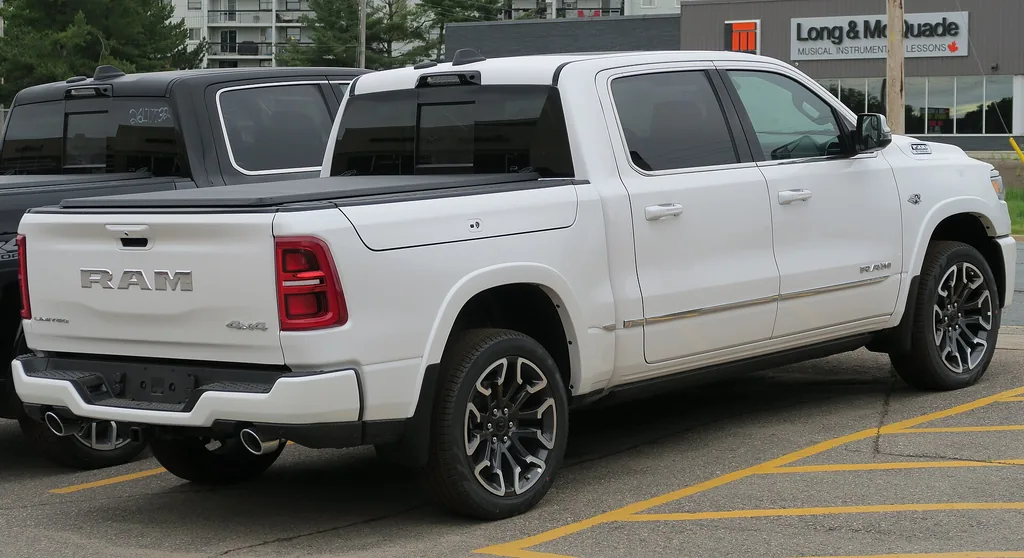
Money matters first. And here the two trucks start almost dead even. Toyota opens about $1,100 cheaper. But Ram fights back with a longer standard-equipment list on its mid trims. Let us walk through both ladders.
Ram 1500 Trims (Tradesman, Express, Big Horn, Warlock, RHO, Limited, Limited Longhorn, Tungsten)
The Ram 1500 lineup runs eight trims for 2026, starting at roughly $42,400 for the Tradesman. A new Express trim slots in with aggressive styling. Big Horn and Warlock cover the middle ground. The RHO brings the 540-hp High-Output Hurricane for off-road performance. Limited, Limited Longhorn, and Tungsten top the range with leather, chrome, and the big screen, pushing well past $60,000 fully loaded.
Tundra Trims (SR, SR5, Limited, Platinum, 1794 Edition, TRD Pro, Capstone)
Toyota keeps a seven-trim ladder, running from about $41,260 for the SR up to roughly $80,800 for the range-topping Capstone. SR and SR5 are work-truck focused. Limited and Platinum move upmarket. The 1794 Edition adds Western-themed leather, and TRD Pro brings off-road hardware. Capstone is the hybrid-only luxury flagship. Note that i-FORCE MAX is not offered on SR or SR5, so budget-minded hybrid shoppers need to step up a trim or two.
Best-Value Trim by Use Case
On the Ram side, the Big Horn tends to hit the sweet spot: enough tech and comfort without Limited-level pricing. On the Tundra side, the Limited trim is where the i-FORCE MAX hybrid becomes available at the most reasonable price point. Either way, the mid-pack trims deliver most of the flagship experience for meaningfully less money.
Engine Options and Towing/Payload
This is where the two trucks tell very different stories. Ram bet its entire 2026 lineup on turbocharged sixes, plus a returning V8. Toyota split the difference between a twin-turbo V6 and a twin-turbo hybrid V6. So the driving character and the tow ratings diverge.
Ram’s Hurricane Twin-Turbo I-6 Lineup
Ram’s engine bay looks different than it did a few years ago. The base 3.6L Pentastar V6 makes 305 hp and 269 lb-ft. The 3.0L Hurricane Standard Output I-6 delivers 420 hp and 469 lb-ft, plus the truck’s best towing figure at up to 11,610 lbs. The 3.0L Hurricane High-Output I-6, reserved for the RHO performance trim, cranks out 540 hp and 521 lb-ft. A 5.7L HEMI V8 also returned for 2026, rated up to 395 hp and 410 lb-ft for buyers who want a naturally aspirated V8. Maximum payload tops out at 2,360 lbs, from the base V6 configuration rather than the more powerful engines.
Toyota’s i-FORCE and i-FORCE MAX Hybrid Lineup
The Tundra’s base i-FORCE twin-turbo V6 makes 348 hp and 405 lb-ft on the SR, or 389 hp and 479 lb-ft on SR5 and higher gas trims. The i-FORCE MAX hybrid climbs to 437 hp and a segment-strong 583 lb-ft of torque, though it is restricted to CrewMax cab models and unavailable on SR or SR5. Manufacturer-quoted towing ranges from about 8,300 to 12,000 lbs depending on configuration, with i-FORCE MAX models rated between 10,290 and 11,450 lbs. Maximum payload comes in at 1,940 lbs, behind the Ram’s ceiling.
Towing and Payload: Who Actually Wins
Toyota’s best gas configuration edges Ram’s best tow rating by roughly 400 lbs. Ram flips the script on payload, beating the Tundra’s ceiling by over 400 lbs. Prioritize bed capacity, lean Ram. Prioritize maximum trailer weight, lean Tundra.
Fuel Economy
Neither of these trucks is going to shame a hybrid sedan, but the gap between trims is real, and it is worth understanding before you pick an engine.
EPA Ratings Side by Side
The Ram’s 3.6L V6 posts the truck’s best EPA combined rating at 22 mpg, with 20 city and 25 highway. The Hurricane Standard Output I-6 lands at 21 mpg combined. The 5.7L HEMI V8 drops to roughly 18-19 mpg combined. On the Toyota side, non-hybrid i-FORCE models run 19-20 mpg combined depending on drivetrain, while the i-FORCE MAX hybrid reaches up to 22 mpg combined on 4×2 Limited, Platinum, and 1794 Edition models, dropping to about 19-20 mpg combined on 4×4 hybrid configurations and the TRD Pro Hybrid.
Which Engine Actually Saves You Money at the Pump
The Ram’s base V6 and the Tundra’s 4×2 hybrid are functionally tied at the top of each lineup. But most buyers skip the base V6 on a full-size truck, and most Tundra hybrids sold are 4×4 CrewMax models closer to 19-20 mpg combined. Expect a similar real-world range from both once you account for the trims people actually buy.
Interior, Tech, and Comfort
Numbers aside, you sit inside this thing every day. And here Ram has built a real reputation for cabin tech, while Toyota leans on chassis refinement.
Touchscreen and Infotainment
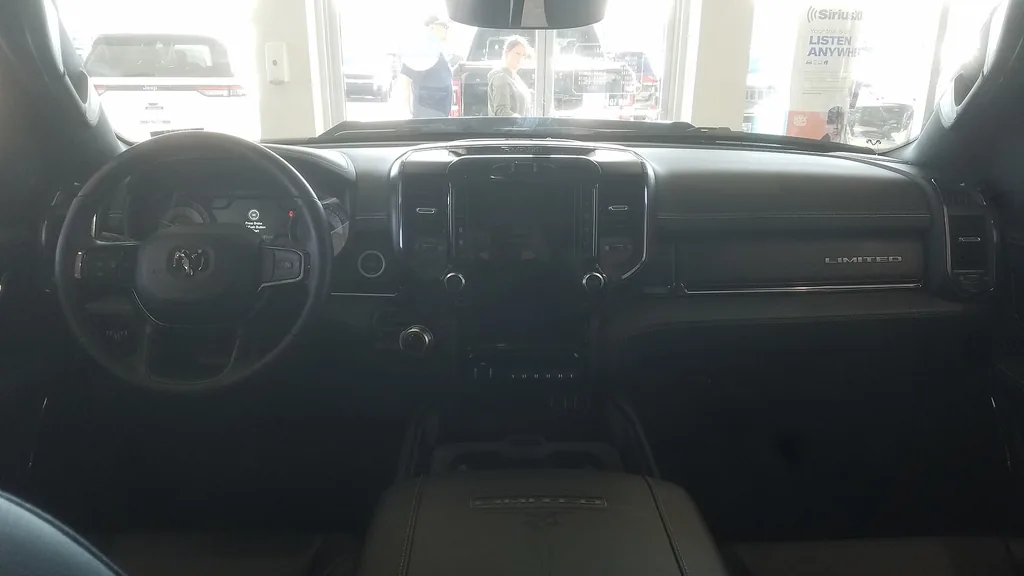
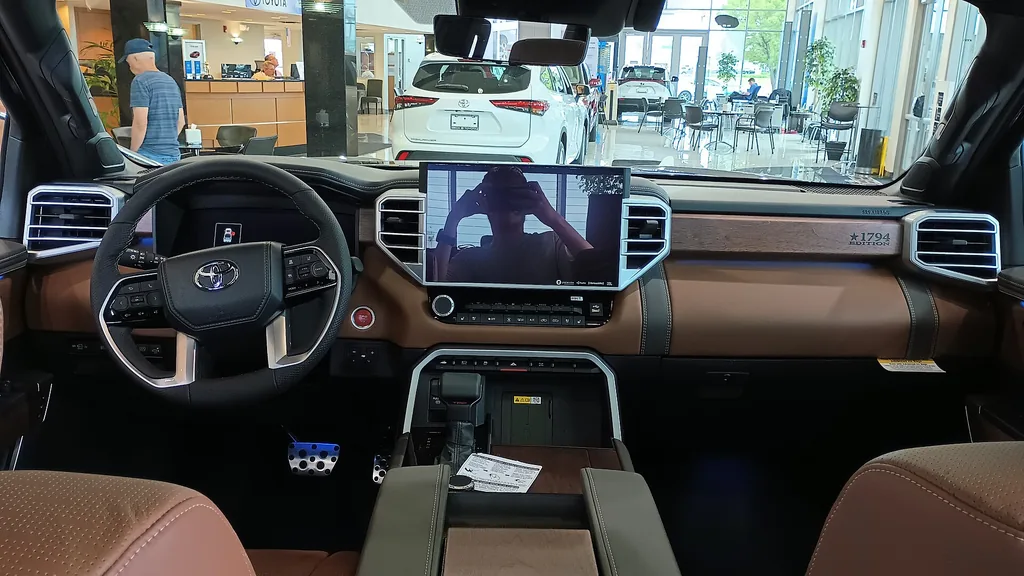
Ram’s Uconnect 5 system starts at 8.4 inches, steps up to a 12-inch navigation-equipped unit, and tops out with a class-exclusive 14.5-inch touchscreen on upper trims. Toyota counters with an 8.0-inch screen on the base SR and a 14.0-inch display standard on every other grade. So both brands now offer large-format screens, but Ram’s biggest unit edges out Toyota’s, and Ram makes the huge screen available across a wider trim spread.
Ride Quality and Suspension
This gap is smaller than it used to be. Ram’s coil-spring rear suspension has long been praised for a smoother ride than leaf-spring trucks, and that reputation has followed the Ram for years. The current-generation Tundra also moved to a coil-spring rear setup, closing much of that gap. Both ride noticeably better than older leaf-spring pickups, though Ram’s optional air suspension is a further step up for frequent towing or auto-leveling.
Cab and Bed Configurations
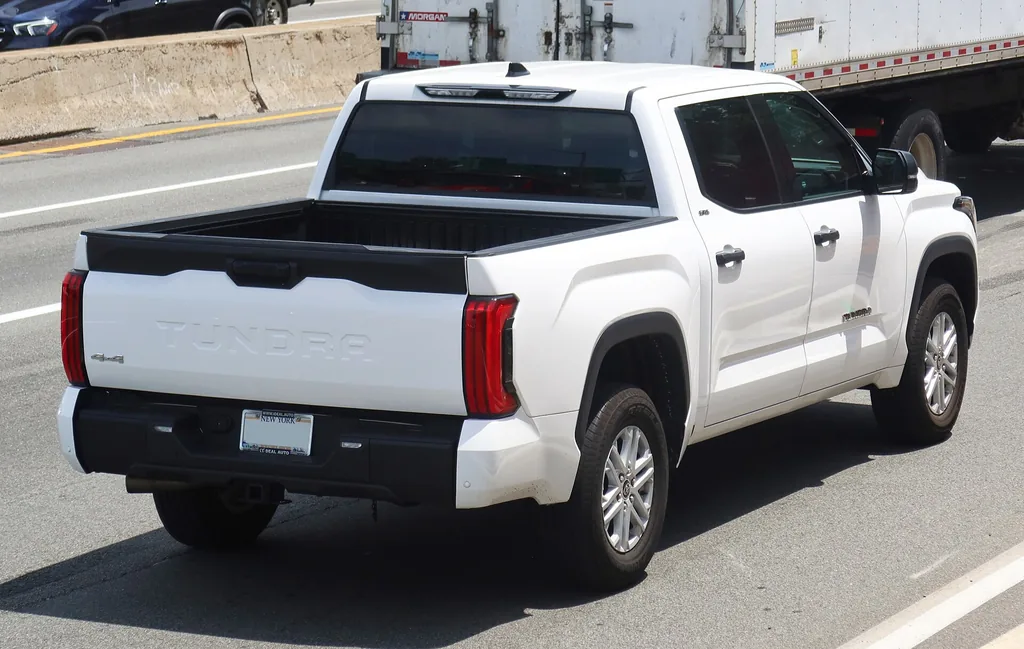
Ram offers Quad Cab, paired only with a 6’4″ bed, and Crew Cab, with either a 5’7″ short bed or 6’4″ standard bed depending on trim. Toyota spreads across Double Cab (6.5′ or 8.1′ bed) and CrewMax (5.5′ or 6.5′ bed). Buyers needing maximum bed length should look at the Tundra Double Cab’s 8.1-foot bed, longer than anything Ram currently offers.
Safety and Driver Assistance
Safety testing tells two different stories for these trucks in 2026, so it is worth reading the fine print rather than just the headline rating.
IIHS Results
The Toyota Tundra earned IIHS Top Safety Pick+ recognition for 2026, a distinction only it and one other pickup in the segment have achieved. The Ram 1500, by contrast, scored a Poor rating in IIHS’s updated moderate overlap front crash test for the 2025-2026 model year, even as it earned Good marks in other individual tests, including headlights and pedestrian crash prevention on certain configurations.
NHTSA Ratings
Both trucks currently hold a 5-star overall safety rating from NHTSA in Crew Cab configuration, so federal testing does not separate them the way IIHS’s newer, tougher test does.
Driver Assistance Tech
Both trucks come with a full suite of driver-assistance features, including adaptive cruise control, automatic emergency braking, and lane-keeping assistance, across most trims. The details of each system vary by manufacturer, but functionally, neither truck leaves you without modern safety tech at this point in the segment.
Reliability, Warranty, and Long-Term Cost
Buying the truck is the easy part. Living with it for a decade is the real test, and this is where the two brands genuinely diverge.
Warranty Coverage
Both trucks carry an identical 3-year/36,000-mile basic warranty. The real difference is the powertrain. For 2026, Ram backs original owners with a 10-year/100,000-mile powertrain limited warranty, well beyond the traditional 5-year/60,000-mile industry standard and beyond Toyota’s own 5-year/60,000-mile powertrain coverage. Toyota’s i-FORCE MAX hybrid system adds extended coverage on top: 8 years/100,000 miles on hybrid components, and 10 years/150,000 miles on the hybrid battery itself.
Reliability Reputation
This is a genuinely contested topic worth covering honestly. Toyota’s trucks have carried a strong long-term reliability reputation for decades, and several independent dependability studies have generally rated the Tundra ahead of the Ram 1500 on long-term durability, though results vary by study and year. That said, the Tundra is not spotless: its twin-turbo V6 has had well-documented early-production issues, including reports of manufacturing debris affecting some engines. Ram has faced its own scrutiny in recent dependability rankings too. Neither truck is beyond reproach, but the broader pattern across independent studies currently favors Toyota’s long-term track record.
Verdict and Which Should You Buy
So where does the 2026 Ram 1500 vs Toyota Tundra debate land? It comes down to what you actually value in a decade-long ownership experience versus what you want on day one.
Buy the Ram 1500 If…
Choose the Ram if you want the most horsepower available, the biggest touchscreen in the segment, and the strongest powertrain warranty of any full-size truck currently sold. The coil-spring ride and payload advantage make it a strong pick for buyers who haul gear more than they tow trailers.
Buy the Toyota Tundra If…
Choose the Tundra if you want a hybrid powertrain option, a slightly higher maximum tow rating, an IIHS Top Safety Pick+ badge, and Toyota’s long-standing reputation for trucks that keep running well past six figures on the odometer.
Final Word
Neither the Ram 1500 nor the Toyota Tundra is the wrong answer here. The Ram wins on power, tech, payload, and warranty length. The Tundra wins on towing ceiling, hybrid choice, current IIHS results, and long-term reliability reputation. Match the truck to what you actually do with it: haul heavy loads and want the latest cabin tech, lean Ram. Tow near the max and want the brand with the stronger durability track record, lean Tundra. Either way, verify current pricing and incentives with your local dealer before you sign.
Related guides: other model vs model matchups and 2026 Toyota Tacoma vs Ford Ranger.
Frequently Asked Questions About the 2026 Ram 1500 vs Toyota Tundra
Which is faster or more powerful, the Ram 1500 or Toyota Tundra?
Which tows more, Ram 1500 or Toyota Tundra?
What is the price difference between the 2026 Ram 1500 and Toyota Tundra?
Which has better fuel economy?
Which is more reliable, Ram 1500 or Toyota Tundra?
Does the Ram 1500 or Toyota Tundra have a longer warranty?
⚠️ Professional Notice:
All 2026 pricing figures in this article are based on manufacturer suggested retail prices and published market data as of September 2026. Real transaction prices vary by trim, dealer, geographic region, and available incentives. Confirm current pricing with your local dealer before any purchase decision.
Fuel economy figures reference EPA combined estimates. Real-world mpg varies based on driving style, terrain, load, and weather conditions. Towing and payload figures are manufacturer-quoted maximums and vary by configuration, cab, bed, and equipment. Safety ratings reference IIHS and NHTSA published data for the 2025-2026 model year and are subject to change as new testing is completed. Warranty terms are subject to change and should be confirmed with the manufacturer or a dealer at time of purchase. NextCarReview.com does not receive compensation from any manufacturer or dealer in exchange for rankings or editorial coverage.
Data Sources and Verification
- OEM technical documentation – Stellantis/Ram Trucks and Toyota Motor Corporation official 2026 model year specifications
- EPA fuel economy estimates – US Environmental Protection Agency 2026 model year combined MPG ratings
- IIHS and NHTSA safety ratings – IIHS 2026 Tundra crew cab, IIHS 2026 Ram 1500 crew cab, and NHTSA, 2025-2026 model year testing
- Ram 10-year/100,000-mile limited powertrain warranty announcement, 2026 model year; EPA 2026 Ram 1500 3.6L 2WD rating
- Aggregated market pricing and independent reliability data – September 2026 dealer listing aggregation and third-party dependability studies across US markets

Morgan Reyes is the founder and editor-in-chief of NextCarReview, which Morgan launched in August 2024. A 2022 graduate of Columbia University, Morgan is based in New York and writes and edits the site’s reviews, comparisons and buying guides. Morgan does not road-test vehicles. Every article is built from published primary data: EPA FuelEconomy.gov ratings, NHTSA crash ratings, recalls and owner complaints, IIHS results, and manufacturer specifications and pricing, with each figure cited and checked before publication. Contact: admin@nextcarreview.com


