In this article 12 sections
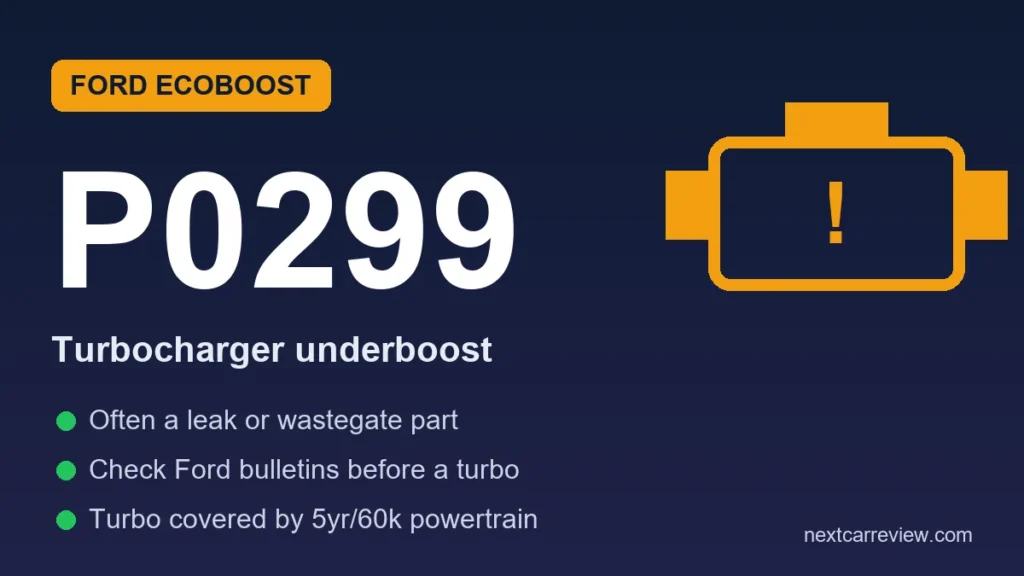
P0299 on a Ford EcoBoost means the turbocharger is not making the boost the engine computer asked for. Ford calls it “Turbocharger/Supercharger A Underboost Condition.” Ford’s own documents name two main causes: a wastegate stuck open, or a large leak between the turbo and the throttle. On many EcoBoost models the fix is a small wastegate linkage part or a software update rather than a new turbo, so check Ford’s bulletins before you pay for one.
Facts cross-checked against Ford OBD documentation and Ford bulletins and programs filed with NHTSA, Ford warranty terms and published repair estimates. See our sourcing policy.
This guide explains how Ford detects underboost, the causes in the order to check them, the Ford bulletins and programs for the F-150, Escape, Explorer, Edge, Ranger and Expedition, repair costs, and whether it is safe to drive. Every bulletin detail comes from Ford documents filed with NHTSA.
For another Ford code, see our P1450 Ford guide or our P1000 Ford guide. And our free VIN decoder confirms your exact engine and build date, which decides which bulletin applies.
| Code | P0299 (generic OBD-II; Ford: Turbocharger/Supercharger A Underboost Condition) |
| Meaning | Actual boost is more than about 4 psi below the boost the computer wants, for 5 seconds |
| Common causes | Boost leak in the charge air cooler tubes, wastegate linkage or actuator, wastegate solenoid, software |
| Symptoms | Lack of power, reduced engine power, check engine light, sometimes a rattle or stumble |
| Safe to drive? | Short distances with reduced power; stop if you see smoke or an oil pressure warning |
| Warranty | Ford’s 5-year/60,000-mile powertrain warranty lists the turbocharger unit |
What Does P0299 Mean on a Ford EcoBoost?
P0299 Code – Quick Diagnostic Intelligence
Ford’s 2019 OBD System Operation Summary describes the check. The engine computer compares the boost it wants with the boost measured by the throttle inlet pressure (boost) sensor. If the wastegate is being commanded almost fully closed and actual boost is still more than 4 psi below the target for 5 seconds, it sets P0299. The same document lists the causes Ford expects: “one or more wastegates stuck open” and a “large conduit leak between compressor and throttle.”
Why the Wastegate Matters
The wastegate controls how much exhaust spins the turbo. If it is stuck open, or the rod that moves it falls off, exhaust bypasses the turbo and boost drops. That is why many Ford bulletins for P0299 focus on wastegate linkage parts, not the turbo itself.
P0299 Symptoms on a Ford
- Lack of power or reduced engine power, often with the check engine light on.
- A stumble or misfire on hard acceleration after highway driving in humid weather on 2011 to 2014 F-150 3.5L EcoBoost trucks, from condensation in the intercooler.
- A rattle from the turbo area when a wastegate rod or linkage is loose.
- Smoke, rough running, low oil or loud turbo noise if the turbo itself is damaged, according to Ford bulletin 24-2264.
Common Causes of P0299 on Ford EcoBoost (Check in This Order)

Engine Computer Software
Some fixes are just a reprogram, with about 0.4 hours of labor: Ford bulletin 20-2152 for the 2019 Ranger and bulletin 20-2246 for the 2020 Explorer 2.3L built on or before July 14, 2020. Ask a dealer to check for updates first.
Another Code Causing It
On the 2020 to 2021 Escape 1.5L, Ford says to diagnose code P3402, a cylinder deactivation fault, first and then see whether P0299 comes back. Always read every stored code before chasing boost.
Boost Leaks in the Charge Air Cooler Tubes
A split coupler, loose clamp or disconnected tube between the turbo and the throttle lets boost escape. Ford’s bulletin 15-0162 starts its diagnosis by checking the charge air cooler tubes and vacuum lines for damage. In freezing weather, Ford also notes that water or ice in the wastegate control hoses, or a hose pinched by a zip tie, can cause boost faults on 2016 to 2017 2.7L engines.
Boost Sensor Wiring
The boost sensor, which Ford calls the throttle inlet pressure sensor, is built into the charge air cooler temperature sensor. Damaged wiring usually sets its own codes, P0237 or P0238, alongside or before P0299.
Wastegate Solenoid
Ford bulletin 15-0162 covers P0299 and related boost codes from the wastegate regulating valve solenoid on the 2013 to 2016 Escape 1.6L, 2013 to 2014 Fusion 1.6L and Fiesta ST.
Wastegate Actuator Linkage
This is the most documented Ford pattern. Ford bulletins cover a wastegate rod that comes off because a clip is missing on the 2016 Explorer 2.3L, missing e-clips on 2019 to 2022 Edge, Ranger, Escape, Explorer and Bronco Sport 2.0L and 2.3L engines, and a linkage lever that separates on the 2021 F-150 2.7L. In several of these, Ford states that the turbocharger does not need to be replaced, and it now sells the linkage parts separately.
Intercooler Condensation (2011 to 2014 F-150 3.5L)
Ford bulletin 12-10-19 for 2011 to 2012 F-150s describes a stumble or misfire after highway driving in humid conditions and notes that P0430 and/or P0299 may also be present. The fix was a revised charge air cooler, a deflector and a software update. Later bulletins in the same series list only misfire codes, and Ford warns that replacing an already updated cooler again will not correct the condition.
Intake Restriction and Turbo Damage
On some newer F-150s, a restricted air intake can make the turbo overspeed and fail. Ford bulletins cover this on 2021 to 2022 Raptor and Tremor trucks, 2021 PowerBoost hybrids and 2024 PowerBoost hybrids, and Ford program 24B67 fixes the 2024 hybrid for free.
The Turbocharger Itself
Replace the turbo only after the checks above. Ford’s service messages say to replace the turbo oil supply filter whenever a turbo is replaced.
Ford Bulletins and Programs for P0299
There is no Ford recall for P0299 and no turbocharger extended warranty program. There are several bulletins and two customer satisfaction programs.

| Document | Vehicles | Fix |
|---|---|---|
| Program 24B67 | 2024 F-150 3.5L PowerBoost hybrid built Jun 9, 2023 to Sep 16, 2024 | Free upper radiator air deflector fix to prevent turbo overspeed and boost loss; valid to January 31, 2027 |
| Bulletin 24-2264 | 2024 F-150 PowerBoost | P0299 from right turbo overspeed; replace upper air deflector |
| Bulletin 24-2257 | 2021 F-150 PowerBoost built on or before Sep 30, 2021 | Replace restricted right air cleaner outlet pipe |
| Bulletin 22-2198 | 2021 to 2022 F-150 Raptor and Tremor | Replace damaged turbo(s) and upper radiator air deflector |
| Bulletin 21-2272 | 2021 F-150 2.7L | Wastegate linkage lever repair kit; turbo replacement not needed |
| Bulletin 20-2246 | 2020 Explorer 2.3L built on or before Jul 14, 2020 | Engine computer reprogram |
| Bulletin 20-2152 | 2019 Ranger | Engine computer reprogram |
| Bulletin 16-0122 | 2016 Explorer 2.3L | Reattach wastegate actuator rod and install missing clip |
| Bulletin 15-0162 | 2013 to 2016 Escape 1.6L, 2013 to 2014 Fusion 1.6L, Fiesta ST | Wastegate regulating valve solenoid |
| Bulletin 12-10-19 | 2011 to 2012 F-150 3.5L | Revised charge air cooler, deflector and software for humid-weather stumble |
P0299 on the Ford F-150, Escape and Explorer
P0299 on the Ford F-150
For 2011 to 2014 3.5L trucks with a humid-weather stumble, look at the intercooler bulletins. For 2021 2.7L trucks, check the wastegate linkage bulletin 21-2272. For 2021 to 2024 PowerBoost, Raptor and Tremor trucks, check the air intake and deflector bulletins and program 24B67. Newer 3.5L trucks also have a service message for a disconnected wastegate actuator rod with a rattle.
P0299 on the Ford Escape
For the 2013 to 2016 1.6L, bulletin 15-0162 covers the wastegate solenoid. For 2019 to 2022 2.0L models, check for a missing wastegate e-clip. For the 2020 to 2021 1.5L, diagnose any P3402 code first.
P0299 on the Ford Explorer
Many owners search for a “Ford Explorer P0299 recall,” but there is no recall for this code. For the 2016 2.3L, bulletin 16-0122 covers the wastegate rod. For the 2020 2.3L, bulletin 20-2246 is a software update, and 2019 to 2022 2.3L engines have Ford service messages for missing wastegate e-clips.
How Much Does It Cost to Fix P0299 on a Ford?
These are RepairPal estimates checked in September 2026, before taxes and fees. A program repair is free, and a turbo failure may be covered by Ford’s powertrain warranty if your vehicle is still inside it.

| Repair | F-150 | Escape | Explorer |
|---|---|---|---|
| Check engine light diagnosis | About $122 to $179 | About $122 to $179 | About $122 to $179 |
| Turbocharger boost sensor | About $224 to $241 | About $126 to $143 | Not listed |
| Boost pressure solenoid | About $164 to $193 | Not listed | Not listed |
| Turbocharger intercooler tube | About $691 to $716 | About $530 to $624 | About $423 to $468 |
| Turbocharger replacement | About $1,576 to $1,932 | About $2,040 to $2,567 | About $2,100 to $2,422 |
How to Diagnose P0299 on a Ford
- Read all codes and freeze frame data. Fix companion codes first, such as boost sensor circuit codes or P3402 on the 1.5L.
- Check for software updates and bulletins for your year and engine.
- Note when it happens. On 2011 to 2014 F-150s, a stumble only in humid weather at high load points to the intercooler bulletins.
- Inspect the charge air cooler tubes, couplers and vacuum lines for splits and loose clamps. A smoke or pressure test finds small boost leaks.
- Check the boost sensor connector and wiring.
- Inspect the wastegate actuator rod, clip and linkage, and listen for a rattle.
- Look for intake restrictions on newer F-150s, including the air cleaner outlet pipe and radiator air deflector.
- Condemn the turbo last, and replace the oil supply filter with it.
Can You Drive With a P0299 Code?
For a short distance, usually yes. Ford’s own program notice for one turbo issue says “the vehicle can continue to be driven with reduced engine power.” But Ford also warns that a restricted intake can overspeed and damage the turbo, and a flashing check engine light means a misfire that can harm the catalytic converter. If you see smoke from the engine bay or an oil pressure warning, pull over and shut the engine off.
P0299 vs Related Ford Boost Codes
- P0234: overboost, the opposite of P0299.
- P0236, P0237, P0238: boost sensor range, low and high circuit faults.
- P0245 and P0246: wastegate solenoid circuit low and high.
- P0430: catalyst efficiency, often seen with P0299 on 2011 to 2012 F-150s with the intercooler condensation issue.
The Bottom Line
P0299 on a Ford EcoBoost means low boost, and the cause is often cheaper than a turbo. Check for software updates and bulletins, look for boost leaks and wastegate linkage problems, and replace the turbo only when the tests point there.
Frequently Asked Questions About the P0299 Code on Ford
What does P0299 mean on a Ford F-150?
Is P0299 serious?
Is there a Ford recall for P0299?
Does P0299 always mean a bad turbo?
How much does it cost to fix P0299 on a Ford?
Is the turbo covered by Ford’s warranty?
Related guides: more check engine code guides and P0301 Code: Cylinder 1 Misfire, Every Cause, and 2026 Repair Cost G….
⚠️ Professional Notice:
Bulletin and program eligibility depends on your exact VIN and build date. This guide is general information; a Ford dealer has the final word on coverage and repairs.
Cost figures are published estimates and vary by vehicle, region and shop. Always get a written quote before authorizing a repair. NextCarReview.com does not receive compensation from any parts manufacturer, retailer, dealer or repair chain for editorial coverage.
Data Sources and Verification
- Ford Motor Company, 2019 MY OBD System Operation Summary for Gasoline Engines (archived copy): web.archive.org (PDF)
- Ford program 24B67: static.nhtsa.gov (PDF)
- Ford bulletins filed with NHTSA: 24-2264, 24-2257, 22-2198, 21-2272, 20-2246, 20-2152, 16-0122, 15-0162, 12-10-19
- Ford service messages on wastegate linkage: SSM 49427, SSM 49960, SSM 54392
- Ford powertrain warranty coverage: ford.com
- RepairPal repair estimates: F-150 turbocharger, Escape boost sensor, Explorer intercooler tube
- NHTSA recall lookup: nhtsa.gov/recalls

Morgan Reyes is the founder and editor-in-chief of NextCarReview, which Morgan launched in August 2024. A 2022 graduate of Columbia University, Morgan is based in New York and writes and edits the site’s reviews, comparisons and buying guides. Morgan does not road-test vehicles. Every article is built from published primary data: EPA FuelEconomy.gov ratings, NHTSA crash ratings, recalls and owner complaints, IIHS results, and manufacturer specifications and pricing, with each figure cited and checked before publication. Contact: admin@nextcarreview.com