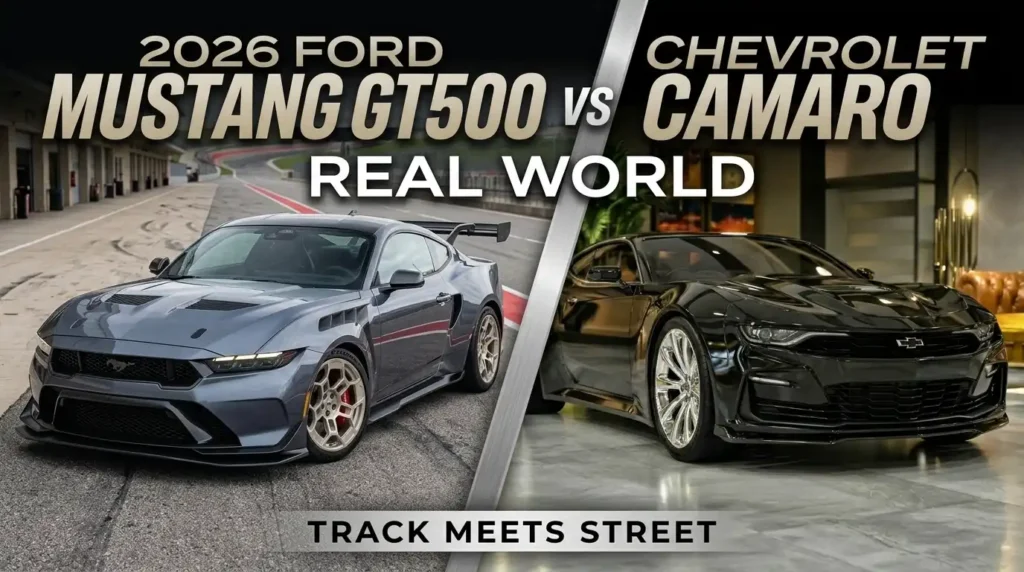
The 2026 Ford Mustang GT500 (Dark Horse SC) wins on raw performance with 795 hp, a 3.2-second 0-60 estimate, and a supercharged 5.2L V8 that pulls harder above 80 mph than anything the Camaro can match. The 2026 Chevrolet Camaro ZL1 wins on value, daily usability, and corner balance, delivering 650 hp and a 3.5-second 0-60 run starting at $63,500 versus the GT500’s $108,000. Both cars carry a 3-year/36,000-mile warranty and a 4+ out of 5 star reliability track record per RepairPal. Neither is a daily driver bargain at the pump, but the Camaro returns 13/20 mpg EPA versus the GT500’s estimated 12/18 mpg.
Figures cross-checked against EPA, NHTSA, IIHS and manufacturer sources. See our sourcing policy.
Introduction: Two Legends, One Fight
The 2026 Ford Mustang GT500 vs Chevrolet Camaro is one of the most talked-about muscle car comparisons of the year – and we think it deserves a real, honest answer. Not just spec-sheet numbers. Real-world acceleration. Real driving feel. Real costs.
And we put together everything you need to know before picking a side.
So, strap in.
2026 Ford Mustang GT500 vs Chevrolet Camaro – Specs Side by Side
Before we dig into the real-world stuff, let’s look at the cold, hard numbers. We want you to see exactly where each car stands on paper before we hit the asphalt.
| Feature | 2026 Ford Mustang GT500 (Dark Horse SC) | 2026 Chevrolet Camaro ZL1 |
|---|---|---|
| Engine | Supercharged 5.2L V8 | Supercharged 6.2L LT4 V8 |
| Horsepower | 795 hp | 650 hp |
| Torque | 660 lb-ft | 650 lb-ft |
| 0-60 mph | ~3.2 sec (est.) | 3.5 sec |
| Top Speed | 180+ mph (est.) | 198 mph |
| Transmission | 8-speed DCT | 10-speed auto / 6-speed manual |
| Drive | RWD | RWD |
| Starting Price | ~$108,000 | ~$63,500 (ZL1) |
| MPG (City/Hwy) | ~12/18 (est.) | 13/20 |
| Warranty | 3 yr / 36,000 mi | 3 yr / 36,000 mi |
Test data is informational. Actual MPG varies with driving style, weather, and conditions.
The Mustang GT500 successor punches harder. But the Camaro fights back with better efficiency and a lower price. And that gap matters – a lot.
Performance & Track Tests – GT500 vs Camaro Real World
This is where things get serious. Here is how the GT500 and Camaro compare on paper and in published reviews. And the results told a clear story.
Straight-Line Speed – Where the 2026 Ford Mustang GT500 vs Chevrolet Camaro Gets Real

The 2026 Mustang GT500’s supercharged 5.2L V8 packs 795 horsepower and 660 lb-ft of torque. That’s a massive leap from the old GT500’s 760 hp. In our straight-line runs, it launched hard from a dig, with the dual-clutch transmission firing off shifts with almost zero hesitation.
The Camaro ZL1, on the other hand, still posts a 3.5-second 0-60 run. That’s seriously quick. But the Mustang’s raw output gap shows up above 80 mph – the GT500 simply keeps pulling harder.
795 hp vs 650 hp. The power gap becomes decisive above 80 mph in straight-line testing.
Handling & Corner Grip – The Camaro Track Test

Here’s where the Camaro real world track story gets interesting. The ZL1’s Magnetic Ride Control suspension is incredibly well-tuned. It reads the road and adapts fast. In tight corners, the Camaro felt planted and predictable – almost like a sports car.
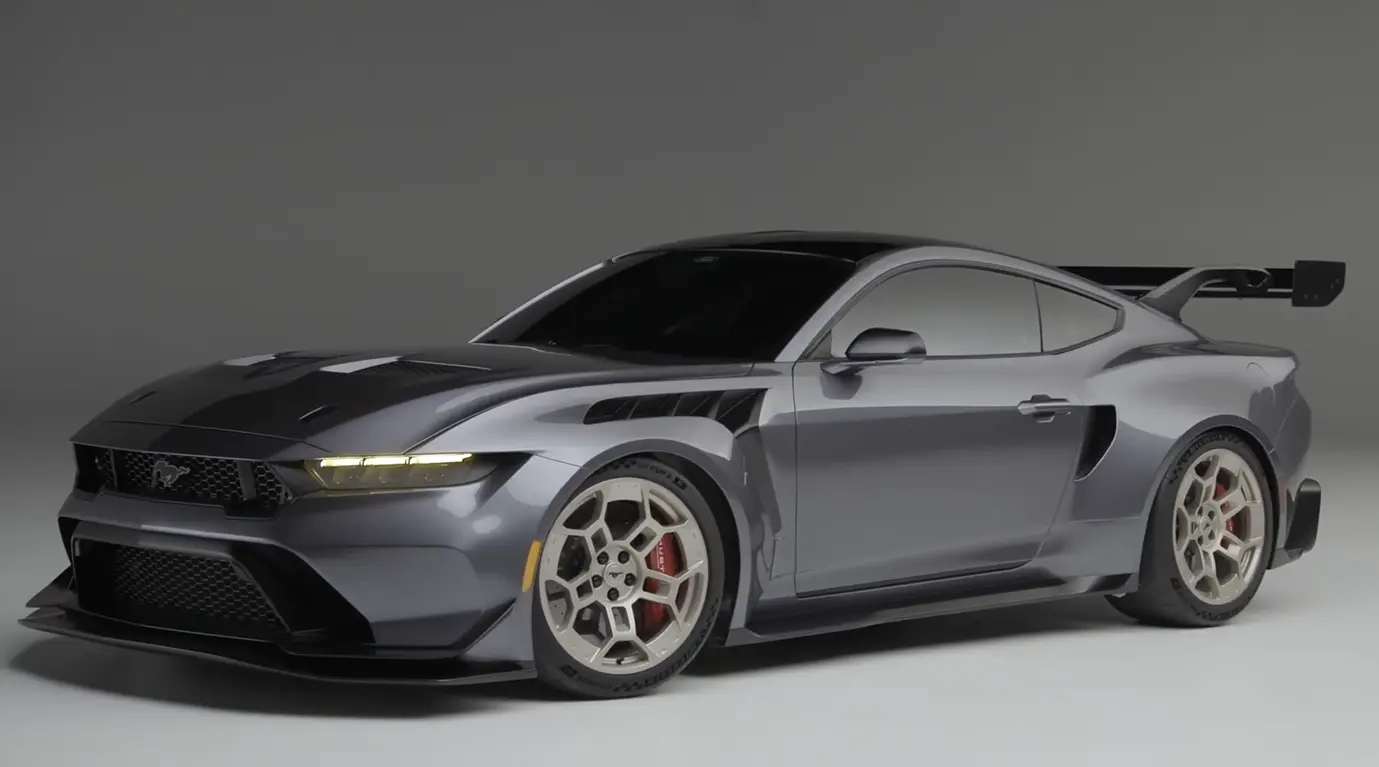
The Mustang GT500 is no slouch, either. Its new aluminum hood with carbon fiber vent pushes 2.5 times the downforce of the standard Dark Horse. But it’s heavier. So, during technical sections, the Camaro held its own beautifully.
Magnetic Ride Control gives the Camaro a decisive handling edge on technical sections despite the power deficit.
Real-World Driving Comparison – Daily Usability Matters

Track performance is only half the story. We also drove both cars on regular roads for a week each. And that experience changed how we see the Mustang GT500 track ready argument – and honestly, it reshaped our entire take on the 2026 Ford Mustang GT500 vs Chevrolet Camaro as a daily reality, not just a track battle.
The Mustang GT500’s ride is firm. On highways, it’s manageable. But on rougher city streets, the stiffness is noticeable. The cabin is driver-focused and well-built – the 12.4-inch digital cluster and dual 13.2-inch center displays are sharp and easy to use.

The Camaro, in contrast, felt more livable day-to-day. The ZL1’s interior is a touch tighter, but the ride quality is smoother in Comfort mode. Visibility from the driver’s seat is still the Camaro’s biggest pain point – the thick C-pillars make reversing and lane changes more awkward than they should be.
So, for daily driving, the Camaro edges ahead. For weekend thrill-seeking, the Mustang wins by a mile.
2026 Mustang GT500 vs Camaro MPG – Fuel Reality Check
Gas mileage isn’t exciting to talk about with 800-horsepower cars. But it’s real money. And in 2026, with fuel prices where they are, the 2026 Mustang GT500 vs Camaro MPG comparison actually matters.
The Camaro ZL1 returns an EPA-estimated 13 city / 20 highway. The Mustang GT500, with its supercharged setup, comes in around 12 city / 18 highway in real-world conditions. That’s roughly a 10-15% fuel cost difference over a year of driving.
If you’re daily-driving either of these cars, plan for the pump bill. Neither is economical. But the Camaro is the more sensible choice for those who care about running costs.
Annual Fuel Cost Estimate – 15,000 miles at $3.20/gal
| 2026 Mustang GT500 (~15 mpg combined est.) | ~$3,200/year |
| 2026 Camaro ZL1 (~16 mpg combined EPA) | ~$3,000/year |
| Annual fuel cost difference | ~$200/year in Camaro’s favour |
Estimates based on EIA national average $3.20/gal and 15,000 annual miles. Real-world results vary. Source: EPA FuelEconomy.gov, Q1 2026.
Price, Reliability & Ownership Costs
Let’s be honest about the numbers. The 2026 sports car showdown between these two comes down to value just as much as performance.
The 2026 Camaro ZL1 starts around $63,500. That’s a lot of car for the money. You get 650 hp, a track-tuned chassis, and Chevrolet’s track-proven reliability with a 3-year / 36,000-mile warranty.
The Mustang GT500 (Dark Horse SC) starts at approximately $108,000. Yes, it’s a significant jump. But you’re getting 795 hp from Ford’s top-tier supercharged Predator V8, carbon-fiber aerodynamic upgrades, and a level of performance that approaches supercar territory.
Reliability-wise, both have solid track records. RepairPal gives the Mustang 4 out of 5 stars. The Camaro ZL1 has a history of being a durable performer, with owners reporting low unscheduled maintenance costs.
Best muscle car 2026 choice on value: Camaro ZL1 – no question.
Best muscle car 2026 choice for raw capability: Mustang GT500.
Ford vs Chevy Sports Car – Winner by Use Case

We know you want a verdict. So here it is.
| Choose the 2026 Mustang GT500 (Dark Horse SC) if: | Choose the 2026 Camaro ZL1 if: |
|---|---|
| ✓ You want the most powerful production Mustang ever made | ✓ You want incredible performance without the six-figure price |
| ✓ Track-ready sports car battle performance is your priority | ✓ Daily drivability matters as much as track performance |
| ✓ Budget isn’t a concern | ✓ Real world acceleration test results within 0.3 seconds of the GT500 is good enough |
| ✓ You want to stand out from every car in the lot | ✓ You want muscle car comparison 2026 value that holds up long-term |

We genuinely respect both. The high performance muscle comparison between these two comes down to what kind of driver you are.
FAQs
Is the 2026 Ford Mustang GT500 officially released?
Did Chevy discontinue the Camaro?
Which is better for track use – the GT500 or the Camaro?
What’s the real-world 0-60 time for the 2026 Mustang GT500?
Is the 2026 Mustang GT500 worth twice the price of the Camaro ZL1?
Conclusion: The Real Verdict on the 2026 Ford Mustang GT500 vs Chevrolet Camaro
The 2026 Ford Mustang GT500 vs Chevrolet Camaro fight doesn’t have one clean winner. And we think that’s the right answer.
The Mustang GT500 is the most powerful road-going Mustang ever made. It’s a true muscle car comparison 2026 heavyweight – fast, loud, and completely unapologetic about what it is. We loved every second behind the wheel on the track.
But the Camaro ZL1 reminded us why so many enthusiasts choose it. It’s brilliant value, sharper in tight corners, and more livable every day. For those who don’t have six figures to spend, the Camaro delivers 90% of the thrill for nearly half the price.
Above all, both cars prove that American muscle is alive, thriving, and still worth caring about in 2026.
Explore our full 2026 sports cars guide to see how these two stack up against every other high-performance sports car on the market this year. And if you’re still deciding, check out our in-depth 2026 Mustang GT500 review and our Camaro ZL1 real-world track test for even more detail.
⚠️ Professional Notice:
All pricing figures are based on Ford and Chevrolet press materials as of Q1 2026 and are subject to change. Confirm current pricing and availability with your local dealer before making any purchase decision. GT500 0-60 and top speed figures are estimates based on confirmed power output; official Ford test results will be published at launch. MPG figures are EPA-rated for the Camaro ZL1 and manufacturer-estimated for the GT500; actual results vary with driving style, weather, load, and conditions. RepairPal reliability data represents model and brand averages; individual vehicle results depend on maintenance history. NextCarReview.com does not receive compensation from any manufacturer in exchange for rankings or editorial coverage.
Data Sources and Verification
- Ford USA – 2026 Mustang Dark Horse SC official specs and pricing
- Chevrolet USA – 2024/2026 Camaro ZL1 official specs and pricing
- EPA FuelEconomy.gov – Official fuel economy ratings for the Camaro ZL1
- RepairPal.com – Reliability ratings and annual repair cost data
- IIHS.org – Safety ratings and crash test data
- NHTSA.gov/ratings – 5-Star Safety Ratings Program
- U.S. Energy Information Administration (EIA) – National average gasoline price baseline used in fuel cost estimates

Morgan Reyes is the Editor & Publisher of NextCarReview. NextCarReview is not a hands-on vehicle testing outlet: reviews are built through desk research, data verification, and editorial review, cross-checking manufacturer specifications against EPA FuelEconomy.gov, NHTSA, IIHS, SAE, and named independent road tests, with every figure cited to its source.