
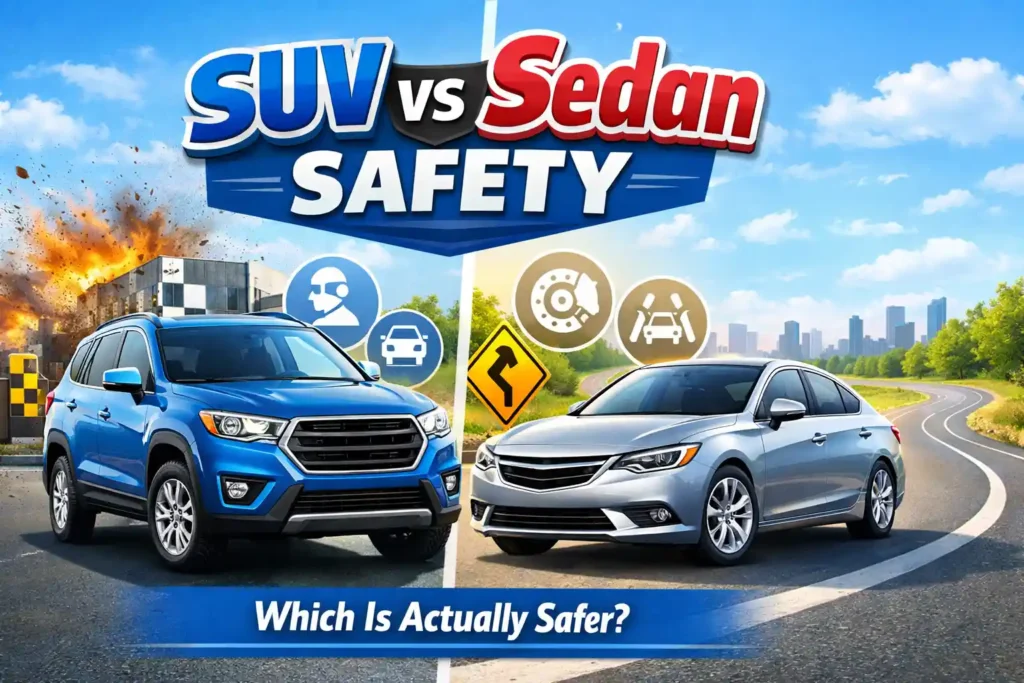
Choosing between a bulky SUV and a sleek sedan is a big decision for your family. While SUVs offer size and height, sedans sit lower and resist rollovers better. This guide compares crash tests, rollover risks, and modern tech to help you pick the safest ride for 2026. Explore the facts before you buy.
When you walk onto a car lot, you see two main choices. You see tall, rugged SUVs and low, smooth sedans. Naturally, you might wonder about SUV vs Sedan Safety. Many people think bigger is always better. However, safety is more than just size.
Modern cars are smarter than ever before. In 2026, both types of vehicles use amazing technology to protect you. But they protect you in different ways. Some cars help you avoid a crash. Others protect you better once a crash happens. Therefore, understanding these differences is key.
In this blog, we will look at how each car handles the road. We will talk about weight, height, and how they flip. Most importantly, we will help you decide which one fits your life. Let’s get startedto the world of vehicle safety.
SUV vs Sedan Safety: The Battle of Size and Weight
Size plays a huge role in a crash. Generally, a heavier vehicle pushes a lighter one back. This is basic physics. Because SUVs are heavier, they often fare better in head-on collisions with smaller cars.
But weight is a double-edged sword. A heavy SUV can need more distance to stop. Tires and brakes matter a lot, but a lighter sedan often stops in a shorter distance. That is to say, the sedan might avoid the hit entirely. Meanwhile, a heavier vehicle carries more momentum.
Why Weight Matters in a Crash
When two objects hit, the bigger one usually “wins.” This is why safety suv vs sedan talks always mention mass. In a multi-car accident, the SUV’s frame acts like a shield. However, if an SUV hits a wall, its own weight can actually work against it.
The Sedan’s Secret Weapon: Agility
Sedans are lower to the ground. This gives them a lower center of gravity. As a result, they handle corners much better. If a deer jumps in front of you, a sedan can swerve quickly. An SUV might feel tippy during that same move.
Sedan vs SUV Safety: Understanding Rollover Risks
One major worry for SUV drivers is rolling over. Because SUVs are tall, they are “top-heavy.” This means they can tip over more easily than a flat sedan.
The Danger of Being Tall
If you turn too sharply in a tall vehicle, the weight shifts to one side. In the past, this was a huge problem for safety sedan vs suv comparisons. Today, electronic stability control (ESC) helps a lot. But even with tech, the laws of physics still apply.
Are Sedans Safer from Flips?
Generally, yes. NHTSA rollover ratings usually favor low sedans over tall SUVs. Their weight is spread out low and wide. Therefore, they stay glued to the road during emergencies. If you live in an area with many curvy roads, a sedan might feel more secure.
Compact SUV vs Sedan Safety: Is Smaller Better?
Many people love “crossovers” or compact SUVs. But how does compact suv vs sedan safety compare? These smaller SUVs are built on car frames. This makes them a mix of both worlds.
- Visibility: You sit higher in a compact SUV. This helps you see traffic ahead.
- Stability: Many sit lower than big SUVs, which can help rollover resistance.
- Protection: They usually have the same safety tech as a midsize sedan.
In short, a compact SUV gives you the “look” of a truck but the feel of a car. Likewise, a midsize sedan offers similar interior space but stays lower to the ground.

Are Sedans Safer Than SUVs?
In some important ways, yes. A sedan sits lower, so its centre of gravity is lower and its rollover risk is far smaller. It also stops and swerves better, which means it avoids more crashes in the first place.
Crash avoidance is the part buyers underrate. A car that brakes shorter and changes direction faster gets out of trouble a taller vehicle cannot. So a sedan can be the safer choice even though it would lose a head on collision with a heavier SUV.
The decisive factor is the specific vehicle, not the shape. A top rated midsize sedan will protect you better than a poorly rated small SUV, and both categories contain award winners and cars that fall short.
So the fair answer is this. Sedans win on rollover risk and accident avoidance. SUVs win on mass in a two vehicle crash. Pick the individually well rated vehicle in whichever shape suits your life.
Are Crossovers Safer Than Sedans?
Crossovers sit between the two, and closer to sedans than most people assume. That is because a crossover is built on a car platform with a unibody structure rather than on a truck frame.
The practical result is that a crossover crumples and absorbs energy much like a car does. It is also lighter and lower than a body on frame SUV, so it handles more like a sedan while still giving you the higher seating position buyers want.
Rollover risk is the real difference. A crossover is taller than a sedan, so its rollover risk is higher, but electronic stability control has been required on new US light vehicles since the 2012 model year and has cut rollover deaths dramatically across every tall vehicle class.
So a modern crossover is a sensible middle ground. You give up a little of the sedan’s agility and gain a little mass and visibility, and with stability control the old rollover objection is much weaker than it was.
Are SUVs or Cars Safer?
On average, SUVs come out ahead in IIHS driver death rate statistics, and mass is a major reason. In a collision between two vehicles, the heavier one protects its occupants better. That is physics and no safety feature changes it.
However, the gap has narrowed sharply. Stability control, side curtain airbags and modern structural design arrived across all classes, and they removed most of the rollover penalty that once made tall vehicles dangerous.
The clearest pattern in the data is not SUV against car at all. It is size. The smallest and lightest vehicles have the highest driver death rates, and the largest and heaviest have the lowest, whichever body style they wear.
Most importantly, body style is now a weaker predictor than the individual vehicle’s ratings. Check the crash test results and the standard driver assistance list for the exact model and trim, because that tells you far more than the category name.
2026 Safety Comparison Table
| Feature | Sedan | SUV | Winner |
| Rollover Risk | Very Low | Moderate | Sedan |
| Braking Distance | Often shorter | Often longer | Sedan (varies) |
| Crash Protection | Depends on size and rating | Mass helps in 2-vehicle crashes | SUV (varies) |
| Visibility | Low | High | SUV |
| Fuel Economy | Usually higher | Usually lower | Sedan |
| Cargo Space | Limited | High | SUV |
Which SUV is Safest in a Crash?
If you decide an SUV is for you, you must pick the right one. Not all are created equal. Specifically, the safest midsize suv models now include features like “side-curtain airbags” that cover all three rows.
The Safest Small SUV Options
Small SUVs are very popular in 2026. Models from brands like Volvo, Mazda, and Subaru frequently earn IIHS awards. They use high-strength steel to keep the cabin from crushing.
Top Safety Rated SUV Features
- Automatic Emergency Braking: The car stops itself if it sees a crash coming.
- Lane Keep Assist: The car nudges you back if you drift.
- Blind Spot Monitoring: Lights flash if a car is hiding next to you.
Are SUVs Safer than Sedans for Long Drives?
Many families ask: suv vs sedan for long drive? On a long trip, fatigue is a safety issue.
Firstly, SUVs offer more room. You don’t feel “squished,” which keeps you relaxed. Secondly, the high seating position reduces eye strain. You can see over the car in front of you.
On the other hand, sedans are quieter. Less wind noise means a more peaceful drive. Also, they use less gas. This means fewer stops at busy gas stations. Most importantly, take regular breaks, whatever you drive.

The Myth of Being “Invincible” in an SUV
Some people drive faster because they feel safe in a big car. This is a mistake. In fact, are suvs safer than cars depending entirely on the driver.
If you drive an SUV too fast, you increase your risk of a rollover. , because you are high up, you might not realize how fast you are actually going. In other words, never let the size of your vehicle make you a careless driver.
Safest Sedans: Why They Still Win Awards
Don’t count the sedan out yet! The safest sedans of 2026 are masterpieces of engineering. Many offer the same driver assistance features found in SUVs.
Crossover vs Sedan: The New Rivalry
Many people are switching to crossovers. However, both sedans and crossovers can score well in IIHS “small overlap” tests. This is when only a corner of the car hits something. Check each model’s results.
Conclusion: Making Your Final Choice
When looking at SUV vs Sedan Safety, there is no single “winner.” It depends on what you value most.
If you want the best protection in a multi-car pileup, an SUV is a strong choice. But if you want to avoid the crash in the first place, a sedan is often better. Most importantly, look for “Top Safety Pick” ratings from the IIHS.
Ultimately, the safest vehicle is the one you feel most comfortable driving. Always take a test drive. Check the visibility. Practice a quick stop. The bottom line, both SUVs and sedans are safer today than ever before.

Related guides: other model vs model matchups and 2024 Ferrari 296 GTS.
FAQs
Is an SUV vs Sedan Safety better for new drivers?
Are sedans more likely to be crushed in a crash with a truck?
Do SUVs have better brakes than sedans?
Why do people think SUVs are the safest choice?
Which is better for driving in heavy rain or snow?
For official rules, ratings and consumer guidance on this topic, see:
Sources
- IIHS: passenger vehicle occupant fatality facts
- IIHS: vehicle ratings and awards
- NHTSA: 5-Star Safety Ratings, including rollover
- NHTSA: Federal Motor Vehicle Safety Standards (FMVSS 126, stability control)

Morgan Reyes is the founder and editor-in-chief of NextCarReview, which Morgan launched in August 2024. A 2022 graduate of Columbia University, Morgan is based in New York and writes and edits the site’s reviews, comparisons and buying guides. Morgan does not road-test vehicles. Every article is built from published primary data: EPA FuelEconomy.gov ratings, NHTSA crash ratings, recalls and owner complaints, IIHS results, and manufacturer specifications and pricing, with each figure cited and checked before publication. Contact: admin@nextcarreview.com


