
In this article 11 sections
P1778 on a Nissan means the CVT transmission is not achieving the pulley ratio the TCM is commanding. The step motor that controls the ratio valve is often blamed, but transmission specialists say it is one of the most over-replaced parts in Nissan CVTs. The real cause is usually valve body wear or internal CVT damage. Repair costs range from $35 for a DIY step motor swap to $3,500 to $8,000 for a full CVT replacement. Nissan extended the CVT warranty to 10 years or 120,000 miles on 2003 to 2010 models, and to 84 months or 84,000 miles on many 2012 to 2019 models, though most of that coverage has now expired.
Sources: NHTSA TSB SB-10038184-2435, Gears Magazine CVT analysis, Nissan CVT warranty extension records, CostHack. See our sourcing policy.
What Does P1778 Mean on a Nissan?
What Does P1778 Mean on a Nissan: Quick Diagnostic Intelligence
P1778 is a Nissan-specific code defined as Step Motor Function. It is set when the TCM (Transmission Control Module) detects that the CVT pulley ratio does not match the commanded ratio. The CVT uses a step motor to control a ratio valve inside the valve body. The step motor rotates in 1/12-turn increments to move the valve, which adjusts hydraulic pressure to the primary and secondary pulleys. The TCM monitors the actual ratio through input and output speed sensors and compares it to the commanded position. When there is a significant discrepancy, P1778 is stored and the check engine light turns on.
An important distinction: P1778 indicates a ratio discrepancy, not necessarily a bad step motor. According to Gears Magazine, the step motor is “one of the most over-replaced parts in these CVTs.” The Nissan factory manual lists only the step motor as a possible cause, which drives unnecessary replacements. In many cases the real problem is valve body wear, pulley leaks, or a sticky ratio control valve inside the transmission.
Common Causes Ranked by Repair Cost
These are the most common causes of P1778 on Nissan vehicles, listed from least expensive to most expensive. The step motor is the easiest part to replace but is often not the root cause.
| Cause | Typical Cost | How Common |
|---|---|---|
| Low or contaminated CVT fluid | $100 to $250 (drain and fill) | Common, check first |
| Faulty step motor | $35 to $100 DIY, $230 to $900 at shop | Over-diagnosed, often not the real cause |
| Wiring or connector damage to step motor | $100 to $300 | Less common, check if P1777 also present |
| TCM reprogramming needed | $100 to $200 | Required after some repairs |
| Valve body wear or damage | $600 to $1,000 | Very common actual root cause |
| TCM replacement | $500 to $1,200 | Uncommon |
| CVT rebuild | $2,500 to $5,000 | When internal damage is extensive |
| CVT replacement | $3,500 to $8,000 | Last resort, often recommended by dealers |
Why the Step Motor Gets Blamed When It Should Not
The Nissan factory service manual lists the step motor as the primary cause of P1778. This leads many shops to replace the motor first. But transmission specialists who rebuild Jatco CVTs daily report that the step motor is rarely the actual problem. The real culprits are worn flow control valves in the valve body, leaking pulley seals, and a sticky or damaged ratio control valve. These internal issues prevent the pulleys from reaching the commanded ratio even when the step motor is functioning correctly.
Before authorizing a step motor replacement, ask the shop to bench test the old motor. A good step motor shows approximately 15 ohms between adjacent pins and 30 ohms across each winding pair on a multimeter. If those readings are within spec, the motor is not the problem and replacing it will not fix P1778.
Nissan CVT Warranty Extensions for P1778
Nissan has extended the CVT warranty multiple times due to widespread transmission failures. If your vehicle is covered, the repair may cost you nothing at an authorized Nissan dealer.
| Models Covered | Extended Coverage | What Year It Was Announced |
|---|---|---|
| All 2003 to 2010 Nissan CVT vehicles | 10 years or 120,000 miles | Original extension |
| 2012 to 2017 Versa, 2014 to 2017 Versa Note, 2013 to 2017 Sentra, 2013 to 2016 Altima, plus Juke | 84 months or 84,000 miles | Class action settlements |
| 2014 to 2018 Rogue, 2015 to 2018 Pathfinder, 2015 to 2018 QX60 | 84 months or 84,000 miles | 2021 settlement |
The extended coverage applies to the CVT assembly and its control unit, transfers to later owners, and is measured from the original in-service date, so most of it has run out by 2026. The 2017-2018 Altima and 2018-2019 Sentra, Versa and Versa Note got a similar 84-month extension under the Martinez settlement. Owners who already paid for qualifying CVT repairs may be eligible for reimbursement from Nissan.
Which Nissan Models Get P1778 Most Often?

P1778 affects nearly every Nissan model equipped with a Jatco CVT. The 2007 to 2014 model years have the highest concentration of reports.
| Model | Peak Years | CVT Type |
|---|---|---|
| Altima (4-cylinder) | 2007 to 2018 | JF011E and JF015E |
| Sentra | 2007 to 2019 | JF015E and JF011E |
| Rogue | 2008 to 2018 | JF011E |
| Murano | 2003 to 2014 | JF010E and JF011E |
| Maxima | 2007 to 2015 | JF010E and JF011E |
| Versa | 2007 to 2019 | JF011E and JF015E |
| Pathfinder | 2013 to 2018 | JF011E |
| Juke | 2011 to 2017 | JF015E |
Class action lawsuits have been settled covering the 2013 to 2018 Altima, 2014 to 2018 Rogue, 2013 to 2019 Sentra, 2012 to 2019 Versa, 2015 to 2018 Pathfinder, and the Juke. NHTSA has not ordered a recall for these CVT failures.
How to Diagnose P1778 on a Nissan

P1778 diagnosis requires more than just reading the code. The key is determining whether the step motor is actually at fault or whether the problem is deeper inside the CVT.
Step 1: Scan for All Codes
Use a scanner that reads manufacturer-specific codes. Check for P1778 and related codes. P1777 (Step Motor Circuit) points to a wiring or connector issue and should be diagnosed first. P0720 indicates an output speed sensor problem. P0868 (low line pressure) suggests internal CVT damage or low fluid.
Step 2: Check CVT Fluid Level and Condition
The fluid should be translucent red or pink. Dark brown fluid or a burnt smell indicates internal damage that a step motor replacement will not fix. Nissan CVTs require NS-2 or NS-3 fluid depending on the model year. Using standard automatic transmission fluid will damage the CVT.
Step 3: Inspect Wiring and Connectors
Check the step motor connector on the valve body area of the CVT for corrosion, damaged pins, or chafed wiring. A wiring issue is more likely if P1777 appears alongside P1778.
Step 4: Bench Test the Step Motor
Measure resistance between adjacent pins on the step motor connector with a multimeter. A good motor reads approximately 15 ohms between adjacent pins and 30 ohms across each winding pair. Out-of-spec readings confirm motor failure. If the readings are within spec, the step motor is not the problem.
Step 5: Check TSB Applicability
If your vehicle matches TSB AT10-009c (2010 Maxima, Murano, Altima V6) or TSB NTB10-150 (2010 Altima, Rogue, Sentra), the repair procedure centers on valve body replacement and TCM reprogramming or initialization, not just a step motor swap. Check warranty extension eligibility before paying out of pocket.
NHTSA Technical Service Bulletins
Nissan has issued several TSBs that directly address P1778 and CVT step motor issues.
TSB AT10-009c (also numbered NTB11-002c, November 2013) covers the 2010 Nissan Maxima, Murano, and Altima V6. The bulletin addresses P1778 with slow acceleration from a stop. It calls for TCM reprogramming on the Maxima and Murano and valve body replacement when diagnosis points to it, while the V6 Altima needs only TCM initialization. The NHTSA document number is SB-10038184-2435.
TSB NTB10-150a (November 2013) covers the 2010 Nissan Altima, Rogue, and Sentra with P1778 stored, or P0720 on Sentras without ABS. The repair is valve body replacement with TCM reprogramming.
Repair Cost Breakdown
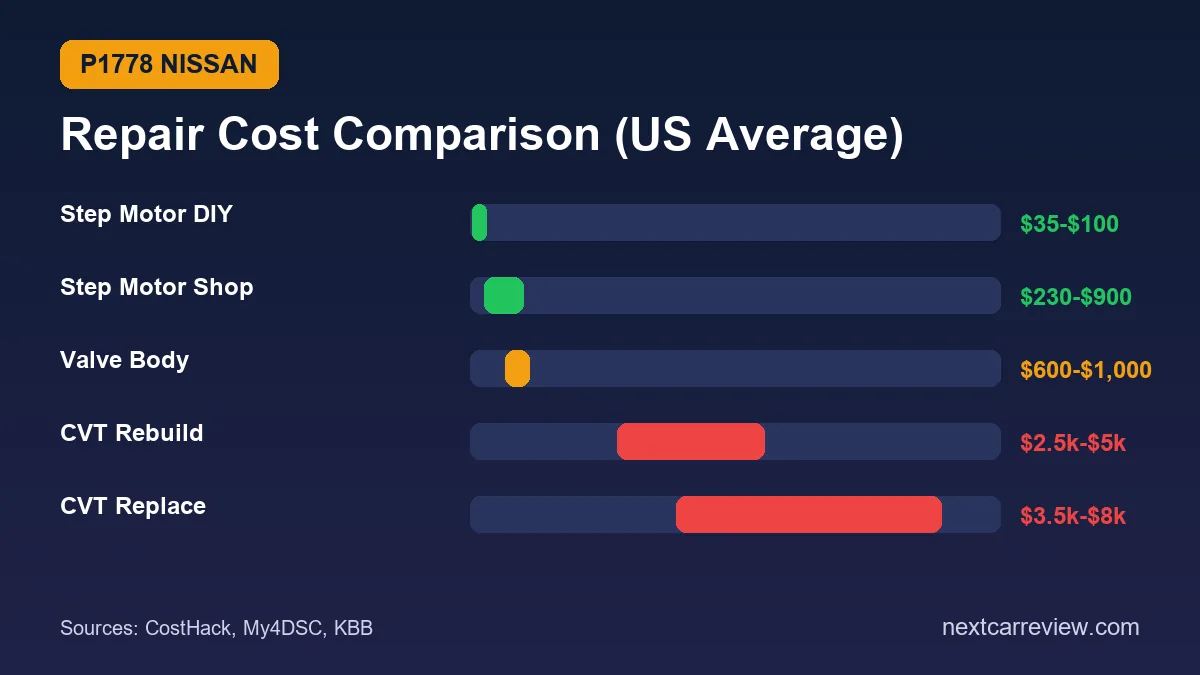
P1778 repair costs vary enormously depending on the actual root cause. Getting an accurate diagnosis before authorizing work can save thousands of dollars.
| Repair | Parts | Labor | Total |
|---|---|---|---|
| Step motor replacement (DIY) | $30 to $100 | $0 | $35 to $100 |
| Step motor replacement (shop) | $30 to $300 | $200 to $600 | $230 to $900 |
| Valve body replacement | $300 to $500 | $300 to $500 | $600 to $1,000 |
| CVT rebuild (independent) | Included | Included | $2,500 to $4,000 |
| CVT replacement (remanufactured) | $2,000 to $3,500 | $1,500 to $2,000 | $3,500 to $5,500 |
| CVT replacement (new from dealer) | $2,500 to $5,000 | $1,500 to $3,000 | $4,000 to $8,000 |
Common OEM step motor part numbers include 203452A for the JF011E transmission found in 2009 to 2012 Altima, 2009 to 2012 Rogue, and 2007 to 2012 Sentra. Aftermarket alternatives from brands like Dorman are available for $30 to $60. Many dealerships will not replace just the step motor and instead recommend the full valve body or CVT replacement.
Is It Safe to Drive With P1778?
P1778 is a medium severity code. It is not immediately dangerous in most cases, but continued driving carries significant risks. The CVT may slip, causing RPMs to spike without corresponding acceleration. The transmission can enter limp mode and limit speed to 25 to 30 miles per hour, which is dangerous at highway speeds. Belt slippage from ratio control failure generates excessive heat that can destroy the CVT belt and pulleys.
Stop driving immediately if you notice transmission shuddering or violent jerking, a burning smell from the transmission area, or if the vehicle will not move in Drive or Reverse. These symptoms indicate the CVT is failing and continued driving will cause catastrophic damage. Get to a repair shop within days, not weeks. Continuing to drive with P1778 can turn a $500 valve body repair into a $4,000 to $8,000 transmission replacement.
Frequently Asked Questions About P1778 on Nissan
Is P1778 always a CVT failure?
Should I replace the step motor first since it is cheaper?
Is my Nissan CVT covered under the extended warranty?
What CVT fluid does my Nissan require?
Can I get reimbursed if I already paid for a CVT repair?
What is the difference between P1777 and P1778?
⚠️ Professional Notice:
This guide covers P1778 as it applies to Nissan vehicles with CVT transmissions. The information is based on Nissan TSBs, NHTSA records, transmission specialist publications, and published repair data. NextCarReview did not diagnose or repair vehicles for this article. Always confirm diagnosis with a qualified technician before authorizing repairs.
Cost figures are published estimates and vary by vehicle, region and shop. Always get a written quote before authorizing a repair. NextCarReview.com does not receive compensation from any parts manufacturer, retailer, dealer or repair chain for editorial coverage.
Data Sources and Verification
- NHTSA Technical Service Bulletin SB-10038184-2435 (TSB AT10-009c / NTB11-002c) for 2010 Maxima, Murano, and Altima V6
- NHTSA CVT warranty extension documents MC-10176204-0001, MC-10218703-0001, and MC-10246457-0001
- Nissan TSB NTB10-150a (2010 Altima, Rogue, Sentra) and Martinez v. Nissan settlement
- Gears Magazine analysis of Jatco CVT step motor misdiagnosis rates
- CostHack and My4DSC for US repair cost estimates
- Nissan class action settlement records for 2013 to 2019 CVT-equipped models
For official rules, ratings and consumer guidance on this topic, see:
More trouble code guides: All car trouble code guides by make, P0744 Code on Nissan, P0335 Code on Nissan.

Morgan Reyes is the founder and editor-in-chief of NextCarReview, which Morgan launched in August 2024. A 2022 graduate of Columbia University, Morgan is based in New York and writes and edits the site’s reviews, comparisons and buying guides. Morgan does not road-test vehicles. Every article is built from published primary data: EPA FuelEconomy.gov ratings, NHTSA crash ratings, recalls and owner complaints, IIHS results, and manufacturer specifications and pricing, with each figure cited and checked before publication. Contact: admin@nextcarreview.com