
In this article 12 sections
P0744 on a Nissan means the torque converter clutch is engaging and disengaging erratically inside the CVT. Unlike traditional automatics, Nissan CVTs lock the torque converter early and keep it locked during most driving. When that lockup becomes intermittent, the resulting friction heat starts a cycle that degrades CVT fluid and can destroy the transmission.
Nissan CVT torque converter codes verified against Jatco service data and NHTSA TSB filings. See our sourcing policy.
What Does P0744 Mean on a Nissan?
What Does P0744 Mean on a Nissan: Quick Diagnostic Intelligence
P0744 stands for Torque Converter Clutch Circuit Intermittent. On Nissan vehicles equipped with a Jatco CVT (continuously variable transmission), the torque converter works primarily as a launch device to get the vehicle moving from a stop. Once moving, the CVT belt or chain system handles ratio changes. The torque converter clutch locks up early and stays locked during most driving to reduce heat and improve fuel economy.
The Transmission Control Module (TCM) monitors slip speed, which is the difference between engine RPM and transmission input RPM. P0744 triggers when slip speed stays above a calculated threshold for a set time while the TCM is commanding lockup. The exact thresholds vary by transmission and are listed in Nissan service information.
This code is more serious on Nissan CVTs than on traditional automatics. Intermittent lockup generates friction heat, and Nissan CVTs are extremely heat-sensitive. The heat degrades the CVT fluid, which causes more slippage, which generates more heat. This vicious cycle can lead to complete CVT failure if ignored.

Which Nissan Models Get P0744 Most Often?
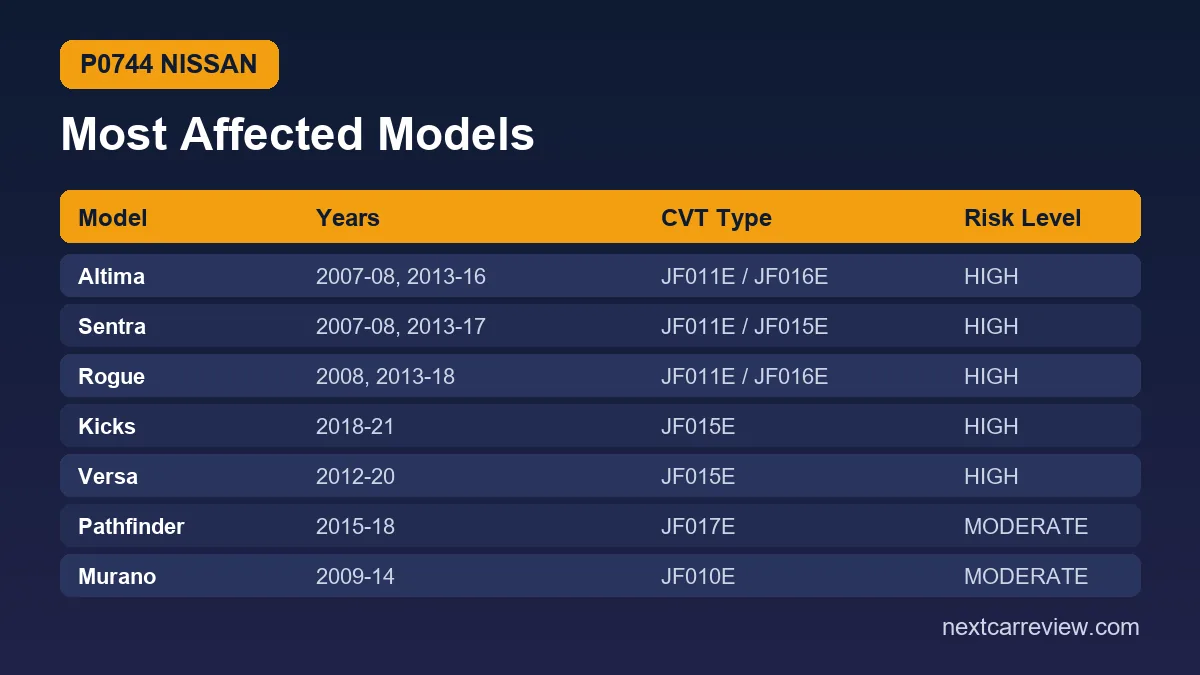
P0744 appears most frequently on Nissan models equipped with the smaller Jatco CVT units. The Altima, Sentra, Rogue, Kicks, and Versa lead in reported cases. Peak failure years are 2007 to 2008 and 2013 to 2018, which align with the first and second generation Jatco CVT designs.
| Model | Years Most Affected | CVT Type (Jatco) | Frequency |
|---|---|---|---|
| Nissan Altima | 2007-2008, 2013-2016 | JF011E, JF016E | High |
| Nissan Sentra | 2007-2008, 2013-2017 | JF011E, JF015E | High |
| Nissan Rogue | 2008, 2013-2018 | JF011E, JF016E | High |
| Nissan Kicks | 2018-2021 | JF015E | High |
| Nissan Versa / Versa Note | 2012-2020 | JF015E | High |
| Nissan Pathfinder | 2015-2018 | JF017E | Moderate |
| Nissan Murano | 2009-2014 | JF010E | Moderate |
| Nissan Maxima | 2007-2008 | JF011E | Moderate |
| Nissan Juke | 2013-2017 | JF015E | Moderate |
Common Causes of P0744 on Nissan CVTs
The causes below are ranked by how often each one triggers P0744 on Nissan vehicles, based on TSB data, NHTSA complaints, and technician reports from transmission specialty shops.
1. CVT Fluid Degradation (About 40% of Cases)
Degraded CVT fluid is the single most common cause. Nissan CVT fluid breaks down faster than conventional automatic transmission fluid, especially under heat stress. Dark, burnt-smelling fluid loses the friction properties needed for reliable torque converter lockup. Many owners skip CVT fluid service entirely, even under severe-duty driving. Using the wrong fluid specification is also a major trigger.
2. Valve Body Wear (About 25% of Cases)
Jatco CVT valve bodies have bores that are prone to premature wear. Worn bores cause internal fluid pressure loss, which leads to inconsistent torque converter clutch engagement. Nissan bulletin NTB09-148a calls for control valve replacement when P0744, P0840, P0845 or P1777 is stored on 2007 to 2008 Altima, Sentra, and Rogue models. Aftermarket rebuild kits with oversized valves are available for this repair.
3. TCC Solenoid Failure (About 15% of Cases)
The torque converter clutch solenoid is integrated into the valve body. Electrical failure or contamination from metal debris in the CVT fluid can cause intermittent operation. On some models, the solenoid is accessible without removing the transmission by dropping the pan.
4. TCM Problems (About 10% of Cases)
The Transmission Control Module can develop software glitches that send erratic lockup commands. Several Nissan warranty extensions specifically include TCM reprogramming as part of the repair. Water intrusion can also damage the TCM, which is often mounted low on the vehicle.
5. Wiring and Connector Issues (About 5% of Cases)
Corroded connectors at the transmission harness, chafed wiring near exhaust components, or poor ground connections can mimic solenoid failure. Always inspect wiring before replacing components.
6. Internal CVT or Torque Converter Failure (About 5% of Cases)
Worn friction material in the torque converter or metal debris from belt and chain wear can contaminate the TCC circuit. At this stage, full CVT replacement is typically required.
NS-2 vs NS-3: The CVT Fluid Mistake That Kills Transmissions
Nissan uses two different CVT fluid specifications, and using the wrong one is a documented cause of P0744.
| Specification | Color | Model Years | Key Detail |
|---|---|---|---|
| NS-2 | Green | 2007-2012 CVTs | Higher viscosity for first-gen Jatco units |
| NS-3 | Blue | Most 2013 and newer CVTs (check manual) | Lower viscosity for redesigned internals |
Some smaller 2013 and newer CVTs still specify NS-2, and the two fluids are not treated as interchangeable. NS-2 should never be used where NS-3 is specified because the newer CVTs require a lower viscosity fluid. Using generic automatic transmission fluid or conventional transmission fluid in any Nissan CVT will cause rapid failure. If you are unsure which fluid your vehicle requires, check the owner’s manual or the label on the CVT dipstick (if equipped).
Is Your Nissan Covered? CVT Warranty Extensions
Nissan has issued multiple CVT warranty extensions across different model years, primarily as a result of class action lawsuit settlements. These extensions specifically cover the torque converter components relevant to P0744. Check your VIN at a Nissan dealership to confirm eligibility.
| Coverage Group | Models | Extended Coverage | Settlement |
|---|---|---|---|
| 2003-2010 models | Altima, Murano, Maxima, others | 10 years / 120,000 miles | Early CVT program (transferable) |
| 2012-2017 cars | Versa, Versa Note, Sentra, Altima (2013-2016), Juke | 84 months / 84,000 miles | Separate Versa/Sentra, Altima and Juke settlements |
| 2014-2018 SUVs | Rogue, Pathfinder, Infiniti QX60 | 84 months / 84,000 miles | Stringer v. Nissan |
| 2017-2019 newer models | 2017-2018 Altima, 2018-2019 Sentra, Versa, Versa Note | 84 months / 84,000 miles | Martinez v. Nissan |
The extensions generally cover the CVT assembly and transmission control unit, and they run from the vehicle’s original in-service date, so the 2003-2010 coverage has ended and most 84-month extensions have expired or are close to expiring. If you already paid out of pocket for a CVT repair on a covered model, you may be eligible for reimbursement by contacting Nissan at 800-867-7669.
Nissan TSBs for P0744
Nissan has issued several Technical Service Bulletins addressing P0744 and related CVT torque converter issues.
| TSB Number | Models Affected | Issue | Fix |
|---|---|---|---|
| NTB09-148a | 2007-2008 Altima, Rogue, Sentra (RE0F10A CVT) | P0744, P0840, P0845 or P1777 stored | Replace control valve assembly, reset TCM data |
| NTB19-040 series (a through H) | 2018-2021 Kicks, 2020-2021 Versa Sedan | P0744 and other CVT DTCs with hesitation and reduced power | Superseded in 2022; P0744 now diagnosed per service manual |
| NTB22-021 | 2018-2021 Kicks, 2020-2021 Versa Sedan | CVT codes such as P0746, P0776, P17F0/P17F1 | Per bulletin procedures |
Always ask the dealership or your technician to check for applicable TSBs before starting diagnosis. A TSB can save hours of diagnostic time and may qualify the repair for warranty coverage.
How to Diagnose P0744 on a Nissan
Follow these steps in order. Each step narrows the possible causes before moving to more expensive diagnostics.
Step 1: Scan for All Codes
Use an OBD-II scanner capable of reading manufacturer-specific codes. Record all stored DTCs, pending codes, and freeze frame data. Pay attention to companion codes because they reveal the scope of the problem. P0744 alone usually points to fluid or solenoid issues. P0744 combined with P0840 or P0845 indicates valve body pressure problems. P0744 with P1778 on 2007 to 2008 models typically means internal CVT failure.
Step 2: Check CVT Fluid Level and Condition
Check fluid at operating temperature per dipstick markings (some models have no dipstick and require a dealer scan tool). Fresh NS-2 fluid is green; fresh NS-3 fluid is blue. Dark brown fluid with a burnt smell means the fluid has broken down. Metal particles on the drain plug magnet indicate internal wear. Milky fluid means coolant contamination, which is a serious problem requiring immediate attention.
Step 3: Check TSBs for Your Model and Year
Look up applicable Technical Service Bulletins before general troubleshooting. If a TSB matches your vehicle, follow its diagnostic flowchart rather than the general procedure below.
Step 4: Test the TCC Solenoid
Locate the TCC solenoid (integrated into the valve body, accessible from the transmission pan on some models). Measure resistance with a multimeter. Compare the reading to the specification in Nissan service information. Apply 12 volts directly to verify the solenoid clicks. Inspect the solenoid screen for metal debris.
Step 5: Check Wiring and Connectors
Inspect the transmission harness connector for corroded pins, bent pins, or damaged locks. Check wiring for chafing near exhaust heat shields. Verify ground connections and measure continuity from the TCM connector to the transmission connector.
Step 6: Road Test With Live Data
Connect a scanner with live data capability. Monitor engine RPM versus transmission input RPM (the difference is slip), TCC solenoid duty cycle, CVT fluid temperature, and line pressure. Drive at a steady 40 mph or higher for at least 30 seconds. Normal operation shows near-zero slip when the TCC is commanded on. Watch for intermittent RPM fluctuations that indicate the TCC is dropping in and out.
P0744 Repair Costs on Nissan
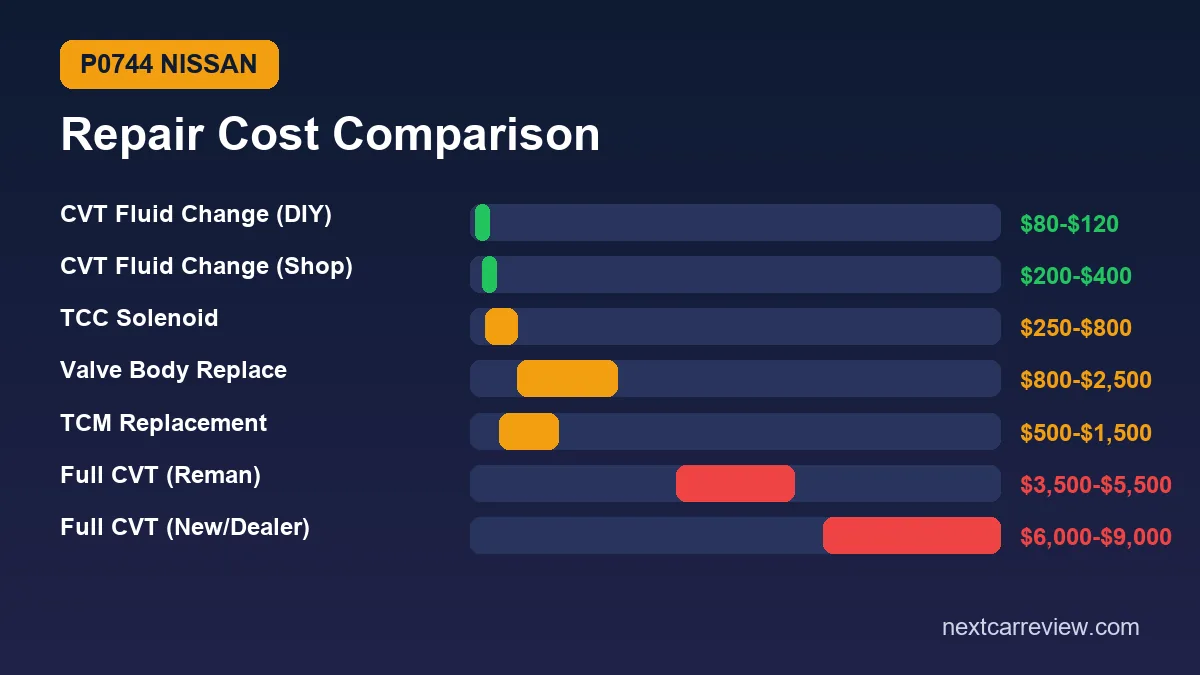
Costs vary significantly depending on the root cause. A CVT fluid change is the least expensive fix and can resolve early-stage cases. Full CVT replacement at a dealer can exceed $8,000. Independent transmission shops typically save $1,000 or more compared to dealer pricing.
| Repair | DIY Cost | Independent Shop | Dealer |
|---|---|---|---|
| CVT fluid drain and fill | $80-$120 | $200-$350 | $250-$400 |
| TCC solenoid replacement | N/A | $250-$600 | $400-$800 |
| Valve body replacement | N/A | $800-$1,500 | $1,200-$2,500 |
| TCM replacement | N/A | $500-$1,000 | $800-$1,500 |
| Full CVT replacement (reman) | N/A | $3,500-$5,500 | $5,000-$7,500 |
| Full CVT replacement (new) | N/A | N/A | $6,000-$9,000 |
Before paying for any repair, check your warranty extension eligibility. Many 2003 to 2019 models received extended CVT coverage, though most has expired by 2026. If you already paid out of pocket for a qualifying repair, file for reimbursement through Nissan.
Can You Drive With P0744?
Minimal driving only. P0744 on a Nissan CVT is not a “monitor and drive” code. Intermittent torque converter lockup generates friction heat that accelerates CVT fluid degradation. Class action lawsuits over Nissan CVTs alleged overheating and shuddering problems, which heat only makes worse. Extended highway driving with an active P0744 code is the fastest path to complete CVT failure. Drive only to the shop for diagnosis.
What Companion Codes Reveal About the Root Cause
The codes stored alongside P0744 provide important diagnostic clues. Here is what common combinations mean on Nissan CVTs.
| Code Combination | Likely Root Cause | Typical Repair |
|---|---|---|
| P0744 alone | CVT fluid degradation or TCC solenoid | Fluid change or solenoid replacement |
| P0744 + P0840/P0845 | Valve body pressure loss | Valve body replacement |
| P0744 + P1777/P1778 | CVT step motor plus TCC failure (07-08) | Internal CVT repair or replacement |
| P0744 + P0741 + P2857-P285A | Factory-defective CVT (Kicks, 2020 Versa) | CVT assembly replacement under warranty |
| P0744 + multiple transmission codes | Electrical failure or major internal damage | Full diagnostic, likely CVT replacement |
Frequently Asked Questions About P0744 on Nissan
What is the most common fix for P0744 on a Nissan?
Does P0744 mean I need a new CVT transmission?
Is there a recall for P0744 on Nissan?
What is the difference between NS-2 and NS-3 CVT fluid?
How does P0744 relate to P1778 on Nissan?
Can I get reimbursed for a P0744 repair I already paid for?
⚠️ Professional Notice:
This guide covers P0744 (Torque Converter Clutch Circuit Intermittent) specifically on Nissan vehicles equipped with Jatco CVTs. While the generic P0744 code applies to all manufacturers, the causes, diagnosis steps, and repair costs described here reflect Nissan CVT-specific failure patterns and Technical Service Bulletins.
Cost figures are published estimates and vary by vehicle, region and shop. Always get a written quote before authorizing a repair. NextCarReview.com does not receive compensation from any parts manufacturer, retailer, dealer or repair chain for editorial coverage.
Data Sources and Verification
- Nissan TSBs NTB09-148a, NTB19-040 series (NTB19-040H), and NTB22-021
- NHTSA TSB filings MC-10246457, MC-10218703, MC-10236629, MC-10176204, MC-10109248
- Martinez v. Nissan North America settlement (2017-2019 Altima, Sentra, Versa) and earlier Versa, Sentra, Altima and Juke settlements
- Stringer v. Nissan North America class action settlement (2014-2018 Rogue, Pathfinder, QX60)
- Nissan Rogue service manual diagnostic procedures for P0744
- RepairPal, KBB, and CVTMechanic.com for current repair cost estimates
- Jatco CVT technical documentation for JF011E, JF015E, JF016E, JF017E specifications
For official rules, ratings and consumer guidance on this topic, see:
More trouble code guides: All car trouble code guides by make, P1778 Code on Nissan, P0335 Code on Nissan.

Morgan Reyes is the founder and editor-in-chief of NextCarReview, which Morgan launched in August 2024. A 2022 graduate of Columbia University, Morgan is based in New York and writes and edits the site’s reviews, comparisons and buying guides. Morgan does not road-test vehicles. Every article is built from published primary data: EPA FuelEconomy.gov ratings, NHTSA crash ratings, recalls and owner complaints, IIHS results, and manufacturer specifications and pricing, with each figure cited and checked before publication. Contact: admin@nextcarreview.com