P0171 on a Ford means the PCM detected a lean air-fuel mixture on Bank 1, after long-term fuel trim reached its limit. A frequently reported fix on Ford 4-cylinder Duratec engines is a cracked PCV elbow under the intake manifold, a $5-$15 part. Ford TSBs cover PCM reprograms for P0171 on some F-150 engines and a PCV hose fuel-odor fix on 2.0L EcoBoost models. P0171 is safe to drive short-term but can damage your catalytic converter if ignored.
Automotive trouble code data compiled from Ford TSBs, NHTSA filings, and manufacturer diagnostic procedures. See our sourcing policy.
What Does P0171 Mean on a Ford?
What Does P0171 Mean on a Ford: Quick Diagnostic Intelligence
P0171 is an OBD-II generic code: “Fuel Injection System Too Lean, Bank 1.” On a Ford, it means the PCM has been adding extra fuel (long-term fuel trim at its limit, which repair references often put around +25%) and the oxygen sensors still report a lean mixture on Bank 1. The engine is getting too much air relative to fuel, or not enough fuel relative to air.
On Ford inline 4-cylinder engines (Focus, Escape 2.5L, Fusion 2.5L), there is only one bank, so P0171 is the only lean code possible. On Ford V6 and V8 engines, Bank 1 is the side with cylinder #1, typically the passenger side (right side) on 3.5L, 3.7L, 4.6L, 5.0L, and 5.4L engines. If both banks run lean, you get P0171 and P0174 together.
P0171 affects engine performance. You may notice rough idle, hesitation on acceleration, reduced fuel economy, and possible stalling at idle in severe cases. A lean condition raises combustion temperatures, which accelerates wear on valves, pistons, and catalytic converters over time.
Common Causes on Ford (Ranked Cheapest to Most Expensive)
These causes are listed from the cheapest fix to the most expensive. Ford publishes no breakdown of P0171 causes by frequency, but repair references frequently cite a cracked PCV elbow on Ford 4-cylinder engines.
- Contaminated MAF sensor (DIY $8-$12, shop $110-$220). The mass airflow sensor under-reports air volume when coated with oil or dirt. The PCM delivers too little fuel for the actual air entering the engine. Especially common on Fords with oiled aftermarket air filters (K&N style) where filter oil migrates to the sensor element. Clean with dedicated MAF sensor cleaner. Never use brake cleaner or carb cleaner on a MAF sensor.
- Cracked PCV elbow or hose ($5-$15 DIY, $100-$250 at a shop). On 2.0L/2.3L/2.5L Duratec engines (Focus, Escape, Fusion, Transit Connect), a rubber elbow under the intake manifold connects the PCV system. Heat and oil vapors make it brittle. When it cracks, unmetered air enters the engine without passing through the MAF sensor. Repair references frequently cite it as a leading cause of P0171 on Ford 4-cylinder engines.
- Vacuum hose or fitting leak ($50-$130 at a shop). Cracked brake booster hose, deteriorated throttle body gasket, split plastic vacuum tees, or a stuck-open EVAP purge valve can all introduce unmetered air. Listen for hissing at idle near the intake manifold area.
- Intake manifold gasket failure ($350-$900 at a shop). On the 3.0L Duratec V6 (Ranger, Escape, Taurus), the lower intake manifold gasket hardens and cracks over time. On the 4.0L SOHC V6 (Explorer, Ranger), the upper intake manifold gaskets fail. On 4.6L/5.4L Triton V8s (F-150, Expedition), the PCV rubber elbow at the rear of the intake becomes brittle.
- IMRC (Intake Manifold Runner Control) failure ($300-$600 at a shop). On Explorer, F-150, Taurus, and Edge with 3.3L, 3.5L, or 3.7L V6 engines, plastic bushings on the IMRC rods crack from heat cycling. The rods can fall out, causing uneven airflow. May also set P1518, P2004, P2007, or P2021 alongside P0171.
- EcoBoost intercooler boot leak ($150-$400 at a shop). On all EcoBoost models (F-150 2.7L/3.5L, Escape 1.5L/2.0L, Mustang 2.3L, Explorer 2.3L/3.0L), the silicone boots connecting the intercooler can loosen or crack under boost pressure. Pressurized air escapes, and the engine receives less air than the MAF sensor measured.
- Weak fuel pump ($400-$1,000 at a shop). On high-mileage F-150, F-250, Explorer, and Expedition trucks with 100k+ miles, fuel pump output drops below spec. Symptoms are typically worse under acceleration, towing, or climbing hills.
Ford Technical Service Bulletins for P0171
Ford has issued multiple TSBs that cover P0171 on specific models. A TSB is not a recall. It tells dealers how to diagnose a known issue, but repair cost depends on your warranty status.
- TSB 23-2195 (2021-2023 F-150, 3.3L V6). Illuminated MIL with P0171 stored in PCM. Fix: PCM reprogram to latest software via FDRS. Ford has since superseded it with TSB 25-2342. If your 3.3L F-150 has P0171, ask the dealer about these bulletins before replacing any parts.
- TSB 21-2443 (2019-2020 F-150, 5.0L V8 Flex Fuel). P0171, P0172, P0174, and/or P0175 lean/rich codes that Ford attributes to software parameters in the PCM. Fix: PCM reprogram.
- TSB 16-0001 (2013-2016 Escape and other 2.0L EcoBoost models). Fuel odor traced to the PCV hose at the valve cover. Fix: inspect the hose connection and replace the PCV hose if needed. The bulletin targets fuel odor, not P0171, but a disconnected PCV hose also lets in unmetered air.
- Late 1990s TSB (1996-2003 various Ford models). Repair references cite a Ford bulletin for a number of late-1990s models that links P0171 and P0174 together to MAF sensor contamination; we could not confirm its number, so treat this as background. Fix: clean or replace MAF sensor.
- EcoBoost TSB 13-8-1 (2011-2012 F-150, 3.5L EcoBoost). Stumble and misfire under hard acceleration in humid conditions due to intercooler condensation. Fix: relocate intercooler air deflector from top to bottom. The bulletin targets misfire codes P0300-P0306 rather than P0171.
We found no NHTSA safety recall tied to code P0171 itself; Ford has handled these conditions through TSBs, which are not recalls. Check your VIN at NHTSA.gov/recalls to confirm no open recalls exist for your specific vehicle.
How to Diagnose P0171 on a Ford (Step by Step)
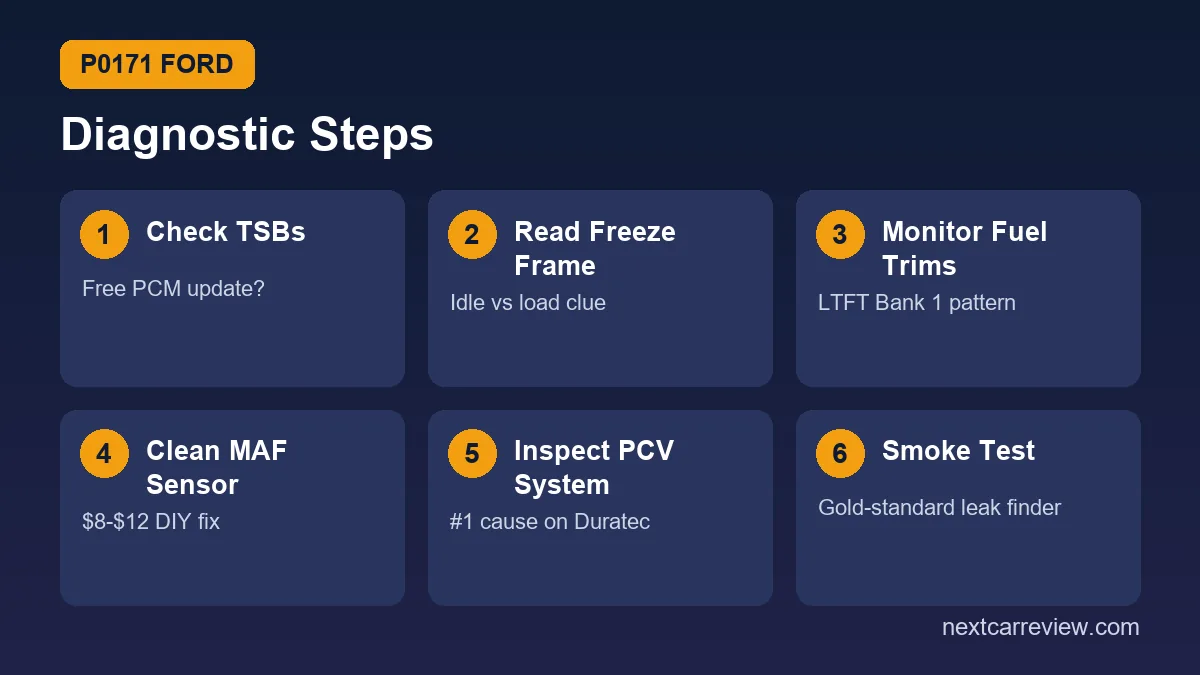
Start with TSB lookup and the cheapest checks first. Many P0171 codes on Ford clear after cleaning the MAF sensor or replacing a $5 PCV elbow.
Step 1: Check for TSBs First (Free)
Look up your VIN at the NHTSA database or ask your Ford dealer about applicable TSBs. A PCM software update, often covered under warranty, may resolve P0171 on some 2019+ models, especially 2021-2023 3.3L F-150 trucks and 2019-2020 5.0L flex-fuel F-150 trucks.
Step 2: Read Freeze Frame Data (5 Minutes, OBD2 Scanner Required)
Note engine RPM, coolant temperature, vehicle speed, and fuel trim values at the time the code set. If P0171 set at idle, suspect a vacuum leak. If it set under load, suspect fuel delivery problems or a boost leak on EcoBoost engines.
Step 3: Monitor Fuel Trims (10 Minutes, OBD2 Scanner)
Watch short-term fuel trim (STFT) and long-term fuel trim (LTFT) for Bank 1 at idle and at 2,500 RPM. Normal is within +/-5%. Three diagnostic patterns to watch for: LTFT high at idle but normal at higher RPM means a vacuum leak. LTFT high at all RPMs means a MAF sensor issue or fuel delivery problem. LTFT high only under boost on EcoBoost engines means an intercooler boot or charge pipe leak.
Step 4: Clean and Test MAF Sensor (15 Minutes, DIY)
Remove the MAF sensor and inspect the sensing element for oil film or dirt. Clean with dedicated MAF sensor cleaner only. Reinstall and clear the code. If fuel trims improve, the MAF was the problem. If not, compare MAF readings to Ford specs at idle (typically 3-7 g/s depending on engine displacement).
Step 5: Inspect PCV System (15-30 Minutes, DIY)
On 2.0L/2.3L/2.5L Duratec engines, check the PCV elbow under the intake manifold. If the rubber is brittle, cracked, or has a hole, replace it. On 4.6L/5.4L Triton V8 engines, check the PCV rubber elbow at the rear of the intake manifold. Listen for hissing sounds at idle near the PCV area.
Step 6: Smoke Test for Vacuum Leaks ($100-$200 at a Shop)
A smoke machine pressurizes the intake system with the engine off. Smoke exits at the leak point. Check the PCV hoses, intake manifold gaskets, brake booster line, EVAP purge valve, throttle body gasket, and all plastic vacuum fittings. This is the gold-standard diagnostic for P0171 on Ford vehicles and avoids replacing parts unnecessarily.
Step 7: Check Fuel Pressure (Requires Gauge or Scanner)
Connect a fuel pressure gauge or monitor fuel pressure PID via OBD2. Ford specs vary by engine: port injection systems should read 30-65 PSI key-on engine-off. GDI and EcoBoost high-pressure fuel systems should read 500-2,500+ PSI (varies with RPM and load). Low fuel pressure means a weak pump, clogged filter, or faulty fuel pressure regulator.
Step 8: Check EcoBoost-Specific Components (If Applicable)
Check intercooler boot clamps for tightness. Inspect charge pipes for cracks, especially at weld points or plastic molding seams. Look for oil residue around intercooler connections, which indicates a boost leak. Check the intercooler for excessive condensation or oil accumulation.
P0171 Ford Repair Costs
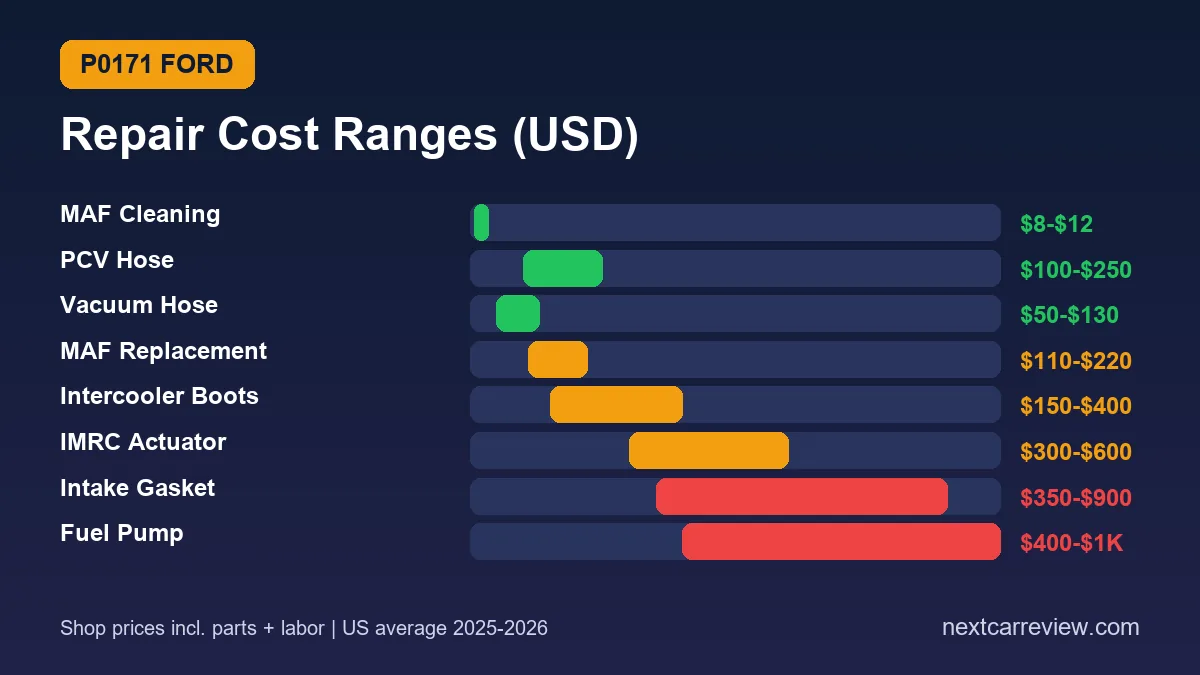
Costs vary by component and whether you do the work yourself. MAF cleaning and PCV elbow replacement are the cheapest and most common fixes. Labor rates assume $100-$150/hour at a US shop.
| Repair | DIY Parts | Shop Total |
|---|---|---|
| MAF sensor cleaning | $8-$12 (spray) | $50-$80 |
| PCV elbow or hose replacement | $5-$15 | $100-$250 |
| Vacuum hose replacement | $10-$30 | $50-$130 |
| EVAP purge valve replacement | $30-$60 | $80-$160 |
| MAF sensor replacement (Motorcraft) | $60-$120 | $110-$220 |
| Oxygen sensor replacement | $50-$150 | $150-$350 |
| EcoBoost intercooler boots | $50-$150 | $150-$400 |
| IMRC actuator replacement | $150-$300 | $300-$600 |
| Intake manifold gasket | $40-$80 | $350-$900 |
| Fuel pump replacement (in-tank) | $200-$400 | $400-$1,000 |
| PCM reprogram (TSB) | N/A | $0-$150 |
| Charge pipe replacement (EcoBoost) | $100-$300 | $200-$500 |
Average repair cost across all P0171 fixes on Ford: $150-$500. The most common fixes (MAF cleaning, PCV hose, vacuum hose) cost under $250 at a shop. Always get a proper diagnosis before authorizing major repairs like intake manifold gasket or fuel pump replacement.
P0171 vs P0174 on Ford V6 and V8 Engines
Both codes indicate a lean condition, but they point to different sides of the engine. Understanding the pattern tells you whether the problem is localized or system-wide.
| Code Pattern | What It Means | Most Likely Causes |
|---|---|---|
| P0171 only | Lean on Bank 1 only (passenger side) | Bank 1 vacuum leak, Bank 1 O2 sensor, Bank 1 injector issue |
| P0174 only | Lean on Bank 2 only (driver side) | Bank 2 vacuum leak, Bank 2 O2 sensor, Bank 2 injector issue |
| P0171 + P0174 together | System-wide lean condition | Dirty MAF sensor, low fuel pressure, central vacuum leak, EVAP purge valve stuck open, PCV system leak |
To tell the difference, compare long-term fuel trims for both banks with a scanner. If LTFT Bank 1 is +20% and LTFT Bank 2 is +2%, the problem is isolated to Bank 1. If both banks show +15% or higher, the problem is shared (MAF sensor, fuel pressure, or a vacuum leak before the intake splits into separate runners).
On the F-150 5.4L Triton with both codes: a frequently reported cause is the PCV rubber elbow at the rear of the intake manifold, a $10 part. On the Explorer 4.0L with both codes: commonly the upper intake manifold gaskets, a labor-intensive repair running $400-$800.
Which Ford Models Get P0171 Most Often?
P0171 appears across the Ford lineup. Repair-database and owner reports (Go-Parts, Samarins) point most often to 4-cylinder Duratec models and high-mileage trucks; the ratings below summarize those reports, not official failure-rate data.
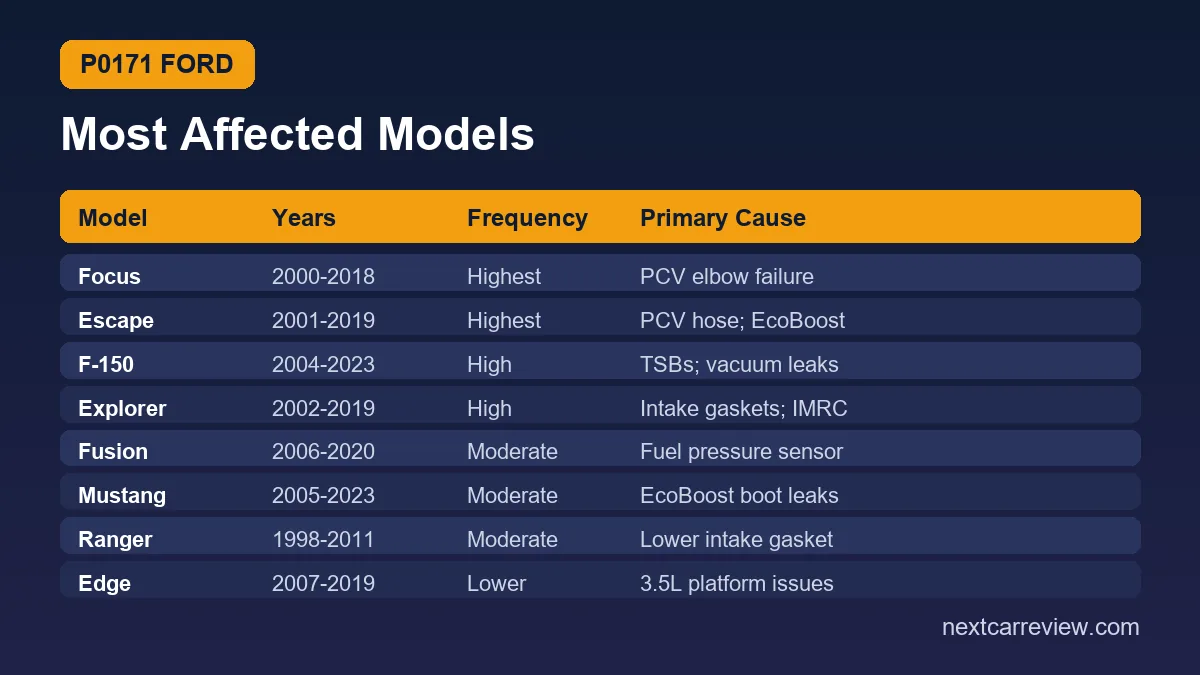
| Model | Years | Frequency | Primary Cause |
|---|---|---|---|
| Focus | 2000-2018 | Highest | PCV elbow failure on Duratec |
| Escape | 2001-2019 | Highest | PCV hose; EcoBoost charge pipe leaks |
| F-150 | 2004-2023 | High | Multiple TSBs; vacuum leaks; PCM software |
| Explorer | 2002-2019 | High | Intake gaskets on 3.5L; IMRC failures |
| Fusion | 2006-2020 | Moderate | Fuel pressure sensor misread on 2.5L |
| Mustang | 2005-2023 | Moderate | EcoBoost boot leaks; V6 intake gaskets |
| Ranger | 1998-2011 | Moderate | Lower intake gasket on 3.0L V6 |
| Edge | 2007-2019 | Lower | Shared 3.5L platform issues |
Is It Safe to Drive a Ford with P0171?
Short-term, yes. P0171 alone does not cause sudden vehicle failure, loss of steering, or brake failure. However, driving with a lean condition is riskier than driving with an EVAP leak code like P0455.
A lean air-fuel mixture raises combustion temperatures. Over time, this can overheat and damage the catalytic converter ($800-$2,500 to replace), cause engine misfires that trigger additional codes, and increase wear on exhaust valves and pistons. If P0171 appears alongside misfire codes (P0300 series), stop driving and get the vehicle diagnosed. Misfires combined with a lean condition can quickly damage a catalytic converter.
If the check engine light is steady (not flashing), you can drive to a shop. If the check engine light is flashing, do not drive. A flashing MIL means active misfires that are causing immediate catalytic converter damage.
Common Misdiagnoses to Avoid
P0171 is easy to misdiagnose on Ford vehicles because several causes produce identical symptoms.
- Replacing the O2 sensor first. The oxygen sensor is reporting the lean condition accurately. It is the messenger, not the cause. Replacing it wastes $150-$350 and the code returns because the actual leak or fuel delivery problem remains.
- Ignoring the PCV system on Duratec engines. Focus and Escape owners who chase vacuum leaks everywhere but under the intake manifold miss the cracked PCV elbow. Repair references frequently cite this $5-$15 part on Ford 4-cylinders.
- Using oiled aftermarket air filters and blaming the MAF. Some Ford owners install K&N or similar oiled filters, which contaminate the MAF sensor. They clean the MAF, it fixes P0171 temporarily, then the code returns later. The root cause is the filter, not the sensor.
- Replacing parts without checking TSBs. A 2022 F-150 owner who replaces the MAF sensor and PCV hoses may not know that TSB 23-2195 (now superseded by TSB 25-2342) covers a PCM reprogram for the 3.3L V6. Always check for applicable TSBs before spending money on parts.
- Confusing EcoBoost boost leaks with vacuum leaks. On turbocharged Ford engines, an intercooler boot leak only causes P0171 under boost (acceleration), not at idle. If fuel trims are normal at idle but high under load, the problem is in the charge air system, not the intake manifold.
P0171 with Other Codes on Ford
P0171 often appears alongside other codes. The combination narrows the diagnosis significantly.
- P0171 + P0174: System-wide lean. Both banks affected. Clean the MAF sensor first, then check fuel pressure, then smoke test for a central vacuum leak. On the 5.4L Triton, check the PCV elbow at the rear of the intake manifold.
- P0171 + P0300/P0301/P0302 (misfires): A severe lean condition is causing misfires. Do not drive. Diagnose the lean cause immediately to prevent catalytic converter damage.
- P0171 + P1518/P2004/P2007: IMRC system failure on Ford V6 engines. The intake manifold runner control is not functioning, causing uneven airflow. Replace the IMRC actuator or clean carbon buildup from the runner flaps.
- P0171 + P0172 (rich): Conflicting codes. This pattern on a 2019-2020 5.0L F-150 is covered by TSB 21-2443. On other models, it can point to a failing oxygen sensor that swings between lean and rich readings.
- P0171 + P0101 (MAF range/performance): The MAF sensor is confirmed faulty. Replace it with a Motorcraft unit.
P0171 on the Ford F-150
The F-150 is part of Ford’s best-selling F-Series line, and P0171 reports span four engine families. The diagnostic approach varies significantly by engine type.
On the 3.3L V6 (2018+): check for TSB 23-2195 first. A PCM reprogram resolves P0171 on many 2021-2023 models. On the 5.0L Coyote V8: check for TSB 21-2443 if it is a 2019-2020 flex-fuel model. Vacuum leaks at the PCV connection or intake manifold gaskets are the next most common cause. On the 3.5L/2.7L EcoBoost: focus on intercooler boot connections and charge pipe integrity. Oil residue around any boost connection indicates a leak. On the 4.6L/5.4L Triton (2004-2014): the PCV rubber elbow at the rear of the intake manifold is a frequently reported cause. This $10 part is known for cracking and is difficult to see without a mirror or borescope.
EcoBoost-Specific P0171 Diagnosis
EcoBoost engines add turbocharger components to the diagnostic process. A standard vacuum leak check is not sufficient on these engines because the leak may only appear under boost pressure.
Ford EcoBoost engines affected: 1.5L (Escape, Bronco Sport), 2.0L (Escape, Edge, Maverick, Bronco Sport), 2.3L (Mustang, Explorer, Ranger), 2.7L (F-150, Bronco, Edge ST), 3.0L (Explorer ST, Aviator), 3.5L (F-150, Expedition, Explorer).
Three EcoBoost-specific causes to check: First, intercooler boot connections. These silicone boots loosen with age and heat cycling. Squeeze-test each boot for firmness and check clamp torque. Second, charge air cooler condensation. In humid climates, moisture and oil vapor accumulate inside the intercooler. Under sudden acceleration, this liquid enters the engine and causes lean/rich swings alongside misfire codes. Ford addressed this on some 2011-2012 3.5L F-150s via TSB 13-8-1. Third, charge pipe cracks. Hard plastic or aluminum charge pipes can develop cracks at weld points or seams. Inspect visually and listen for boost hissing under acceleration.
Frequently Asked Questions
How much does it cost to fix P0171 on a Ford?
Can I drive my Ford with P0171?
Will P0171 fail an emissions test?
What is the most common cause of P0171 on a Ford Focus?
Why does my Ford EcoBoost get P0171 only under acceleration?
Should I clean or replace the MAF sensor on my Ford?
What is the difference between P0171 and P0174 on a Ford?
⚠️ Professional Notice:
All repair costs are US national averages for 2025-2026. Actual costs vary by region, shop labor rate, vehicle condition, and parts availability. Prices do not include diagnostic fees unless noted.
Cost figures are published estimates and vary by vehicle, region and shop. Always get a written quote before authorizing a repair. NextCarReview.com does not receive compensation from any parts manufacturer, retailer, dealer or repair chain for editorial coverage.
Data Sources and Verification
- Ford Motor Company Technical Service Bulletins: TSB 23-2195, TSB 21-2443, TSB 16-0001
- NHTSA Technical Service Bulletin database (nhtsa.gov)
- AA1Car Ford lean code diagnostic guide (aa1car.com)
- Ford dealer diagnostic procedures and Motorcraft service specifications
- OBD-II diagnostic standards (SAE J2012) for P0171 code definition
- F150 EcoBoost Forum community diagnostic data (f150ecoboost.net)
- Go-Parts.com Ford P0171 model-specific guides
- TroubleshootMyVehicle Ford V6/V8 P0171/P0174 diagnostic procedures
- Repair cost estimates compiled from RepairPal, AutoZone, and independent shop surveys

Morgan Reyes is the founder and editor-in-chief of NextCarReview, which Morgan launched in August 2024. A 2022 graduate of Columbia University, Morgan is based in New York and writes and edits the site’s reviews, comparisons and buying guides. Morgan does not road-test vehicles. Every article is built from published primary data: EPA FuelEconomy.gov ratings, NHTSA crash ratings, recalls and owner complaints, IIHS results, and manufacturer specifications and pricing, with each figure cited and checked before publication. Contact: admin@nextcarreview.com