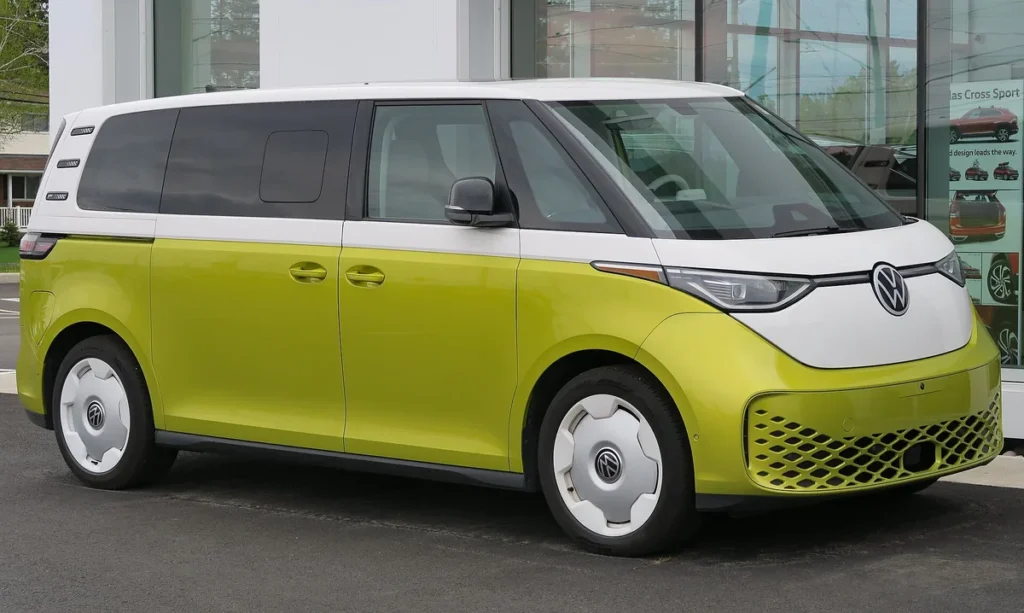
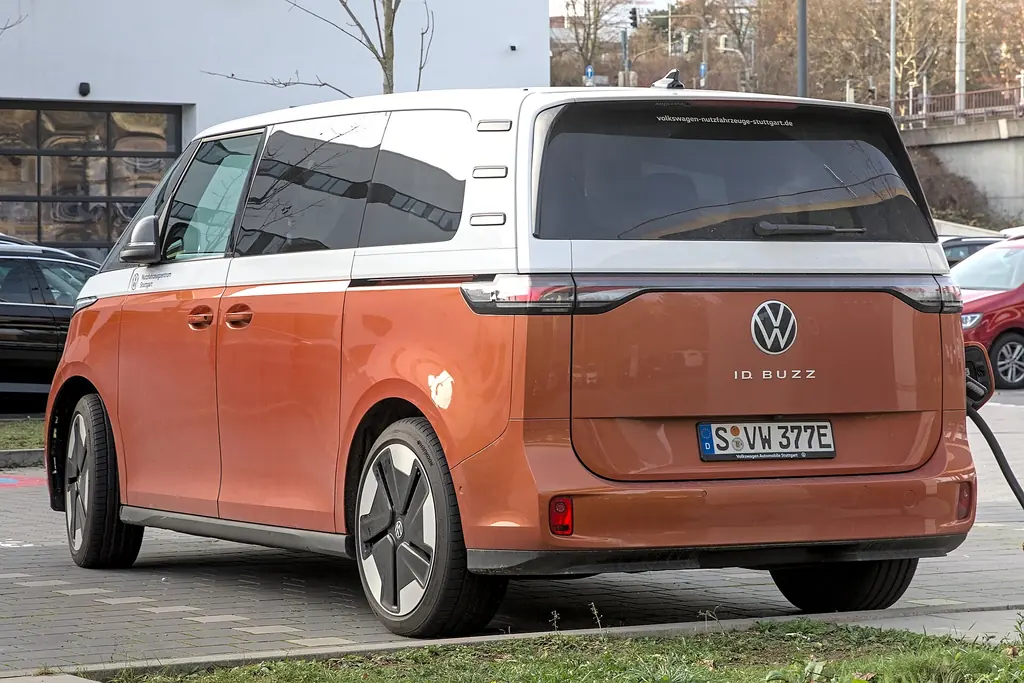
Volkswagen ID. Buzz, rear 3/4 exterior, orange/white. Photo: Alexander Migl, CC BY-SA 4.0, via Wikimedia Commons
The 2025 Volkswagen ID. Buzz blends retro VW bus style with electric power, with an EPA-rated range of up to 234 miles, up to 335 hp and three rows of seats. This review covers specs, prices, safety, recalls and the US model-year pause.
The 2025 Volkswagen ID. Buzz is an all-electric, three-row minivan inspired by the original VW bus.
This guide covers its specs, range, charging, prices, what reviewers say, and what to check when buying one, including the fact that VW skipped the 2026 model year in the US.
What Makes the 2025 Volkswagen ID. Buzz Unique?
The 2025 Volkswagen ID. Buzz stands out as an all-electric minivan. It pays tribute to the classic VW bus with a modern spin. Therefore, it blends nostalgia with eco-friendly innovation.
It boasts spacious interiors, advanced tech, and practical design. It is aimed at families and buyers who want something different from a conventional minivan. Its bold look and zero-emission drive set it apart from gas-powered rivals.
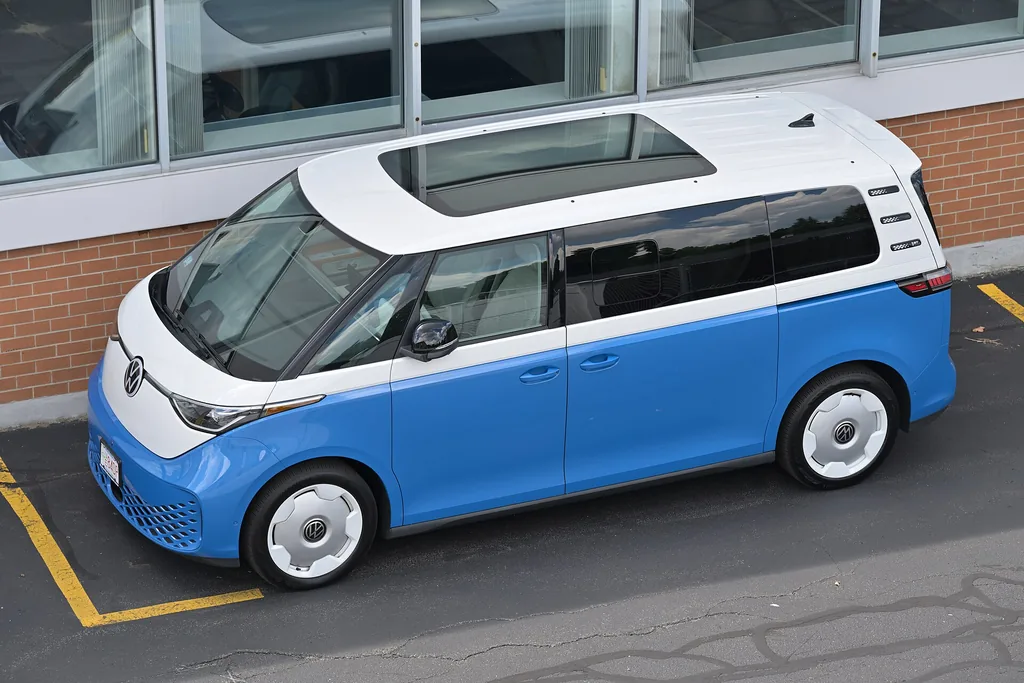
2025 Volkswagen ID. Buzz LWB (US), side exterior, blue/white. Photo: 4300streetcar, CC BY 4.0, via Wikimedia Commons
A Love Letter to the Classic VW Bus
The original VW bus, known as the Type 2 or Microbus, shaped the 1950s and 1960s. Surfers, hippies, and travellers embraced its free-spirited soul. Similarly, the 2025 VW ID. Buzz captures that magic. It features round headlights, a vibrant two-tone paint scheme, and a boxy silhouette.
However, it swaps the old gas engine for electric power. It has no tailpipe emissions, and its large VW logo makes it instantly recognizable.
2025 Volkswagen ID. Buzz Specs: Power, Range, and More
Here are the key 2025 Volkswagen ID. Buzz specs.
Powertrain and Performance
The ID. Buzz offers two powertrain options to suit different needs:
Rear-Wheel Drive (RWD): A single rear motor makes 282 horsepower. It has the longer EPA range of the two versions.
All-Wheel Drive (AWD): Dual motors (4MOTION) raise output to 335 horsepower and add traction in rain or snow.
Both models use a 91-kWh battery (86 kWh usable). It is far quicker than the original VW bus.
The floor-mounted battery gives it a low center of gravity.
Range and Charging Capabilities
EPA range figures:
RWD Models: The EPA estimates 234 miles per charge and 83 MPGe combined.
AWD Models: 231 miles and 80 MPGe combined. Real-world range drops in cold weather, at high speed and with heavy loads.
Charging options keep the ID. Buzz convenient:
DC Fast Charging: It supports up to 200 kW, and VW quotes about 26 minutes for 10% to 80%.
Level 2 Charging: An 11 kW onboard charger is compatible with both home and public charging stations. It can fully charge overnight. If you buy used, ask whether any charging plan included with the original sale is still active.
The 2025 ID. Buzz uses a CCS1 charge port, so Tesla Supercharger use needs an approved adapter; check VW for current access.
It supports over-the-air software updates.
Dimensions and Practicality
Key US dimensions:
Length: 195.4 inches, about 10 inches shorter than a Honda Odyssey. This makes it easier to park than larger minivans.
Width: 78.1 inches, fitting comfortably in standard parking spaces.
Height: 76.2 inches, taller than most rivals for extra cabin room.
Wheelbase: The US model uses the long-wheelbase body, much longer than the original VW bus.
Despite its size, the van turns tightly, thanks to a 38.8-foot turning circle. Its boxy shape maximizes interior space.
Cargo and Seating Configurations
The ID. Buzz is built to carry people and gear. It seats seven with a second-row bench or six with captain’s chairs. Cargo space:
Behind the third row: 18.6 cubic feet.
Behind the second row: 75.5 cubic feet.
With rear rows folded: up to 145.5 cubic feet.
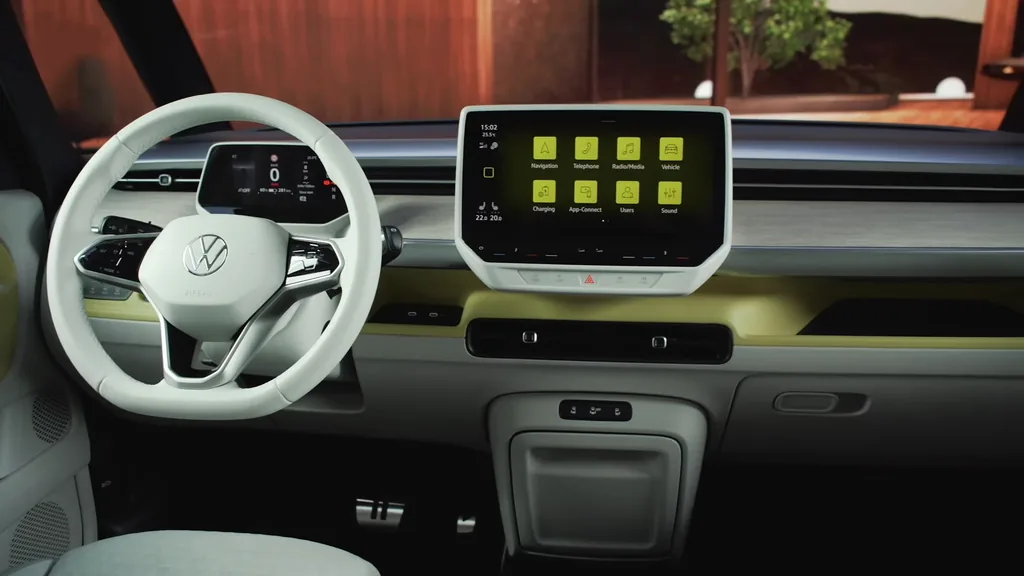
2022 Volkswagen ID. Buzz, interior / dashboard. Photo: AutobildEs, CC BY 3.0, via Wikimedia Commons
The seats fold flat, and the third row can be removed entirely. A “Flexboard” cargo cover not only hides valuables but also adds storage nooks.
The second-row seats slide and recline for extra comfort.
2025 Volkswagen ID. Buzz Reviews: What Critics Say
Published reviews of the 2025 Volkswagen ID. Buzz share common themes.
What Reviewers Praise
Retro Charm: Reviewers single out the two-tone paint and retro design.
Roomy Cabin: The tall body gives generous headroom, and large windows create an airy feel.
Smooth Drive: Reviewers note the quiet electric drive and comfortable ride.
Family Features: Power sliding doors and wide openings make loading children easier.
What Reviewers Critique
Limited Range: The 234-mile range trails the Kia EV9 Long Range RWD (304 miles), so long road trips need planning.
High Price: Starting at $59,995, it’s more expensive than gas-powered minivans. A 1st Edition 4MOTION is $69,995 before destination.
Touch Controls: The 12.9-inch touchscreen and haptic buttons can be frustrating for some users. Reviewers also criticize the two-switch window controls.
Interior Plastics: Hard plastics in the cabin feel cheap for the price. Critics expect softer materials at this price.
Common Owner Complaints
Owner forums frequently mention the styling as a reason to buy.
Cold-weather range and touch controls are the most common complaints.
Features and Technology: Inside the VW ID. Buzz
Here are the main 2025 ID. Buzz features.
Infotainment and Connectivity
A 12.9-inch touchscreen anchors the dashboard. It’s sharp but has a learning curve. Features include:
Wireless Apple CarPlay and Android Auto.
Navigation, Bluetooth, and natural-language voice control are included.
USB-C ports in all three rows.
A Wi-Fi hotspot and an available Harman Kardon audio system.
A 5.3-inch digital driver display shows speed and range. Some reviewers find the menus slow to navigate.
Safety and Driver Assistance
NHTSA rates the 2025 ID. Buzz 5 stars overall (4 frontal, 5 side, 4 rollover), and it earned five stars from Euro NCAP. VW’s IQ.DRIVE suite includes:
Adaptive cruise control maintains safe distances.
Lane-keeping assist nudges the wheel to stay centred.
Blind-spot monitoring and rear cross-traffic alerts prevent collisions.
Automatic emergency braking stops for pedestrians or cars.
Optional extras, such as a head-up display and 360-degree camera, simplify parking. Available Park Assist Plus can steer into spaces.
Comfort and Convenience
The cabin feels open with giant windows. Features include (some depend on trim):
Heated front seats, with ventilation and massage on some trims.
Heated second-row seats (trim-dependent).
Three-zone climate control.
Power sliding doors and a power liftgate, hands-free on some trims.
An available panoramic glass roof with electrochromic tint.
A sliding centre console moves to the second row. Synthetic leather upholstery is used instead of animal leather.
Volkswagen ID. Buzz, detail – rear seats. Photo: Irmantas Baltrusaitis, CC BY-SA 4.0, via Wikimedia Commons
Trims and Pricing: Which ID. Buzz Should You Buy?
The 2025 Volkswagen ID. Buzz comes in three trims. Prices start high, and it’s not eligible for the federal EV tax credit (which ended for vehicles acquired after Sept. 30, 2025). Here is the 2025 lineup:
Pro S ($59,995): RWD, 282 hp, basic features like the 12.9-inch screen and heated seats.
Pro S Plus ($63,495 RWD, $67,995 AWD): Adds premium audio, a head-up display and a surround-view camera.
1st Edition ($65,495 RWD, $69,995 AWD): Unique styling, panoramic roof and the most standard equipment.
Canadian pricing is higher and is listed in Canadian dollars.
Trim
Price (RWD)
Price (AWD)
Features
Pro S
$59,995
N/A
RWD, 282 hp, 12.9-inch screen, heated seats
Pro S Plus
$63,495
$67,995
RWD or AWD, premium stereo, head-up display, surround-view camera
First Edition
$65,495
$69,995
RWD or AWD, unique styling, panoramic roof, all premium features
Note: Prices are US MSRPs before destination. Not eligible for the U.S. federal EV tax credit, which ended for vehicles acquired after Sept. 30, 2025.
Who Should Buy the 2025 VW ID. Buzz?
Its best-suited buyers are:
Families: It fits multiple car seats and offers easy access.
VW Fans: The design is a direct tribute to the classic bus.
Eco Drivers: No tailpipe emissions and recycled cabin materials.
Trendsetters: Its look stands out from every other minivan.
However, long-distance travellers or budget shoppers might hesitate. The 234-mile range limits road trips, and it costs more than gas minivans.
How the ID. Buzz Stacks Up Against Rivals
The ID. Buzz is one of very few all-electric minivans in the U.S., but it still faces competition from both electric and gas-powered vehicles.
VW ID. Buzz vs. Kia EV9
The Kia EV9 is a three-row electric SUV; the 2025 Long Range RWD is EPA-rated at 304 miles. It is cheaper and more efficient (89 MPGe combined for the EV9 Long Range RWD vs. 83 MPGe for the RWD ID. Buzz). However, the ID. Buzz provides more cargo space (145.5 cubic feet vs. 81.9 cubic feet) and retro flair.
VW ID. Buzz vs. Chrysler Pacifica Hybrid
The Pacifica Hybrid is a plug-in hybrid minivan with about 32 miles of electric range and a gas engine for long trips. It costs less than the ID. Buzz, while the ID. Buzz is fully electric.
VW ID. Buzz vs. Honda Odyssey
The Honda Odyssey is a gas V6 minivan that costs much less and has no range limits for long trips. The ID. Buzz has no fuel costs or tailpipe emissions.
The Future of the Volkswagen ID. Buzz
VW has paused the ID. Buzz in the US. A camper version, the ID. California, has been shown for Europe, but VW has not confirmed it for the US. It’ll feature a pop-up roof, compact kitchen, and foldable bed.
A cargo van version is sold in Europe.
VW skipped the 2026 model year in the US, and in September 2026 it told dealers the van would return as a 2028 model rather than a 2027.
Will Prices Drop?
The ID. Buzz is built in Germany. With no 2026 or 2027 model in the US, remaining 2025 stock and used vans are the only options, and dealer discounts vary, so compare offers.
Customization and Lifestyle Appeal
The ID. Buzz offers several personalization options. Drivers can choose from bold colours like Pomelo Yellow or classic two-tone combinations.
Accessories such as roof racks, bike carriers, and all-weather mats are ideal for active lifestyles.
A Lifestyle Icon
Volkswagen markets the ID. Buzz as a lifestyle vehicle. Its roomy cabin and electric range make it suitable for camping, road trips, or city cruises.
Sustainability and Environmental Impact
The ID. Buzz has no tailpipe emissions. Volkswagen utilizes recycled plastics and sustainable fabrics within its products. Specifically, seat covers are made from recycled PET bottles and feature eco-friendly dyes.
VW has set long-term carbon-reduction goals for its production.
Nothing in the US yet. VW skipped the 2026 model year and, in September 2026, delayed the van’s US return to the 2028 model year. The EPA lists no 2026 ID. Buzz. A 2025 is therefore still the current US model.
Practical checks
Check battery state of health and charging history with a dealer scan.
Confirm the remaining EV battery warranty (VW covers the high-voltage battery for 8 years or 100,000 miles).
Test DC fast charging if possible, and check whether software updates have been applied.
FAQ
What is the range of the 2025 Volkswagen ID. Buzz?
The 2025 VW ID. Buzz has an EPA-estimated range of 234 miles for RWD models and 231 miles for AWD models. Real-world range may be closer to 200 miles in cold weather or with heavy loads.
How much does the 2025 VW ID. Buzz cost?
The ID. Buzz starts at $59,995 for the Pro S trim. The Pro S Plus costs $63,495 (RWD) or $67,995 (AWD). The First Edition starts at $65,495 (RWD) or $69,995 (AWD).
Is the Volkswagen ID. Buzz fully electric?
Yes, the 2025 ID. Buzz is a fully electric vehicle. It has no gas engine and runs on a 91-kWh battery.
How many people does the VW ID. Buzz seat?
The ID. Buzz seats up to seven with a second-row bench or six with captain’s chairs. The third row always has two seats.
Does the 2025 VW ID. Buzz qualify for EV tax credits?
No, the ID. Buzz is not eligible for federal EV tax credits in the U.S. because it’s built in Germany, and that credit ended for vehicles acquired after Sept. 30, 2025.
Is there a 2026 Volkswagen ID. Buzz?
No. VW skipped the 2026 model year in the US and has said the ID. Buzz will return as a 2028 model.
Does the 2025 ID. Buzz have recalls?
Yes. NHTSA lists two: 25V269 for the third-row bench belts and 25V233 for the brake warning light symbol. Check your VIN.
Conclusion: Is the 2025 VW ID. Buzz Worth It?
The 2025 Volkswagen ID. Buzz blends nostalgia with innovation. Its main drawbacks are the 234-mile range and high price, and VW has paused US sales until a 2028 model. For buyers who want a distinctive electric people-mover, a discounted or used 2025 can make sense; check the two recalls first.
Check the official data
Specs, prices and safety ratings change between model years and trims. Verify them for the exact 2025 Volkswagen you are considering:
Morgan Reyes is the founder and editor-in-chief of NextCarReview, which Morgan launched in August 2024. A 2022 graduate of Columbia University, Morgan is based in New York and writes and edits the site’s reviews, comparisons and buying guides. Morgan does not road-test vehicles. Every article is built from published primary data: EPA FuelEconomy.gov ratings, NHTSA crash ratings, recalls and owner complaints, IIHS results, and manufacturer specifications and pricing, with each figure cited and checked before publication. Contact: admin@nextcarreview.com